What makes non slip chef shoes comfortable for 12-hour shifts
For chefs, comfort is not a luxury—it is essential to performance, safety, and endurance. When evaluating non slip chef shoes for 12-hour shifts, the real difference comes down to support, cushioning, breathability, and slip-resistant stability that lasts under constant pressure. Understanding these features helps buyers and professionals choose footwear that protects both productivity and long-term foot health.
Why do non slip chef shoes matter so much in commercial kitchens?
In hospitality, catering, institutional dining, and specialty foodservice environments, footwear is not a minor uniform detail. It affects employee fatigue, slip risk, shift consistency, and even staffing reliability. For information researchers comparing non slip chef shoes, the key question is not simply which pair looks durable, but which construction supports standing, pivoting, and walking on wet, greasy, and uneven kitchen floors for an entire working day.
This matters across the broader commercial trade landscape as well. Hotels, central kitchens, restaurant groups, culinary schools, event venues, and healthcare foodservice operations all purchase footwear with different priorities: some focus on safety, others on cost control, and many on staff retention. Global Commercial Trade (GCT) helps commercial buyers assess these variables with a sourcing mindset that combines operational use, compliance expectations, and supplier reliability.
- Long shifts increase stress on the heel, arch, forefoot, knees, and lower back.
- Kitchen floors often combine water, oil, detergents, and food debris, creating unpredictable traction conditions.
- Fast-paced service requires repeated turning, stopping, lifting, and short-distance acceleration.
- Poor shoe comfort can reduce concentration, slow workflow, and increase end-of-shift pain complaints.
Comfort is an operational issue, not only a personal preference
A chef may tolerate discomfort for a few hours, but a 12-hour shift exposes weaknesses quickly. Thin insoles flatten, stiff uppers create rubbing, low breathability increases heat buildup, and inadequate outsole grip forces the body to compensate with tense movement. Over time, that can contribute to plantar fatigue, pressure points, and reduced mobility during service peaks.
What features make non slip chef shoes comfortable for 12-hour shifts?
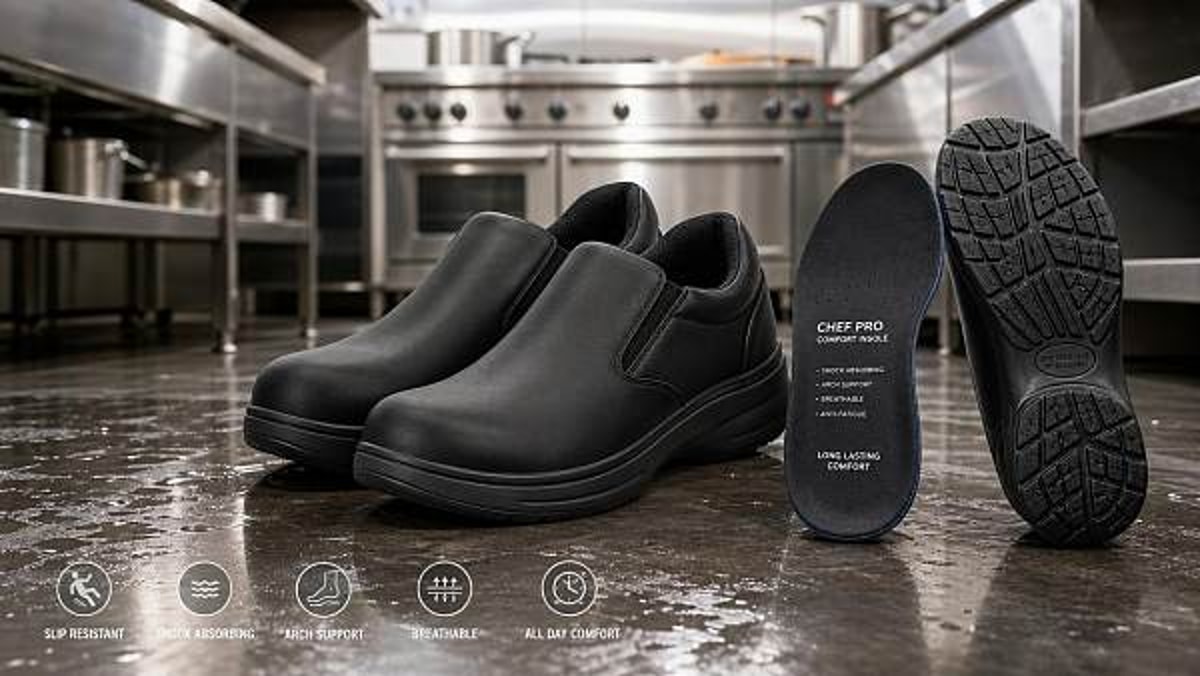
When buyers compare non slip chef shoes, comfort should be broken into measurable components rather than judged by appearance alone. The table below helps translate user experience into procurement criteria.
These features interact with each other. For example, excellent cushioning cannot compensate for poor grip, and a slip-resistant outsole alone will not solve end-of-day foot pain if the shoe lacks support. The most comfortable non slip chef shoes usually balance traction, pressure distribution, and thermal comfort rather than overemphasize one feature.
1. Midsole support and energy management
A common mistake is focusing only on the outsole. In reality, the midsole largely determines whether a shoe remains comfortable after eight, ten, or twelve hours. Softer is not always better. If the foam compresses too quickly, the foot sinks and stability declines. Commercial buyers should look for cushioning that rebounds consistently and supports weight over repeated shifts.
2. Stable fit without pressure points
Chef shoes should secure the foot without squeezing the toes or rubbing the heel. A proper collar shape, balanced toe box, and stable heel counter reduce internal movement. Excess movement causes friction, while overly tight construction leads to numbness and forefoot fatigue. In high-temperature kitchens, feet may swell slightly during service, making fit tolerance even more important.
3. Surface grip that works in real kitchen conditions
Slip resistance must remain effective on mixed contaminants, not only on clean floors. Tread geometry, contact surface, and rubber behavior all matter. A shoe can feel comfortable when new but become less secure if grease fills shallow grooves. This is why experienced procurement teams evaluate ease of cleaning alongside slip performance.
Which shoe constructions work best for different kitchen scenarios?
Not every kitchen needs the same type of non slip chef shoes. A hotel banquet kitchen, a fast-casual chain, and a pastry production unit expose workers to different movement patterns and floor conditions. Scenario-based selection reduces both overspending and underperformance.
For multi-site operators, one universal model may not satisfy all users. GCT often advises buyers to segment staff by work zone and shift pattern first, then compare shoe categories. This sourcing method can improve satisfaction without unnecessarily increasing total procurement complexity.
When clogs, lace-ups, and slip-ons each make sense
- Clog-style options may appeal in kitchens where quick cleaning and step-in convenience matter, but buyers should assess heel security carefully.
- Lace-up styles usually provide better fit adjustment and foot lockdown, which can help active kitchen staff who pivot and walk more.
- Slip-on work shoes reduce loose-lace concerns and speed up wear, but they must still offer dependable collar hold and interior support.
How should buyers compare non slip chef shoes beyond price?
Price is visible; comfort failure is often hidden until after deployment. For procurement teams, especially those managing hospitality groups or institutional kitchens, the more useful question is total value over the service life of the shoe. That includes employee acceptance, cleaning efficiency, replacement frequency, and incident prevention.
Procurement checklist for informed comparison
- Map the working environment: identify wet zones, greasy zones, dry prep areas, and average standing time.
- Clarify user profile: note whether staff are mostly stationary, highly mobile, or carrying loads regularly.
- Request material details: ask about upper cleanability, insole removability, and outsole compound.
- Review sample pairs in real conditions: short corridor tests are less useful than actual kitchen floor trials.
- Compare replacement cycles: a cheaper shoe replaced more often may cost more over time.
In B2B sourcing, documentation quality also matters. Buyers should confirm size consistency, carton planning, lead time stability, and available support for mixed-size orders. GCT’s commercial sourcing approach is especially useful when buyers need to compare multiple suppliers across regions and balance comfort specifications with delivery risk.
Common buying mistakes
- Choosing based on retail-style softness without testing all-day structural support.
- Ignoring fit range, which can create complaints across teams with different foot shapes.
- Assuming all slip-resistant labels mean equal performance on greasy commercial floors.
- Overlooking maintenance needs, especially when tread channels become difficult to clean.
What standards and compliance points should be reviewed?
Comfort is critical, but commercial buyers also need to consider applicable workplace safety and product compliance expectations. Requirements vary by market, employer policy, and use case, yet several review points are broadly relevant when sourcing non slip chef shoes for professional settings.
Commercial footwear sourcing often benefits from a documentation-first review. Instead of assuming a product fits all markets, buyers should ask for technical sheets, care instructions, and available testing information. This is particularly important when importing for hotel groups, education sectors, or cross-border catering projects.
How can businesses balance cost, comfort, and replacement cycles?
For budget-conscious operators, the lowest unit price can look attractive. However, if staff reject the shoe, if comfort declines too fast, or if slip performance degrades early, the overall program becomes more expensive. Cost evaluation should include wear life, user satisfaction, and operational disruption.
A practical cost-thinking model
A moderately priced pair of non slip chef shoes that lasts longer and causes fewer comfort complaints may outperform a lower-priced alternative over the same period. This is especially true in kitchens with high shift intensity, where discomfort leads to faster replacement requests and lower compliance with footwear policies.
- Entry-level options may suit lower-intensity environments or temporary staffing programs.
- Mid-range options often provide the best balance for standard restaurant and hotel kitchen teams.
- Higher-spec models may be justified for executive kitchens, premium hospitality, or sites with extreme standing demands.
GCT supports this type of evaluation by helping buyers compare sourcing channels, manufacturing capabilities, and practical trade-offs. In commercial procurement, a reliable supplier with stable sizing, consistent materials, and transparent documentation often delivers better results than a lower-cost source with unpredictable quality.
FAQ: what do information researchers ask most about non slip chef shoes?
Are non slip chef shoes enough to prevent slips on their own?
No. Non slip chef shoes reduce risk, but floor maintenance, cleaning frequency, drainage design, and staff movement habits also affect outcomes. Buyers should view slip-resistant footwear as one part of a broader kitchen safety system. Still, selecting the right outsole pattern and compound is a major step toward better daily stability.
Should buyers choose softer shoes for better comfort?
Not always. Extremely soft shoes can feel pleasant at first but may compress too quickly during a 12-hour shift. For all-day kitchen use, resilient support is often more valuable than plush softness. The best non slip chef shoes typically combine cushioning with structural control so that comfort remains consistent as fatigue builds.
What upper material is usually easiest to manage in commercial kitchens?
Many buyers prefer smooth, wipe-clean uppers because they simplify hygiene routines and reduce absorption of spills. However, the material should also balance flexibility and heat management. In hot kitchens, a completely sealed upper may feel cleaner but trap more heat, so the right choice depends on cleaning requirements and ambient conditions.
How many sample pairs should a commercial buyer test before rollout?
There is no universal number, but pilot testing across different foot shapes, job roles, and shift types is recommended. A chef de partie, stewarding staff member, and bakery worker may respond differently to the same shoe. Short trials should be followed by feedback on traction, fatigue, heat buildup, and end-of-shift soreness.
Why choose us for sourcing guidance on non slip chef shoes?
Global Commercial Trade (GCT) supports buyers who need more than a product list. We help procurement teams, hospitality groups, institutional purchasers, and project planners evaluate non slip chef shoes through the lens of commercial use, supplier capability, and sourcing risk. That means comparing comfort features, use scenarios, documentation quality, and fulfillment practicality in one decision process.
If you are researching non slip chef shoes for hotel kitchens, restaurant chains, culinary schools, or catering facilities, you can contact us to discuss specific purchasing questions such as:
- Parameter confirmation, including outsole type, insole design, upper material, and fit structure
- Product selection for different kitchen formats, staffing profiles, and shift lengths
- Lead time planning for bulk orders, mixed-size allocations, and multi-site delivery schedules
- Custom solution discussions for private label, uniform integration, or project-based sourcing
- Compliance and documentation review for target markets and commercial import requirements
- Sample support and quotation communication for comparative evaluation before final purchase
For information researchers, the right next step is not guessing from appearance or price alone. It is building a clear specification and testing shortlist based on real kitchen conditions. That is where GCT adds value: translating sourcing complexity into practical buying decisions that support comfort, safety, and long-shift performance.
Search News
Hot Articles
- Commercial KitchenStainless steel GN pans with reinforced corners last longer in busy kitchensMay 02, 2026
- Hotel Room AmenitiesMemory foam hotel mattresses: when soft comfort leads to faster saggingMay 02, 2026
- Hotel Room AmenitiesElectronic hotel door locks: battery alerts are often less simple than they seemMay 02, 2026
Popular Tags
Need ExpertConsultation?
Connect with our specialized leisureengineering team for procurementstrategies.
Recommended News
 May 02, 2026Wholesale chef coats that hold shape after repeated industrial washingWholesale chef coats that stay sharp after repeated industrial washing. Compare fabrics, stitching, and supplier standards to choose durable uniforms that protect brand image and reduce replacement costs.● Institutional Buyer
 May 02, 2026What makes non slip chef shoes comfortable for 12-hour shiftsNon slip chef shoes for 12-hour shifts should deliver lasting support, cushioning, breathability, and grip. Learn what buyers and chefs should compare before choosing.● Institutional Buyer
 May 02, 2026Kenya Marathon Record Break Sparks Carbon-Plate Shoe Export Surge to AfricaKenya Marathon Record Break sparks surge in carbon-plate shoe exports to Africa—urgent bilingual labeling compliance needed for EAC markets.● Institutional Buyer
 May 01, 2026Custom Hotel Uniforms: Where Fit Problems Usually StartCustom hotel uniforms often fail at the fit-planning stage. Learn where sizing issues start, how to compare suppliers, and how to avoid costly reorders with smarter sourcing.● Institutional Buyer
 Apr 28, 2026How to Shortlist an Office Supplies WholesalerOffice supplies wholesaler selection starts with the right criteria. Learn how to compare an office supplies supplier, distributor, or manufacturer for cost, quality, compliance, and scalable B2B sourcing.● Institutional Buyer
 Apr 28, 20262026 Office Supplies Supplier Trends to WatchExplore 2026 office supplies supplier trends and learn how every office supplies wholesaler, distributor, and manufacturer can improve sourcing, compliance, fulfillment, and OEM growth.● Institutional Buyer
 Apr 28, 2026What to Check Before Choosing an ExporterOffice supplies supplier and exporter checklist: compare quality, compliance, lead times, MOQ, and service to choose a reliable office supplies manufacturer or wholesaler with confidence.● Institutional Buyer
 Apr 28, 2026Can an Office Supplies Producer Improve MarginsCan an office supplies producer improve margins? Learn how an office supplies manufacturer, supplier, and exporter boosts profit through smarter sourcing, lean production, and OEM value.● Institutional Buyer
 Apr 28, 2026How Bulk Suppliers Handle Custom PackingOffice supplies supplier insights: learn how an office supplies wholesaler, distributor, or OEM manufacturer manages custom packing to reduce risk, control cost, and improve delivery.● Institutional Buyer
 Apr 28, 2026Office Supplies OEM Manufacturer Pros and ConsOffice supplies OEM manufacturer pros and cons explained for every office supplies supplier, wholesaler, distributor, and B2B buyer—compare cost, quality, MOQ, and delivery before sourcing.● Institutional Buyer
 Apr 28, 2026Who Needs an Office Supplies B2B SupplierOffice supplies supplier guide for procurement teams, distributors, and institutions. Learn when to choose an office supplies wholesaler or manufacturer for stable supply and better B2B sourcing.● Institutional Buyer
 Apr 28, 2026How to Avoid Risks With Office Supplies FactoriesOffice supplies supplier risk guide: learn how to vet an office supplies manufacturer, wholesaler, distributor, or factory for quality, compliance, OEM reliability, and on-time delivery.● Institutional Buyer
 Apr 27, 2026Office Supplies Manufacturer MOQ ExplainedOffice supplies manufacturer MOQ explained: compare an office supplies supplier, wholesaler, distributor, OEM manufacturer, and factory to reduce cost, improve flexibility, and source smarter.● Institutional Buyer
 Apr 27, 2026Distributor or Supplier for Fast ReordersOffice supplies supplier or distributor for fast reorders? Compare lead times, stock stability, and bulk supply options to choose a reliable office supplies B2B supplier.● Institutional Buyer
 Apr 27, 2026How Wholesalers Cut Office Supply CostsOffice supplies supplier and office supplies wholesaler solutions help cut costs through bulk buying, OEM options, and smarter sourcing. Compare distributors and manufacturers to save more.● Institutional Buyer
 Apr 27, 2026Office Supplies Supplier Pricing Red FlagsOffice supplies supplier pricing red flags explained: compare an office supplies wholesaler, distributor, or manufacturer, spot hidden risks, and choose a reliable B2B partner with confidence.● Institutional Buyer
 Apr 27, 2026How to Vet an Office Supplies ExporterOffice supplies supplier vetting made simple: learn how to assess an office supplies exporter, manufacturer, wholesaler, and distributor for quality, compliance, and reliable B2B growth.● Institutional Buyer
 Apr 27, 2026What to Ask an Office Supplies Producer FirstOffice supplies supplier screening starts with the right questions. Learn how to evaluate an office supplies manufacturer, wholesaler, or producer on quality, OEM, compliance, pricing, and delivery.● Institutional Buyer
 Apr 27, 2026How to Compare Office Supplies Bulk SuppliersCompare every office supplies supplier model—wholesaler, distributor, OEM manufacturer, and bulk supplier—to evaluate quality, compliance, lead times, and costs for smarter B2B sourcing.● Institutional Buyer
 Apr 27, 2026Is an Office Supplies OEM Manufacturer Worth ItOffice supplies OEM manufacturer or standard sourcing? Compare an office supplies supplier, wholesaler, and distributor to find the best B2B fit for cost, branding, and scalable growth.● Institutional Buyer
 Apr 27, 2026Best Office Supplies B2B Supplier for ScaleFind the best office supplies B2B supplier for scale. Compare an office supplies supplier, wholesaler, distributor, and OEM manufacturer to secure reliable bulk sourcing and growth.● Institutional Buyer
 Apr 27, 2026Office Supplies Factory Audit ChecklistOffice supplies factory audit checklist for choosing a reliable office supplies manufacturer, supplier, or OEM partner. Learn key quality, compliance, and capacity checks before sourcing.● Institutional Buyer
 Apr 27, 2026When to Work With an Office Supplies ManufacturerOffice supplies manufacturer or office supplies supplier? Learn when to source direct, compare wholesaler vs OEM options, and improve cost, quality, and supply stability.● Institutional Buyer
 Apr 27, 2026What Makes a Reliable Office Supplies DistributorDiscover what sets a reliable office supplies distributor apart. Compare an office supplies supplier, wholesaler, or B2B supplier by quality, lead times, inventory, and global delivery.● Institutional Buyer