Office Supplies Supplier Pricing Red Flags
Choosing the right office supplies supplier can protect your budget, brand reputation, and delivery timelines. Whether you are comparing an office supplies wholesaler, office supplies distributor, or office supplies manufacturer, pricing that looks unusually low often hides quality issues, weak compliance, or unstable supply capacity. This guide highlights the key pricing red flags buyers should assess before selecting an office supplies B2B supplier or long-term sourcing partner.
Why low pricing in office supplies sourcing deserves closer scrutiny
In office supplies procurement, price is never just a number on a quotation sheet. A low unit cost for notebooks, filing products, writing instruments, toner-compatible items, desk accessories, or educational stationery may reflect smart scale efficiency, but it may also indicate downgraded raw materials, incomplete testing, weak packaging standards, or an unstable factory schedule. For buyers handling monthly, quarterly, or annual purchasing cycles, these hidden issues often surface after contracts are signed.
This matters even more in B2B environments where orders are not one-off retail transactions. Institutional buyers, commercial groups, and distributors often require repeatable quality across 3 to 5 purchase cycles, predictable replenishment windows of 7–30 days, and documentation that supports internal approval. If a supplier cannot maintain the same cost structure over time, the first low quote becomes a future pricing shock, not a savings opportunity.
A credible office supplies supplier should be able to explain what drives its price: material grade, manufacturing method, carton configuration, minimum order quantity, branding options, testing scope, and logistics terms. When a supplier avoids these details and focuses only on “best price,” procurement teams should slow down. In many cases, the real risk is not overpaying. It is underestimating the total cost of supply failure.
For information researchers and business evaluators, the practical question is simple: does the quotation reflect a sustainable supply model? GCT approaches this issue from a sourcing intelligence perspective, helping buyers assess not only pricing but also manufacturing logic, export readiness, and commercial suitability across office and educational supplies categories.
- A price that is 8%–15% below the market range may still be reasonable if the supplier has scale, standard SKUs, and consolidated shipping.
- A price that is 20%–35% below comparable offers often requires immediate verification of material grade, compliance scope, and production consistency.
- Any quote with unclear lead time, vague specifications, or missing trade terms should be reviewed before sample approval.
What pricing red flags should buyers check before approving a supplier?
The most common pricing red flags in office supplies B2B sourcing appear before production starts. They show up in incomplete quotations, inconsistent specification sheets, unusual sample behavior, or terms that seem flexible until order confirmation. Buyers comparing an office supplies wholesaler and an office supplies manufacturer should look beyond the top-line price and test the quotation structure itself.
Red flag 1: specifications are too vague to support real comparison
If two suppliers quote the same binder, pen, or storage box category but one offer omits paper weight, plastic thickness, refill type, carton count, or branding method, the lower price is not truly comparable. Buyers should confirm at least 5 specification points before evaluating value. Without that discipline, a lower quote may simply represent a smaller product, lighter material, or a less durable finish.
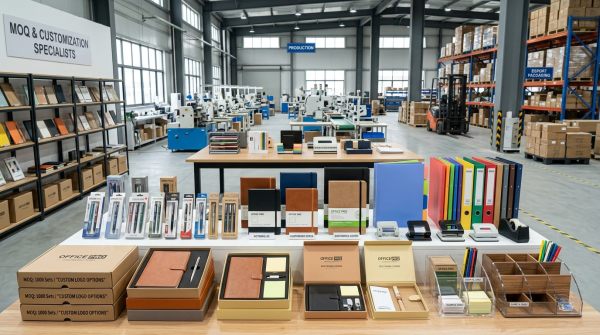
This issue is especially common in private label or OEM office supplies programs. A supplier may quote based on a standard stock version, while the buyer expects custom color, logo printing, multilingual packaging, or export carton reinforcement. These changes can move cost by 5%–18%, so an attractive first quote often becomes misleading once the actual scope is clarified.
Red flag 2: lead time is shorter than the production reality
Commercial buyers frequently face urgent replenishment requests, but unrealistic lead time is a classic warning sign. For many standard office supplies, a normal ex-factory lead time may fall within 15–35 days depending on order volume, customization, and packaging requirements. If a supplier promises 5–7 days for a made-to-order program without clarifying available inventory or production capacity, the low price may be masking scheduling risk.
Late delivery has a direct cost: temporary spot buying, project delay, split shipments, and internal administrative time. For distributors and agents, missing one back-to-school cycle or quarterly office rollout can be more expensive than a 3%–6% higher purchase price from a stable source.
Red flag 3: samples look acceptable, but batch controls are unclear
A supplier may send an acceptable pre-production sample at a low quoted price, yet provide no evidence of batch inspection procedures, incoming material checks, or carton-level consistency control. This creates a serious risk in products such as pens, markers, folders, staplers, desk organizers, and school supplies where tolerance, finish, and usability affect end-user satisfaction. A sample proves possibility, not production discipline.
Ask how the supplier handles 3 stages of control: raw material verification, in-line production checks, and pre-shipment inspection. If the answer is vague, the price may depend on inconsistent output rather than efficient manufacturing.
The table below helps procurement teams compare suspicious pricing signals against likely operational causes in office supplies sourcing.
For purchasing teams, the lesson is practical: an office supplies distributor or manufacturer that can explain pricing logic usually creates fewer surprises. A supplier that only defends the number without explaining the structure often transfers risk to the buyer.
How to compare office supplies wholesaler, distributor, and manufacturer pricing
Different supplier types can all play a useful role in office supplies procurement, but their pricing models are not the same. A wholesaler may offer faster mixed-SKU availability, a distributor may add regional service and stock support, and a manufacturer may provide better control over OEM or large-volume orders. Trouble begins when buyers compare all three on unit price alone.
For example, a manufacturer’s ex-factory price may look lowest for orders above one container load or a clearly defined MOQ, but the buyer may need to manage packaging review, documentation, and shipping coordination. A distributor’s price may be higher by 6%–12%, yet include local inventory, easier claim handling, and smaller replenishment batches. The cheapest source depends on the buying model, not the quotation line.
This is where sourcing intelligence matters. GCT helps buyers evaluate supplier fit by commercial context: institutional rollout, education channel supply, hospitality back-office usage, distributor expansion, or private label development. Price should be reviewed together with flexibility, compliance readiness, and order management capability over at least 2 to 4 reorder cycles.
The following comparison table can help business evaluators understand when a low quote is strategic and when it is risky.
The right comparison method is total procurement value. That means unit price plus stock reliability, specification control, claim response, documentation, and reorder predictability. For many distributors and agents, this broader view prevents margin erosion later in the selling cycle.
A practical 4-point comparison model
Use four filters when evaluating a low quotation from any office supplies B2B supplier: product equivalence, service scope, supply continuity, and claim handling. If one supplier looks cheaper but fails in 2 of these 4 areas, the apparent savings may not survive the first quarter of use.
- Confirm equal specifications: same material, dimensions, pack size, and branding method.
- Confirm equal service scope: samples, artwork review, export packaging, and document support.
- Confirm equal continuity: reorder lead time, MOQ stability, and substitute control.
- Confirm equal claim handling: return policy, defect threshold, and replacement timeline.
Which compliance and quality signals are often missing from cheap offers?
In the office and educational supplies sector, low pricing can hide not only product quality issues but also gaps in documentation, packaging safety, labeling, or material declarations. Not every product requires the same compliance review, yet B2B buyers should still check whether the offer aligns with destination market expectations, customer channel standards, and product-use context.
For example, paper products may require consistent fiber quality and print clarity. Writing instruments and markers may need attention to ink performance, odor control, and packaging information. Plastic desk accessories, folders, and organizers may require review of material composition, finish consistency, and durability under routine commercial use. Cheap pricing often comes from reducing these controls rather than improving efficiency.
Commercial buyers should also assess the packaging and shipping side. If export cartons are under-specified, palletization is poor, or moisture protection is missing, damage rates can rise during 2–6 weeks of transit depending on route and season. That risk is rarely visible in the first quotation. It shows up later as shortages, damaged goods, and claim disputes.
GCT supports buyers by translating commercial sourcing requirements into practical review points: category risk, documentation readiness, customization impact, and supplier communication quality. This is especially valuable when comparing multiple international office supplies suppliers across different manufacturing regions.
5 compliance and quality checks before final price approval
- Confirm product specification sheets include material details, dimensions, pack count, and intended use category.
- Ask what inspection points are checked before shipment, especially for writing, binding, cutting, or stacking functions.
- Review label, barcode, carton mark, and multilingual packaging requirements if goods enter distributor or retail channels.
- Check whether the supplier can support sample approval, pilot batch review, and reorder consistency over 2–3 production runs.
- Verify how non-conforming goods are handled, including response time, replacement method, and evidence requirements.
These checks do not require buyers to assume every low-priced supplier is unreliable. They simply prevent procurement teams from confusing incomplete offers with competitive offers. In office supplies sourcing, missing detail is often the earliest sign of hidden cost.
Watch for cost shifted outside the unit price
Some quotations look aggressive because costs are shifted elsewhere: higher sample fees, paid artwork revisions, extra export packing charges, low defect tolerance support, or limited document assistance. Ask for a landed comparison covering 6 items: product cost, packaging, documentation, inspection, logistics terms, and claim responsibility. This creates a more reliable business case than unit price alone.
How can procurement teams reduce risk when evaluating a low office supplies quote?
A disciplined procurement process can identify pricing red flags before they become supply problems. The goal is not to reject lower-cost offers automatically. It is to verify whether the quote is supported by a workable commercial model. For most office supplies sourcing projects, buyers can use a 4-step review process that fits both standard purchasing and strategic supplier onboarding.
Step 1: lock the specification baseline
Before comparing quotations, define the exact baseline: item dimensions, material thickness or weight where relevant, pack size, printing or branding method, color requirements, carton rules, and incoterms. Even a small change in paper weight, plastic density, or accessory count can alter pricing meaningfully. A locked baseline eliminates false savings created by under-specification.
Step 2: test responsiveness and commercial clarity
A reliable office supplies B2B supplier should answer basic commercial questions within a reasonable cycle, often 24–72 hours for quotation clarification depending on time zone and product complexity. Slow or inconsistent replies during pre-order discussion can signal poor order follow-up later. Business evaluators should note not only the answer, but how clearly the supplier explains trade-offs in cost, lead time, and customization.
Step 3: validate with sample and pilot logic
If the order is meaningful in value, launch a sample review and, when possible, a pilot batch or limited first order. This is particularly important for branded notebooks, files, writing sets, and desk systems intended for schools, offices, or institutional distribution. A small verification step can reveal whether the quoted cost is viable under actual production conditions.
Step 4: review total cost over one reorder cycle
The first shipment is not the full story. Procurement teams should model the first order plus one reorder cycle over 60–120 days. Include potential costs from delayed replenishment, defects, additional approval time, and mixed quality across batches. This approach gives distributors, agents, and commercial buyers a more realistic decision basis than headline pricing.
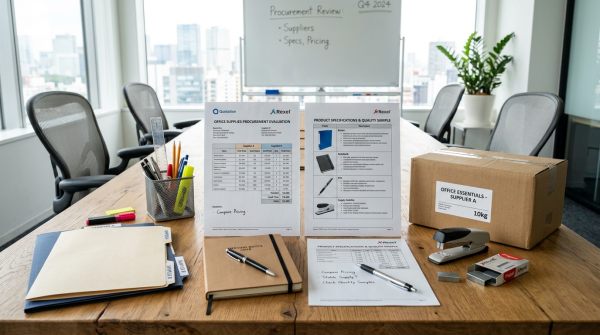
The table below summarizes a practical office supplies supplier review framework that can be used during quotation screening.
This process is useful for research-stage buyers and mature procurement teams alike. It turns pricing from a sales promise into a verifiable sourcing decision.
FAQ for buyers reviewing office supplies supplier pricing
How low is too low when comparing office supplies quotes?
There is no universal threshold, because product category, region, order size, and customization level all matter. Still, if a quotation is more than 20% below comparable offers and the supplier cannot clearly explain material, packaging, and lead-time assumptions, buyers should treat it as a red flag. The issue is not the number itself. It is the absence of transparent cost logic behind it.
What should distributors and agents ask before accepting a low quote?
Ask for 5 key items: confirmed specifications, MOQ, standard lead time, packing method, and claim process. If you resell under your own channel, also confirm barcode format, carton labeling, and reorder stability. A low first order price has limited value if channel complaints or replacement costs reduce your margin later.
Are office supplies manufacturers always cheaper than distributors?
Not always. Manufacturers often perform better on volume, OEM, and repeated custom orders. Distributors may be more cost-effective for smaller mixed orders, local stock programs, or urgent replenishment. The better value depends on order structure, not just source type. Buyers should compare total delivered value across at least one initial order and one reorder cycle.
What is the safest way to verify a new office supplies B2B supplier?
Start with specification alignment, then sample review, then a controlled first order. If possible, verify 3 areas before scaling up: batch consistency, communication quality, and packaging reliability. This staged approach is especially useful for educational supplies, private label office products, and distribution contracts where repeatability matters more than a single shipment result.
Why work with GCT when assessing office supplies supplier pricing?
For many buyers, the hardest part of office supplies sourcing is not finding suppliers. It is separating commercially sound offers from low-price risk. GCT supports this decision process by combining market-focused sourcing insight with category-specific commercial evaluation across office and educational supplies. That helps buyers, procurement teams, and channel partners move faster without reducing diligence.
If you are evaluating an office supplies wholesaler, distributor, or manufacturer, GCT can help you review quotation structure, supplier positioning, customization feasibility, documentation readiness, and likely risk points across 3 core dimensions: product fit, supply reliability, and commercial clarity. This is particularly useful when the offer looks attractive but the details remain incomplete.
Our sourcing perspective is designed for real B2B decisions. That includes support for product selection, supplier comparison, order model planning, expected lead-time ranges, private label discussion, and compliance-oriented documentation review. Whether you are researching new channels, consolidating vendors, or preparing for annual procurement, a structured review can prevent costly misalignment.
Contact GCT if you want practical guidance on office supplies supplier pricing, including parameter confirmation, category selection, sample strategy, order quantity planning, lead-time evaluation, customization scope, document expectations, and quotation comparison. A better sourcing decision starts when price is examined in context, not in isolation.
Search News
Hot Articles
- Stage Lighting & Truss2026 FIBA Women's World Cup Draw Sets LED Timing Screen RequirementsApr 27, 2026
- Hotel Room AmenitiesIranian Delegation’s Ritual Gesture at Sanya ASG Sparks Mideast Hospitality Procurement ShiftApr 27, 2026
- Arcade & VR MachinesSnooker World Championship 'China Derby' Drives VR Viewing DemandApr 27, 2026
Popular Tags
Need ExpertConsultation?
Connect with our specialized leisureengineering team for procurementstrategies.
Recommended News
 Apr 27, 2026Office Supplies Manufacturer MOQ ExplainedOffice supplies manufacturer MOQ explained: compare an office supplies supplier, wholesaler, distributor, OEM manufacturer, and factory to reduce cost, improve flexibility, and source smarter.● Institutional Buyer
 Apr 27, 2026Distributor or Supplier for Fast ReordersOffice supplies supplier or distributor for fast reorders? Compare lead times, stock stability, and bulk supply options to choose a reliable office supplies B2B supplier.● Institutional Buyer
 Apr 27, 2026How Wholesalers Cut Office Supply CostsOffice supplies supplier and office supplies wholesaler solutions help cut costs through bulk buying, OEM options, and smarter sourcing. Compare distributors and manufacturers to save more.● Institutional Buyer
 Apr 27, 2026Office Supplies Supplier Pricing Red FlagsOffice supplies supplier pricing red flags explained: compare an office supplies wholesaler, distributor, or manufacturer, spot hidden risks, and choose a reliable B2B partner with confidence.● Institutional Buyer
 Apr 27, 2026How to Vet an Office Supplies ExporterOffice supplies supplier vetting made simple: learn how to assess an office supplies exporter, manufacturer, wholesaler, and distributor for quality, compliance, and reliable B2B growth.● Institutional Buyer
 Apr 27, 2026What to Ask an Office Supplies Producer FirstOffice supplies supplier screening starts with the right questions. Learn how to evaluate an office supplies manufacturer, wholesaler, or producer on quality, OEM, compliance, pricing, and delivery.● Institutional Buyer
 Apr 27, 2026How to Compare Office Supplies Bulk SuppliersCompare every office supplies supplier model—wholesaler, distributor, OEM manufacturer, and bulk supplier—to evaluate quality, compliance, lead times, and costs for smarter B2B sourcing.● Institutional Buyer
 Apr 27, 2026Is an Office Supplies OEM Manufacturer Worth ItOffice supplies OEM manufacturer or standard sourcing? Compare an office supplies supplier, wholesaler, and distributor to find the best B2B fit for cost, branding, and scalable growth.● Institutional Buyer
 Apr 27, 2026Best Office Supplies B2B Supplier for ScaleFind the best office supplies B2B supplier for scale. Compare an office supplies supplier, wholesaler, distributor, and OEM manufacturer to secure reliable bulk sourcing and growth.● Institutional Buyer
 Apr 27, 2026Office Supplies Factory Audit ChecklistOffice supplies factory audit checklist for choosing a reliable office supplies manufacturer, supplier, or OEM partner. Learn key quality, compliance, and capacity checks before sourcing.● Institutional Buyer
 Apr 27, 2026When to Work With an Office Supplies ManufacturerOffice supplies manufacturer or office supplies supplier? Learn when to source direct, compare wholesaler vs OEM options, and improve cost, quality, and supply stability.● Institutional Buyer
 Apr 27, 2026What Makes a Reliable Office Supplies DistributorDiscover what sets a reliable office supplies distributor apart. Compare an office supplies supplier, wholesaler, or B2B supplier by quality, lead times, inventory, and global delivery.● Institutional Buyer
 Apr 27, 2026Office Supplies Wholesaler vs DistributorOffice supplies wholesaler vs distributor: learn how an office supplies supplier, distributor, or manufacturer impacts pricing, lead time, and growth—choose the best B2B sourcing model.● Institutional Buyer
 Apr 27, 2026How to Choose an Office Supplies SupplierLearn how to choose the right office supplies supplier by comparing an office supplies wholesaler, distributor, manufacturer, or B2B supplier for quality, price, delivery, and growth.● Institutional Buyer
 Apr 24, 2026How to Pick Educational Supplies by AgeEducational supplies by age: discover how commercial furniture, sensory playground designs, playground safety, climbers, borders, music accessories, hotel tables and amusement equipment improve ROI.● Institutional Buyer
 Apr 24, 2026Educational Supplies That Schools Reorder MostEducational supplies schools reorder most: from commercial furniture support and music accessories to playground safety, playground borders, and sensory playground essentials—discover high-demand categories buyers need year-round.● Institutional Buyer
 Apr 23, 2026How to Compare Educational Supplies Beyond Unit PriceEducational supplies buying guide: compare commercial furniture, sensory playground, music accessories, and playground safety beyond unit price to cut risk and boost long-term value.● Institutional Buyer
 Apr 23, 2026Educational Supplies That Wear Out Fast in Shared UseEducational supplies wear out fast in shared spaces. Learn how commercial furniture, music accessories, playground borders, playground climbers, sensory playground systems, and playground safety solutions reduce risk and replacement costs.● Institutional Buyer
 Apr 22, 2026When Cheap Office Supplies End Up Costing MoreOffice supplies that seem cheap can cost more over time for trampoline park, indoor playground, arcade games, musical instruments, and luxury jewelry businesses—discover smarter sourcing tips.● Institutional Buyer
 Apr 22, 2026Office Supplies Costs That Quietly Add Up Over a YearOffice supplies costs can quietly rise alongside arcade games, musical instruments, indoor playground and trampoline park operations. Discover smarter sourcing to protect margins.● Institutional Buyer
 Apr 21, 2026Office supplies wholesaler terms that cause reorder problemsOffice supplies wholesaler terms can quietly trigger costly reorders. Learn how a reliable office supplies supplier should handle MOQ, lead times, substitutions, and pricing before you sign.● Institutional Buyer
 Apr 21, 2026The hidden service gaps between office supplies suppliersOffice supplies supplier insights: uncover hidden service gaps in office supplies wholesaler selection, plus sourcing links to musical instruments for bands, custom jewelry manufacturer, and indoor playground supplier.● Institutional Buyer
 Apr 24, 2026Why office supplies wholesalers vary so much on MOQ and lead timeOffice supplies supplier insights: learn why an office supplies wholesaler differs on MOQ and lead time, and compare sourcing logic across custom jewelry manufacturer and indoor playground supplier options.● Institutional Buyer
 Apr 24, 2026How to compare an office supplies supplier beyond priceCompare an office supplies supplier beyond price—evaluate quality, compliance, customization, and delivery. Learn how the right office supplies wholesaler reduces risk and boosts long-term value.● Institutional Buyer