How to Vet an Office Supplies Exporter
Choosing the right office supplies exporter is critical for buyers seeking quality, compliance, and long-term supply stability. Whether you are comparing an office supplies supplier, office supplies manufacturer, or office supplies wholesaler, proper vetting helps reduce sourcing risks and improve procurement outcomes. This guide explains the key factors procurement teams, distributors, and B2B decision-makers should assess before selecting a reliable global partner.
For most buyers, the real question is not simply whether an exporter can offer a competitive price. It is whether that company can consistently deliver compliant, market-ready products, communicate clearly, protect your margins, and support your business as demand changes. A low quote from the wrong supplier can quickly become expensive if it leads to delays, quality failures, customs issues, or customer complaints. That is why effective vetting should focus on operational reliability, product quality, documentation, commercial terms, and long-term fit.
What buyers are really trying to confirm before choosing an office supplies exporter
When procurement teams, distributors, and sourcing managers search for how to vet an office supplies exporter, their intent is usually practical and risk-driven. They want to know how to distinguish a credible supplier from one that only looks good on paper. In most cases, they are trying to answer a few critical questions:
- Can this exporter deliver consistent quality across multiple orders?
- Do they understand product compliance requirements for my market?
- Are their prices sustainable, or are they cutting corners?
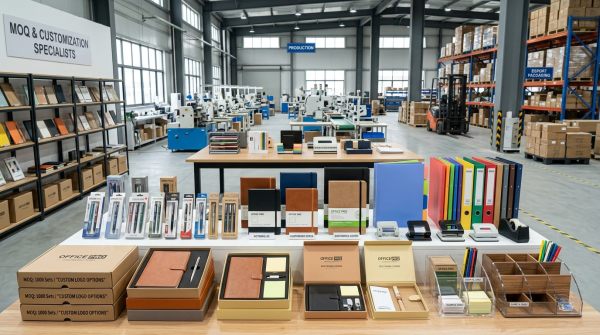
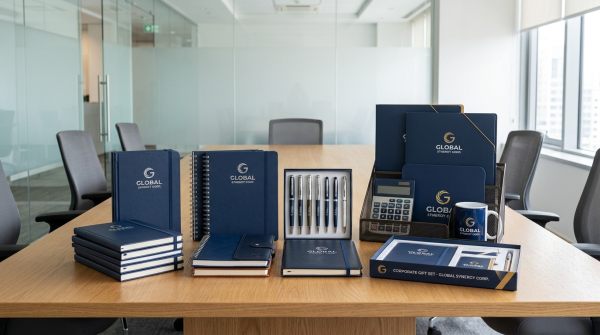
- Can they handle private label, OEM, or packaging customization correctly?
- Will they communicate well if problems occur?
- Do they have the capacity and systems to support long-term growth?
That means the most useful evaluation process is not a generic supplier checklist. It is a structured review of the exporter’s capabilities, credibility, and fit for your distribution model or procurement needs.
Start with exporter type: supplier, manufacturer, or wholesaler
Before comparing offers, clarify what kind of partner you are evaluating. In the office supplies industry, the terms office supplies supplier, office supplies manufacturer, and office supplies wholesaler are often used interchangeably, but they do not always represent the same business model.
- Manufacturer: Produces goods directly, often offering better control over quality, customization, and cost structure.
- Wholesaler: Buys in bulk and resells a range of products, which can be useful for mixed-category sourcing and lower complexity.
- Supplier/exporter: May be a manufacturer, trading company, or hybrid sourcing operator that manages export sales and logistics.
This distinction matters because it affects lead times, pricing transparency, customization options, and accountability. If your business requires custom notebooks, branded filing systems, or institutional-grade writing products, a real manufacturer may be the better fit. If you need a wide basket of standard SKUs consolidated into one shipment, a capable wholesaler or export supplier may offer more convenience.
Check whether the company is operationally credible, not just visible online
A polished website and fast quotation response do not prove that an office supplies exporter is reliable. Buyers should verify whether the company is a legitimate and active business with real export capability.
Review the following basics first:
- Business registration details and legal company name
- Export license or relevant trade credentials
- Years in operation
- Main export markets
- Factory address or sourcing office address
- Bank account details matching the registered entity
- Third-party verification records, if available
Ask for supporting documents early. Serious exporters are usually comfortable sharing business licenses, company profiles, audit summaries, and key export references. If the company avoids basic verification requests or provides inconsistent information, that is a meaningful warning sign.
Evaluate product quality through evidence, not assumptions
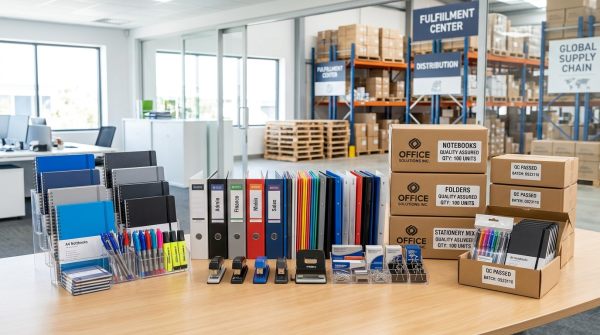
Quality consistency is one of the biggest concerns in office supplies sourcing. Products may look acceptable in a sample but perform poorly in bulk production. This is especially important for high-volume items such as pens, paper products, folders, staplers, desk accessories, educational materials, and private-label stationery.
To properly assess quality, buyers should request:
- Current product catalogs with specifications
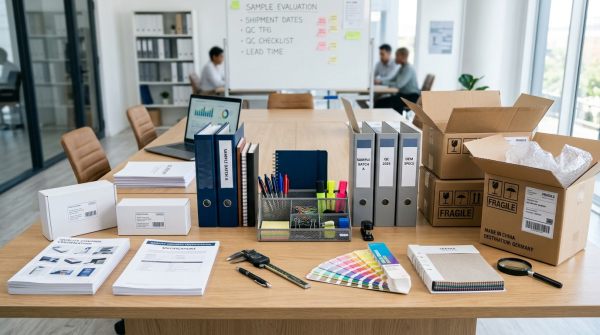
- Physical samples from existing production
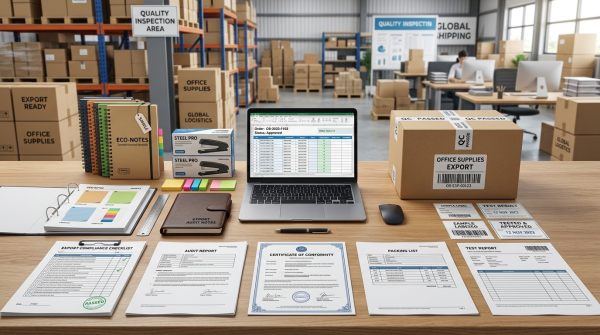
- Material details and test reports where relevant
- Photos or videos of packaging and carton standards
- Quality control process documentation
- Batch consistency records or internal inspection standards
Do not rely on one perfect sample. Compare samples across colors, models, and production dates if possible. If you are a distributor or reseller, also evaluate how well the packaging, labeling, barcode placement, and retail presentation match your market requirements.
Verify compliance for the destination market
Compliance is often overlooked during early supplier screening, but it can become a major source of cost and disruption later. Depending on the product category and destination market, office supplies may need to meet chemical safety, labeling, packaging, environmental, or consumer product regulations.
Ask the exporter which compliance standards they commonly support in your target market. Then verify with documentation instead of accepting general assurances. Relevant checkpoints may include:
- Material safety and restricted substance compliance
- Country-specific labeling standards
- Packaging and recycling requirements
- Product test reports from recognized laboratories
- Children’s product standards where applicable
- REACH, RoHS, CPSIA, or other applicable frameworks depending on item type and market
An experienced office supplies exporter should understand that compliance is not a minor detail. It is part of the product offering. If the supplier seems unclear about documentation, testing scope, or destination-specific requirements, that can create risk for customs clearance and downstream sales.
Assess manufacturing and supply chain capacity
Many sourcing problems do not come from bad intent. They come from weak capacity planning. An exporter may provide good samples and attractive pricing, but still struggle with scale, peak-season demand, material sourcing, or delivery coordination.
Ask practical questions such as:
- What is your monthly production capacity for my key SKUs?
- Which products are made in-house and which are outsourced?
- What are your normal and peak-season lead times?
- How do you manage raw material shortages?
- Can you support mixed-container shipments?
- What is your backup plan if one production line is disrupted?
If your business depends on back-to-school cycles, corporate contract fulfillment, or regular replenishment programs, supply chain resilience matters as much as price. A strong office supplies supplier should be able to explain its production planning process clearly and realistically.
Review communication quality and problem-solving ability
One of the most underestimated parts of vetting is communication. In global trade, even a technically capable exporter can become difficult to work with if communication is slow, vague, or inconsistent.
During the quotation and sampling stage, pay attention to how the team handles details:
- Do they answer questions directly?
- Do they confirm specifications clearly in writing?
- Do they identify potential issues before production?
- Do they understand your packaging and labeling instructions?
- Do they respond with commercial clarity or with generic sales language?
Good exporters reduce friction. They document changes, confirm timelines, and escalate risks early. This matters especially for buyers managing multiple SKUs, retailer requirements, or private-label programs where small errors can affect an entire shipment.
Look closely at pricing structure, not just the headline quote
A cheap quote is not automatically a good deal. Buyers should understand how the price is built and whether it is commercially sustainable. In office supplies, aggressive pricing can sometimes indicate thinner materials, inconsistent ink quality, low-grade plastics, poor finishing, or weak export packaging.
Ask for a breakdown where appropriate, including:
- Unit price by order volume
- Tooling or sampling charges
- Packaging costs
- Private label or printing costs
- Incoterm basis such as EXW, FOB, CIF, or DDP
- Expected price validity period
Then compare the quote against product specifications and commercial terms. If one office supplies wholesaler is much cheaper than all others, identify why. A credible supplier should be able to explain cost differences in a way that makes operational sense.
Request proof of export experience in similar markets or channels
Not every exporter is equally prepared for every buyer type. A supplier that serves discount retailers may not be suitable for institutional procurement. One that exports standard commodity stationery may not be ideal for custom branded office kits or education-sector tenders.
Ask for examples of relevant experience, such as:
- Markets they currently ship to
- Types of customers they support
- Private-label or OEM projects completed
- Category strengths in office and educational supplies
- Retail, distribution, or contract supply references
You do not always need customer names, but you do need evidence that the exporter understands your business model. This is especially important for distributors, agents, and brand owners who depend on product consistency and channel readiness.
Use audits, inspections, and trial orders to reduce risk
The best way to vet an office supplies exporter is to combine document review with real-world validation. If the order value or strategic importance is significant, use third-party verification tools before committing to large volumes.
Common risk-control steps include:
- Factory audit or supplier assessment
- Social compliance audit if required by your customers
- Pre-production sample approval
- In-line inspection for complex or high-volume orders
- Pre-shipment inspection based on AQL standards
- Small trial order before long-term contract commitment
Trial orders are particularly useful because they reveal how the exporter performs under normal commercial pressure. You can assess documentation accuracy, production consistency, shipping coordination, and responsiveness after payment.
Red flags that should make buyers pause
Even if pricing is attractive, some warning signs justify extra caution or disqualification. Common red flags include:
- Unwillingness to provide company registration or audit information
- Bank account details that do not match the company entity
- Inconsistent product specifications across documents
- Very low prices with no clear commercial explanation
- Pressure for unusually large upfront payments
- Poor sample quality compared with sales claims
- Limited understanding of export compliance or packaging rules
- Frequent communication delays during early-stage discussions
One issue alone may not always eliminate a supplier, but multiple warning signs usually indicate future risk. For procurement teams, it is often better to spend more time validating than to spend months resolving avoidable supply problems.
A practical vetting checklist for office supplies sourcing teams
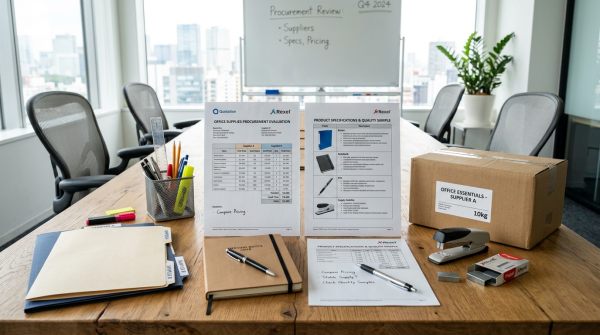
To simplify evaluation, buyers can use a structured scorecard when comparing exporters. A practical shortlist review should cover the following areas:
- Company legitimacy: registration, export status, years in business
- Business model: manufacturer, wholesaler, trading exporter, or hybrid
- Product quality: samples, specifications, QC standards, consistency
- Compliance: testing, labeling, market documentation
- Capacity: output, lead times, backup capability
- Customization: OEM, ODM, branding, packaging flexibility
- Commercial terms: pricing logic, MOQ, payment terms, Incoterms
- Communication: speed, accuracy, accountability
- Export experience: markets served, category expertise, channel fit
- Risk controls: audits, inspections, trial order performance
This kind of scorecard helps teams compare suppliers objectively rather than choosing based on price or presentation alone.
Conclusion: choose the exporter that lowers total risk, not just upfront cost
Vetting an office supplies exporter is ultimately about reducing uncertainty. The right partner should not only offer competitive pricing, but also demonstrate quality consistency, compliance readiness, dependable communication, and a supply model that matches your business needs. For buyers evaluating an office supplies supplier, office supplies manufacturer, or office supplies wholesaler, the best decision usually comes from evidence-based comparison rather than fast quotation turnover.
If you want stronger procurement outcomes, focus on total value: stable quality, fewer disruptions, smoother imports, better customer satisfaction, and a supplier relationship that can scale with your business. In international office supplies sourcing, that is what separates a workable vendor from a truly reliable export partner.
Search News
Hot Articles
- Stage Lighting & Truss2026 FIBA Women's World Cup Draw Sets LED Timing Screen RequirementsApr 27, 2026
- Hotel Room AmenitiesIranian Delegation’s Ritual Gesture at Sanya ASG Sparks Mideast Hospitality Procurement ShiftApr 27, 2026
- Arcade & VR MachinesSnooker World Championship 'China Derby' Drives VR Viewing DemandApr 27, 2026
Popular Tags
Need ExpertConsultation?
Connect with our specialized leisureengineering team for procurementstrategies.
Recommended News
 Apr 27, 2026Office Supplies Manufacturer MOQ ExplainedOffice supplies manufacturer MOQ explained: compare an office supplies supplier, wholesaler, distributor, OEM manufacturer, and factory to reduce cost, improve flexibility, and source smarter.● Institutional Buyer
 Apr 27, 2026Distributor or Supplier for Fast ReordersOffice supplies supplier or distributor for fast reorders? Compare lead times, stock stability, and bulk supply options to choose a reliable office supplies B2B supplier.● Institutional Buyer
 Apr 27, 2026How Wholesalers Cut Office Supply CostsOffice supplies supplier and office supplies wholesaler solutions help cut costs through bulk buying, OEM options, and smarter sourcing. Compare distributors and manufacturers to save more.● Institutional Buyer
 Apr 27, 2026Office Supplies Supplier Pricing Red FlagsOffice supplies supplier pricing red flags explained: compare an office supplies wholesaler, distributor, or manufacturer, spot hidden risks, and choose a reliable B2B partner with confidence.● Institutional Buyer
 Apr 27, 2026How to Vet an Office Supplies ExporterOffice supplies supplier vetting made simple: learn how to assess an office supplies exporter, manufacturer, wholesaler, and distributor for quality, compliance, and reliable B2B growth.● Institutional Buyer
 Apr 27, 2026What to Ask an Office Supplies Producer FirstOffice supplies supplier screening starts with the right questions. Learn how to evaluate an office supplies manufacturer, wholesaler, or producer on quality, OEM, compliance, pricing, and delivery.● Institutional Buyer
 Apr 27, 2026How to Compare Office Supplies Bulk SuppliersCompare every office supplies supplier model—wholesaler, distributor, OEM manufacturer, and bulk supplier—to evaluate quality, compliance, lead times, and costs for smarter B2B sourcing.● Institutional Buyer
 Apr 27, 2026Is an Office Supplies OEM Manufacturer Worth ItOffice supplies OEM manufacturer or standard sourcing? Compare an office supplies supplier, wholesaler, and distributor to find the best B2B fit for cost, branding, and scalable growth.● Institutional Buyer
 Apr 27, 2026Best Office Supplies B2B Supplier for ScaleFind the best office supplies B2B supplier for scale. Compare an office supplies supplier, wholesaler, distributor, and OEM manufacturer to secure reliable bulk sourcing and growth.● Institutional Buyer
 Apr 27, 2026Office Supplies Factory Audit ChecklistOffice supplies factory audit checklist for choosing a reliable office supplies manufacturer, supplier, or OEM partner. Learn key quality, compliance, and capacity checks before sourcing.● Institutional Buyer
 Apr 27, 2026When to Work With an Office Supplies ManufacturerOffice supplies manufacturer or office supplies supplier? Learn when to source direct, compare wholesaler vs OEM options, and improve cost, quality, and supply stability.● Institutional Buyer
 Apr 27, 2026What Makes a Reliable Office Supplies DistributorDiscover what sets a reliable office supplies distributor apart. Compare an office supplies supplier, wholesaler, or B2B supplier by quality, lead times, inventory, and global delivery.● Institutional Buyer
 Apr 27, 2026Office Supplies Wholesaler vs DistributorOffice supplies wholesaler vs distributor: learn how an office supplies supplier, distributor, or manufacturer impacts pricing, lead time, and growth—choose the best B2B sourcing model.● Institutional Buyer
 Apr 27, 2026How to Choose an Office Supplies SupplierLearn how to choose the right office supplies supplier by comparing an office supplies wholesaler, distributor, manufacturer, or B2B supplier for quality, price, delivery, and growth.● Institutional Buyer
 Apr 24, 2026How to Pick Educational Supplies by AgeEducational supplies by age: discover how commercial furniture, sensory playground designs, playground safety, climbers, borders, music accessories, hotel tables and amusement equipment improve ROI.● Institutional Buyer
 Apr 24, 2026Educational Supplies That Schools Reorder MostEducational supplies schools reorder most: from commercial furniture support and music accessories to playground safety, playground borders, and sensory playground essentials—discover high-demand categories buyers need year-round.● Institutional Buyer
 Apr 23, 2026How to Compare Educational Supplies Beyond Unit PriceEducational supplies buying guide: compare commercial furniture, sensory playground, music accessories, and playground safety beyond unit price to cut risk and boost long-term value.● Institutional Buyer
 Apr 23, 2026Educational Supplies That Wear Out Fast in Shared UseEducational supplies wear out fast in shared spaces. Learn how commercial furniture, music accessories, playground borders, playground climbers, sensory playground systems, and playground safety solutions reduce risk and replacement costs.● Institutional Buyer
 Apr 22, 2026When Cheap Office Supplies End Up Costing MoreOffice supplies that seem cheap can cost more over time for trampoline park, indoor playground, arcade games, musical instruments, and luxury jewelry businesses—discover smarter sourcing tips.● Institutional Buyer
 Apr 22, 2026Office Supplies Costs That Quietly Add Up Over a YearOffice supplies costs can quietly rise alongside arcade games, musical instruments, indoor playground and trampoline park operations. Discover smarter sourcing to protect margins.● Institutional Buyer
 Apr 21, 2026Office supplies wholesaler terms that cause reorder problemsOffice supplies wholesaler terms can quietly trigger costly reorders. Learn how a reliable office supplies supplier should handle MOQ, lead times, substitutions, and pricing before you sign.● Institutional Buyer
 Apr 21, 2026The hidden service gaps between office supplies suppliersOffice supplies supplier insights: uncover hidden service gaps in office supplies wholesaler selection, plus sourcing links to musical instruments for bands, custom jewelry manufacturer, and indoor playground supplier.● Institutional Buyer
 Apr 24, 2026Why office supplies wholesalers vary so much on MOQ and lead timeOffice supplies supplier insights: learn why an office supplies wholesaler differs on MOQ and lead time, and compare sourcing logic across custom jewelry manufacturer and indoor playground supplier options.● Institutional Buyer
 Apr 24, 2026How to compare an office supplies supplier beyond priceCompare an office supplies supplier beyond price—evaluate quality, compliance, customization, and delivery. Learn how the right office supplies wholesaler reduces risk and boosts long-term value.● Institutional Buyer