Is an Office Supplies OEM Manufacturer Worth It
Choosing an office supplies OEM manufacturer can be a smart move for buyers seeking customization, cost control, and scalable supply. Whether you are comparing an office supplies supplier, office supplies wholesaler, or office supplies distributor, understanding OEM value is essential for better sourcing decisions. This guide helps procurement teams, resellers, and business evaluators assess when an office supplies manufacturer truly delivers long-term B2B advantages.
In the office supplies industry, the OEM model is no longer limited to basic private labeling. Today, buyers often expect custom packaging, material selection, product bundling, compliance support, and stable replenishment across multiple SKUs. For institutions, distributors, and commercial sourcing teams, the decision is less about whether OEM is fashionable and more about whether it fits demand volume, brand goals, and operational risk tolerance.
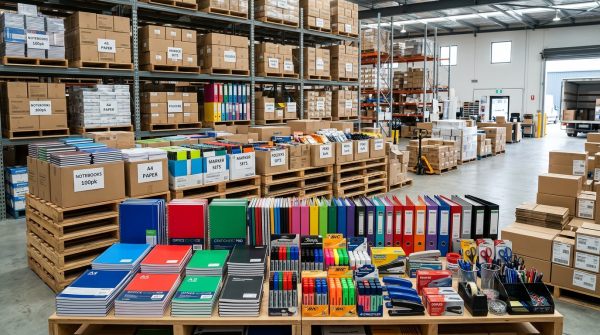
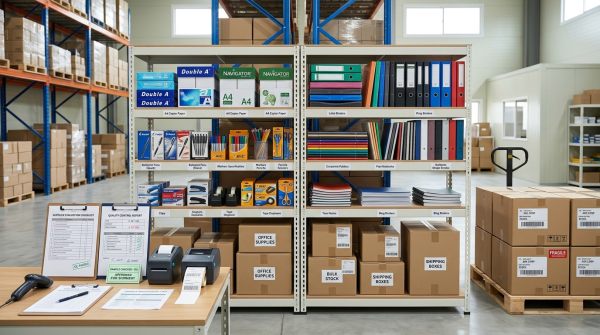
This is especially relevant for companies sourcing notebooks, filing products, writing instruments, desk accessories, educational office items, and corporate stationery kits. A strong office supplies OEM manufacturer can improve margin control by 8%–20% in the right program, but a poor fit can create delays, excess inventory, and inconsistent quality. The real value depends on product category, order frequency, and supplier capability.
For global buyers and market evaluators, the best approach is practical: compare OEM against standard wholesale sourcing, examine cost and lead-time tradeoffs, and test whether the factory can support long-term brand growth. The sections below break down where OEM makes sense, where it does not, and how to evaluate an office supplies manufacturer with greater confidence.
What an OEM Manufacturer Means in Office Supplies Procurement
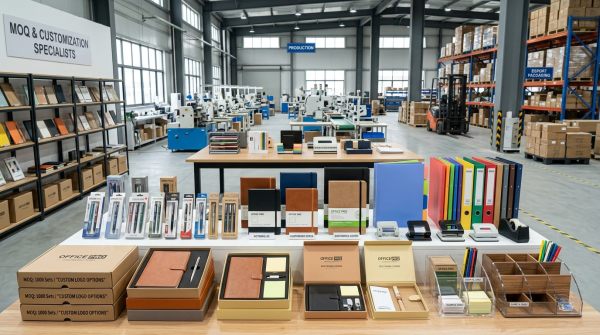
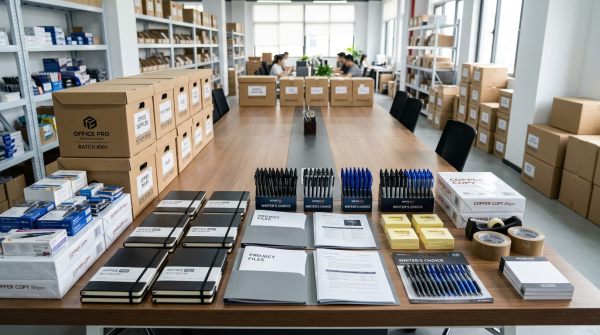
In office supplies, OEM generally refers to a manufacturer producing goods based on a buyer’s branding, packaging, feature requirements, or specification adjustments. This may involve custom logo printing on pens, branded binders, school and office kits, color-specific desk organizers, or packaging tailored for retail, e-commerce, or institutional distribution. The level of customization can range from 1 simple logo application to 5 or more specification changes in one project.
For procurement teams, the practical difference between an office supplies OEM manufacturer and a general office supplies supplier is control. A standard supplier typically sells ready-made items from an existing catalog. An OEM partner can adapt dimensions, materials, packaging counts, barcode labeling, and carton marks to meet internal procurement rules or channel requirements. This becomes important when supplying school systems, corporate groups, public-sector buyers, or multi-country distributors.
However, not every office product benefits equally from OEM. Commodity items with very low unit values, such as standard paper clips or generic staples, may not justify tooling, printing setup, or higher MOQs. In contrast, higher-visibility products like notebooks, planners, writing sets, and desktop storage products often provide stronger branding and margin opportunities. Buyers should match OEM effort to the product’s commercial role.
For GCT’s target audience, especially distributors and business evaluators, the key question is whether OEM improves competitiveness without creating unnecessary operational complexity. That requires understanding the scope of customization, factory responsiveness, compliance readiness, and replenishment reliability across 2 to 4 purchasing cycles, not just one trial order.
Common OEM Customization Layers
The office supplies sector usually applies OEM across a layered model. Some projects only need packaging changes, while others involve structural design and material replacement. Buyers can reduce project risk by confirming which layer they actually need before requesting quotations.
- Level 1: Logo printing or private label packaging for existing catalog products.
- Level 2: Color, finish, carton mark, barcode, and pack-count adjustments.
- Level 3: Material upgrades, accessory additions, and bundled office kits.
- Level 4: Mold-related or size-related product changes for differentiated lines.
Each level affects MOQ, sample cycle, and lead time. A Level 1 project may move in 7–15 days for sampling, while a Level 4 project can require 3–6 weeks before mass production starts. That timeline difference matters when tenders or seasonal back-to-school programs have fixed deadlines.
The table below shows how OEM differs from standard sourcing models in office supplies procurement.
The main conclusion is clear: OEM is not automatically better than wholesale or standard supply. It becomes worthwhile when buyers need repeatable volume, product differentiation, or packaging control that supports a wider B2B strategy.
When an Office Supplies OEM Manufacturer Is Worth the Investment
An OEM program becomes commercially sensible when a buyer has predictable demand, channel-specific requirements, or margin pressure that cannot be solved by buying standard catalog items. In many office supplies categories, the breakeven point often starts when annual purchasing volume reaches 3 to 6 reorder cycles or when the buyer manages at least 20–50 core SKUs under one brand program.
For distributors and resellers, private label office products can strengthen market position in a crowded category. If multiple distributors are selling the same imported notebook or filing tray, price competition quickly becomes the only lever. OEM helps create a more exclusive range, especially in stationery sets, conference kits, school-office hybrid products, and branded desk accessories. Even small packaging changes can help a distributor separate its offer from generic market listings.
For institutional and corporate buyers, the value may be less about resale margin and more about standardization. A company sourcing office supplies for 10, 20, or 50 branches may want consistent branding, carton labels by department, fixed pack sizes, and simplified replenishment. OEM can reduce internal handling time and improve deployment accuracy, particularly when the same supply kit must be sent repeatedly to new offices, classrooms, or project sites.
OEM is also useful when sustainability or material control matters. Some buyers request recycled paper content, specific plastic alternatives, low-odor markers, or reduced packaging layers. These changes may not require a completely new product, but they do require a manufacturer that can document material options and maintain consistency over 2 to 3 production batches.
Buyer Profiles That Usually Benefit Most
- Distributors managing their own brand portfolio across regional markets.
- Corporate procurement teams standardizing employee welcome kits or office starter packs.
- Educational and institutional buyers needing fixed item bundles with repeat demand.
- Retail and e-commerce sellers seeking differentiated packaging and better margin control.
Situations Where OEM May Not Be Ideal
OEM is less attractive when demand is uncertain, SKU turnover is too frequent, or order quantities are below the supplier’s workable MOQ. For example, a buyer testing 6 colors of a niche desk organizer with no sales history may face slow-moving stock and fragmented reorders. In such cases, an office supplies wholesaler or distributor model may be more efficient for the first 1 to 2 market cycles.
It is also less suitable when the buyer lacks internal resources for artwork approval, packaging review, or forecast planning. OEM reduces some costs but adds coordination work. Without clear ownership on the buyer side, delays often appear in the approval stage rather than in factory production.
The following comparison helps buyers decide when OEM is commercially justified.
A practical rule is that OEM works best when the buyer can forecast demand for at least 90–180 days and define clear product or packaging specifications before production starts.
How to Evaluate an Office Supplies OEM Manufacturer
The right office supplies manufacturer should be assessed on operational fit, not just unit price. Buyers often focus on quotation comparisons while overlooking approval speed, defect handling, packaging accuracy, and replenishment discipline. A supplier that is 4% cheaper but misses delivery windows by 2 weeks can easily become the more expensive option in practice.
Start with category competence. A factory that is strong in paper products may not be equally strong in molded plastic desk accessories or metal filing hardware. Buyers should ask which products are manufactured in-house, which are subcontracted, and how many production steps are internally controlled. This matters because quality consistency is easier to manage when 60%–80% of key processes are directly supervised.
Next, review sampling and change control. In office supplies OEM projects, small deviations in logo placement, color tone, carton marks, or pack count can create large downstream issues. A reliable manufacturer should be able to confirm artwork files, sample revision rounds, and approval checkpoints clearly. In many projects, 2 sample rounds are normal; more than 3 rounds may indicate unclear specifications or weak pre-production coordination.
Lead time structure is equally important. Buyers should distinguish between sample lead time, material preparation time, production time, and shipping readiness. A quoted lead time of 30 days may only cover factory production and exclude packaging approval or accessory sourcing. For office supplies, a realistic total cycle for a moderate OEM order often ranges from 4 to 8 weeks depending on SKU complexity and packaging type.
Core Evaluation Checklist
- Confirm whether the manufacturer has relevant experience in the exact office supplies category you plan to buy.
- Check workable MOQ by SKU, by color, and by packaging version, not just total order quantity.
- Review sampling timeline, revision limits, and approval responsibilities.
- Ask about inspection method, defect handling, and replacement or credit procedures.
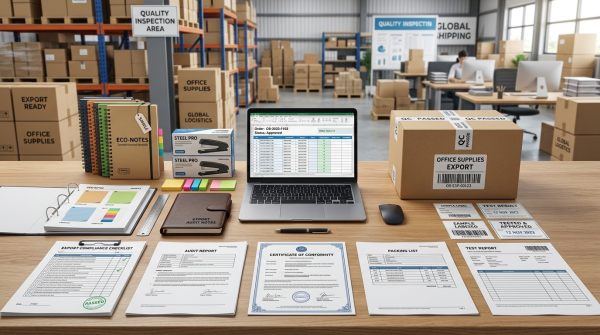
- Verify export documentation capability, carton labeling accuracy, and shipment coordination.
Useful Questions for Commercial Evaluation
Business evaluators should also ask how the factory supports SKU expansion over time. A supplier may handle 5 products well but struggle with 30 mixed office items under one program. It is helpful to understand whether they can consolidate packaging styles, standardize brand colors, and manage reorder planning for quarterly demand. This is often more important than winning the first RFQ.
Buyers should be cautious of unusually low quotes tied to vague packaging assumptions. In office supplies, the same notebook can carry different costs depending on paper weight, cover finish, elastic band, shrink wrap, set packing, and export carton strength. Unless each specification line is clear, the quotation is not fully comparable.
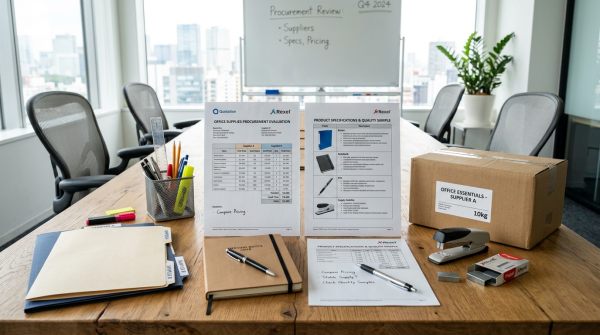
The table below summarizes practical evaluation factors for selecting an OEM office supplies partner.
A strong office supplies OEM manufacturer usually performs consistently across these factors. If one area is weak, such as change control or MOQ transparency, the sourcing risk rises even when pricing seems attractive.
Cost, Lead Time, and Risk Control in OEM Office Supplies Projects
Many buyers assume OEM automatically lowers cost. In reality, total cost must be measured across unit price, setup expense, inventory burden, error correction, and reorder efficiency. A custom office supplies program can lower landed cost over time if volume is stable, but the first production run may include artwork setup, packaging plate charges, extra sampling, or higher carton customization expense.
The best way to evaluate cost is by separating one-time and recurring costs. One-time items may include sample development, print setup, or mold adjustment. Recurring costs include material choice, labor, packaging, inspection, and freight preparation. If these are not separated, procurement teams may misread the economics of the project and reject an OEM program that becomes efficient from the second or third order onward.
Lead time risk is another major factor. Office supplies are often tied to school openings, new office setups, annual budgeting cycles, and promotional campaigns. Missing a launch window by 10–14 days can erase the margin advantage of the entire program. Buyers should therefore build a schedule with at least 4 control points: specification freeze, sample approval, production confirmation, and pre-shipment verification.
Risk control should also cover packaging accuracy and mixed-SKU management. In office products, mistakes often happen not because the pen or folder is unusable, but because the wrong barcode, carton mark, language insert, or pack quantity reaches the warehouse. These are avoidable failures that should be addressed in the pre-production checklist.
Typical Risk Areas in Office Supplies OEM Orders
- MOQ set too high for slow-moving colors or specialty variants.
- Artwork approval delayed because file formats or print positions are unclear.
- Carton labels and inner pack counts do not match warehouse receiving rules.
- Reorders change materials or shades slightly, creating inconsistency in the market.
- Multiple low-value SKUs are combined without clear replenishment planning.
A Practical 5-Step Control Process
- Lock product specifications, materials, colors, packaging counts, and labeling requirements.
- Approve pre-production samples against a written checklist, not verbal confirmation only.
- Confirm mass production schedule and critical raw material availability.
- Inspect print quality, assortment accuracy, and packaging compliance before shipment.
- Review first-order performance and adjust MOQ or pack configuration before reorder.
The table below outlines common cost and risk considerations for office supplies OEM planning.
For most commercial buyers, OEM becomes worth it when cost savings or brand gains are paired with predictable delivery and controlled complexity. Without those controls, customization can become an expensive distraction rather than a sourcing advantage.
FAQ and Final Buying Guidance for B2B Office Supplies Sourcing
How long does an office supplies OEM project usually take?
A basic private label project may take 3–5 weeks from artwork confirmation to shipment readiness. More customized programs involving material changes, kit assembly, or multiple packaging layers often take 6–8 weeks. Buyers should also reserve internal time for approvals, especially if several stakeholders need to sign off on branding and pack configuration.
What MOQ should buyers expect?
MOQ varies widely by product category and customization level. A standard printed notebook or pen may have a manageable MOQ, while customized desk organizers, mixed office kits, or color-specific filing products may require higher thresholds. The critical point is to ask whether MOQ applies per SKU, per color, per packaging version, or per order total. That distinction can significantly affect stock planning.
Is OEM better than buying from an office supplies distributor?
Not always. An office supplies distributor is often the better option for urgent replenishment, low-volume mixed purchasing, or trial demand. OEM becomes stronger when a business wants repeatability, custom branding, tailored packaging, and better medium-term margin control. Many buyers actually use both models at the same time: distribution for fast-moving generic items and OEM for strategic branded lines.
Which products are most suitable for OEM in office supplies?
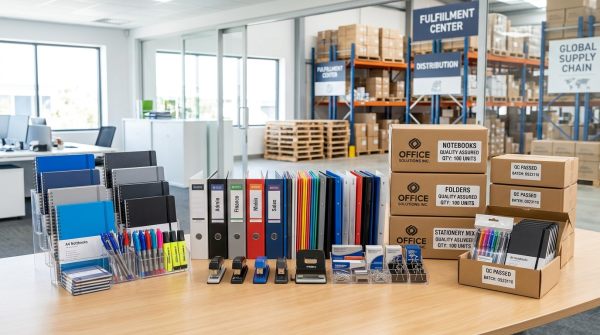
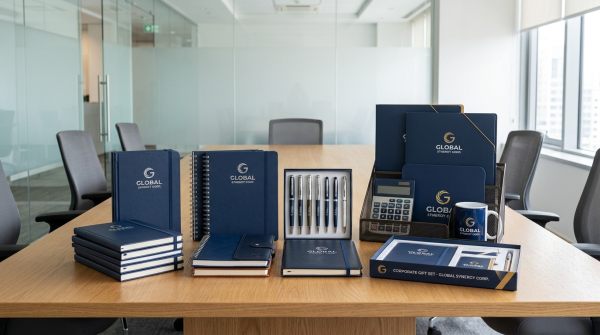
Products with visible branding value or repeat institutional demand are usually the best candidates. Examples include notebooks, planners, writing instruments, desk sets, presentation folders, school-office starter kits, and conference stationery packs. These categories benefit from customized packaging, logo placement, color matching, and bundled configuration more than low-value generic consumables do.
Final decision framework
If your organization buys office products in stable volumes, needs packaging or brand control, and can forecast demand across at least 1 to 2 quarters, an office supplies OEM manufacturer is often worth serious consideration. If demand is irregular, urgent, or highly fragmented, a wholesaler or distributor model may be more practical. The best sourcing strategy is not ideological; it is matched to category, volume, and commercial objective.
For procurement teams, resellers, and commercial evaluators, the strongest OEM partnerships are built on clear specifications, disciplined approvals, realistic lead times, and measurable reorder potential. That is where long-term value emerges: not from customization alone, but from customization that is operationally sustainable.
If you are comparing an office supplies supplier, office supplies wholesaler, office supplies distributor, or office supplies manufacturer for a private label or custom sourcing program, now is the right time to assess the numbers, the risks, and the fit. Contact GCT to discuss sourcing priorities, request a tailored evaluation framework, or explore office supplies OEM solutions that align with your B2B growth strategy.
Search News
Hot Articles
- Stage Lighting & Truss2026 FIBA Women's World Cup Draw Sets LED Timing Screen RequirementsApr 27, 2026
- Hotel Room AmenitiesIranian Delegation’s Ritual Gesture at Sanya ASG Sparks Mideast Hospitality Procurement ShiftApr 27, 2026
- Arcade & VR MachinesSnooker World Championship 'China Derby' Drives VR Viewing DemandApr 27, 2026
Popular Tags
Need ExpertConsultation?
Connect with our specialized leisureengineering team for procurementstrategies.
Recommended News
 Apr 27, 2026Office Supplies Manufacturer MOQ ExplainedOffice supplies manufacturer MOQ explained: compare an office supplies supplier, wholesaler, distributor, OEM manufacturer, and factory to reduce cost, improve flexibility, and source smarter.● Institutional Buyer
 Apr 27, 2026Distributor or Supplier for Fast ReordersOffice supplies supplier or distributor for fast reorders? Compare lead times, stock stability, and bulk supply options to choose a reliable office supplies B2B supplier.● Institutional Buyer
 Apr 27, 2026How Wholesalers Cut Office Supply CostsOffice supplies supplier and office supplies wholesaler solutions help cut costs through bulk buying, OEM options, and smarter sourcing. Compare distributors and manufacturers to save more.● Institutional Buyer
 Apr 27, 2026Office Supplies Supplier Pricing Red FlagsOffice supplies supplier pricing red flags explained: compare an office supplies wholesaler, distributor, or manufacturer, spot hidden risks, and choose a reliable B2B partner with confidence.● Institutional Buyer
 Apr 27, 2026How to Vet an Office Supplies ExporterOffice supplies supplier vetting made simple: learn how to assess an office supplies exporter, manufacturer, wholesaler, and distributor for quality, compliance, and reliable B2B growth.● Institutional Buyer
 Apr 27, 2026What to Ask an Office Supplies Producer FirstOffice supplies supplier screening starts with the right questions. Learn how to evaluate an office supplies manufacturer, wholesaler, or producer on quality, OEM, compliance, pricing, and delivery.● Institutional Buyer
 Apr 27, 2026How to Compare Office Supplies Bulk SuppliersCompare every office supplies supplier model—wholesaler, distributor, OEM manufacturer, and bulk supplier—to evaluate quality, compliance, lead times, and costs for smarter B2B sourcing.● Institutional Buyer
 Apr 27, 2026Is an Office Supplies OEM Manufacturer Worth ItOffice supplies OEM manufacturer or standard sourcing? Compare an office supplies supplier, wholesaler, and distributor to find the best B2B fit for cost, branding, and scalable growth.● Institutional Buyer
 Apr 27, 2026Best Office Supplies B2B Supplier for ScaleFind the best office supplies B2B supplier for scale. Compare an office supplies supplier, wholesaler, distributor, and OEM manufacturer to secure reliable bulk sourcing and growth.● Institutional Buyer
 Apr 27, 2026Office Supplies Factory Audit ChecklistOffice supplies factory audit checklist for choosing a reliable office supplies manufacturer, supplier, or OEM partner. Learn key quality, compliance, and capacity checks before sourcing.● Institutional Buyer
 Apr 27, 2026When to Work With an Office Supplies ManufacturerOffice supplies manufacturer or office supplies supplier? Learn when to source direct, compare wholesaler vs OEM options, and improve cost, quality, and supply stability.● Institutional Buyer
 Apr 27, 2026What Makes a Reliable Office Supplies DistributorDiscover what sets a reliable office supplies distributor apart. Compare an office supplies supplier, wholesaler, or B2B supplier by quality, lead times, inventory, and global delivery.● Institutional Buyer
 Apr 27, 2026Office Supplies Wholesaler vs DistributorOffice supplies wholesaler vs distributor: learn how an office supplies supplier, distributor, or manufacturer impacts pricing, lead time, and growth—choose the best B2B sourcing model.● Institutional Buyer
 Apr 27, 2026How to Choose an Office Supplies SupplierLearn how to choose the right office supplies supplier by comparing an office supplies wholesaler, distributor, manufacturer, or B2B supplier for quality, price, delivery, and growth.● Institutional Buyer
 Apr 24, 2026How to Pick Educational Supplies by AgeEducational supplies by age: discover how commercial furniture, sensory playground designs, playground safety, climbers, borders, music accessories, hotel tables and amusement equipment improve ROI.● Institutional Buyer
 Apr 24, 2026Educational Supplies That Schools Reorder MostEducational supplies schools reorder most: from commercial furniture support and music accessories to playground safety, playground borders, and sensory playground essentials—discover high-demand categories buyers need year-round.● Institutional Buyer
 Apr 23, 2026How to Compare Educational Supplies Beyond Unit PriceEducational supplies buying guide: compare commercial furniture, sensory playground, music accessories, and playground safety beyond unit price to cut risk and boost long-term value.● Institutional Buyer
 Apr 23, 2026Educational Supplies That Wear Out Fast in Shared UseEducational supplies wear out fast in shared spaces. Learn how commercial furniture, music accessories, playground borders, playground climbers, sensory playground systems, and playground safety solutions reduce risk and replacement costs.● Institutional Buyer
 Apr 22, 2026When Cheap Office Supplies End Up Costing MoreOffice supplies that seem cheap can cost more over time for trampoline park, indoor playground, arcade games, musical instruments, and luxury jewelry businesses—discover smarter sourcing tips.● Institutional Buyer
 Apr 22, 2026Office Supplies Costs That Quietly Add Up Over a YearOffice supplies costs can quietly rise alongside arcade games, musical instruments, indoor playground and trampoline park operations. Discover smarter sourcing to protect margins.● Institutional Buyer
 Apr 21, 2026Office supplies wholesaler terms that cause reorder problemsOffice supplies wholesaler terms can quietly trigger costly reorders. Learn how a reliable office supplies supplier should handle MOQ, lead times, substitutions, and pricing before you sign.● Institutional Buyer
 Apr 21, 2026The hidden service gaps between office supplies suppliersOffice supplies supplier insights: uncover hidden service gaps in office supplies wholesaler selection, plus sourcing links to musical instruments for bands, custom jewelry manufacturer, and indoor playground supplier.● Institutional Buyer
 Apr 24, 2026Why office supplies wholesalers vary so much on MOQ and lead timeOffice supplies supplier insights: learn why an office supplies wholesaler differs on MOQ and lead time, and compare sourcing logic across custom jewelry manufacturer and indoor playground supplier options.● Institutional Buyer
 Apr 24, 2026How to compare an office supplies supplier beyond priceCompare an office supplies supplier beyond price—evaluate quality, compliance, customization, and delivery. Learn how the right office supplies wholesaler reduces risk and boosts long-term value.● Institutional Buyer