Custom printed hotel key cards: PVC or wood for a better guest feel?
Choosing between PVC and wood for custom printed hotel key cards can shape how guests perceive your brand from the very first touch. For procurement teams balancing durability, cost, sustainability, and design impact, the right material is more than a practical choice—it is part of the guest experience strategy. This guide compares both options to help commercial buyers make a smarter sourcing decision.
Guest touchpoints are changing, and key card material now carries more brand weight
In hospitality procurement, small physical items are gaining strategic importance. Hotels are investing heavily in sensory branding, sustainability claims, and more coherent guest journeys. As a result, custom printed hotel key cards are no longer treated as simple room access tools. They now sit at the intersection of operations, design, and perception. What used to be a low-attention commodity is becoming part of how a property signals quality, responsibility, and consistency.
This shift is especially visible in upscale hotels, boutique concepts, lifestyle chains, eco-resorts, and mixed-use hospitality projects. Procurement managers are being asked to justify not only the price of key cards, but also the guest feel, environmental positioning, print quality, replacement rate, and alignment with broader brand standards. That is why the debate around PVC versus wood has become more relevant. It reflects a larger market question: should hotel sourcing prioritize proven functionality, or use materials more actively to communicate a modern brand story?
Why the PVC versus wood decision is becoming more visible in hotel sourcing
Several market signals are pushing this material choice into procurement discussions. First, guests increasingly notice tactile details. In a competitive accommodation market, touch-and-feel elements matter more than before, especially when online reviews often mention “premium,” “eco-conscious,” or “thoughtful design.” Second, brand owners want physical assets that support sustainability messaging without disrupting operations. Third, hotel operators are under pressure to optimize total cost, not just purchase price, which means durability, reusability, and supply reliability matter as much as aesthetics.
Custom printed hotel key cards have therefore moved into a more nuanced sourcing category. Buyers are not simply comparing one unit price against another. They are comparing lifecycle performance, compatibility with lock systems, print finish, personalization flexibility, lead time stability, and the emotional effect of the card in the guest’s hand.
Key trend signals affecting material choice
PVC remains the operational benchmark, but expectations around it are changing
PVC has long dominated custom printed hotel key cards because it is familiar, durable, cost-efficient, and compatible with most RFID or magnetic access systems. For large chains, business hotels, convention properties, and high-volume operators, PVC continues to solve core procurement problems well. It supports consistent printing, sharp branding, broad finishing options, and straightforward replacement. Suppliers also tend to have mature production lines and stable quality control for PVC cards.
However, the market expectation around PVC is changing. Buyers are increasingly asking whether standard plastic cards still fit a property’s sustainability positioning. In response, suppliers now present variations such as recycled PVC, reduced-plastic blends, or more responsible manufacturing processes. This means the PVC conversation is moving from “Is it reliable?” to “Can it remain reliable while better matching ESG and brand expectations?”
For procurement professionals, this is an important distinction. PVC is not disappearing from hospitality. Instead, it is being evaluated under tougher criteria: environmental communication, guest perception, and long-term brand fit. In many projects, PVC remains the most practical material, but it may need to be specified more carefully than before.
Wood is benefiting from the premiumization and sustainability narrative
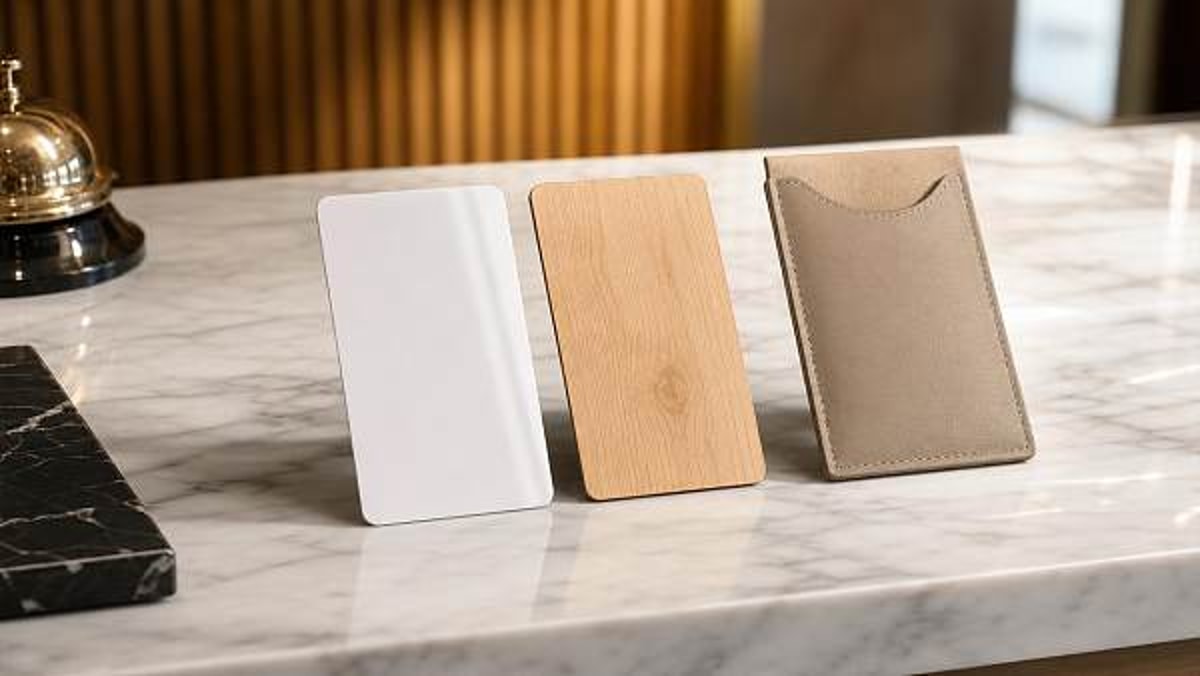
Wooden custom printed hotel key cards are attracting more interest because they immediately communicate difference. The texture, weight, and natural grain create a stronger tactile memory than standard plastic cards. For resorts, boutique hotels, wellness properties, nature-focused brands, and luxury concepts, wood can reinforce a sense of place and authenticity. It often works especially well where the brand story includes craftsmanship, local identity, or environmental positioning.
This does not mean wood is automatically the superior choice. Its value depends on context. In some properties, the guest may notice and appreciate the material upgrade. In others, the card may be treated as a functional object and lost quickly, making the investment harder to justify. Wood also requires more careful evaluation of finish durability, edge quality, printing or engraving method, and chip integration. Therefore, its rise is less about replacing PVC across the board and more about hospitality segmentation. As guest experience strategies become more differentiated, wood is becoming a more credible option in selected hotel formats.
Where each material tends to fit best
The real decision is not material alone, but total guest feel versus total operating fit
Procurement teams often frame the comparison as aesthetics versus cost, but that is too narrow. The better sourcing question is how custom printed hotel key cards perform across the full guest and operational cycle. Guest feel includes touch, visual quality, perceived cleanliness, originality, and how well the card matches the property atmosphere. Operating fit includes access technology compatibility, print consistency, replacement rate, unit economics, storage stability, and supplier responsiveness.
PVC tends to score higher on operational predictability. Wood often scores higher on distinctiveness and sensory branding. The right answer depends on where the hotel creates value. If the property competes through speed, consistency, and scale, PVC usually remains the safer choice. If it competes through atmosphere, emotional detail, and a strong sustainability narrative, wood may deliver more strategic return despite a potentially higher cost or narrower operational flexibility.
What is driving procurement teams to reassess custom printed hotel key cards now
Four drivers are shaping current buying behavior. The first is brand coherence. Hotels want every object in the room journey to support the same design language, from signage to packaging to key cards. The second is sustainability accountability. Purchasing departments are expected to ask harder questions about raw materials, certifications, waste, and disposal implications. The third is guest expectation management. Premium guests increasingly notice details that feel generic versus considered. The fourth is supplier strategy. Buyers want fewer sourcing surprises, stronger OEM or ODM capability, and better coordination between design, chip technology, and manufacturing.
In that context, custom printed hotel key cards become a useful indicator of supplier maturity. A strong supplier should not only quote PVC or wood options, but also explain print methods, finish limitations, RFID integration, sustainability claims, sampling lead times, and likely performance under daily hospitality use. That level of transparency matters more today than a simple catalog comparison.
Main drivers behind current material reassessment
Who feels the impact most across the hotel buying chain
The PVC-versus-wood decision affects more than procurement alone. Brand teams care about visual identity and emotional consistency. Operations teams care about card failures, replacement handling, and compatibility with lock systems. Sustainability officers care about the credibility of environmental messaging. Owners care about the business case and whether guests will actually perceive the upgrade. Suppliers care about whether they can maintain quality at the required scale.
That is why sourcing custom printed hotel key cards should involve a short cross-functional review rather than a price-only decision. In many hotel groups, the most effective approach is to define a standard PVC option for core properties and assess wood for premium, destination, or concept-led brands where the guest touchpoint carries more strategic influence.
How buyers should evaluate the next phase of material choice
Looking ahead, procurement teams should avoid treating material choice as a one-time design preference. The better approach is to build a decision framework. Start by asking what the key card is expected to do beyond access control. Is it mainly functional, or is it part of the property’s storytelling? Then assess lifecycle conditions: expected guest turnover, average loss rate, humidity exposure, housekeeping handling, and storage duration. Finally, test supplier credibility through samples, chip reliability, branding accuracy, and claim verification.
A useful near-term strategy is selective deployment. Instead of forcing one material across every brand, use custom printed hotel key cards in a segmented way. PVC can remain the base solution where efficiency and consistency dominate. Wood can be reserved for premium applications, VIP programs, eco-positioned properties, or openings where memorability matters more. This approach reflects a broader sourcing trend across hospitality: smarter material allocation rather than one-size-fits-all standardization.
Practical sourcing signals worth monitoring before you commit
Before selecting PVC or wood, buyers should watch a few practical signals. Ask whether the supplier has stable experience with hotel access technologies, not just decorative cards. Confirm what finish options are realistically durable in daily use. Check whether wood cards maintain consistent quality across batches, especially in color, grain, and edge finishing. For PVC, ask whether recycled-content options affect print quality or chip performance. Also review lead times for reorders, because hotel key cards are low in unit value but high in operational urgency.
Most importantly, measure success by fit, not novelty. The best custom printed hotel key cards are the ones guests notice in the right way and teams do not need to worry about afterward. In some hotels, that will still be PVC. In others, wood will create a stronger and more aligned impression.
Final judgment for commercial buyers
The market direction is clear: hotel procurement is becoming more experience-led, more sustainability-aware, and more selective about material meaning. PVC is still the operational benchmark for custom printed hotel key cards because it offers reliability, scalability, and cost discipline. Wood is gaining relevance because it supports premium differentiation, eco-oriented storytelling, and a stronger first-touch impression. Neither material is universally better. The better choice depends on brand position, guest expectations, operational realities, and sourcing maturity.
If your team wants to judge the impact on your own business, focus on five questions: what guest feeling are you trying to create, how important is sustainability signaling in your segment, what replacement rate can your operation tolerate, how standardized does your portfolio need to be, and which supplier can prove both quality and consistency? Those answers will reveal whether PVC or wood is the smarter next move for your custom printed hotel key cards strategy.
Search News
Hot Articles
- Commercial KitchenStainless steel GN pans with reinforced corners last longer in busy kitchensMay 02, 2026
- Hotel Room AmenitiesMemory foam hotel mattresses: when soft comfort leads to faster saggingMay 02, 2026
- Hotel Room AmenitiesElectronic hotel door locks: battery alerts are often less simple than they seemMay 02, 2026
Popular Tags
Need ExpertConsultation?
Connect with our specialized leisureengineering team for procurementstrategies.
Recommended News
 May 02, 2026Memory foam hotel mattresses: when soft comfort leads to faster saggingMemory foam hotel mattresses may feel luxurious at first, but can soft comfort cause faster sagging? Discover how buyers can reduce risk, improve durability, and protect hotel ROI.● Hospitality Sourcing Dir
 May 02, 2026Electronic hotel door locks: battery alerts are often less simple than they seemElectronic hotel door locks battery alerts are more complex than they appear. Learn how firmware, usage, and environment affect reliability, maintenance efficiency, and smarter sourcing.● Hospitality Sourcing Dir
 May 02, 2026Hotel housekeeping carts: the layout detail that saves minutes on every floorHotel housekeeping carts can save minutes on every floor. Discover how smarter cart layout improves workflow, reduces labor strain, and supports faster, more consistent room turnover.● Hospitality Sourcing Dir
 May 02, 2026Wholesale hotel safes: keypad reliability matters more than extra featuresWholesale hotel safes should be judged by keypad reliability first. Discover the checklist that helps buyers reduce lockouts, maintenance costs, and guest complaints.● Hospitality Sourcing Dir
 May 02, 2026Hotel lobby chandeliers: how size mistakes affect the whole arrival experienceHotel lobby chandeliers can make or break first impressions. Learn how sizing mistakes affect luxury, circulation, and brand value—and how to choose the right scale.● Hospitality Sourcing Dir
 May 02, 2026Industrial ironing machines: steam output is not the only thing to compareIndustrial ironing machines should be compared by more than steam output. Discover how temperature control, pressure stability, efficiency, and durability affect real commercial performance.● Hospitality Sourcing Dir
 May 02, 2026Blackout curtains for hotels that block light without trapping heatBlackout curtains for hotels that block light without trapping heat—discover smarter fabrics, thermal comfort benefits, and sourcing tips for better guest sleep and hotel performance.● Hospitality Sourcing Dir
 May 02, 2026Hotel luggage carts: why wheel quality matters more than frame finishHotel luggage carts perform best when wheel quality comes first. Discover how better casters reduce noise, protect floors, improve handling, and lower long-term hotel maintenance costs.● Hospitality Sourcing Dir
 May 02, 2026Custom printed hotel key cards: PVC or wood for a better guest feel?Custom printed hotel key cards: compare PVC and wood to find the best mix of guest feel, durability, sustainability, and brand impact for smarter hotel sourcing.● Hospitality Sourcing Dir
 May 02, 2026Commercial laundry equipment sizing mistakes that raise utility billsCommercial laundry equipment sizing mistakes can quietly drive up water, energy, and labor costs. Learn the biggest planning errors and how smarter sizing protects budgets and efficiency.● Hospitality Sourcing Dir
 May 02, 2026Why some wholesale bath towels for hotels wear out too fastWholesale bath towels for hotels can wear out fast due to fiber quality, GSM, weave, and laundering mismatch. Learn how to choose durable towels that cut replacement costs and protect guest experience.● Hospitality Sourcing Dir
 May 01, 2026Hotel Desks That Work for Both Business Guests and Small RoomsHotel desks for compact rooms: learn how to choose durable, space-saving, business-friendly designs that improve guest satisfaction and simplify hotel procurement.● Hospitality Sourcing Dir
 May 01, 2026Hotel Slippers in Bulk: Cheap Pairs Can Hurt Guest PerceptionHotel slippers bulk choices affect more than cost. Discover how cheap pairs can damage guest perception, comfort, and brand value—and how smarter sourcing improves reviews.● Hospitality Sourcing Dir
 May 01, 2026Hotel Room Furniture Sets That Balance Style and Replacement CostHotel room furniture sets that combine style, durability, and lower replacement cost. Discover a practical checklist for smarter sourcing, better lifecycle value, and reliable hospitality project results.● Hospitality Sourcing Dir
 May 01, 2026Hotel Bed Linens Wholesale Quality Checks Before Large OrdersHotel bed linens wholesale quality checks: learn how to verify fabric strength, shrinkage, stitching, wash durability, and supplier reliability before placing large hotel bedding orders.● Hospitality Sourcing Dir
 May 01, 2026Hotel Bathroom Amenities That Shape First Impressions FastHotel bathroom amenities shape guest first impressions fast. Discover how the right choices improve brand image, efficiency, and perceived quality from day one.● Hospitality Sourcing Dir
 Apr 30, 2026Hotel cabinets that look custom without custom lead timesHotel cabinets that look custom without long custom lead times. Learn how to balance brand style, durability, and faster installation for hotel projects.● Hospitality Sourcing Dir
 Apr 30, 2026Hotel sofas that hold shape better in high turnover roomsHotel sofas that keep their shape longer in high-turnover rooms. Learn what frame, cushion, and upholstery specs improve durability, guest appeal, and lifecycle value.● Hospitality Sourcing Dir
 Apr 30, 2026Hotel wardrobes that save space without looking budgetHotel wardrobes that save space without looking budget: discover premium, durable designs, smart specs, and sourcing tips to maximize guestroom value.● Hospitality Sourcing Dir
 Apr 30, 2026Hotel room furniture mistakes that quietly hurt guest comfortHotel room furniture mistakes can quietly damage guest comfort, reviews, and brand value. Learn how smarter layout, sizing, and material choices improve hotel room performance.● Hospitality Sourcing Dir
 Apr 30, 2026What makes hotel outdoor furniture easier to maintainHotel outdoor furniture is easier to maintain when it uses weather-resistant materials, smart construction, and replaceable parts. Learn how to cut upkeep and improve long-term value.● Hospitality Sourcing Dir
 Apr 30, 2026Hotel lobby furniture trends shifting guest first impressionsHotel lobby furniture trends are redefining first impressions with modular comfort, brand storytelling, tech integration, and durable style that elevates guest experience.● Hospitality Sourcing Dir
 Apr 30, 2026Why some hotel nightstands wear out faster than expectedHotel nightstands wear out faster when materials, edge sealing, and hardware are underspecified. Learn how to spot durable options, reduce lifecycle costs, and source smarter for hospitality projects.● Hospitality Sourcing Dir
 Apr 28, 2026Iranian Delegation at Sanya Asian Beach Games Spurs Halal-Certified Hardware DemandHalal-certified hardware demand surges after Iranian delegation’s cultural showcase at Sanya Asian Beach Games—key for GCC event tech exporters.● Hospitality Sourcing Dir