Why some wholesale bath towels for hotels wear out too fast
Many buyers assume all wholesale bath towels for hotels deliver the same durability, but rapid wear often points to deeper issues in fiber quality, GSM balance, weave construction, and laundering compatibility. For procurement teams, understanding why towels thin out, fray, or lose softness too quickly is essential to controlling replacement costs, protecting guest experience, and choosing suppliers that meet true commercial-use standards.
Why do some wholesale bath towels for hotels fail much earlier than expected?
Early towel failure is rarely caused by one issue alone. In most hotel operations, fast wear happens when product specifications are chosen for showroom appeal rather than for repeated industrial use. A towel may feel thick and soft at delivery, yet still perform poorly after dozens of high-temperature washes, bleaching cycles, tumble drying, and heavy guest turnover.
For procurement teams sourcing wholesale bath towels for hotels, the biggest hidden risk is assuming that visual similarity means equal durability. Two towels can look nearly identical on arrival while having very different cotton grades, yarn strength, edge stitching quality, and finishing treatments. Lower-grade fibers break faster, weak hems unravel earlier, and aggressive softening finishes can wash out quickly, leaving the towel rough, flat, and thin.
Another common cause is a mismatch between towel construction and the hotel’s laundry environment. A luxury resort with in-house controlled laundering may handle towels differently from a city business hotel using a high-volume commercial laundry partner. If the towel was not designed for that wash chemistry and drying intensity, its service life can drop sharply even when the initial price seemed competitive.
Which material and construction factors matter most when evaluating wholesale bath towels for hotels?
The first factor is fiber quality. Long-staple cotton generally produces stronger, smoother yarns than short-staple cotton, which helps reduce linting, pilling, and premature thinning. Ring-spun cotton is often preferred in hospitality because it can balance softness with resilience, while poorly spun yarns may lose bulk and break down faster under repeated washing.
The second factor is GSM, or grams per square meter. Many buyers chase higher GSM because it signals plushness, but more weight does not automatically mean better durability. Excessively heavy towels can become harder to dry fully, placing extra stress on laundering systems and increasing fiber fatigue. Very low GSM towels, on the other hand, may reduce upfront cost but often sacrifice absorbency, body, and lifespan. The right GSM depends on brand positioning, guest expectations, climate, and laundry setup.
The third factor is weave and pile construction. Dense, balanced loops usually hold up better than loosely constructed pile that feels fluffy only because it is over-finished. Buyers should also inspect the foundation fabric, not just the top feel. If the base structure is weak, the towel may distort, lose shape, or show bald patches after commercial use.
Finally, pay close attention to hems and borders. In many hotel towel replacement cases, the first visible damage is not the center body but edge fraying, seam opening, or border shrinkage. Strong double stitching, reinforced edges, and stable shrinkage performance are practical quality indicators that matter more than marketing language.
How can buyers tell whether softness is genuine durability or just a temporary finishing effect?
This is one of the most important questions in hotel textile procurement. Some wholesale bath towels for hotels feel exceptionally soft because of chemical finishing agents rather than because of superior yarn and construction. These treatments may improve hand feel at the sampling stage, but after several wash cycles the finish diminishes, exposing a harsher and weaker underlying fabric.
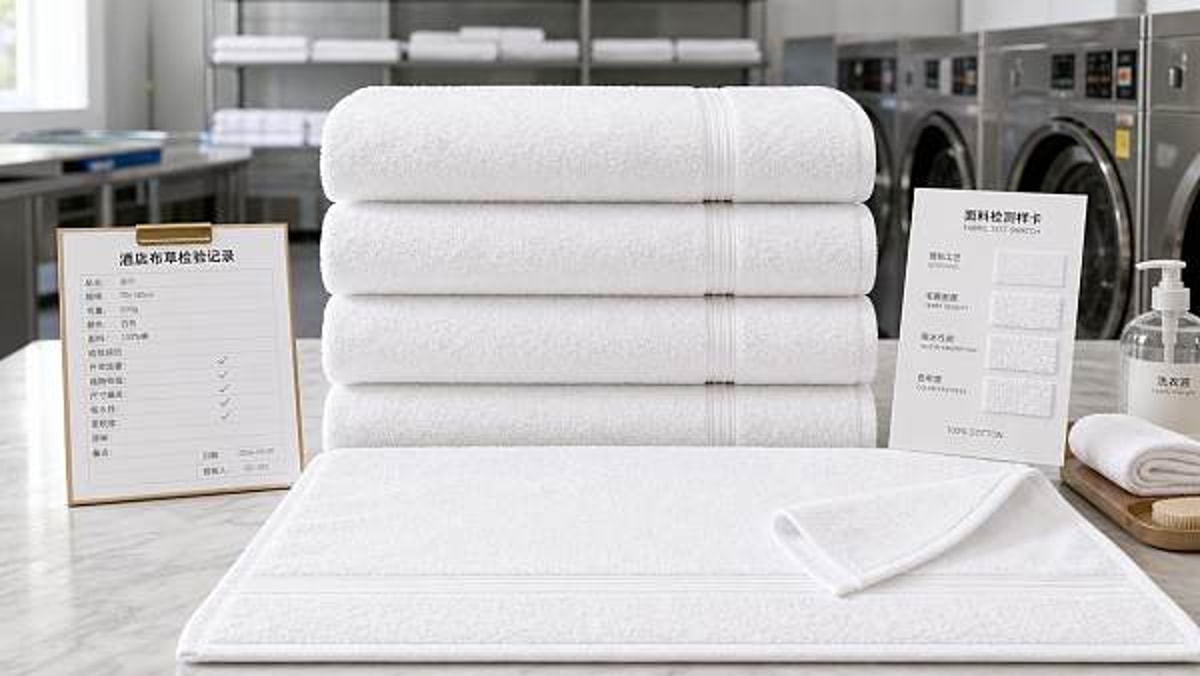
A smart buyer asks suppliers not only for a pre-wash sample, but also for a post-laundry sample tested through multiple industrial wash and dry cycles. Comparing the two reveals whether the towel retains loft, absorbency, color stability, and hand feel. If the towel looks dramatically flatter or rougher after testing, its softness was likely cosmetic rather than structural.
Absorbency is another clue. Over-finished towels may initially repel water because finishing residues interfere with performance. In contrast, well-made hotel towels should improve after proper laundering and maintain a balanced feel. Procurement professionals should also request data on shrinkage, colorfastness, seam strength, and dimensional stability. These are more reliable signs of long-term value than touch alone.
What are the most common procurement mistakes that lead to fast towel replacement?
The first mistake is buying on price alone. Low initial pricing can look attractive in a tender comparison, but if the towel needs replacement months earlier than expected, the total cost of ownership rises quickly. Frequent replenishment also creates operational disruption, inconsistent room presentation, and more quality complaints from guests.
The second mistake is relying too heavily on generic specifications. A purchase order that lists only size, color, and GSM is not enough. Two suppliers can meet those three points while delivering very different levels of cotton purity, yarn count, loop density, stitching quality, and wash durability. For wholesale bath towels for hotels, a procurement specification should be detailed enough to reduce substitution risk.
The third mistake is failing to align product choice with hotel segment. Budget hotels, upscale business hotels, resorts, serviced apartments, and wellness properties often need different towel performance profiles. A spa-focused property may prioritize plushness and absorbency, while a high-turnover airport hotel may need faster drying and stronger cycle resistance. A one-spec-fits-all approach often creates disappointment.
The fourth mistake is skipping real-use trials. Before approving a bulk order, buyers should test towels under actual operating conditions. Even a strong factory sample does not guarantee the same result in the hotel’s laundry system. Pilot testing can reveal linting issues, shrinkage, hem failure, or unacceptable texture change before a costly rollout.
What should procurement teams compare side by side before choosing a supplier?
A side-by-side comparison is far more useful than reviewing quotations in isolation. The table below highlights the most practical checks for buyers sourcing wholesale bath towels for hotels.
How do laundering practices affect the lifespan of wholesale bath towels for hotels?
Even excellent towels can wear out too fast under poor laundering control. Excessive bleach concentration, harsh alkali levels, overloaded machines, and over-drying all accelerate fiber damage. Towels become brittle, lose absorbency, and develop frayed edges sooner than expected. In many cases, the supplier gets blamed for a problem that is partly operational.
That said, commercial-grade towels should be selected with realistic laundering conditions in mind. Buyers should explain whether the property uses tunnel washers, high-temperature disinfection, outsourced industrial laundries, or on-premise washing. A responsible supplier can then recommend a construction more suited to the actual environment rather than offering a generic hotel towel line.
It is also useful to review towel loss through data, not assumptions. If replacement rates spike in one property but not another, the issue may lie in laundry handling, chemical dosing, sorting practices, or drying time. Procurement and operations teams should work together, because linen durability is a cross-functional performance issue, not just a purchasing decision.
Are expensive towels always the better choice for hotels?
Not always. High-priced towels may deliver better fibers, stronger construction, and a more premium guest experience, but only if the specification matches the property’s service model. An ultra-plush towel in a fast-turnover environment may create drying bottlenecks, higher energy consumption, and slower room readiness. In that context, a slightly lighter but more stable product may create better long-term value.
The real goal is not to buy the cheapest or the most luxurious option. It is to buy the most appropriate option. For wholesale bath towels for hotels, value comes from the balance of guest comfort, durability, wash efficiency, replenishment rate, and brand positioning. A towel that lasts 30% longer with consistent presentation may be a better commercial decision than one that simply feels better on day one.
What questions should buyers ask before placing a bulk order?
Before confirming a supplier, procurement teams should ask practical, decision-oriented questions: What cotton grade is used? What is the tolerance on size and GSM? Has the towel been tested under hospitality laundering conditions? How much shrinkage occurs after repeated washes? What stitching method is used at the hems? Can the supplier provide consistent production across future batches? Is there a trial order option before full rollout?
It is equally important to clarify commercial terms that affect risk. Ask about quality claims procedures, replacement commitments, production lead times, private labeling or embroidery options, and documentation for material and compliance standards. For group buyers managing multiple locations, confirm whether the supplier can support standardized specifications across regions without compromising consistency.
For organizations working through sourcing platforms or intelligence-led trade partners such as GCT, these discussions should go beyond catalog browsing. The strongest procurement decisions combine verified supplier capability, technical textile understanding, and fit-for-use evaluation. That approach reduces the chance of buying towels that look right on paper but wear out too fast in service.
What is the clearest takeaway for hotel procurement teams?
When wholesale bath towels for hotels wear out too fast, the problem usually starts long before the first guest uses them. It begins with incomplete specifications, weak supplier validation, unrealistic softness expectations, or poor alignment between towel construction and laundering conditions. Buyers who focus only on upfront cost often end up paying more through faster replacement, higher complaint risk, and lower brand consistency.
A stronger buying process focuses on lifecycle performance. That means checking fiber quality, construction details, laundering compatibility, hem durability, and post-wash results before scaling an order. It also means comparing suppliers on consistency, accountability, and commercial support, not just on price per piece.
If you need to move from general evaluation to a real sourcing decision, the first priorities to discuss are your target hotel segment, expected wash frequency, preferred GSM range, guest experience requirements, replacement cycle goals, testing standards, and order continuity needs. Those questions will lead to a more accurate specification, a better supplier match, and wholesale bath towels for hotels that hold up under real commercial pressure.
Search News
Hot Articles
- Commercial KitchenStainless steel GN pans with reinforced corners last longer in busy kitchensMay 02, 2026
- Hotel Room AmenitiesMemory foam hotel mattresses: when soft comfort leads to faster saggingMay 02, 2026
- Hotel Room AmenitiesElectronic hotel door locks: battery alerts are often less simple than they seemMay 02, 2026
Popular Tags
Need ExpertConsultation?
Connect with our specialized leisureengineering team for procurementstrategies.
Recommended News
 May 02, 2026Memory foam hotel mattresses: when soft comfort leads to faster saggingMemory foam hotel mattresses may feel luxurious at first, but can soft comfort cause faster sagging? Discover how buyers can reduce risk, improve durability, and protect hotel ROI.● Hospitality Sourcing Dir
 May 02, 2026Electronic hotel door locks: battery alerts are often less simple than they seemElectronic hotel door locks battery alerts are more complex than they appear. Learn how firmware, usage, and environment affect reliability, maintenance efficiency, and smarter sourcing.● Hospitality Sourcing Dir
 May 02, 2026Hotel housekeeping carts: the layout detail that saves minutes on every floorHotel housekeeping carts can save minutes on every floor. Discover how smarter cart layout improves workflow, reduces labor strain, and supports faster, more consistent room turnover.● Hospitality Sourcing Dir
 May 02, 2026Wholesale hotel safes: keypad reliability matters more than extra featuresWholesale hotel safes should be judged by keypad reliability first. Discover the checklist that helps buyers reduce lockouts, maintenance costs, and guest complaints.● Hospitality Sourcing Dir
 May 02, 2026Hotel lobby chandeliers: how size mistakes affect the whole arrival experienceHotel lobby chandeliers can make or break first impressions. Learn how sizing mistakes affect luxury, circulation, and brand value—and how to choose the right scale.● Hospitality Sourcing Dir
 May 02, 2026Industrial ironing machines: steam output is not the only thing to compareIndustrial ironing machines should be compared by more than steam output. Discover how temperature control, pressure stability, efficiency, and durability affect real commercial performance.● Hospitality Sourcing Dir
 May 02, 2026Blackout curtains for hotels that block light without trapping heatBlackout curtains for hotels that block light without trapping heat—discover smarter fabrics, thermal comfort benefits, and sourcing tips for better guest sleep and hotel performance.● Hospitality Sourcing Dir
 May 02, 2026Hotel luggage carts: why wheel quality matters more than frame finishHotel luggage carts perform best when wheel quality comes first. Discover how better casters reduce noise, protect floors, improve handling, and lower long-term hotel maintenance costs.● Hospitality Sourcing Dir
 May 02, 2026Custom printed hotel key cards: PVC or wood for a better guest feel?Custom printed hotel key cards: compare PVC and wood to find the best mix of guest feel, durability, sustainability, and brand impact for smarter hotel sourcing.● Hospitality Sourcing Dir
 May 02, 2026Commercial laundry equipment sizing mistakes that raise utility billsCommercial laundry equipment sizing mistakes can quietly drive up water, energy, and labor costs. Learn the biggest planning errors and how smarter sizing protects budgets and efficiency.● Hospitality Sourcing Dir
 May 02, 2026Why some wholesale bath towels for hotels wear out too fastWholesale bath towels for hotels can wear out fast due to fiber quality, GSM, weave, and laundering mismatch. Learn how to choose durable towels that cut replacement costs and protect guest experience.● Hospitality Sourcing Dir
 May 01, 2026Hotel Desks That Work for Both Business Guests and Small RoomsHotel desks for compact rooms: learn how to choose durable, space-saving, business-friendly designs that improve guest satisfaction and simplify hotel procurement.● Hospitality Sourcing Dir
 May 01, 2026Hotel Slippers in Bulk: Cheap Pairs Can Hurt Guest PerceptionHotel slippers bulk choices affect more than cost. Discover how cheap pairs can damage guest perception, comfort, and brand value—and how smarter sourcing improves reviews.● Hospitality Sourcing Dir
 May 01, 2026Hotel Room Furniture Sets That Balance Style and Replacement CostHotel room furniture sets that combine style, durability, and lower replacement cost. Discover a practical checklist for smarter sourcing, better lifecycle value, and reliable hospitality project results.● Hospitality Sourcing Dir
 May 01, 2026Hotel Bed Linens Wholesale Quality Checks Before Large OrdersHotel bed linens wholesale quality checks: learn how to verify fabric strength, shrinkage, stitching, wash durability, and supplier reliability before placing large hotel bedding orders.● Hospitality Sourcing Dir
 May 01, 2026Hotel Bathroom Amenities That Shape First Impressions FastHotel bathroom amenities shape guest first impressions fast. Discover how the right choices improve brand image, efficiency, and perceived quality from day one.● Hospitality Sourcing Dir
 Apr 30, 2026Hotel cabinets that look custom without custom lead timesHotel cabinets that look custom without long custom lead times. Learn how to balance brand style, durability, and faster installation for hotel projects.● Hospitality Sourcing Dir
 Apr 30, 2026Hotel sofas that hold shape better in high turnover roomsHotel sofas that keep their shape longer in high-turnover rooms. Learn what frame, cushion, and upholstery specs improve durability, guest appeal, and lifecycle value.● Hospitality Sourcing Dir
 Apr 30, 2026Hotel wardrobes that save space without looking budgetHotel wardrobes that save space without looking budget: discover premium, durable designs, smart specs, and sourcing tips to maximize guestroom value.● Hospitality Sourcing Dir
 Apr 30, 2026Hotel room furniture mistakes that quietly hurt guest comfortHotel room furniture mistakes can quietly damage guest comfort, reviews, and brand value. Learn how smarter layout, sizing, and material choices improve hotel room performance.● Hospitality Sourcing Dir
 Apr 30, 2026What makes hotel outdoor furniture easier to maintainHotel outdoor furniture is easier to maintain when it uses weather-resistant materials, smart construction, and replaceable parts. Learn how to cut upkeep and improve long-term value.● Hospitality Sourcing Dir
 Apr 30, 2026Hotel lobby furniture trends shifting guest first impressionsHotel lobby furniture trends are redefining first impressions with modular comfort, brand storytelling, tech integration, and durable style that elevates guest experience.● Hospitality Sourcing Dir
 Apr 30, 2026Why some hotel nightstands wear out faster than expectedHotel nightstands wear out faster when materials, edge sealing, and hardware are underspecified. Learn how to spot durable options, reduce lifecycle costs, and source smarter for hospitality projects.● Hospitality Sourcing Dir
 Apr 28, 2026Iranian Delegation at Sanya Asian Beach Games Spurs Halal-Certified Hardware DemandHalal-certified hardware demand surges after Iranian delegation’s cultural showcase at Sanya Asian Beach Games—key for GCC event tech exporters.● Hospitality Sourcing Dir