Electronic hotel door locks: battery alerts are often less simple than they seem
For technical evaluators, electronic hotel door locks often appear straightforward—until battery alerts trigger false assumptions, service inefficiencies, or unexpected guestroom access issues. In reality, low-battery warnings can reflect firmware logic, lock usage patterns, environmental factors, and maintenance workflows rather than a simple countdown to failure. Understanding these variables is essential for making accurate product assessments and smarter sourcing decisions.
For most buyers and evaluators, the key question is not whether electronic hotel door locks have battery alerts, but whether those alerts are reliable enough to support operations at scale. A warning that appears too early can create unnecessary labor and battery waste. A warning that appears too late can create guest disruption, emergency openings, and avoidable service calls.
This is why battery behavior deserves deeper scrutiny during product assessment. In hotel environments, the battery alert is part of a larger system involving lock hardware, power management, credential-reading cycles, door-closing behavior, audit trails, wireless features, and maintenance processes. Evaluating only the headline battery life claim often leads to poor comparisons between products that perform very differently in real buildings.
Why battery alerts in electronic hotel door locks are not a simple “time remaining” indicator
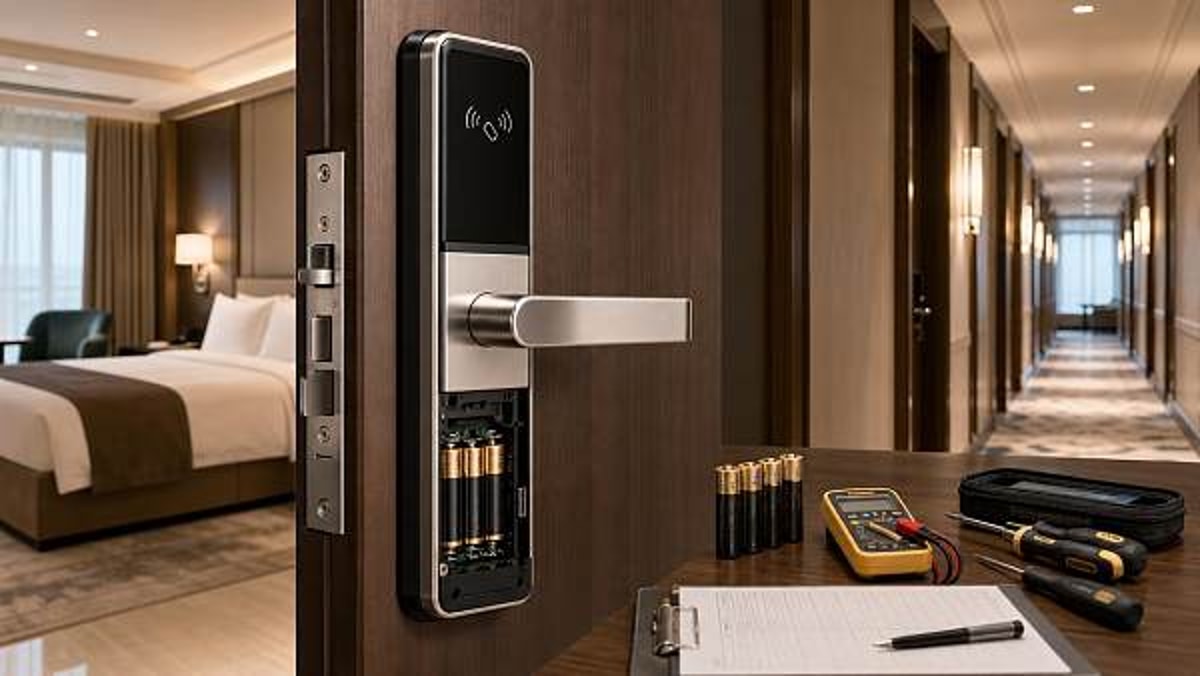
Many technical evaluators initially assume that a low-battery alert works like a fuel gauge. In practice, most electronic hotel door locks do not calculate remaining life in a linear, highly precise way. Instead, they use voltage thresholds, load-response behavior, internal algorithms, and event-based logic to decide when to display a warning or send a system alert.
That distinction matters. Battery voltage can recover when a lock is idle and drop sharply during a high-load event such as motor actuation, credential validation, LED signaling, or wireless communication. As a result, the same lock may appear healthy during a static check and weak during real use. This is one reason battery alerts can seem inconsistent from the perspective of operators.
Technical evaluators should therefore avoid asking only, “How many months does the battery last?” A more useful question is, “Under what conditions does the lock trigger an alert, how much service window remains after that alert, and how consistent is that behavior across varying room usage patterns?”
What technical evaluators are actually trying to determine
When evaluating electronic hotel door locks, technical teams usually care about four practical outcomes. First, they want to know whether the alert logic protects guest access with an adequate safety margin. Second, they need to estimate maintenance burden across hundreds or thousands of doors. Third, they want to understand whether the lock’s power design is robust across climate and usage variability. Fourth, they need to compare products in a fair, repeatable way.
These concerns go beyond hardware specification sheets. A lock can advertise long nominal battery life yet still generate operational friction if warnings are difficult to interpret, inconsistent across firmware versions, or poorly integrated into the property’s maintenance workflow. On the other hand, a lock with conservative alerts may look less impressive on paper but prove easier to manage in live hotel operations.
The best sourcing decisions come from evaluating battery alerts as part of risk management. The real issue is not maximum battery duration in laboratory conditions. It is how predictably the lock behaves in occupied rooms, during high season, in low-temperature corridors, or under housekeeping and guest traffic patterns that differ from vendor test assumptions.
What causes low-battery alerts to behave differently in real hotel environments
Usage intensity is one of the biggest variables. A room near the elevator, lobby, or service area may experience significantly more entries than a room in a quieter wing. If the lock powers card reading, encryption, indicator lights, and a clutch or motor mechanism on each interaction, battery drain will not be evenly distributed across the property.
Door condition also matters. Misalignment, latch friction, improper installation, or heavy handle resistance can increase the energy needed for each successful opening event. In this scenario, the battery alert is not only reflecting battery chemistry. It may also be signaling mechanical inefficiency that accelerates power consumption.
Environmental conditions are another major factor. Low temperatures can reduce effective battery performance, while humidity and condensation may affect contacts or electronics over time. Coastal properties, resorts with open-air corridors, mountain hotels, and high-humidity spa facilities often see different battery behavior than climate-controlled urban properties.
Battery quality and replacement practices create further variation. Mixed battery brands, old stock, counterfeit cells, partially used batteries, or inconsistent replacement dates can distort field performance. Even if the lock itself is well designed, poor battery management at the property level can produce erratic alert timing and misleading maintenance data.
Wireless functions may also change the power profile. Electronic hotel door locks with Bluetooth, Zigbee, gateway connections, mobile credential support, or remote audit uploads can consume energy differently from offline RFID-only models. Evaluators should identify whether battery-life claims are based on offline operation or on actual deployed feature sets.
Why early battery alerts are not always a design flaw
One common mistake is to interpret every early warning as poor battery accuracy. In many cases, manufacturers intentionally build in conservative thresholds to preserve a large service window. This helps ensure that a guest can still enter the room many times after the first warning appears, even if staff do not replace batteries immediately.
From an engineering standpoint, this can be a rational design choice. Hotels do not replace batteries the instant an alert appears. There may be delays due to staffing levels, room occupancy, system synchronization, or maintenance scheduling. A lock that warns early may reduce the chance of a no-entry incident, which is often far more costly than replacing batteries before they are fully exhausted.
For technical evaluators, the right question is whether the early alert creates manageable inefficiency or meaningful waste. If a lock consistently triggers warnings when a substantial but operationally sensible reserve remains, that may be acceptable. If it triggers so early that properties replace batteries with large unused capacity, the maintenance model may need closer scrutiny.
Why late battery alerts are often the bigger operational risk
Late warnings can look attractive during product demonstrations because they imply excellent battery utilization. But from a hotel operations perspective, late alerts can be dangerous. If the usable margin after a warning is too small, guest inconvenience and emergency maintenance become more likely.
This risk becomes more serious in geographically dispersed properties, resorts with large room inventories, or hotels where engineering teams do not continuously patrol guest floors. A lock that provides a warning but leaves only a short intervention window may perform adequately in a small test setting while failing operationally in a large commercial deployment.
Technical evaluators should ask vendors for data on post-alert opening cycles, not just total battery life. The number of successful credential reads and door openings after a low-battery trigger is often more meaningful than a vague promise of “months remaining.” That reserve capacity determines whether an alert supports smooth maintenance planning or only serves as a last-minute failure notice.
How firmware logic shapes the meaning of a battery alert
In modern electronic hotel door locks, battery alerts are increasingly software-mediated. Firmware may filter voltage readings, average multiple events, compensate for transient drops, or trigger alerts only after repeated low-voltage observations. This means two locks using the same batteries can behave differently depending on firmware design.
Firmware also affects how alerts are presented. Some locks display warnings locally with LEDs or sounds. Others write status into audit logs or report it to a management platform. Some systems classify multiple battery states, such as low, critical, and replace immediately. Others use a simpler single-threshold approach. The operational value of the alert depends heavily on this reporting architecture.
For sourcing teams, firmware maturity should be evaluated alongside hardware quality. Ask whether battery-management logic has changed across software versions, whether thresholds are field-adjustable, and how updates are controlled. A lock platform with stable and well-documented firmware behavior is easier to validate than one with unclear alert logic that changes between production batches or software revisions.
Questions technical evaluators should ask suppliers before comparing products
A strong evaluation process usually begins with precise supplier questions. Start with battery chemistry and standard cell type. Then ask how battery life was tested: credential type, openings per day, temperature, wireless mode, latch resistance assumptions, and whether standby and active consumption were separated.
Next, ask exactly how low-battery alerts are triggered. Is the alert based on open-circuit voltage, loaded voltage, repeated low readings, or predictive estimation? How many openings remain after the first alert? What happens if the room remains occupied and no battery replacement occurs for several days? Can staff still access audit trails, and do emergency access procedures change under low-power conditions?
Also ask about fleet visibility. Can the property management or lock management software show battery status by room, floor, or building? Are alerts real-time, periodic, or only captured when a card is presented or a handheld device is used? If the system is offline, what is the process for identifying low-battery locks before guest complaints appear?
Finally, ask for field references. Lab claims are useful, but large-hotel deployment data is more valuable. Request examples from properties with similar corridor conditions, occupancy patterns, and maintenance structures. The best suppliers can explain not only nominal battery life, but also how their electronic hotel door locks behave under real operational stress.
How to test battery alert performance in a meaningful way
Bench testing alone is not enough. Technical evaluators should design a protocol that combines mechanical, electrical, and operational variables. At minimum, the test should include repeated entry cycles, varying dwell times, different temperatures if relevant, and multiple battery brands or batches that meet the recommended specification.
It is also important to test borderline conditions. Introduce slight door misalignment, simulate high-traffic rooms, and evaluate performance after periods of inactivity followed by bursts of use. If wireless functionality is part of the deployment plan, test with those features fully enabled rather than relying on offline assumptions.
Document not only when the first alert occurs, but how stable the alert behavior remains afterward. Does the lock continue to function normally for a predictable number of cycles? Do warnings appear intermittently and then disappear? Does battery status reported through software match what maintenance staff see at the door? These are the observations that reveal operational quality.
A meaningful evaluation should also include serviceability. How long does it take trained staff to replace batteries? Is the compartment secure but easy to access? Can battery replacement be done without reprogramming or risking data loss? A sound battery alert system loses value if the replacement process itself is slow or error-prone.
The maintenance workflow question most buyers underestimate
Even a well-designed alert can fail at the property level if maintenance workflows are weak. Hotels need a clear response policy: who receives the alert, how quickly it is logged, whether replacement is done by room status priority, and how battery changes are recorded. Without this discipline, teams may wrongly blame the lock when the real issue is process inconsistency.
For this reason, technical evaluators should assess software integration and reporting usability, not just lock electronics. A battery warning is only useful if it turns into timely action. Dashboards, exception reports, mobile maintenance notifications, and historical battery trend records can be as important as the lock’s electrical threshold design.
Properties with preventive maintenance programs often benefit from grouping replacements by zone or service window rather than reacting room by room. But this only works if alert timing is sufficiently predictable. During evaluation, consider whether the lock’s battery behavior supports the maintenance model your hotel portfolio actually uses.
How to interpret vendor battery-life claims without being misled
Battery-life claims are often presented in idealized terms. A statement such as “up to 18 months” may be technically true under controlled assumptions, but still have limited procurement value if the assumptions are not disclosed. Evaluators should normalize claims by openings per day, battery type, room temperature, wireless activity, and alert reserve window.
It is also helpful to separate three metrics that vendors sometimes blur together: total battery depletion time, time to first alert, and number of safe openings after alert. These are not interchangeable. Two products may advertise similar total life while offering very different maintenance burden and guest-access risk profiles.
In comparative sourcing, transparency often matters more than the highest number. A supplier that clearly defines conditions, post-alert reserve, and operational limitations is usually easier to trust than one promoting long battery life without explaining alert logic. For commercial projects, predictable behavior usually has more value than optimistic headline claims.
What this means for sourcing electronic hotel door locks at scale
For portfolio buyers, the goal is to select electronic hotel door locks that balance guest security, maintenance efficiency, and predictable lifecycle cost. Battery alerts are not a minor feature; they are an operational control point. Weak alert design can increase labor, cause room outages, and distort total cost of ownership even if the initial unit price looks attractive.
At scale, small differences become significant. A lock that triggers unnecessary warnings across 1,000 rooms can generate large cumulative labor cost. A lock that provides inadequate warning on even a small percentage of doors can damage guest satisfaction and front-desk efficiency. Technical evaluation should therefore connect battery alert behavior to service economics, not just product specification.
The most resilient sourcing decisions usually favor platforms with transparent test methods, stable firmware, documented reserve capacity, strong reporting tools, and referenceable field performance. In other words, buyers should evaluate the battery alert as part of the lock ecosystem, not as an isolated indicator light.
Conclusion: judge battery alerts by operational reliability, not simplicity
Battery alerts in electronic hotel door locks are often less simple than they seem because they reflect the interaction of power electronics, firmware logic, door mechanics, environmental conditions, and maintenance behavior. For technical evaluators, this means a low-battery warning should never be treated as a basic countdown display.
A better evaluation approach asks three practical questions: When does the alert appear under realistic conditions? How much reliable operating margin remains afterward? And how easily can the hotel act on that information? The answers to those questions reveal much more about product quality than nominal battery-life marketing alone.
When assessed correctly, battery alert behavior becomes a powerful indicator of overall lock platform maturity. For commercial hospitality sourcing, that insight supports smarter product comparisons, lower operational risk, and better long-term performance across the guestroom estate.
Search News
Hot Articles
- Commercial KitchenStainless steel GN pans with reinforced corners last longer in busy kitchensMay 02, 2026
- Hotel Room AmenitiesMemory foam hotel mattresses: when soft comfort leads to faster saggingMay 02, 2026
- Hotel Room AmenitiesElectronic hotel door locks: battery alerts are often less simple than they seemMay 02, 2026
Popular Tags
Need ExpertConsultation?
Connect with our specialized leisureengineering team for procurementstrategies.
Recommended News
 May 02, 2026Memory foam hotel mattresses: when soft comfort leads to faster saggingMemory foam hotel mattresses may feel luxurious at first, but can soft comfort cause faster sagging? Discover how buyers can reduce risk, improve durability, and protect hotel ROI.● Hospitality Sourcing Dir
 May 02, 2026Electronic hotel door locks: battery alerts are often less simple than they seemElectronic hotel door locks battery alerts are more complex than they appear. Learn how firmware, usage, and environment affect reliability, maintenance efficiency, and smarter sourcing.● Hospitality Sourcing Dir
 May 02, 2026Hotel housekeeping carts: the layout detail that saves minutes on every floorHotel housekeeping carts can save minutes on every floor. Discover how smarter cart layout improves workflow, reduces labor strain, and supports faster, more consistent room turnover.● Hospitality Sourcing Dir
 May 02, 2026Wholesale hotel safes: keypad reliability matters more than extra featuresWholesale hotel safes should be judged by keypad reliability first. Discover the checklist that helps buyers reduce lockouts, maintenance costs, and guest complaints.● Hospitality Sourcing Dir
 May 02, 2026Hotel lobby chandeliers: how size mistakes affect the whole arrival experienceHotel lobby chandeliers can make or break first impressions. Learn how sizing mistakes affect luxury, circulation, and brand value—and how to choose the right scale.● Hospitality Sourcing Dir
 May 02, 2026Industrial ironing machines: steam output is not the only thing to compareIndustrial ironing machines should be compared by more than steam output. Discover how temperature control, pressure stability, efficiency, and durability affect real commercial performance.● Hospitality Sourcing Dir
 May 02, 2026Blackout curtains for hotels that block light without trapping heatBlackout curtains for hotels that block light without trapping heat—discover smarter fabrics, thermal comfort benefits, and sourcing tips for better guest sleep and hotel performance.● Hospitality Sourcing Dir
 May 02, 2026Hotel luggage carts: why wheel quality matters more than frame finishHotel luggage carts perform best when wheel quality comes first. Discover how better casters reduce noise, protect floors, improve handling, and lower long-term hotel maintenance costs.● Hospitality Sourcing Dir
 May 02, 2026Custom printed hotel key cards: PVC or wood for a better guest feel?Custom printed hotel key cards: compare PVC and wood to find the best mix of guest feel, durability, sustainability, and brand impact for smarter hotel sourcing.● Hospitality Sourcing Dir
 May 02, 2026Commercial laundry equipment sizing mistakes that raise utility billsCommercial laundry equipment sizing mistakes can quietly drive up water, energy, and labor costs. Learn the biggest planning errors and how smarter sizing protects budgets and efficiency.● Hospitality Sourcing Dir
 May 02, 2026Why some wholesale bath towels for hotels wear out too fastWholesale bath towels for hotels can wear out fast due to fiber quality, GSM, weave, and laundering mismatch. Learn how to choose durable towels that cut replacement costs and protect guest experience.● Hospitality Sourcing Dir
 May 01, 2026Hotel Desks That Work for Both Business Guests and Small RoomsHotel desks for compact rooms: learn how to choose durable, space-saving, business-friendly designs that improve guest satisfaction and simplify hotel procurement.● Hospitality Sourcing Dir
 May 01, 2026Hotel Slippers in Bulk: Cheap Pairs Can Hurt Guest PerceptionHotel slippers bulk choices affect more than cost. Discover how cheap pairs can damage guest perception, comfort, and brand value—and how smarter sourcing improves reviews.● Hospitality Sourcing Dir
 May 01, 2026Hotel Room Furniture Sets That Balance Style and Replacement CostHotel room furniture sets that combine style, durability, and lower replacement cost. Discover a practical checklist for smarter sourcing, better lifecycle value, and reliable hospitality project results.● Hospitality Sourcing Dir
 May 01, 2026Hotel Bed Linens Wholesale Quality Checks Before Large OrdersHotel bed linens wholesale quality checks: learn how to verify fabric strength, shrinkage, stitching, wash durability, and supplier reliability before placing large hotel bedding orders.● Hospitality Sourcing Dir
 May 01, 2026Hotel Bathroom Amenities That Shape First Impressions FastHotel bathroom amenities shape guest first impressions fast. Discover how the right choices improve brand image, efficiency, and perceived quality from day one.● Hospitality Sourcing Dir
 Apr 30, 2026Hotel cabinets that look custom without custom lead timesHotel cabinets that look custom without long custom lead times. Learn how to balance brand style, durability, and faster installation for hotel projects.● Hospitality Sourcing Dir
 Apr 30, 2026Hotel sofas that hold shape better in high turnover roomsHotel sofas that keep their shape longer in high-turnover rooms. Learn what frame, cushion, and upholstery specs improve durability, guest appeal, and lifecycle value.● Hospitality Sourcing Dir
 Apr 30, 2026Hotel wardrobes that save space without looking budgetHotel wardrobes that save space without looking budget: discover premium, durable designs, smart specs, and sourcing tips to maximize guestroom value.● Hospitality Sourcing Dir
 Apr 30, 2026Hotel room furniture mistakes that quietly hurt guest comfortHotel room furniture mistakes can quietly damage guest comfort, reviews, and brand value. Learn how smarter layout, sizing, and material choices improve hotel room performance.● Hospitality Sourcing Dir
 Apr 30, 2026What makes hotel outdoor furniture easier to maintainHotel outdoor furniture is easier to maintain when it uses weather-resistant materials, smart construction, and replaceable parts. Learn how to cut upkeep and improve long-term value.● Hospitality Sourcing Dir
 Apr 30, 2026Hotel lobby furniture trends shifting guest first impressionsHotel lobby furniture trends are redefining first impressions with modular comfort, brand storytelling, tech integration, and durable style that elevates guest experience.● Hospitality Sourcing Dir
 Apr 30, 2026Why some hotel nightstands wear out faster than expectedHotel nightstands wear out faster when materials, edge sealing, and hardware are underspecified. Learn how to spot durable options, reduce lifecycle costs, and source smarter for hospitality projects.● Hospitality Sourcing Dir
 Apr 28, 2026Iranian Delegation at Sanya Asian Beach Games Spurs Halal-Certified Hardware DemandHalal-certified hardware demand surges after Iranian delegation’s cultural showcase at Sanya Asian Beach Games—key for GCC event tech exporters.● Hospitality Sourcing Dir