Hotel Desks That Work for Both Business Guests and Small Rooms
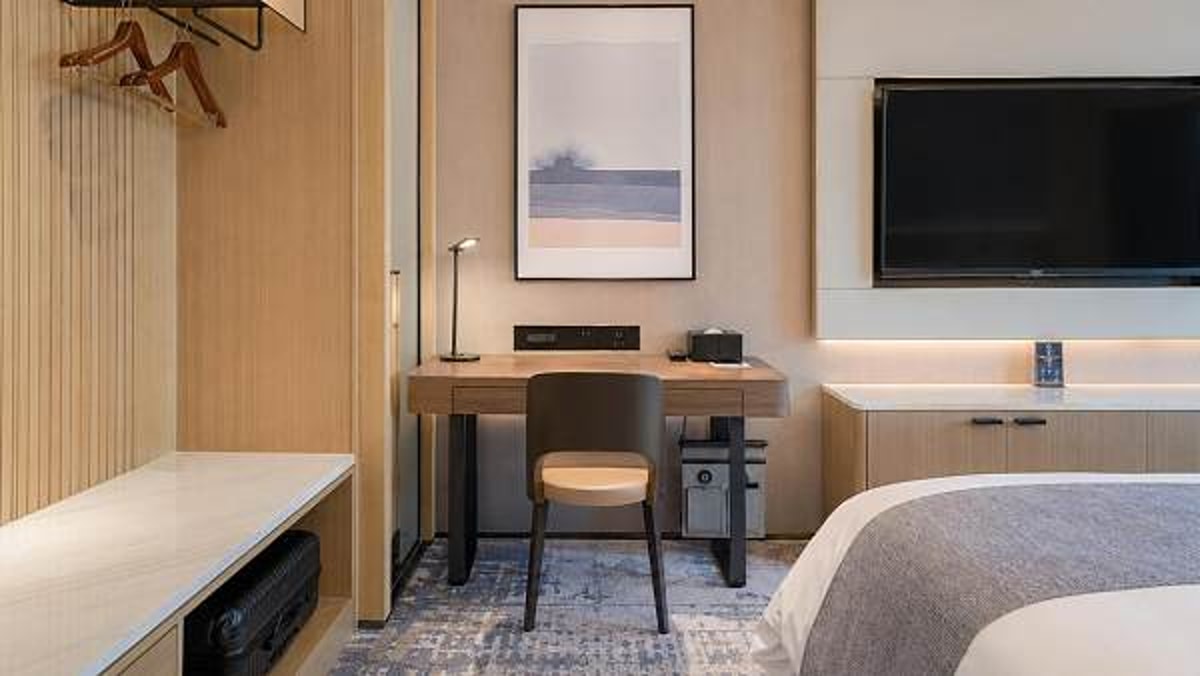
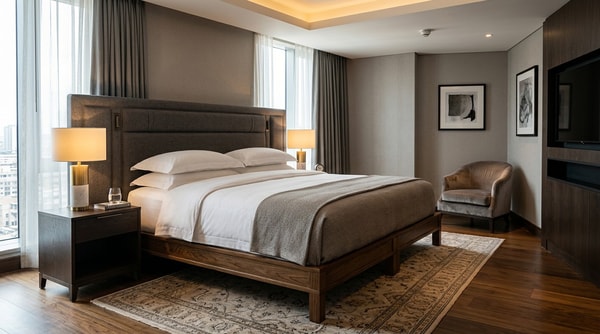
For procurement teams balancing guest comfort, room efficiency, and brand standards, choosing the right hotel desks is more strategic than it seems. The best solutions must support business travelers, fit compact room layouts, and align with durability, design, and budget goals. This guide explores how to source hotel desks that deliver both functionality and space-smart value for modern hospitality projects.
Why hotel desks matter more in compact guest room planning
In many hotel projects, the desk is treated as a secondary casegoods item. Procurement teams often prioritize beds, wardrobes, bathroom fixtures, and lighting first. Yet hotel desks strongly influence how guests perceive room usability, especially in properties serving corporate travelers, mixed-use tourism, and longer stays.
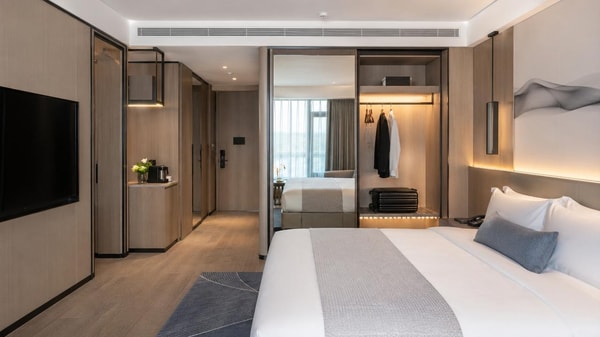
A poorly selected desk can create several operational problems at once: blocked circulation, limited luggage placement, awkward chair clearance, damaged finishes, and low guest satisfaction for in-room work. In small rooms, every centimeter matters. The desk must function as a work surface without making the room feel cramped.
For buyers managing multi-property rollouts, hotel desks also affect consistency, replacement costs, installation efficiency, and supplier coordination. This is where a sourcing-led approach becomes more valuable than a purely design-led decision.
- Business guests expect practical workspace, charging access, and seating comfort.
- Small room formats require compact footprints, clean edges, and efficient wall integration.
- Hotel operations need finishes that resist scratches, moisture, cleaning chemicals, and frequent use.
- Procurement teams need standardization options without sacrificing brand identity.
What should procurement teams evaluate first when sourcing hotel desks?
The most effective way to evaluate hotel desks is to begin with room type, guest profile, and operating model. A desk that works in an upscale business hotel may be unsuitable for a compact city property, resort villa, or hybrid hospitality concept. Procurement decisions improve when teams define usage priorities before comparing materials or quotations.
Core decision criteria
- Desk depth and width relative to room circulation, bedside spacing, and luggage zones.
- Integrated functions such as power access, cable management, vanity use, or minibar adjacency.
- Material durability, edge protection, and maintenance demands under housekeeping routines.
- Manufacturing repeatability for phased projects, refurbishments, and replacement matching.
- Compliance considerations, including fire performance expectations and general furniture safety.
The table below helps procurement teams compare common hotel desks by room condition rather than by appearance alone. This approach is especially useful for sourcing across different hotel categories or regional project pipelines.
This comparison shows that the right hotel desks are usually the result of layout discipline and operational foresight, not only style selection. Buyers who define room-use priorities early can reduce costly redesigns and post-installation complaints.
Which desk dimensions and features work best for business guests?
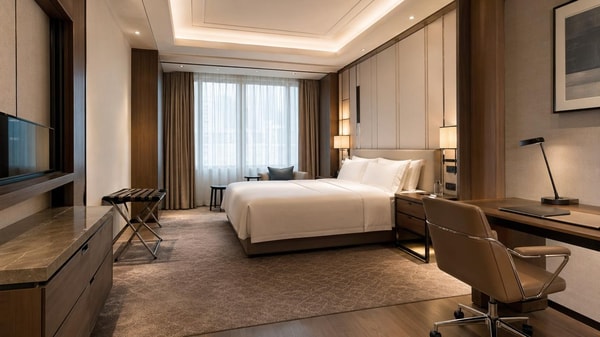
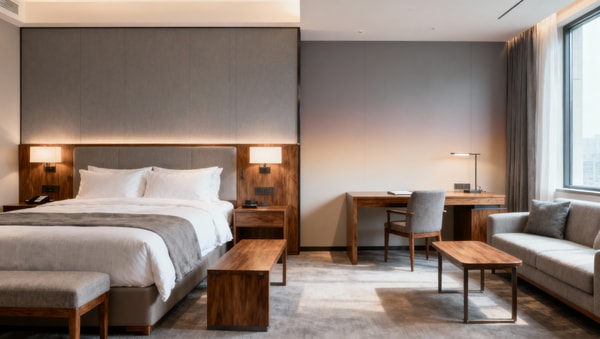
Business travelers do not always need a large executive-style workstation, but they do need a practical and comfortable setup. For hotel desks in small rooms, the goal is to provide enough surface area for a laptop, phone, notebook, and beverage without crowding adjacent furniture.
Practical dimensional guidelines
Specifications vary by brand positioning and room layout, but many procurement teams use a practical range: moderate width, controlled depth, and adequate knee clearance. Excessive depth often harms circulation more than it improves usability. Slimmer desks can perform well when combined with efficient cable access and a comfortable task chair.
This parameter guide for hotel desks can support RFQ discussions with suppliers, designers, and project managers during early space planning and mock-up review.
The key takeaway is that compact hotel desks should not be undersized to the point of token functionality. A desk that appears efficient on a plan but cannot support actual guest use often creates negative feedback that outweighs minor space savings.
How to balance durability, aesthetics, and total cost
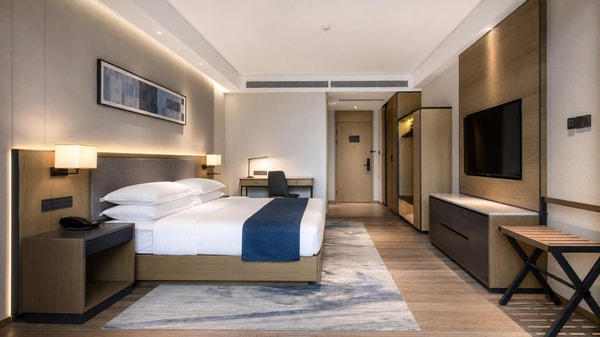
Procurement teams rarely buy hotel desks as isolated products. They source part of a broader guest room package that includes wardrobes, headboards, TV panels, luggage benches, and seating. That means finish alignment, material consistency, and lifecycle cost matter as much as unit price.
Material choices and trade-offs
- High-pressure laminate surfaces are often selected for durability, scratch resistance, and maintenance ease in busy properties.
- Wood veneer delivers a premium appearance but may require closer control over impact resistance, moisture exposure, and finish matching.
- Powder-coated metal frames can improve structural stability and modern styling, especially for floating or slim-profile hotel desks.
- Engineered boards may offer cost control, but buyers should verify substrate quality, edge treatment, and fastening reliability.
The true cost of hotel desks includes freight efficiency, installation labor, damage replacement, housekeeping wear, and future replenishment. A cheaper desk may become more expensive if it chips easily, lacks modular parts, or cannot be color-matched during later refurbishment.
Questions that reduce hidden cost risk
- Can the supplier maintain finish consistency across multiple production batches?
- Are vulnerable parts such as drawer slides, edge bands, or cable covers easy to replace?
- Does the packaging protect corners and surfaces during international transport and site handling?
- Will the chosen design simplify or complicate room cleaning and maintenance routines?
What compliance and project coordination points are often overlooked?
When sourcing hotel desks internationally, procurement teams should go beyond appearance boards and price sheets. Commercial furniture must fit broader project requirements, including safety expectations, installation conditions, and documentation readiness. The details vary by market and project specification, but overlooking them can delay approvals or site acceptance.
Common checkpoints
- Material declarations relevant to project sustainability or indoor environment policies, where requested by the client or operator.
- Fire performance expectations for components or surrounding fit-out materials, depending on local project standards.
- Electrical coordination if hotel desks include sockets, lighting, or charging systems.
- Anchor fixing details for wall-mounted units to avoid site conflicts with partitions or services.
- Carton labeling and room-by-room installation sequencing for large hospitality rollouts.
For procurement teams managing cross-border sourcing, the value of a specialist platform such as Global Commercial Trade lies in reducing information gaps. Buyers often need supplier comparison, OEM or ODM capability assessment, production feasibility input, and category-specific market intelligence before committing to a furniture package.
Instead of evaluating hotel desks only as furniture SKUs, GCT supports a broader procurement logic: alignment between design intent, manufacturing capacity, compliance expectations, and commercial rollout needs. That is especially relevant for hospitality groups, developers, and FF&E procurement managers working across several properties or regions.
Which sourcing model works best for standard, custom, and multi-property projects?
Not every hotel project needs fully custom hotel desks. In many cases, the best value comes from adapting a standardized platform with controlled modifications. This reduces engineering time, shortens lead time, and lowers quality variance while preserving brand character.
The sourcing model comparison below can help buyers decide when to choose standard catalog hotel desks, semi-custom solutions, or full bespoke production.
For many buyers, semi-custom hotel desks deliver the strongest procurement balance. They provide enough flexibility for compact rooms and business-friendly features without the complexity of starting from zero. This approach can also simplify supplier benchmarking and sample approval.
Common mistakes buyers make when selecting hotel desks
Several recurring mistakes appear in hospitality furniture sourcing. Most are not caused by poor intent. They happen because room planning, operations, design, and procurement work in parallel and important details slip between teams.
Frequent procurement errors
- Selecting hotel desks based on renderings without testing real guest-use scenarios in a mock-up room.
- Ignoring chair compatibility, legroom, and power access while focusing only on top dimensions.
- Using residential-grade detailing in high-turnover commercial environments.
- Approving custom shapes that complicate packaging, installation, and future part replacement.
- Failing to map desk design to different room categories, leading to inconsistency or over-specification.
A disciplined review process can prevent these issues. Buyers should involve operations, design, and supplier engineering early enough to validate hotel desks against real conditions, not just aesthetic intent.
FAQ: practical questions about hotel desks for procurement teams
How do I choose hotel desks for very small guest rooms?
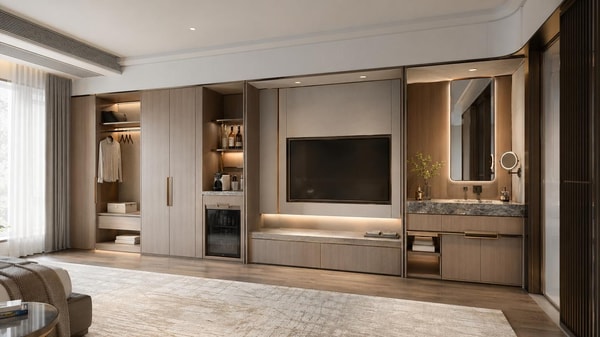
Start with circulation and multi-function use. In tight layouts, wall-mounted or vanity-integrated hotel desks often work better than bulky freestanding units. Prioritize moderate depth, accessible charging, rounded corners, and enough surface for a laptop. Always verify chair storage and luggage movement in a mock-up.
Are drawers necessary for hotel desks?
Not always. Drawers add convenience, but they also increase cost, hardware maintenance, and cleaning complexity. For short-stay urban hotels, open shelves or clean-top designs may be more efficient. For business-heavy or extended-stay properties, at least one discreet storage element can improve guest experience.
What should I ask suppliers before requesting a final quotation?
Ask about substrate type, finish options, edge protection, hardware brand level if relevant, assembly method, packaging, replacement part availability, and typical lead time. For hotel desks with integrated power, confirm responsibility for electrical components, certifications where applicable, and installation scope.
How long is the usual lead time for hotel desks?
Lead time depends on standard versus custom production, material sourcing, and project scale. Standardized hotel desks may move faster than bespoke units, while custom finishes or integrated millwork can extend development and production. Procurement teams should also add time for sampling, mock-up approval, freight, customs, and site sequencing.
Why work with GCT for hotel desk sourcing decisions?
For procurement professionals, the challenge is rarely finding a desk supplier. The challenge is identifying hotel desks that fit the room concept, support guest expectations, meet project requirements, and remain commercially workable through production and delivery. That demands reliable category insight, supplier visibility, and practical evaluation methods.
Global Commercial Trade supports buyers with a focused B2B sourcing perspective across commercial experience sectors, including Hotel & Catering Equipment. This makes it easier to compare supply options, assess OEM or ODM readiness, understand project-fit trade-offs, and shortlist solutions with stronger operational logic.
What you can discuss with us
- Parameter confirmation for hotel desks based on room size, guest mix, and brand positioning.
- Product selection between standard, semi-custom, and bespoke desk programs.
- Lead time planning for new openings, renovations, or phased procurement schedules.
- Custom solution review for integrated power, storage, vanity, or millwork coordination.
- Documentation and compliance questions linked to commercial furniture sourcing.
- Sample support, finish comparison, and quotation alignment for decision-stage evaluation.
If your team is comparing hotel desks for business-oriented rooms, compact layouts, or multi-property hospitality projects, contact GCT with your room plan, target specifications, expected order volume, and timeline. We can help structure the sourcing conversation around function, manufacturability, compliance, and commercial fit so your next desk package performs well beyond the sample room.
Search News
Hot Articles
- Musical InstrumentsChina Table Tennis Team Departs for London; BS EN 14904:2021 Takes EffectMay 01, 2026
- Outdoor RidesSanya Asian Beach Games Closure Triggers Halal Certification Demand for Sand Sports EquipmentMay 01, 2026
- Outdoor RidesAI Football Training Robots Export Surge After Man Utd MatchMay 01, 2026
Popular Tags
Need ExpertConsultation?
Connect with our specialized leisureengineering team for procurementstrategies.
Recommended News
 May 01, 2026Hotel Desks That Work for Both Business Guests and Small RoomsHotel desks for compact rooms: learn how to choose durable, space-saving, business-friendly designs that improve guest satisfaction and simplify hotel procurement.● Hospitality Sourcing Dir
 May 01, 2026Hotel Slippers in Bulk: Cheap Pairs Can Hurt Guest PerceptionHotel slippers bulk choices affect more than cost. Discover how cheap pairs can damage guest perception, comfort, and brand value—and how smarter sourcing improves reviews.● Hospitality Sourcing Dir
 May 01, 2026Hotel Room Furniture Sets That Balance Style and Replacement CostHotel room furniture sets that combine style, durability, and lower replacement cost. Discover a practical checklist for smarter sourcing, better lifecycle value, and reliable hospitality project results.● Hospitality Sourcing Dir
 May 01, 2026Hotel Bed Linens Wholesale Quality Checks Before Large OrdersHotel bed linens wholesale quality checks: learn how to verify fabric strength, shrinkage, stitching, wash durability, and supplier reliability before placing large hotel bedding orders.● Hospitality Sourcing Dir
 May 01, 2026Hotel Bathroom Amenities That Shape First Impressions FastHotel bathroom amenities shape guest first impressions fast. Discover how the right choices improve brand image, efficiency, and perceived quality from day one.● Hospitality Sourcing Dir
 Apr 30, 2026Hotel cabinets that look custom without custom lead timesHotel cabinets that look custom without long custom lead times. Learn how to balance brand style, durability, and faster installation for hotel projects.● Hospitality Sourcing Dir
 Apr 30, 2026Hotel sofas that hold shape better in high turnover roomsHotel sofas that keep their shape longer in high-turnover rooms. Learn what frame, cushion, and upholstery specs improve durability, guest appeal, and lifecycle value.● Hospitality Sourcing Dir
 Apr 30, 2026Hotel wardrobes that save space without looking budgetHotel wardrobes that save space without looking budget: discover premium, durable designs, smart specs, and sourcing tips to maximize guestroom value.● Hospitality Sourcing Dir
 Apr 30, 2026Hotel room furniture mistakes that quietly hurt guest comfortHotel room furniture mistakes can quietly damage guest comfort, reviews, and brand value. Learn how smarter layout, sizing, and material choices improve hotel room performance.● Hospitality Sourcing Dir
 Apr 30, 2026What makes hotel outdoor furniture easier to maintainHotel outdoor furniture is easier to maintain when it uses weather-resistant materials, smart construction, and replaceable parts. Learn how to cut upkeep and improve long-term value.● Hospitality Sourcing Dir
 Apr 30, 2026Hotel lobby furniture trends shifting guest first impressionsHotel lobby furniture trends are redefining first impressions with modular comfort, brand storytelling, tech integration, and durable style that elevates guest experience.● Hospitality Sourcing Dir
 Apr 30, 2026Why some hotel nightstands wear out faster than expectedHotel nightstands wear out faster when materials, edge sealing, and hardware are underspecified. Learn how to spot durable options, reduce lifecycle costs, and source smarter for hospitality projects.● Hospitality Sourcing Dir
 Apr 28, 2026Iranian Delegation at Sanya Asian Beach Games Spurs Halal-Certified Hardware DemandHalal-certified hardware demand surges after Iranian delegation’s cultural showcase at Sanya Asian Beach Games—key for GCC event tech exporters.● Hospitality Sourcing Dir
 Apr 27, 2026Iranian Delegation’s Ritual Gesture at Sanya ASG Sparks Mideast Hospitality Procurement ShiftIranian delegation's ritual gesture at Sanya ASG sparks Middle East hospitality procurement shift—key for hotel amenities, travel services & cultural compliance.● Hospitality Sourcing Dir
 Apr 28, 2026Hotel Beds in 2026 Are Being Chosen for Sleep Quality, Not Just StyleHotel beds, hotel furniture, and custom furniture in 2026 are defined by sleep quality, durability, and guest value—see how luxury furniture buyers source smarter.● Hospitality Sourcing Dir
 Apr 28, 2026Cheap Hotel Furniture Can Raise Costs Later in Unexpected WaysHotel furniture buying guide: compare hotel beds, hotel chairs, hotel tables, custom furniture and luxury furniture to avoid hidden costs and choose durable hotel equipment.● Hospitality Sourcing Dir
 Apr 28, 2026Hotel Furniture Replacement Cycles Are Changing in 2026Hotel furniture trends for 2026: discover smarter replacement cycles for hotel beds, hotel chairs, hotel tables, luxury furniture, and custom furniture to boost ROI and guest appeal.● Hospitality Sourcing Dir
 Apr 28, 2026Why Do Some Hotel Beds Get Complaints Faster Than Others?Hotel beds complaints often start with poor specs, not looks. Learn how hotel furniture, custom furniture, luxury furniture, hotel chairs, hotel tables, and hotel equipment affect guest satisfaction.● Hospitality Sourcing Dir
 Apr 28, 2026Hotel Beds: Which Frame and Mattress Setup Lasts Longer?Hotel beds guide: compare frame and mattress setups that last longer, with insights on hotel furniture, custom furniture, luxury furniture, hotel chairs and hotel tables.● Hospitality Sourcing Dir
 Apr 27, 2026Is Luxury Jewelry for Hotels a Smart Investment?Luxury jewelry for hotels: see how a custom jewelry manufacturer helps hotels turn custom luxury jewelry into brand value, guest appeal, and profitable luxury jewelry B2B growth.● Hospitality Sourcing Dir
 Apr 21, 2026Open or closed hotel wardrobes for easier housekeeping?Hotel wardrobes affect housekeeping speed, guest appeal, and hospitality procurement. Compare open vs closed designs for hotel furniture, luxury furniture, and hotel room furniture planning.● Hospitality Sourcing Dir
 Apr 21, 2026Hotel wardrobes that fit luggage without wasting spaceHotel wardrobes that fit luggage smartly without wasting space—explore hotel furniture solutions that elevate hotel room furniture, support hospitality procurement, and enhance guest comfort.● Hospitality Sourcing Dir
 Apr 21, 2026Why hotel room furniture wears unevenly after openingHotel furniture wear starts unevenly from day one. Learn how hotel beds, hotel chairs, hotel desks and hotel room furniture perform in real use, with smart hospitality procurement tips.● Hospitality Sourcing Dir
 Apr 21, 2026Hotel room furniture packages that cut design mismatchHotel room furniture packages align hotel furniture, hotel beds, hotel chairs, hotel tables, and hotel desks with luxury furniture standards—reducing design mismatch and speeding hospitality procurement.● Hospitality Sourcing Dir