Hotel Beds: Which Frame and Mattress Setup Lasts Longer?
For hotels balancing guest comfort, durability, and lifecycle cost, choosing the right hotel beds is a strategic investment. From frame construction to mattress pairing, the best setup must align with broader hotel furniture needs, including hotel chairs, hotel tables, and even custom furniture for brand consistency. This guide explores which combinations last longer and how luxury furniture standards influence smarter procurement decisions.
For procurement teams, dealers, and commercial evaluators, bed longevity is not only a product question. It affects housekeeping efficiency, replacement cycles, guest review consistency, room downtime, and total furniture planning across the property. A bed that performs well for 7 to 10 years under hospitality use can materially reduce capital disruption compared with a setup that shows structural or comfort failure in year 3 or 4.
In hotel environments, the most durable solution is rarely a mattress-only decision. The relationship between frame material, joint construction, support deck, edge stability, mattress density, and maintenance routine determines service life. For buyers sourcing at scale, it is also important to compare standard room, premium room, extended-stay, and luxury suite requirements instead of applying one specification across every category.
Why Hotel Bed Longevity Depends on the Full System, Not a Single Component
A hotel bed functions as a system made of at least 4 core elements: the bed frame, the support platform or slat base, the mattress, and the topper or surface comfort layer if used. If one component underperforms, the entire setup ages faster. For example, a high-density mattress placed on a weak support base can sag early because pressure is not distributed evenly across the sleep surface.
This is especially relevant in commercial furniture procurement because hotel occupancy patterns create higher stress than residential use. A guestroom bed may see 250 to 320 occupied nights per year in many operating models, and the same frame can be exposed to repeated luggage impact, edge sitting, housekeeping movement, and occasional misuse. Durability must therefore be assessed under hospitality conditions, not showroom conditions.
Another frequent mistake is evaluating only initial price. A frame that costs 15% less but requires replacement in 4 years may be more expensive over an 8-year planning window than a sturdier frame with reinforced side rails and commercial-grade joinery. For buyers working across hotel chairs, hotel tables, and custom furniture packages, consistency in lifecycle cost modeling is as important as style consistency.
Key stress factors in hospitality use
- Frequent occupancy turnover, often 5 to 7 times more intensive than residential use patterns.
- Heavy edge loading when guests sit to dress, work, or place bags on the bed perimeter.
- Repeated repositioning during housekeeping, especially in rooms cleaned daily.
- Variable sleeper weights and dual-use scenarios in family, business, and long-stay segments.
- Climate and humidity effects that can influence timber movement, foam aging, and fabric wear.
The following comparison helps buyers separate residential-style specifications from commercial hotel bed requirements. It also shows why the frame and mattress should be selected as one package rather than sourced independently without testing compatibility.
The key takeaway is straightforward: long-lasting hotel beds come from correct pairing. Procurement teams that write frame and mattress specifications separately often create hidden failure points. Integrated evaluation usually lowers guest complaints and reduces premature replacement.
Which Bed Frame Materials and Constructions Last Longer in Hotels
Among common hotel bed frame options, welded steel and reinforced engineered wood structures generally outperform light residential wood frames in high-turnover hospitality environments. Steel frames usually deliver better dimensional stability, stronger joint integrity, and lower risk of loosening over time. However, not all steel frames are equal. Tube thickness, welding quality, anti-corrosion treatment, and center support design all affect long-term performance.
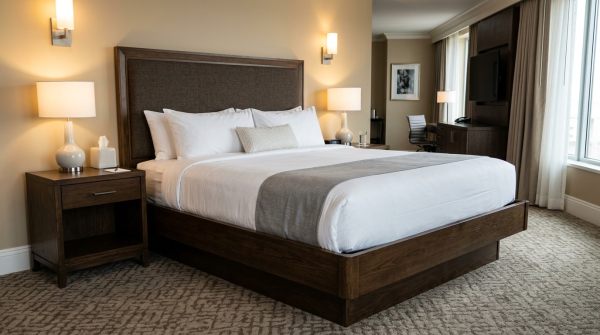
Solid wood can still be a strong option in luxury furniture programs when the design requires warmer aesthetics or premium custom furniture detailing. The issue is not wood itself, but the construction method. Mortise-and-tenon or heavy-duty metal bracket reinforcement is preferable to basic cam-lock assemblies if the hotel expects 8 years or more of dependable use. Moisture variation and repeated moving also make weak timber joints more likely to squeak or shift.
For upholstered bed bases, the hidden internal structure matters more than the visible finish. Many buyers focus on headboard fabric, stitching, or panel design for brand consistency with hotel chairs and hotel tables, but the lifespan depends on the internal frame, corner blocking, deck board thickness, and leg attachment points. In practice, these concealed details determine whether the bed stays stable after thousands of room cycles.
Frame types commonly used in hotel projects
Steel platform frames
Best suited for midscale, upscale, and long-stay hotels where reliability and low maintenance are priorities. They are usually strong enough for king, queen, and twin configurations, and often simplify modular transport and installation. A well-designed steel frame can remain serviceable for 8 to 12 years if corrosion control and fastening inspections are handled properly.
Engineered wood box bases
These are common where aesthetics, integrated upholstery, and cost control must be balanced. They perform well when panel thickness is sufficient and support rails are reinforced. Buyers should verify edge durability and resistance to impact from luggage and housekeeping equipment.
Solid wood decorative frames
Often selected for boutique and luxury hotels. They offer strong visual value and compatibility with high-end room concepts, but need better joinery discipline and periodic tightening. Decorative quality should never replace structural testing.
The table below compares common frame choices from a procurement perspective, including service life expectation, risk points, and best-fit hotel segments.
For most commercial projects, welded steel or reinforced engineered wood offers the best balance of longevity, procurement predictability, and installation control. Solid wood works well when brand expression justifies the added construction scrutiny and maintenance planning.
Mattress Setups That Hold Comfort and Shape Longer
When hotel buyers ask which mattress lasts longer, the answer typically depends on core design, density, and edge performance. In commercial environments, pocket spring, continuous coil, high-density foam, and hybrid mattresses are the main categories. Each can work, but their durability profile changes based on room segment, expected occupancy, and whether the bed is used for short stays, family stays, or premium sleep positioning.
Pocket spring mattresses usually provide better motion isolation and premium guest perception, making them common in upscale hotels. However, lower-gauge systems with weak foam encasement can lose edge stability faster if guests frequently sit on the same side. High-density foam or hybrid constructions often deliver more uniform wear if density levels are appropriate and the support base is fully compatible.
Commercial buyers should watch 3 indicators closely: core support retention, surface body impression depth, and edge compression recovery. A mattress that still looks acceptable after 5 years may already be underperforming in comfort. In many hospitality programs, practical replacement planning starts around year 5 to 7 for standard rooms and may extend toward 8 years in lower-turnover premium inventory with proper rotation and protection.
Recommended pairings by hotel segment
- Economy and midscale hotels: reinforced platform frame plus commercial foam or basic hybrid mattress for stable operating cost.
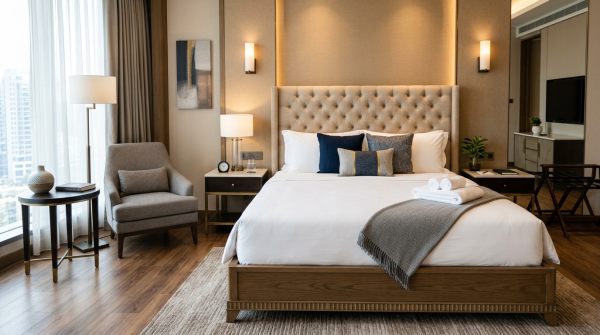
- Upscale hotels: steel or reinforced wood base plus pocket spring hybrid mattress with stronger edge support.
- Luxury suites: premium upholstered frame plus high-spec hybrid or advanced spring system, often with topper management.
- Extended-stay properties: durable frame plus medium-firm hybrid or dense foam setup to handle longer, repeated use by the same guest.
The matrix below summarizes how common mattress constructions compare for commercial durability, guest feel, and operational suitability.
For many projects, the longest-lasting and most versatile combination is a reinforced steel or engineered wood frame with a commercial hybrid mattress built for edge stability. That setup typically offers the best mix of durability, guest acceptance, and room-category flexibility.
Procurement Criteria: What Buyers Should Check Before Approving a Hotel Bed Program
A reliable hotel bed specification should be reviewed like any other commercial furniture package. Procurement teams should verify construction documents, sample testing, finish consistency, installation method, after-sales support, and replenishment capacity. This matters even more in multi-property sourcing where one supplier may be expected to support 100 rooms, 500 rooms, or phased rollouts over 2 to 4 quarters.
The best buying decision often comes from comparing not fewer than 4 dimensions: structural durability, guest comfort retention, maintenance burden, and design integration. A bed that performs well structurally but clashes with the hotel’s luxury furniture language may still be the wrong choice if it disrupts the visual relationship with hotel chairs, hotel tables, and casegoods. In branded hospitality, consistency supports both guest perception and resale value in renovation cycles.
Commercial evaluators should also request clarity on tolerances, spare part availability, packaging protection, and lead times. A technically good product can become a poor procurement result if replacement legs, upholstery panels, or matching finishes are unavailable after 18 or 24 months. For distributors and agents, this is especially important when building repeat business with owners and operators.
A practical 6-point buyer checklist
- Confirm frame structure, including material, joint type, center support, and leg reinforcement.
- Review mattress construction details, especially support core, edge system, and comfort layer consistency.
- Ask for recommended maintenance frequency, such as quarterly frame checks and mattress rotation intervals.
- Check packaging and installation procedures to reduce on-site damage and room readiness delays.
- Verify whether replenishment orders can match original finishes and dimensions after 12–36 months.
- Compare total ownership cost over a 5-year and 8-year horizon, not just first purchase price.
The table below can be used as a simplified procurement scoring model for hotel bed sourcing. It is especially useful during RFQ review or multi-supplier evaluation.
Using a structured procurement model helps buyers avoid subjective decisions based only on showroom softness or decorative appearance. In hotel furniture sourcing, performance consistency usually creates more value than first-impression appeal alone.
Maintenance, Replacement Planning, and Common Mistakes That Shorten Bed Life
Even durable hotel beds can lose years of service life if maintenance routines are weak. The most common operational mistakes are skipping inspection schedules, dragging frames during room resets, failing to rotate compatible mattresses, and ignoring early signs of edge breakdown. Small issues such as loose bolts or uneven support contact can accelerate wear across the full sleep system within 6 to 12 months.
Hotels should establish a simple maintenance rhythm aligned with occupancy and room type. In many properties, a quarterly frame inspection and a mattress condition review every 6 months is a practical baseline. Premium rooms with thicker toppers, decorative upholstered surrounds, or lower room counts may need different care rules than high-turnover standard rooms. The goal is to detect service decline before guest complaints become visible online or at the front desk.
Replacement planning should also be coordinated with wider furniture renovation cycles. If hotel chairs and hotel tables are due for refresh in year 6, bed replacement may be scheduled to match room closure periods and reduce labor duplication. This is particularly relevant for custom furniture programs where finishes, textiles, and hardware must remain visually aligned across the room set.
Common mistakes in hotel bed management
- Choosing decorative bed bases with inadequate internal reinforcement.
- Using mattresses that are too soft for commercial occupancy patterns.
- Ignoring manufacturer guidance on support base compatibility.
- Replacing only mattresses while keeping degraded frame components.
- Failing to standardize inspection records across multiple properties.
When should a hotel replace beds?
There is no single answer, but many operators treat 5 to 7 years as the main review point for mattresses and 7 to 12 years for robust commercial frames. Early replacement may be necessary if there is recurrent noise, visible sagging, edge collapse, hygiene issues, or measurable guest dissatisfaction. For upscale and luxury properties, brand standards may justify replacement before structural end-of-life to preserve sleep quality positioning.
How maintenance supports procurement ROI
A good maintenance program can extend functional life by 1 to 2 years in many commercial scenarios. That extension has real value when multiplied across 80 rooms, 200 rooms, or multi-site portfolios. More importantly, it protects procurement decisions by ensuring that a well-specified bed system delivers the lifecycle performance it was purchased to provide.
FAQ for Hotel Buyers, Evaluators, and Distribution Partners
Which setup usually lasts longer: metal frame with hybrid mattress or wood frame with spring mattress?
In many hotel applications, a reinforced metal frame paired with a commercial hybrid mattress lasts longer because the structure is more stable and the mattress benefits from consistent support. A well-built wood frame can still perform well, but it is more dependent on joint quality and maintenance discipline. For high-occupancy properties, metal-plus-hybrid is often the safer operational choice.
Are luxury upholstered beds less durable than simpler commercial frames?
Not necessarily. Luxury furniture aesthetics do not automatically reduce durability. The deciding factor is whether the upholstered base has a strong internal structure, reinforced corners, and serviceable upholstery details. Buyers should evaluate internal engineering before approving decorative finishes.
How important is bed height in hotel furniture selection?
Bed height affects guest comfort perception, accessibility, housekeeping effort, and room proportion. A combined sleep height in the range of roughly 55 to 68 cm is common in many hotel concepts, but the correct target depends on market positioning, mattress thickness, and frame design. It should also align visually with adjacent furniture pieces in the room.
Can one bed specification work across all room categories?
It can, but it is not always optimal. Many operators use 1 core frame platform across 2 or 3 room categories while varying mattress comfort, topper specification, or headboard finish. This approach balances procurement efficiency with differentiated guest experience and brand hierarchy.
The longest-lasting hotel beds usually combine a commercial-grade frame, a compatible support deck, and a mattress designed for hospitality wear rather than residential softness. Buyers who evaluate structure, comfort retention, operational fit, and replacement planning together tend to achieve better lifecycle value and more stable guest satisfaction.
For sourcing teams managing hotel beds alongside hotel chairs, hotel tables, and custom furniture programs, integrated specification is the most practical route to durability and design consistency. If you are comparing suppliers, planning a renovation cycle, or building a new hospitality furniture package, now is the right time to review your bed system at the package level rather than as a standalone item.
To explore tailored hotel bed solutions, material options, or procurement support for commercial furniture projects, contact us today to discuss your room concept, target lifespan, and sourcing priorities.
Search News
Hot Articles
- Stage Lighting & Truss2026 FIBA Women's World Cup Draw Sparks LED Timing Screen Upgrade DemandApr 28, 2026
- Pro Stage AudioKenyan Marathon WR Break Drives Demand for Timing Chips & Track SensorsApr 28, 2026
- Smart Campus Tech2026 Shanghai Smart Campus Expo: VR Teaching Devices Gain ITU & ISO/IEC 23053 CertificationApr 28, 2026
Popular Tags
Need ExpertConsultation?
Connect with our specialized leisureengineering team for procurementstrategies.
Recommended News
 Apr 28, 2026Iranian Delegation at Sanya Asian Beach Games Spurs Halal-Certified Hardware DemandHalal-certified hardware demand surges after Iranian delegation’s cultural showcase at Sanya Asian Beach Games—key for GCC event tech exporters.● Hospitality Sourcing Dir
 Apr 27, 2026Iranian Delegation’s Ritual Gesture at Sanya ASG Sparks Mideast Hospitality Procurement ShiftIranian delegation's ritual gesture at Sanya ASG sparks Middle East hospitality procurement shift—key for hotel amenities, travel services & cultural compliance.● Hospitality Sourcing Dir
 Apr 28, 2026Cheap Hotel Furniture Can Raise Costs Later in Unexpected WaysHotel furniture buying guide: compare hotel beds, hotel chairs, hotel tables, custom furniture and luxury furniture to avoid hidden costs and choose durable hotel equipment.● Hospitality Sourcing Dir
 Apr 28, 2026Hotel Furniture Replacement Cycles Are Changing in 2026Hotel furniture trends for 2026: discover smarter replacement cycles for hotel beds, hotel chairs, hotel tables, luxury furniture, and custom furniture to boost ROI and guest appeal.● Hospitality Sourcing Dir
 Apr 28, 2026Why Do Some Hotel Beds Get Complaints Faster Than Others?Hotel beds complaints often start with poor specs, not looks. Learn how hotel furniture, custom furniture, luxury furniture, hotel chairs, hotel tables, and hotel equipment affect guest satisfaction.● Hospitality Sourcing Dir
 Apr 28, 2026Hotel Beds: Which Frame and Mattress Setup Lasts Longer?Hotel beds guide: compare frame and mattress setups that last longer, with insights on hotel furniture, custom furniture, luxury furniture, hotel chairs and hotel tables.● Hospitality Sourcing Dir
 Apr 27, 2026Is Luxury Jewelry for Hotels a Smart Investment?Luxury jewelry for hotels: see how a custom jewelry manufacturer helps hotels turn custom luxury jewelry into brand value, guest appeal, and profitable luxury jewelry B2B growth.● Hospitality Sourcing Dir
 Apr 21, 2026Open or closed hotel wardrobes for easier housekeeping?Hotel wardrobes affect housekeeping speed, guest appeal, and hospitality procurement. Compare open vs closed designs for hotel furniture, luxury furniture, and hotel room furniture planning.● Hospitality Sourcing Dir
 Apr 21, 2026Hotel wardrobes that fit luggage without wasting spaceHotel wardrobes that fit luggage smartly without wasting space—explore hotel furniture solutions that elevate hotel room furniture, support hospitality procurement, and enhance guest comfort.● Hospitality Sourcing Dir
 Apr 21, 2026Why hotel room furniture wears unevenly after openingHotel furniture wear starts unevenly from day one. Learn how hotel beds, hotel chairs, hotel desks and hotel room furniture perform in real use, with smart hospitality procurement tips.● Hospitality Sourcing Dir
 Apr 21, 2026Hotel room furniture packages that cut design mismatchHotel room furniture packages align hotel furniture, hotel beds, hotel chairs, hotel tables, and hotel desks with luxury furniture standards—reducing design mismatch and speeding hospitality procurement.● Hospitality Sourcing Dir
 Apr 21, 2026Low seat or deep seat hotel sofas for modern lobbies?Hotel furniture buyers compare low seat and deep seat hotel sofas for modern lobbies. Explore luxury furniture choices that improve comfort, traffic flow, brand image, and hospitality procurement value.● Hospitality Sourcing Dir
 Apr 21, 2026Hotel sofas that keep their shape in high traffic areasHotel sofas, hotel furniture, and hospitality furniture that keep shape in high-traffic areas—discover luxury furniture sourcing tips, durable commercial furniture specs, and smarter hospitality procurement.● Hospitality Sourcing Dir
 Apr 21, 2026Why hospitality furniture needs different specs by zoneHospitality furniture specs vary by zone. Learn how hotel furniture, hotel beds, hotel chairs, hotel tables, and hotel desks improve durability, ROI, and luxury guest experience.● Hospitality Sourcing Dir
 Apr 21, 2026Hospitality furniture that supports faster room turnoverHospitality furniture that speeds room turnover: compare hotel beds, hotel chairs, hotel tables, hotel desks and hotel sofas for easier cleaning, durability, and smarter hospitality procurement.● Hospitality Sourcing Dir
 Apr 21, 2026Where hotel equipment budgets usually go off trackHotel furniture and hotel equipment budgets often fail from hidden scope, logistics, and lifecycle costs. Learn smarter hospitality procurement for hotel beds, chairs, tables, and luxury furniture.● Hospitality Sourcing Dir
 Apr 21, 2026Hotel equipment upgrades that improve guest flow firstHotel equipment upgrades improve guest flow fast with hotel furniture, hotel beds, hotel chairs, catering equipment, and soundproofing materials—boost comfort, efficiency, and procurement ROI.● Hospitality Sourcing Dir
 Apr 21, 2026What shortens the life of commercial furniture in hotelsHotel furniture and commercial furniture wear out fast when hotel beds, hotel chairs, hotel tables, hotel desks, and hotel sofas face heavy use, poor maintenance, and weak materials. Learn smart hospitality procurement tips.● Hospitality Sourcing Dir
 Apr 21, 2026Commercial furniture trends hotels are actually adoptingCommercial furniture trends hotels are adopting: luxury furniture, hotel beds, hotel chairs, hotel tables and hotel sofas that improve hotel furniture sourcing, durability, and hospitality procurement value.● Hospitality Sourcing Dir
 Apr 21, 2026How to spot hotel furniture built for daily wearHotel furniture buying guide: learn how to assess hotel beds, hotel chairs, hotel tables, and hospitality furniture for daily wear, lower maintenance, and smarter hospitality procurement.● Hospitality Sourcing Dir
 Apr 21, 2026Hotel furniture mistakes that age a room too quicklyHotel furniture buying guide: avoid costly hotel beds, hotel chairs, and hotel room furniture mistakes. Discover luxury furniture tips for durable, brand-right hospitality procurement.● Hospitality Sourcing Dir
 Apr 21, 2026Why some soundproofing materials fail after installationLearn why soundproofing materials fail after installation in hotel furniture projects. Explore hotel beds, hotel sofas, hotel wardrobes and hospitality procurement tips for lasting acoustic performance.● Hospitality Sourcing Dir
 Apr 21, 2026Soundproofing materials that work best between guest roomsSoundproofing materials for hotel furniture projects: discover the best systems between guest rooms, from mineral wool to acoustic doors, to improve comfort, protect reviews, and support hospitality procurement.● Hospitality Sourcing Dir
 Apr 21, 2026How firm should hotel beds be for mixed guest profiles?Hotel beds for mixed guest profiles: learn how hotel furniture and hospitality procurement teams balance comfort, durability, and luxury furniture standards to improve guest satisfaction.● Hospitality Sourcing Dir