What makes hotel outdoor furniture easier to maintain
For project managers, choosing hotel outdoor furniture is not only about style—it is about long-term performance, lower upkeep, and predictable lifecycle costs. The easiest products to maintain combine weather-resistant materials, commercial-grade finishes, smart structural design, and simple cleaning routines. This guide explores what makes hotel outdoor furniture more practical for demanding hospitality projects while helping you balance durability, guest experience, and procurement efficiency.
Understanding Maintainability in Hotel Outdoor Furniture
In hospitality projects, maintainability means more than being easy to wipe down. For hotel outdoor furniture, it includes how well a product resists rain, UV exposure, stains, chlorinated pool environments, coastal humidity, and repeated guest use over 3 to 7 years or longer. Project managers usually evaluate these factors alongside design intent, brand positioning, and operational labor requirements.
The reason this matters is simple: outdoor areas are revenue-supporting spaces. Pool decks, rooftop lounges, terrace dining zones, garden walkways, and beachfront seating all influence guest dwell time and property image. If chairs fade after one season, tabletops swell within 12 months, or cushions need constant replacement, the maintenance burden quickly turns a design feature into an operational problem.
For commercial buyers, easy maintenance also supports budget control. A lower purchase price does not always mean lower cost. Furniture that needs refinishing every year, fabric replacement every 18 to 24 months, or frequent tightening after heavy use often increases labor, spare parts demand, and service interruptions. In contrast, well-specified hotel outdoor furniture reduces touchpoints for housekeeping, engineering, and procurement teams.
What project teams usually mean by “easy to maintain”
From a project delivery perspective, maintainability typically combines five practical dimensions: resistance to weather, ease of cleaning, low need for repairs, replaceable components, and consistent appearance over time. These are not abstract qualities. They affect staffing schedules, annual operating costs, and the ability to keep outdoor zones guest-ready during peak occupancy periods.
- Materials should resist moisture, corrosion, fading, and thermal movement across seasonal temperature swings.
- Surfaces should allow routine cleaning with mild soap, water, and non-abrasive tools in 5 to 15 minutes per item.
- Frames and joints should remain stable under repeated commercial use, stack handling, and frequent repositioning.
- Cushions, slings, glides, and hardware should be replaceable without replacing the full unit.
- Finishes should retain a consistent look even after hundreds of cleaning cycles and prolonged sun exposure.
When these conditions are met, hotel outdoor furniture becomes easier to manage across large properties, mixed-use resorts, and multi-phase renovations. This is especially relevant for operators sourcing for 50, 100, or 300-plus seating positions, where even a small maintenance issue can scale into significant recurring cost.
Why the Hospitality Industry Pays Close Attention to Maintenance
Hotels are not residential environments. Outdoor furniture in hospitality settings is exposed to more frequent use, more aggressive cleaning routines, and more demanding guest expectations. A beachfront resort may deal with salt-laden air 365 days a year, while an urban rooftop bar may face strong UV, pollution deposits, and furniture movement every evening service. The maintenance profile changes by location, but the need for resilience remains constant.
Project managers also work within cross-functional constraints. Design teams want a premium visual language, operations teams want low daily upkeep, and procurement wants reliable lead times and manageable replacement programs. In this environment, hotel outdoor furniture must perform as a long-life commercial asset rather than a decorative accessory. That is why sourcing decisions increasingly focus on lifecycle practicality, not only on launch-day appearance.
Another reason for higher attention is the growing value of outdoor commercial experiences. Many hospitality properties now rely on terraces, wellness decks, all-day dining patios, and event lawns to create differentiated guest journeys. These spaces often see service from early morning to late evening, which means furniture may be cleaned 1 to 3 times per day during high season. Products that simplify that routine offer measurable operational value.
Typical pressures affecting maintenance performance
The following overview helps project teams map common hotel conditions to maintenance implications. It is useful during early specification, especially when comparing products across climate zones and service formats.
This table shows why maintenance planning should start before procurement is finalized. The same hotel outdoor furniture that works well in a covered courtyard may underperform on a seafront deck. Matching product specification to operating conditions usually reduces avoidable maintenance events within the first 6 to 24 months.
A wider sourcing perspective
For international sourcing teams and commercial trade platforms, maintainability is also tied to supply chain quality. Consistent hardware specifications, stable finishing processes, and available replacement parts matter because hospitality buyers often standardize furniture programs across multiple sites. A sourcing partner that understands both product performance and commercial deployment can help reduce mismatch between catalog claims and real project conditions.
The Materials and Construction Features That Reduce Upkeep
The easiest hotel outdoor furniture to maintain usually starts with the right material selection. Not all outdoor-grade materials perform equally in commercial use. Project managers should focus on the combination of frame, surface, hardware, and upholstery rather than judging one attribute in isolation. A durable frame can still become high-maintenance if the finish chips easily or if cushions trap water after every rainfall.
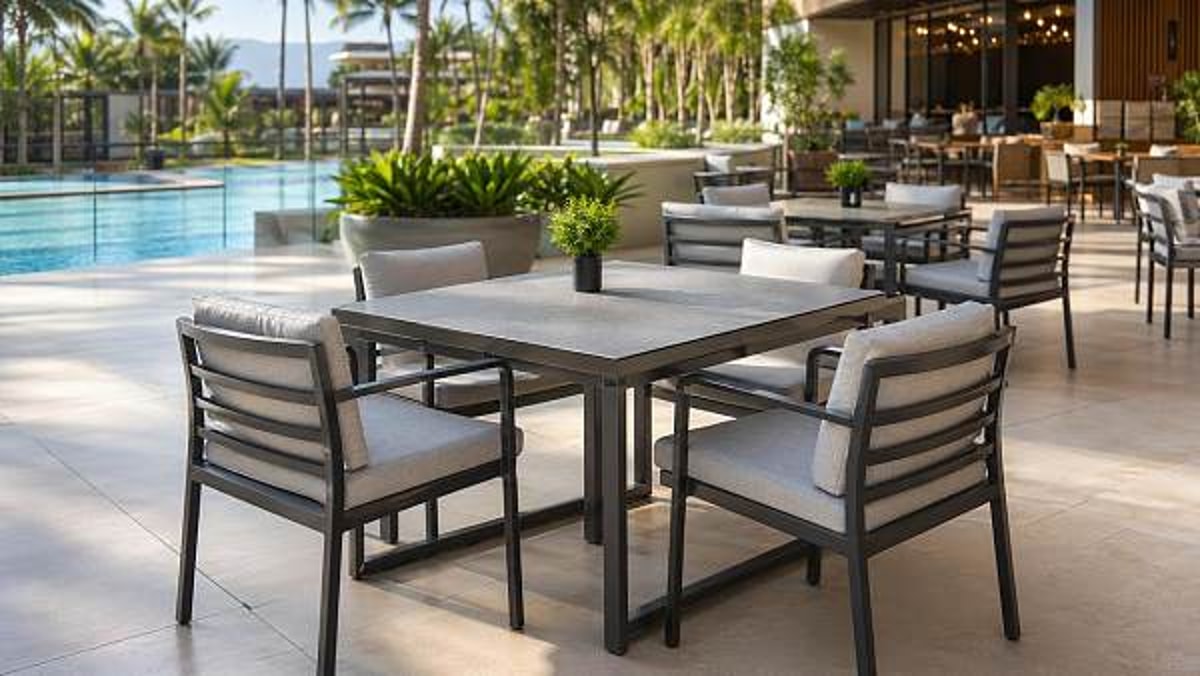
Aluminum is widely favored in hospitality because it is lightweight, corrosion-resistant, and relatively easy to clean. Powder-coated aluminum often performs well in many hotel settings, especially when the coating is applied consistently and edges are protected. Stainless steel can also be suitable, but in coastal zones it requires careful grade selection and more attention to routine rinsing. Synthetic wicker, high-pressure laminate tops, compact surfaces, and performance textiles are often chosen for similar reasons: practical care and visual durability.
Construction details matter just as much as materials. Smooth welds, sealed joints, concealed drainage paths, replaceable feet, and tamper-resistant fasteners all reduce maintenance frequency. In busy projects, these features can save many labor hours per quarter because teams spend less time tightening, touching up, or troubleshooting moisture-related damage.
Which material choices usually make maintenance easier
The following comparison gives project managers a practical way to screen material options during specification and supplier discussions.
This comparison does not mean every project needs the same specification. Instead, it highlights where hotel outdoor furniture often gains maintainability advantages. For example, quick-dry cushioning may be more important at a resort pool, while stain resistance may be the main priority for an outdoor restaurant terrace serving three meal periods daily.
Structural details worth checking before approval
- Drainage design: water should not pool inside frames or beneath cushion seams after rainfall.
- Hardware compatibility: bolts, screws, and inserts should suit outdoor commercial exposure for at least several seasons.
- Glides and feet: replaceable components reduce damage to both furniture and terrace flooring.
- Surface texture: overly rough textures can trap dirt and increase cleaning time by 20% to 30% in some operational settings.
- Finish continuity: edges and welded areas should have even protection, since weak points often fail first.
These checks are especially useful during sample review and mock-up approval. For project managers overseeing phased installations, identifying maintenance risks at the sample stage can prevent widespread issues after deployment.
Application Value Across Typical Hotel Outdoor Zones
Different hotel zones place different demands on furniture, so maintainability should be assessed by application. A lounge chair near a pool, a dining chair on a terrace, and a bench in a landscaped entry area do not fail in the same way. The most practical hotel outdoor furniture programs are those that align product construction with each use case rather than forcing one solution across every environment.
For project leaders, this approach supports operational efficiency. Housekeeping routines, replacement planning, and spare-parts stocking become easier when each zone uses products with an appropriate maintenance profile. It also helps preserve guest-facing consistency, because furniture looks cleaner and performs better when specified according to actual use intensity.
In many hospitality projects, outdoor furniture is no longer limited to one patio or pool deck. Properties may include 4 to 8 distinct exterior zones, each with different exposure levels and traffic cycles. That is why zoning strategy matters in both design development and sourcing.
Common hotel zones and maintenance priorities
The table below summarizes how maintenance priorities shift across typical hotel applications.
This type of zoning analysis helps avoid overspecification in low-stress areas and underspecification in high-stress ones. It also supports more accurate forecasting for replacement cycles, cleaning labor, and spare component planning over 12, 24, and 36 months.
How maintainability improves business performance
The value of easier-to-maintain hotel outdoor furniture is not limited to the engineering team. It affects guest satisfaction, visual consistency, and service continuity. Furniture that remains clean, stable, and presentable with less intervention helps hotels keep outdoor areas activated for dining, social events, and leisure use without constant operational friction.
For ownership groups and operators, this creates a practical link between specification quality and asset performance. Reduced maintenance can mean fewer out-of-service seats, lower emergency replacements, and less pressure during peak occupancy periods. In commercial environments, those advantages are often more meaningful than a small upfront saving.
Practical Evaluation and Maintenance Planning for Project Managers
A strong specification process makes hotel outdoor furniture easier to maintain from day one. Project managers should align design consultants, operators, and suppliers around measurable criteria before final approval. This usually includes exposure mapping, sample review, cleaning compatibility, replacement-part availability, and installation details. The earlier these issues are clarified, the lower the risk of post-installation maintenance surprises.
During supplier evaluation, it is helpful to request care instructions, finish limitations, and expected service points in writing. Ask how the furniture should be cleaned weekly, monthly, and seasonally. Clarify whether glides, slings, cushions, or hardware can be replaced individually. For larger hospitality projects, even a 2% to 5% spare-part strategy can reduce future disruption when isolated damage occurs.
It is also wise to consider logistics and installation factors. Outdoor furniture often passes through storage, staging, and phased handover before guests ever use it. Products that scratch easily, require complex assembly, or demand specialized maintenance chemicals can create avoidable complications during this early period.
A practical review checklist before specification sign-off
- Confirm the exact exposure type for each zone: full sun, covered exterior, poolside, beachfront, or seasonal use.
- Review frame material, finish type, and hardware compatibility as a combined system, not separate claims.
- Inspect samples after cleaning tests, water exposure, and movement simulation where possible.
- Check whether upholstery components dry within practical operational windows, often under 2 to 6 hours depending on climate.
- Verify replacement-part lead time, especially for cushions, glides, and commonly stressed accessories.
- Coordinate storage and off-season protection plans if the property uses seasonal layouts or event-based reconfiguration.
A checklist like this turns maintainability into a manageable project criterion rather than a vague preference. It also supports better communication between sourcing teams and manufacturers, especially when products are being selected across multiple international supply options.
Routine care still matters
Even the best hotel outdoor furniture needs routine care. In most properties, a simple program of daily wipe-downs, weekly washing, monthly inspection, and seasonal deep checks is enough to protect performance. Problems often arise not because the product is weak, but because care routines are mismatched to the environment. For example, coastal furniture may need freshwater rinsing more frequently than inland furniture, even if both use similar frames.
This is where sourcing intelligence becomes valuable. Buyers need products that not only look appropriate for hospitality settings, but also fit the operational reality of each property. A commercial sourcing hub with sector knowledge can help connect project teams with manufacturers that understand design, compliance, and long-term use in demanding outdoor environments.
Why Work With Us for Hotel Outdoor Furniture Projects
For project managers and commercial buyers, selecting hotel outdoor furniture is rarely a one-variable decision. It requires balancing aesthetics, maintainability, delivery schedules, replacement planning, and supplier reliability. Global Commercial Trade supports this process by connecting hospitality-focused sourcing intelligence with practical evaluation criteria across commercial product categories.
Our focus is not limited to surface-level product browsing. We help buyers and project teams assess outdoor furniture options in the context of real commercial use: climate exposure, maintenance burden, operational routines, and long-term asset value. This is especially useful for hotel groups, developers, and procurement teams working across multiple zones, phased installations, or international sourcing channels.
If you are comparing hotel outdoor furniture solutions, we can support your next step with practical guidance on parameter confirmation, product selection, expected delivery windows, customization direction, sample evaluation, and commercial quotation alignment. Whether your project involves poolside loungers, dining sets, rooftop seating, or mixed outdoor programs, the goal is the same: specify products that are easier to maintain and more reliable in operation.
Contact us for project-specific support
- Confirm material and finish parameters for your climate and usage profile.
- Review suitable hotel outdoor furniture options for pool, terrace, rooftop, or landscape applications.
- Discuss lead time ranges, phased delivery needs, and spare-part planning.
- Explore customization, sample support, and practical care expectations before approval.
- Request quotation communication aligned with commercial project requirements and sourcing priorities.
When hotel outdoor furniture is chosen with maintenance in mind, the result is not only a better-looking space, but also a more efficient project outcome. Contact us to discuss your specifications, operating conditions, and sourcing goals in greater detail.
Search News
Hot Articles
Popular Tags
Need ExpertConsultation?
Connect with our specialized leisureengineering team for procurementstrategies.
Recommended News
 Apr 30, 2026Hotel cabinets that look custom without custom lead timesHotel cabinets that look custom without long custom lead times. Learn how to balance brand style, durability, and faster installation for hotel projects.● Hospitality Sourcing Dir
 Apr 30, 2026Hotel sofas that hold shape better in high turnover roomsHotel sofas that keep their shape longer in high-turnover rooms. Learn what frame, cushion, and upholstery specs improve durability, guest appeal, and lifecycle value.● Hospitality Sourcing Dir
 Apr 30, 2026Hotel wardrobes that save space without looking budgetHotel wardrobes that save space without looking budget: discover premium, durable designs, smart specs, and sourcing tips to maximize guestroom value.● Hospitality Sourcing Dir
 Apr 30, 2026Hotel room furniture mistakes that quietly hurt guest comfortHotel room furniture mistakes can quietly damage guest comfort, reviews, and brand value. Learn how smarter layout, sizing, and material choices improve hotel room performance.● Hospitality Sourcing Dir
 Apr 30, 2026What makes hotel outdoor furniture easier to maintainHotel outdoor furniture is easier to maintain when it uses weather-resistant materials, smart construction, and replaceable parts. Learn how to cut upkeep and improve long-term value.● Hospitality Sourcing Dir
 Apr 30, 2026Hotel lobby furniture trends shifting guest first impressionsHotel lobby furniture trends are redefining first impressions with modular comfort, brand storytelling, tech integration, and durable style that elevates guest experience.● Hospitality Sourcing Dir
 Apr 30, 2026Why some hotel nightstands wear out faster than expectedHotel nightstands wear out faster when materials, edge sealing, and hardware are underspecified. Learn how to spot durable options, reduce lifecycle costs, and source smarter for hospitality projects.● Hospitality Sourcing Dir
 Apr 28, 2026Iranian Delegation at Sanya Asian Beach Games Spurs Halal-Certified Hardware DemandHalal-certified hardware demand surges after Iranian delegation’s cultural showcase at Sanya Asian Beach Games—key for GCC event tech exporters.● Hospitality Sourcing Dir
 Apr 27, 2026Iranian Delegation’s Ritual Gesture at Sanya ASG Sparks Mideast Hospitality Procurement ShiftIranian delegation's ritual gesture at Sanya ASG sparks Middle East hospitality procurement shift—key for hotel amenities, travel services & cultural compliance.● Hospitality Sourcing Dir
 Apr 28, 2026Hotel Beds in 2026 Are Being Chosen for Sleep Quality, Not Just StyleHotel beds, hotel furniture, and custom furniture in 2026 are defined by sleep quality, durability, and guest value—see how luxury furniture buyers source smarter.● Hospitality Sourcing Dir
 Apr 28, 2026Cheap Hotel Furniture Can Raise Costs Later in Unexpected WaysHotel furniture buying guide: compare hotel beds, hotel chairs, hotel tables, custom furniture and luxury furniture to avoid hidden costs and choose durable hotel equipment.● Hospitality Sourcing Dir
 Apr 28, 2026Hotel Furniture Replacement Cycles Are Changing in 2026Hotel furniture trends for 2026: discover smarter replacement cycles for hotel beds, hotel chairs, hotel tables, luxury furniture, and custom furniture to boost ROI and guest appeal.● Hospitality Sourcing Dir
 Apr 28, 2026Why Do Some Hotel Beds Get Complaints Faster Than Others?Hotel beds complaints often start with poor specs, not looks. Learn how hotel furniture, custom furniture, luxury furniture, hotel chairs, hotel tables, and hotel equipment affect guest satisfaction.● Hospitality Sourcing Dir
 Apr 28, 2026Hotel Beds: Which Frame and Mattress Setup Lasts Longer?Hotel beds guide: compare frame and mattress setups that last longer, with insights on hotel furniture, custom furniture, luxury furniture, hotel chairs and hotel tables.● Hospitality Sourcing Dir
 Apr 27, 2026Is Luxury Jewelry for Hotels a Smart Investment?Luxury jewelry for hotels: see how a custom jewelry manufacturer helps hotels turn custom luxury jewelry into brand value, guest appeal, and profitable luxury jewelry B2B growth.● Hospitality Sourcing Dir
 Apr 21, 2026Open or closed hotel wardrobes for easier housekeeping?Hotel wardrobes affect housekeeping speed, guest appeal, and hospitality procurement. Compare open vs closed designs for hotel furniture, luxury furniture, and hotel room furniture planning.● Hospitality Sourcing Dir
 Apr 21, 2026Hotel wardrobes that fit luggage without wasting spaceHotel wardrobes that fit luggage smartly without wasting space—explore hotel furniture solutions that elevate hotel room furniture, support hospitality procurement, and enhance guest comfort.● Hospitality Sourcing Dir
 Apr 21, 2026Why hotel room furniture wears unevenly after openingHotel furniture wear starts unevenly from day one. Learn how hotel beds, hotel chairs, hotel desks and hotel room furniture perform in real use, with smart hospitality procurement tips.● Hospitality Sourcing Dir
 Apr 21, 2026Hotel room furniture packages that cut design mismatchHotel room furniture packages align hotel furniture, hotel beds, hotel chairs, hotel tables, and hotel desks with luxury furniture standards—reducing design mismatch and speeding hospitality procurement.● Hospitality Sourcing Dir
 Apr 21, 2026Low seat or deep seat hotel sofas for modern lobbies?Hotel furniture buyers compare low seat and deep seat hotel sofas for modern lobbies. Explore luxury furniture choices that improve comfort, traffic flow, brand image, and hospitality procurement value.● Hospitality Sourcing Dir
 Apr 21, 2026Hotel sofas that keep their shape in high traffic areasHotel sofas, hotel furniture, and hospitality furniture that keep shape in high-traffic areas—discover luxury furniture sourcing tips, durable commercial furniture specs, and smarter hospitality procurement.● Hospitality Sourcing Dir
 Apr 21, 2026Why hospitality furniture needs different specs by zoneHospitality furniture specs vary by zone. Learn how hotel furniture, hotel beds, hotel chairs, hotel tables, and hotel desks improve durability, ROI, and luxury guest experience.● Hospitality Sourcing Dir
 Apr 21, 2026Hospitality furniture that supports faster room turnoverHospitality furniture that speeds room turnover: compare hotel beds, hotel chairs, hotel tables, hotel desks and hotel sofas for easier cleaning, durability, and smarter hospitality procurement.● Hospitality Sourcing Dir
 Apr 21, 2026Where hotel equipment budgets usually go off trackHotel furniture and hotel equipment budgets often fail from hidden scope, logistics, and lifecycle costs. Learn smarter hospitality procurement for hotel beds, chairs, tables, and luxury furniture.● Hospitality Sourcing Dir