Hotel housekeeping carts: the layout detail that saves minutes on every floor
In hotel operations, small layout decisions often create measurable gains. Hotel housekeeping carts are more than storage tools—they shape cleaning speed, staff movement, and floor-level efficiency. For project managers overseeing hospitality fit-outs or operational upgrades, understanding how cart design affects workflow can reveal practical ways to save minutes on every floor without compromising service standards.
Why project managers should treat hotel housekeeping carts as an operational design decision
When buyers search for hotel housekeeping carts, they are rarely looking for a simple product list. In most cases, they want to know which cart configuration improves housekeeping productivity, supports brand standards, and fits the realities of a specific property. For project managers and engineering leads, the real question is not “Which cart is available?” but “Which layout will reduce wasted motion and support reliable room turnover?”
The short answer is that cart layout matters more than many teams expect. A poorly arranged cart slows replenishment, increases bending and reaching, creates corridor obstruction, and forces attendants to repeat small tasks dozens of times per shift. Those seconds add up across every room, every floor, and every day. A better-designed cart can save minutes on each floor by putting high-frequency items in the right place, reducing restocking interruptions, and improving route flow.
This is why hotel housekeeping carts should be evaluated as part of operational infrastructure, not as a low-priority accessory. In a hotel opening, refurbishment, or service optimization project, the cart sits at the intersection of labor cost, guest perception, ergonomics, and corridor design. That makes it highly relevant to anyone responsible for project outcomes and long-term operating efficiency.
What target readers care about most before choosing a cart layout
For project managers, the main concern is usually practical return rather than product features in isolation. They want to know whether a different cart layout will shorten room cleaning cycles, reduce labor pressure, and align with the service model of the property. They also need to understand whether the cart will fit elevator dimensions, corridor widths, storage rooms, and linen logistics without creating friction for the housekeeping team.
Another major concern is standardization. In multi-floor or multi-property operations, managers prefer hotel housekeeping carts that help create repeatable routines. When supplies are placed consistently, training becomes easier, restocking becomes faster, and supervisors can identify process issues more quickly. In other words, the right cart does not just carry items; it supports operational discipline.
Readers in this role also worry about hidden costs. A cart that looks spacious on paper may be too heavy in use. A model with many compartments may slow access if the arrangement does not match actual cleaning sequence. A premium finish may elevate presentation but fail under heavy-duty movement. Decision-makers need guidance that connects design details to real operating conditions, not generic claims.
How cart layout saves minutes on every floor
The savings do not usually come from one dramatic innovation. They come from eliminating repeated micro-delays. Housekeeping attendants interact with their carts hundreds of times per shift. Every unnecessary reach, lid opening, bag adjustment, or search for supplies increases time and fatigue. When the layout reflects the order of tasks inside a guest room, movement becomes more fluid and consistent.
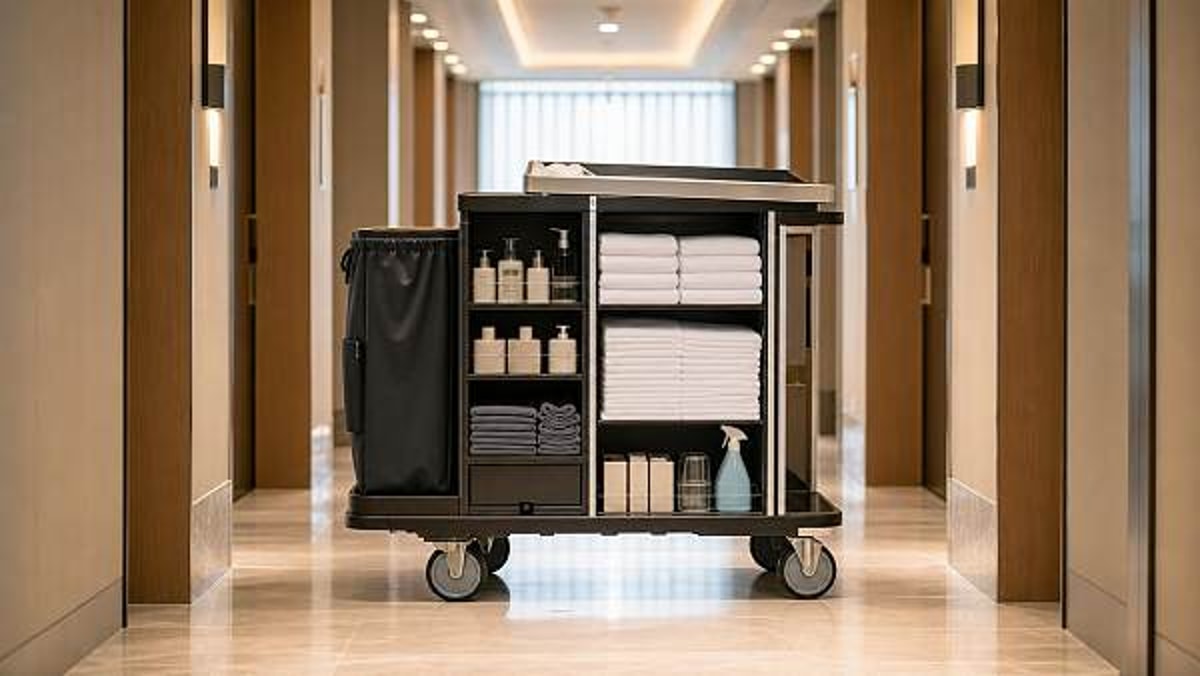
For example, high-frequency consumables such as towels, amenities, liners, and cleaning cloths should be accessible from the most natural standing position. If attendants must circle the cart or open multiple layers to reach standard items, room servicing slows down. Likewise, if soiled linen collection is awkward or unstable, the cart becomes harder to maneuver and more difficult to keep presentable in guest-facing corridors.
Floor-level efficiency also depends on how often attendants need to return to a service area. A layout that balances capacity with accessibility can reduce replenishment trips without turning the cart into an oversized unit that is difficult to push. This is especially important in large hotels where elevator waits, long corridors, and back-of-house distances can consume significant time.
In practical terms, the best hotel housekeeping carts are designed around task sequence, item frequency, and property layout. That is what saves minutes on every floor: less searching, less repositioning, fewer refill interruptions, and smoother movement between rooms.
Which layout features actually improve housekeeping workflow
Not every visible feature creates operational value. Project managers should focus first on layout features that directly affect speed and usability. Open shelving for fast-access items is often more efficient than deep enclosed storage for frequently used stock. Adjustable shelves can be valuable when room categories vary, but only if they remain stable and easy to reset.
Top-deck organization matters more than many specifications suggest. A useful top section supports the most immediate tools of the attendant’s workflow, such as sprays, cloths, gloves, and guest amenities for quick replacement. If the top surface becomes cluttered or unstable, the whole service rhythm slows. Small dividers, removable bins, and labeled sections often deliver more benefit than simply adding more total volume.
Bag placement is another high-impact detail. Waste and linen collection should be easy to load without awkward lifting, but the bags should not swing excessively or widen the cart beyond corridor comfort. Side-mounted systems may improve loading, while rear-mounted systems may improve balance, depending on the property’s circulation pattern. The right solution depends on whether maneuverability or disposal access is the larger constraint.
Wheel quality also influences workflow more than buyers expect. Smooth, quiet casters reduce effort and noise in guest areas. Locking wheels can improve safety on sloped or uneven surfaces. If wheels perform poorly, attendants compensate physically, which affects speed, fatigue, and long-term maintenance. For hospitality projects, mobility should be treated as a core performance feature, not a minor hardware choice.
How to match hotel housekeeping carts to different property types
A city business hotel, a resort, and an extended-stay property do not use carts in exactly the same way. The correct layout depends on room density, service frequency, amenity standards, corridor size, and labor model. This is one reason generic procurement decisions often underperform in operation.
In high-density urban hotels, corridor widths and elevator dimensions often make compact maneuverability more valuable than maximum storage. A narrower cart with excellent organization can outperform a larger model if it reduces congestion and speeds room-to-room movement. In these properties, fast access and smooth steering are usually priorities.
In resorts or large-format properties, transport distance may be the larger issue. Carts may need greater linen capacity and stronger wheel systems because attendants cover longer floorplates and spend more time between service zones. Here, reducing replenishment trips can produce significant labor savings, even if the cart is slightly larger.
Luxury hotels face an additional layer of expectation. The cart must support high service standards while maintaining a discreet, polished appearance in guest-facing spaces. Soft-close elements, enclosed sections, premium finishes, and noise control may justify added investment if they protect the guest experience. In this segment, the visual and acoustic behavior of hotel housekeeping carts can matter almost as much as their storage logic.
For extended-stay or mixed-use hospitality environments, room supply profiles can differ substantially from one service zone to another. Flexible internal compartments and modular bins may offer more value than fixed layouts. Project teams should map actual inventory requirements rather than rely on standard assumptions.
What to evaluate during procurement beyond the product brochure
Brochures often emphasize dimensions, materials, and total capacity, but these metrics alone do not show how a cart will perform during a live shift. Project managers should evaluate carts through use-case testing whenever possible. Ask attendants or housekeeping supervisors to simulate a realistic room servicing sequence and identify points of friction.
Watch how easily the cart enters and exits a guest room zone, how often users need to change hand position, and whether key items remain accessible when the cart is partially depleted. A layout that works when fully stocked may become inefficient halfway through a shift if supplies collapse into deep shelves or bins lose stability.
Maintenance should also be part of procurement analysis. Hotel housekeeping carts experience daily impacts, chemical exposure, and repetitive movement. Surfaces should be easy to clean, structural components should resist warping, and replacement parts such as wheels, bags, and handles should be available without long delays. A lower purchase price can become expensive if downtime and replacement frequency increase.
Noise is another overlooked criterion. In premium hospitality environments, rattling shelves, loose lids, and rough wheels can undermine the guest experience early in the morning or near occupied rooms. Quiet operation is not a luxury detail; it is part of service quality control.
How to think about ROI: labor, consistency, and guest impact
For business-focused readers, the value of hotel housekeeping carts should be assessed in operational terms. If a better layout saves even a small amount of time per room, the cumulative gain can be meaningful across hundreds of rooms and multiple shifts. Time savings may support faster room turnaround, reduce overtime pressure, or improve staffing flexibility during peak occupancy periods.
There is also a consistency dividend. When carts are logically arranged, attendants are less likely to forget replenishment items, overstock certain materials, or improvise inconsistent storage patterns. That helps maintain room presentation standards and reduces supervisory correction. In properties where guest expectations are high, consistency is directly tied to brand perception.
Ergonomics contributes to ROI as well. Better access height, smoother movement, and more stable bag systems can reduce physical strain. While this may seem secondary, fatigue affects both pace and error rates. Over time, ergonomic improvements can support retention, training effectiveness, and safer operations.
Guest impact is the final layer. A well-designed cart helps housekeeping work efficiently without making corridors feel blocked, cluttered, or noisy. In hotels where guest traffic overlaps with service activity, that matters. The cart is part of the visible service environment, and its design influences how operational activity is perceived.
Common specification mistakes that create problems after installation
One common mistake is buying the largest available cart in the belief that more capacity always means fewer interruptions. In reality, oversized carts can slow turning movement, block corridors, and create strain when fully loaded. Capacity should be calibrated to floor pattern and replenishment access, not maximized by default.
Another mistake is overvaluing compartment count without considering usage logic. More sections do not automatically create better organization. If the compartments do not reflect actual item groups and cleaning sequence, attendants may ignore them or develop workarounds. Practical usability matters more than feature density.
Project teams also sometimes separate cart procurement from broader housekeeping workflow planning. This can lead to mismatches between cart dimensions and storage rooms, service elevators, or linen refill processes. The cart should be specified as part of an integrated operational system that includes back-of-house layout and replenishment rhythm.
Finally, some buyers underestimate the importance of field feedback. Housekeeping supervisors and attendants often identify efficiency issues that spec sheets cannot reveal. Their input is essential if the goal is to save time in real use rather than simply approve a compliant purchase.
A practical framework for selecting the right cart layout
A useful selection process starts with workflow mapping. Identify the average number of rooms serviced per shift, the standard item set, refill frequency, corridor conditions, and room categories. Then define which tasks consume avoidable time. This allows the procurement team to compare hotel housekeeping carts against actual operational pain points.
Next, rank layout priorities. For some properties, compact maneuverability is the priority. For others, linen capacity or discreet guest-facing appearance may matter more. It is rarely possible to maximize every attribute at once, so teams should make trade-offs consciously rather than assume one model suits all use cases.
After that, conduct a pilot test if feasible. Even a limited trial on one floor can reveal whether attendants move faster, restock less often, and report lower fatigue. Measure not only cleaning time but also ease of movement, noise, and user preference. Quantitative and qualitative feedback together produce a stronger specification decision.
Finally, standardize the winning layout. Once a cart configuration proves effective, document stocking logic, label positions, and replenishment rules. The best productivity gains come not only from purchasing a good cart, but from embedding it in a repeatable operating method.
Conclusion: the smallest mobile workstation can influence the biggest housekeeping metrics
Hotel housekeeping carts may seem like a minor line item in a hospitality project, but they have outsized influence on daily execution. For project managers and engineering leads, the key insight is simple: cart layout affects labor efficiency, consistency, ergonomics, and guest-facing service quality all at once.
If the goal is to save minutes on every floor, the answer is not to chase the most complex cart or the cheapest one. It is to choose a layout that matches task sequence, floor conditions, supply profile, and service expectations. In well-run hotels, that kind of fit is what turns a basic equipment decision into a measurable operational improvement.
When specified thoughtfully, hotel housekeeping carts become more than storage units. They become workflow tools that help teams move faster, work more comfortably, and maintain standards with less friction. For any hotel upgrade or new-build project, that is a detail worth taking seriously.
Search News
Hot Articles
- Commercial KitchenStainless steel GN pans with reinforced corners last longer in busy kitchensMay 02, 2026
- Hotel Room AmenitiesMemory foam hotel mattresses: when soft comfort leads to faster saggingMay 02, 2026
- Hotel Room AmenitiesElectronic hotel door locks: battery alerts are often less simple than they seemMay 02, 2026
Popular Tags
Need ExpertConsultation?
Connect with our specialized leisureengineering team for procurementstrategies.
Recommended News
 May 02, 2026Memory foam hotel mattresses: when soft comfort leads to faster saggingMemory foam hotel mattresses may feel luxurious at first, but can soft comfort cause faster sagging? Discover how buyers can reduce risk, improve durability, and protect hotel ROI.● Hospitality Sourcing Dir
 May 02, 2026Electronic hotel door locks: battery alerts are often less simple than they seemElectronic hotel door locks battery alerts are more complex than they appear. Learn how firmware, usage, and environment affect reliability, maintenance efficiency, and smarter sourcing.● Hospitality Sourcing Dir
 May 02, 2026Hotel housekeeping carts: the layout detail that saves minutes on every floorHotel housekeeping carts can save minutes on every floor. Discover how smarter cart layout improves workflow, reduces labor strain, and supports faster, more consistent room turnover.● Hospitality Sourcing Dir
 May 02, 2026Wholesale hotel safes: keypad reliability matters more than extra featuresWholesale hotel safes should be judged by keypad reliability first. Discover the checklist that helps buyers reduce lockouts, maintenance costs, and guest complaints.● Hospitality Sourcing Dir
 May 02, 2026Hotel lobby chandeliers: how size mistakes affect the whole arrival experienceHotel lobby chandeliers can make or break first impressions. Learn how sizing mistakes affect luxury, circulation, and brand value—and how to choose the right scale.● Hospitality Sourcing Dir
 May 02, 2026Industrial ironing machines: steam output is not the only thing to compareIndustrial ironing machines should be compared by more than steam output. Discover how temperature control, pressure stability, efficiency, and durability affect real commercial performance.● Hospitality Sourcing Dir
 May 02, 2026Blackout curtains for hotels that block light without trapping heatBlackout curtains for hotels that block light without trapping heat—discover smarter fabrics, thermal comfort benefits, and sourcing tips for better guest sleep and hotel performance.● Hospitality Sourcing Dir
 May 02, 2026Hotel luggage carts: why wheel quality matters more than frame finishHotel luggage carts perform best when wheel quality comes first. Discover how better casters reduce noise, protect floors, improve handling, and lower long-term hotel maintenance costs.● Hospitality Sourcing Dir
 May 02, 2026Custom printed hotel key cards: PVC or wood for a better guest feel?Custom printed hotel key cards: compare PVC and wood to find the best mix of guest feel, durability, sustainability, and brand impact for smarter hotel sourcing.● Hospitality Sourcing Dir
 May 02, 2026Commercial laundry equipment sizing mistakes that raise utility billsCommercial laundry equipment sizing mistakes can quietly drive up water, energy, and labor costs. Learn the biggest planning errors and how smarter sizing protects budgets and efficiency.● Hospitality Sourcing Dir
 May 02, 2026Why some wholesale bath towels for hotels wear out too fastWholesale bath towels for hotels can wear out fast due to fiber quality, GSM, weave, and laundering mismatch. Learn how to choose durable towels that cut replacement costs and protect guest experience.● Hospitality Sourcing Dir
 May 01, 2026Hotel Desks That Work for Both Business Guests and Small RoomsHotel desks for compact rooms: learn how to choose durable, space-saving, business-friendly designs that improve guest satisfaction and simplify hotel procurement.● Hospitality Sourcing Dir
 May 01, 2026Hotel Slippers in Bulk: Cheap Pairs Can Hurt Guest PerceptionHotel slippers bulk choices affect more than cost. Discover how cheap pairs can damage guest perception, comfort, and brand value—and how smarter sourcing improves reviews.● Hospitality Sourcing Dir
 May 01, 2026Hotel Room Furniture Sets That Balance Style and Replacement CostHotel room furniture sets that combine style, durability, and lower replacement cost. Discover a practical checklist for smarter sourcing, better lifecycle value, and reliable hospitality project results.● Hospitality Sourcing Dir
 May 01, 2026Hotel Bed Linens Wholesale Quality Checks Before Large OrdersHotel bed linens wholesale quality checks: learn how to verify fabric strength, shrinkage, stitching, wash durability, and supplier reliability before placing large hotel bedding orders.● Hospitality Sourcing Dir
 May 01, 2026Hotel Bathroom Amenities That Shape First Impressions FastHotel bathroom amenities shape guest first impressions fast. Discover how the right choices improve brand image, efficiency, and perceived quality from day one.● Hospitality Sourcing Dir
 Apr 30, 2026Hotel cabinets that look custom without custom lead timesHotel cabinets that look custom without long custom lead times. Learn how to balance brand style, durability, and faster installation for hotel projects.● Hospitality Sourcing Dir
 Apr 30, 2026Hotel sofas that hold shape better in high turnover roomsHotel sofas that keep their shape longer in high-turnover rooms. Learn what frame, cushion, and upholstery specs improve durability, guest appeal, and lifecycle value.● Hospitality Sourcing Dir
 Apr 30, 2026Hotel wardrobes that save space without looking budgetHotel wardrobes that save space without looking budget: discover premium, durable designs, smart specs, and sourcing tips to maximize guestroom value.● Hospitality Sourcing Dir
 Apr 30, 2026Hotel room furniture mistakes that quietly hurt guest comfortHotel room furniture mistakes can quietly damage guest comfort, reviews, and brand value. Learn how smarter layout, sizing, and material choices improve hotel room performance.● Hospitality Sourcing Dir
 Apr 30, 2026What makes hotel outdoor furniture easier to maintainHotel outdoor furniture is easier to maintain when it uses weather-resistant materials, smart construction, and replaceable parts. Learn how to cut upkeep and improve long-term value.● Hospitality Sourcing Dir
 Apr 30, 2026Hotel lobby furniture trends shifting guest first impressionsHotel lobby furniture trends are redefining first impressions with modular comfort, brand storytelling, tech integration, and durable style that elevates guest experience.● Hospitality Sourcing Dir
 Apr 30, 2026Why some hotel nightstands wear out faster than expectedHotel nightstands wear out faster when materials, edge sealing, and hardware are underspecified. Learn how to spot durable options, reduce lifecycle costs, and source smarter for hospitality projects.● Hospitality Sourcing Dir
 Apr 28, 2026Iranian Delegation at Sanya Asian Beach Games Spurs Halal-Certified Hardware DemandHalal-certified hardware demand surges after Iranian delegation’s cultural showcase at Sanya Asian Beach Games—key for GCC event tech exporters.● Hospitality Sourcing Dir