Custom Printed Lanyards: Which Material Holds Up Best?
When sourcing custom printed lanyards for commercial use, procurement teams need more than attractive branding—they need materials that withstand daily wear, maintain print quality, and meet budget targets. From polyester and nylon to eco-friendly options, choosing the right lanyard material can directly affect durability, user experience, and long-term value. This guide examines which material performs best in demanding business environments.
Understanding material performance in custom printed lanyards
At a basic level, custom printed lanyards are functional branding tools used to carry ID badges, access cards, keys, event passes, or safety credentials. In practice, however, they sit at the intersection of brand visibility, daily utility, and operational reliability. For procurement teams in hospitality, education, offices, retail, exhibitions, and leisure venues, the best lanyard is not simply the cheapest unit. It is the one that balances durability, print clarity, comfort, compliance, and consistent supply.
Material choice matters because the lanyard is the foundation of product performance. A weak or unsuitable strap can fray quickly, absorb moisture, irritate skin, fade under sunlight, or distort logos after repeated use. In high-traffic commercial environments, these small failures create visible quality issues. A faded badge lanyard at a premium hotel, trade show, smart campus, or branded retail launch can weaken the professional image the buyer is trying to project.
That is why the question “Which material holds up best?” deserves a nuanced answer. There is no single perfect option for every use case. Polyester often leads in cost-to-performance value. Nylon tends to deliver a smoother finish and stronger premium feel. Woven, tubular, PET recycled, bamboo fiber, and cotton blends each have a place depending on exposure conditions, branding method, and end-user expectations. The right decision depends on how the custom printed lanyards will be used, cleaned, stored, and replaced.
Why commercial buyers are paying closer attention
Across commercial sectors, lanyards are no longer treated as minor accessories. They support access control, visitor management, staff identification, and promotional visibility. In many industries served by global sourcing platforms such as GCT, these items appear in public-facing settings where appearance and reliability are both visible. A hospitality group may need elegant staff lanyards that survive long shifts. An education buyer may prioritize comfort and breakaway safety. An event operator may need thousands of printed pieces delivered on schedule with reliable color consistency.
There is also a stronger emphasis on procurement accountability. Buyers are expected to justify spend, reduce waste, and select materials aligned with brand standards or sustainability policies. This has pushed custom printed lanyards into a more strategic category, especially when ordered at scale for multi-site operations, product launches, conferences, or licensing programs. Material selection now influences replacement cycles, complaint rates, and even perceived brand value.
As a result, sourcing decisions increasingly focus on life-cycle value rather than unit price alone. A slightly higher-cost lanyard that resists fading, retains print definition, and remains comfortable after months of use may deliver better overall economics than a low-cost option that needs frequent replacement.
A practical overview of the main lanyard materials
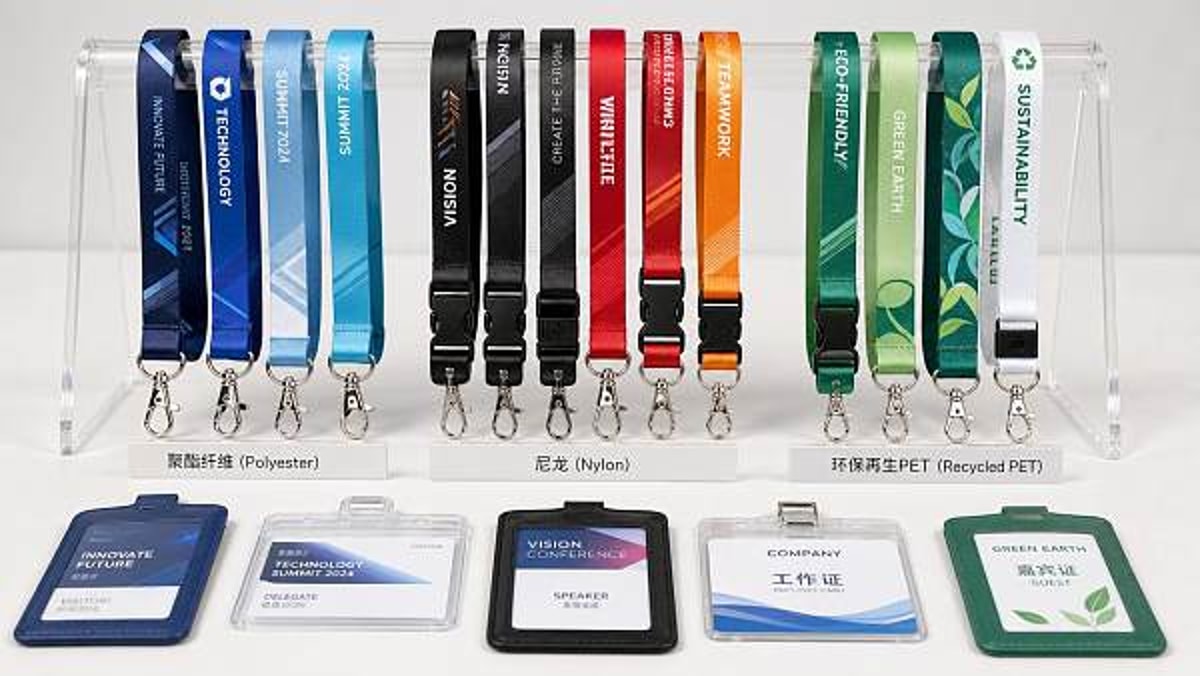
Most custom printed lanyards on the market are made from a small group of core materials. Their differences affect not only durability, but also printing method, tactile quality, and suitability for different industries.
Which material holds up best in daily commercial use?
If “holds up best” means the most balanced performer across cost, wear resistance, and print retention, polyester is usually the leading choice for custom printed lanyards. It has become the market standard for good reasons: it tolerates frequent use, handles multiple printing methods well, and performs reliably in large-volume production. It is especially suitable when procurement teams need predictable results for staff IDs, visitor passes, trade show credentials, campus use, or promotional distribution.
If the priority is higher-end appearance and stronger tactile quality, nylon often performs exceptionally well. It is durable and visually refined, making it attractive for premium environments such as upscale hospitality, branded showrooms, and luxury retail support functions. However, nylon is often selected for image and finish as much as for pure endurance, so buyers should confirm whether the added cost supports the intended application.
For maximum logo longevity, woven custom printed lanyards can outperform printed surfaces because the branding is integrated into the fabric structure rather than applied on top. This makes them a smart option for long service life and repetitive daily wear. The trade-off is design flexibility. Fine gradients, complex artwork, and photographic effects are better achieved through dye sublimation or screen printing on polyester.
Eco-friendly materials can also hold up well, but they require more careful qualification. Recycled PET lanyards, for example, can be highly durable when sourced from an experienced manufacturer with stable quality control. Procurement teams should avoid assuming that “sustainable” automatically means lower performance. Today, many recycled-material custom printed lanyards meet commercial standards while helping brands communicate environmental responsibility.
Performance factors that matter beyond the base material
Material is critical, but it is not the only factor that determines whether custom printed lanyards last. Construction quality often has equal influence. Stitching, edge finishing, attachment hardware, and printing method all affect how a lanyard performs in the field. A strong polyester strap can still fail early if the swivel hook is low grade or the safety buckle is poorly fitted.
Print technology also changes outcomes. Screen printing is crisp and economical for simple logos, particularly on nylon and polyester. Dye sublimation works especially well for all-over artwork, gradients, and multi-color designs, often on polyester. Woven branding lasts longer under abrasion but limits graphic complexity. Procurement teams should therefore evaluate the material-and-print combination rather than the fabric alone.
Comfort is another operational factor. A lanyard worn for eight to twelve hours by hotel staff, teachers, office workers, or event crews should feel smooth against the neck and remain light enough to avoid fatigue. Softer tubular styles may be better for long wear, while flat polyester may be preferred for more prominent branding surfaces. If breakaway safety is required, the connector quality should be assessed together with the strap material.
Typical application needs by commercial environment
Different operating environments place different demands on custom printed lanyards. The best material in one setting may not be ideal in another.
How procurement teams should evaluate suppliers
For commercial buyers, selecting custom printed lanyards should include supplier evaluation as well as product evaluation. Ask for material specifications, sample swatches, and confirmation of print method. Review hardware options such as swivel clips, badge reels, buckles, and safety breakaways. If the lanyards support access cards or security credentials, test weight-bearing capacity and attachment integrity.
It is also wise to request pre-production samples that reflect actual logo colors and finishing. This is particularly important for buyers managing brand standards across multiple regions or sites. In global sourcing environments, consistency from batch to batch can be as important as the initial sample quality. Procurement teams should verify lead time stability, packaging standards, and defect handling policies before placing larger orders.
Where sustainability claims are involved, ask for evidence rather than marketing language. Recycled content declarations, supply chain transparency, and relevant compliance documentation all help buyers reduce sourcing risk. For organizations operating in hospitality, education, or public-facing retail, trust in supplier capability supports both brand protection and operational continuity.
Common mistakes when choosing custom printed lanyards
One common mistake is choosing based only on unit price. This can lead to low-grade materials, weak fittings, or poor print adherence that fail quickly in use. Another mistake is selecting a premium material without aligning it to actual operating conditions. Not every employee ID program needs nylon, just as not every eco initiative can rely on the lowest-cost recycled option available.
A third issue is ignoring user experience. If staff wear the lanyard all day, comfort matters. If visitors receive the item at events, visual appeal matters. If the lanyard supports access control, hardware reliability matters. Custom printed lanyards function best when buyers match material, construction, and branding method to the real environment rather than treating the order as a generic promotional item.
A clear decision path for long-term value
For most commercial programs, polyester remains the most dependable all-around answer. It offers strong durability, broad print compatibility, and practical cost efficiency, making it the safest standard for many procurement teams. Nylon is often the better fit where premium presentation matters more. Woven styles excel when long-term brand endurance is the priority. Recycled PET is increasingly attractive for buyers balancing durability with sustainability objectives.
The best custom printed lanyards are therefore not defined by a universal material winner, but by fit-for-purpose sourcing. Buyers who assess wear conditions, branding complexity, end-user comfort, and supplier consistency are far more likely to achieve reliable results. In a commercial landscape where every branded touchpoint contributes to the customer or staff experience, a well-specified lanyard is a small product with outsized operational value.
If your team is comparing options for hospitality groups, institutional programs, events, or premium retail environments, begin with real usage conditions and request samples that reflect final production quality. That approach turns custom printed lanyards from a routine order into a smarter, longer-lasting sourcing decision.
Search News
Hot Articles
Popular Tags
Need ExpertConsultation?
Connect with our specialized leisureengineering team for procurementstrategies.
Recommended News
 May 04, 2026PU Leather Journals: Why Some Covers Peel Too SoonPU leather journals can look elegant and affordable, but why do some peel so quickly? Discover the real causes, warning signs, and smarter buying tips before you choose.● Institutional Buyer
 May 04, 2026Retractable Badge Reels: The Small Item That Fails FirstRetractable badge reels fail faster than many workplace accessories. Learn what causes breakage, how to source durable options, and how to cut replacement costs.● Institutional Buyer
 May 04, 2026Id Card Holders Wholesale: Hard Shell or Soft Vinyl?Id card holders wholesale guide: compare hard shell vs soft vinyl for durability, cost, branding, and daily use to choose the best bulk option for offices, schools, events, and more.● Institutional Buyer
 May 04, 2026Office Laminating Machines: The Heat Settings People OverlookOffice laminating machines perform best when heat settings match pouch thickness, paper type, and speed. Learn how proper temperature control reduces bubbles, curl, waste, and rework.● Institutional Buyer
 May 04, 2026Custom Printed Lanyards: Which Material Holds Up Best?Custom printed lanyards: discover which materials last longest, keep logos sharp, and deliver better value for events, offices, schools, and premium commercial use.● Institutional Buyer
 May 04, 2026Why Wholesale Spiral Notebooks Vary So Much in Paper FeelWholesale spiral notebooks can look alike yet feel completely different. Learn what paper weight, fiber, coating, and sourcing standards mean for writing quality and smarter bulk buying.● Institutional Buyer
 May 04, 2026Binding Machines Wholesale: Small Price Gaps, Big Quality RisksBinding machines wholesale buyers face hidden quality risks behind small price gaps. Learn how to compare durability, compliance, and total cost before you order.● Institutional Buyer
 May 04, 2026Custom Printed Planners That People Actually Keep UsingCustom printed planners that people actually keep using—learn how to choose the right format, materials, and branding to boost retention, usability, and long-term brand value.● Institutional Buyer
 May 02, 2026Wholesale chef coats that hold shape after repeated industrial washingWholesale chef coats that stay sharp after repeated industrial washing. Compare fabrics, stitching, and supplier standards to choose durable uniforms that protect brand image and reduce replacement costs.● Institutional Buyer
 May 02, 2026What makes non slip chef shoes comfortable for 12-hour shiftsNon slip chef shoes for 12-hour shifts should deliver lasting support, cushioning, breathability, and grip. Learn what buyers and chefs should compare before choosing.● Institutional Buyer
 May 02, 2026Kenya Marathon Record Break Sparks Carbon-Plate Shoe Export Surge to AfricaKenya Marathon Record Break sparks surge in carbon-plate shoe exports to Africa—urgent bilingual labeling compliance needed for EAC markets.● Institutional Buyer
 May 01, 2026Custom Hotel Uniforms: Where Fit Problems Usually StartCustom hotel uniforms often fail at the fit-planning stage. Learn where sizing issues start, how to compare suppliers, and how to avoid costly reorders with smarter sourcing.● Institutional Buyer
 Apr 28, 2026How to Shortlist an Office Supplies WholesalerOffice supplies wholesaler selection starts with the right criteria. Learn how to compare an office supplies supplier, distributor, or manufacturer for cost, quality, compliance, and scalable B2B sourcing.● Institutional Buyer
 Apr 28, 20262026 Office Supplies Supplier Trends to WatchExplore 2026 office supplies supplier trends and learn how every office supplies wholesaler, distributor, and manufacturer can improve sourcing, compliance, fulfillment, and OEM growth.● Institutional Buyer
 Apr 28, 2026What to Check Before Choosing an ExporterOffice supplies supplier and exporter checklist: compare quality, compliance, lead times, MOQ, and service to choose a reliable office supplies manufacturer or wholesaler with confidence.● Institutional Buyer
 Apr 28, 2026Can an Office Supplies Producer Improve MarginsCan an office supplies producer improve margins? Learn how an office supplies manufacturer, supplier, and exporter boosts profit through smarter sourcing, lean production, and OEM value.● Institutional Buyer
 Apr 28, 2026How Bulk Suppliers Handle Custom PackingOffice supplies supplier insights: learn how an office supplies wholesaler, distributor, or OEM manufacturer manages custom packing to reduce risk, control cost, and improve delivery.● Institutional Buyer
 Apr 28, 2026Office Supplies OEM Manufacturer Pros and ConsOffice supplies OEM manufacturer pros and cons explained for every office supplies supplier, wholesaler, distributor, and B2B buyer—compare cost, quality, MOQ, and delivery before sourcing.● Institutional Buyer
 Apr 28, 2026Who Needs an Office Supplies B2B SupplierOffice supplies supplier guide for procurement teams, distributors, and institutions. Learn when to choose an office supplies wholesaler or manufacturer for stable supply and better B2B sourcing.● Institutional Buyer
 Apr 28, 2026How to Avoid Risks With Office Supplies FactoriesOffice supplies supplier risk guide: learn how to vet an office supplies manufacturer, wholesaler, distributor, or factory for quality, compliance, OEM reliability, and on-time delivery.● Institutional Buyer
 Apr 27, 2026Office Supplies Manufacturer MOQ ExplainedOffice supplies manufacturer MOQ explained: compare an office supplies supplier, wholesaler, distributor, OEM manufacturer, and factory to reduce cost, improve flexibility, and source smarter.● Institutional Buyer
 Apr 27, 2026Distributor or Supplier for Fast ReordersOffice supplies supplier or distributor for fast reorders? Compare lead times, stock stability, and bulk supply options to choose a reliable office supplies B2B supplier.● Institutional Buyer
 Apr 27, 2026How Wholesalers Cut Office Supply CostsOffice supplies supplier and office supplies wholesaler solutions help cut costs through bulk buying, OEM options, and smarter sourcing. Compare distributors and manufacturers to save more.● Institutional Buyer
 Apr 27, 2026Office Supplies Supplier Pricing Red FlagsOffice supplies supplier pricing red flags explained: compare an office supplies wholesaler, distributor, or manufacturer, spot hidden risks, and choose a reliable B2B partner with confidence.● Institutional Buyer