Luxury Vinyl Tile Commercial Flooring in High-Traffic Areas
In high-traffic commercial environments, choosing the right flooring directly affects durability, maintenance costs, and project performance. Luxury vinyl tile commercial flooring has become a practical solution for project managers seeking a balance of design flexibility, wear resistance, and long-term value. This guide explores why it stands out in demanding spaces and what decision-makers should evaluate before specifying it.
For most project managers, the core question is not whether luxury vinyl tile commercial flooring looks attractive. It is whether the product can handle constant foot traffic, rolling loads, cleaning routines, compliance demands, and lifecycle cost expectations without creating avoidable risk. In many commercial settings, the answer is yes—but only when the specification is precise and matched to the actual operating conditions.
The strongest search intent behind this topic is practical evaluation. Readers are usually comparing flooring options for offices, education facilities, hospitality venues, retail spaces, clinics, corridors, lobbies, and mixed-use developments. They want to know where luxury vinyl tile commercial products perform well, where they can fail, what technical criteria matter, and how to make a decision that protects schedule, budget, and long-term asset value.
Why luxury vinyl tile commercial flooring is widely specified in high-traffic projects
Luxury vinyl tile, often shortened to LVT, has become a preferred commercial flooring category because it solves several project demands at once. It can deliver the visual effect of wood, stone, or abstract design while offering better resilience, simpler maintenance, and faster replacement than many traditional hard-surface materials.
In high-traffic environments, this combination matters. Project leaders are under pressure to balance aesthetics with operational realities. A floor that looks premium but chips easily, stains, creates acoustic complaints, or requires costly downtime quickly becomes a poor investment. Commercial LVT is attractive because it often performs as a middle path between appearance, cost control, and operational durability.
Another reason for its popularity is flexibility in specification. Different formats, wear layers, installation systems, slip-resistance profiles, and backing constructions allow teams to adapt the flooring to the needs of front-of-house, back-of-house, circulation zones, and tenant-facing environments. That makes luxury vinyl tile commercial flooring especially useful in projects where multiple functional zones must still feel visually consistent.
What project managers care about most before approving the material
For project managers and engineering leads, flooring is never just a finish. It is a risk category that affects warranty exposure, construction sequencing, maintenance planning, user safety, and long-term replacement cycles. That is why the most important questions tend to be practical rather than decorative.
First, they want to understand traffic suitability. A product that works well in a boutique office may not survive in an airport-adjacent hotel corridor, a school entrance, or a busy retail aisle. The decision should be based on actual traffic intensity, cleaning frequency, point loads, rolling carts, exposure to moisture, and the likelihood of abrasive dirt entering the space.
Second, they care about installation risk. Subfloor conditions, moisture levels, adhesive compatibility, flatness tolerance, and transition detailing can all determine whether the flooring performs as promised. Many failures blamed on the product are actually specification or installation failures.
Third, they focus on total cost of ownership. The purchase price alone is not enough. A lower-cost floor that requires frequent repair, aggressive cleaning chemicals, or early replacement may be more expensive over a seven- to ten-year period than a higher-grade commercial LVT system.
Finally, they need confidence in compliance and supplier reliability. In commercial projects, especially those involving hospitality groups, campuses, healthcare-adjacent spaces, or international procurement, documentation matters. Fire performance, slip resistance, indoor air quality, environmental certifications, and warranty clarity all affect final approval.
Where LVT performs best in high-traffic commercial areas
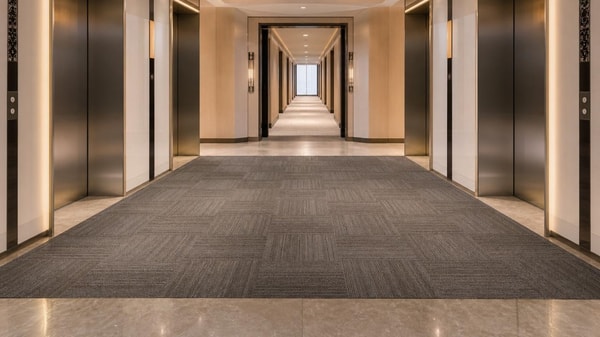
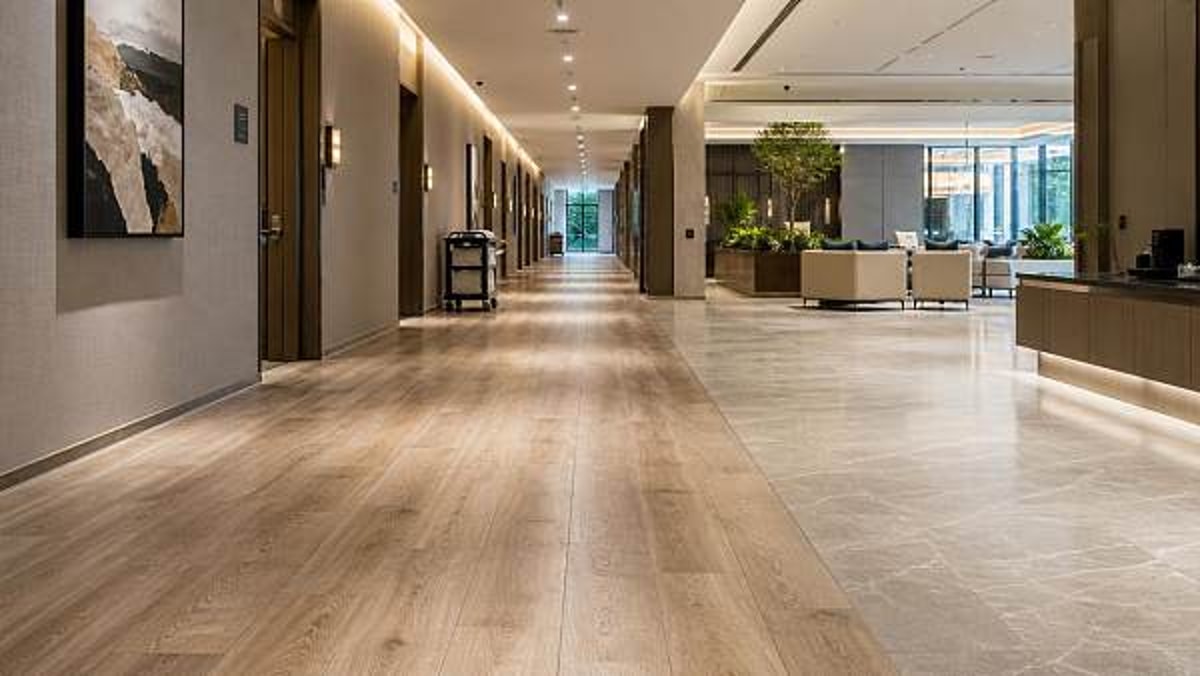
Luxury vinyl tile commercial flooring is particularly effective in spaces that require a clean visual presentation, regular foot traffic tolerance, and manageable maintenance. Hotel guest corridors, reception areas, meeting room circulation zones, retail sales floors, office common areas, education interiors, libraries, and mixed-use public areas are common examples.
In hospitality settings, LVT is often selected because it combines a premium look with faster maintenance turnaround. Unlike porous natural materials, many commercial LVT products are easier to clean and less likely to show dramatic wear variation across busy circulation routes. This helps operators maintain a consistent brand image with lower disruption to guests.
In office and education environments, acoustic comfort and underfoot feel can also influence selection. Compared with some harder surfaces, LVT may help reduce noise transmission and improve walking comfort, particularly when paired with appropriate backing systems or acoustic underlay solutions. For buildings where occupant comfort affects satisfaction, this can be a meaningful advantage.
Retail environments benefit from design flexibility and selective replaceability. If a localized area becomes damaged, individual tiles or planks may be replaced more efficiently than broadloom systems or some continuous-surface installations. For store operators trying to limit closure time, that feature can support business continuity.
Where caution is needed: not every high-traffic area has the same demands
One common mistake is treating all high-traffic zones as equivalent. They are not. Traffic volume is only one variable. The real performance question is the combination of traffic type, maintenance chemistry, load profile, moisture exposure, and substrate condition.
For example, entrances exposed to heavy grit, rainwater, and repeated wheeled traffic may place much greater stress on the floor than an interior corridor with constant pedestrian movement. Similarly, spaces with rolling hospital equipment, stock trolleys, or heavy service carts can create wear patterns and indentation risks that require more robust specification or an alternative flooring solution.
Commercial kitchens, wet rooms, and industrial service zones may also call for caution. While some resilient flooring systems are suitable for moisture-prone areas, not every luxury vinyl tile commercial product is ideal for standing water, grease exposure, heat fluctuation, or highly aggressive cleaning. In these areas, project teams should assess whether a specialized safety floor or another material category better fits the operating environment.
Direct sunlight and thermal movement are additional concerns. Large glazed areas, storefront zones, and sun-exposed atriums can create dimensional stress if the selected product is not designed for those conditions. Expansion behavior, installation method, and manufacturer guidance should be reviewed early in design development.
The specification factors that matter more than brand slogans
If decision-makers want to avoid expensive surprises, they should move beyond generic product claims and focus on measurable specification criteria. The first is wear layer thickness and overall construction quality. In demanding commercial use, the wear layer is a major predictor of how well the floor will resist scratches, scuffs, and visual degradation over time.
Second, evaluate indentation resistance and dimensional stability. In commercial spaces with furniture movement, mobile equipment, and varying environmental conditions, the floor must hold its shape and surface integrity. Product data should be reviewed in relation to actual site loads rather than marketing language.
Third, examine slip resistance in the context of the project. A floor that is acceptable in dry office use may not be appropriate in hospitality circulation near entrances or food service zones. Safety performance should align with real use conditions, not only laboratory assumptions.
Fourth, check acoustic performance if the project includes multi-story occupancy, guest comfort requirements, or learning environments. Reducing impact sound can influence user experience and lower complaints, especially in hotels, offices, and campus accommodation settings.
Fifth, confirm maintenance requirements. Some flooring products look cost-effective at procurement stage but require specific cleaners, strict polishing routines, or more frequent restorative work. Commercial buyers should compare maintenance protocols before making a final choice.
Finally, verify environmental and regulatory documentation. Depending on jurisdiction and project type, low-VOC certification, fire ratings, and third-party testing may be essential. For international buyers, documentation consistency is also a sign of supplier maturity and reliability.
Installation quality is often the real success factor
Even the best luxury vinyl tile commercial flooring can underperform if the installation process is weak. For project managers, this is one of the highest-value areas for risk control because many failures originate below the surface. Moisture in the subfloor, uneven substrates, improper adhesive selection, rushed curing times, and poor layout planning can all lead to premature issues.
Subfloor preparation is especially critical. Commercial LVT requires a stable, smooth, and properly tested base. If the substrate is not within flatness and moisture tolerances, visible telegraphing, adhesive failure, gapping, or edge lifting may occur. These are not minor cosmetic problems in active commercial environments; they can become maintenance issues, safety concerns, and warranty disputes.
Sequencing also matters. Flooring should be coordinated with HVAC commissioning, enclosure status, wet trades, millwork installation, and furniture movement. If LVT is installed too early in a compressed schedule, it may be exposed to site abuse before handover, reducing the perceived quality of the finished project.
Experienced installers and clear manufacturer-approved methods are therefore essential. Project teams should treat installation controls as part of procurement evaluation, not as an afterthought delegated solely to the subcontractor.
How luxury vinyl tile commercial flooring compares on lifecycle value
From a budget perspective, commercial flooring should be assessed over its full operating life. That includes material cost, installation complexity, maintenance labor, cleaning products, disruption during repair, replacement timing, and the effect on occupant experience. On this basis, luxury vinyl tile commercial flooring often performs strongly.
Compared with some premium natural materials, LVT can reduce upfront cost while still supporting a high-end visual concept. Compared with some soft-surface options, it may offer simpler daily maintenance and better resistance to staining in certain environments. Compared with cheaper resilient floors, a better-grade commercial LVT product may deliver longer visual retention and fewer replacement events.
The main financial advantage is predictability. When the flooring is properly specified and installed, operators often gain a more controllable maintenance profile and a clearer replacement strategy. That matters to project owners and facility managers who must plan capex and opex across multiple sites.
However, lifecycle value only holds if the product grade matches the use case. Under-specifying the floor to save on initial purchase can erase the entire value proposition. In practice, many flooring failures are not caused by choosing LVT, but by choosing the wrong LVT.
A practical evaluation checklist for project decision-makers
For teams evaluating options, a structured checklist can speed up decisions and reduce downstream risk. Start with use-case mapping. Identify entrances, corridors, service zones, public-facing areas, back-of-house routes, and any locations with wheeled traffic or moisture exposure. Do not specify the same build-up everywhere unless the performance demands are truly similar.
Then request technical data that addresses the project directly. Focus on wear layer, dimensional stability, indentation resistance, slip performance, acoustic properties, fire classification, VOC emissions, and warranty terms. Ask suppliers to explain how the proposed product has performed in similar commercial installations.
Next, review the maintenance model. Confirm daily cleaning requirements, periodic restoration needs, recommended chemicals, and likely repair procedures. If the building operator has limited maintenance resources, this should affect specification decisions.
After that, verify installation readiness. Require moisture testing protocols, substrate preparation standards, environmental condition requirements, and installer qualifications. Clarify responsibility lines before procurement is finalized.
Finally, evaluate supplier capability. For larger commercial programs, sourcing reliability matters as much as the sample board. Lead times, batch consistency, accessory availability, replacement stock planning, and documentation quality all influence project success.
What a strong sourcing decision looks like
A strong sourcing decision is not simply picking the lowest quote from a catalog. It is selecting a flooring system that aligns with the operational reality of the space, the brand expectation of the client, and the risk tolerance of the project team. In this context, the best luxury vinyl tile commercial choice is the one that performs consistently over time, not the one that only looks convincing during specification stage.
For global buyers and multi-site commercial developers, standardization can also be a strategic benefit. When a supplier can provide repeatable quality, clear compliance records, and dependable replenishment support, procurement becomes more efficient across regions and future refurbishments. This is especially valuable in hospitality groups, campus networks, and branded commercial rollouts.
Decision-makers should therefore look for evidence, not assumptions. Mockups, reference projects, maintenance projections, and transparent technical documentation provide a stronger basis for approval than generic claims about durability or style.
Conclusion
In high-traffic environments, luxury vinyl tile commercial flooring is often a smart and commercially balanced solution. It can deliver strong visual flexibility, good durability, easier maintenance, and favorable lifecycle value—but only when matched carefully to the actual demands of the space.
For project managers, the right approach is to evaluate LVT through the lens of performance risk: traffic type, load conditions, moisture, maintenance regime, compliance requirements, substrate readiness, and supplier reliability. When those factors are properly managed, LVT can support both design goals and operational efficiency in a wide range of commercial settings.
The key takeaway is simple: do not ask whether LVT is good in high-traffic areas in general. Ask whether a specific luxury vinyl tile commercial system is right for your specific high-traffic environment. That is the question that leads to better specifications, fewer failures, and stronger long-term project outcomes.
Search News
Hot Articles
Popular Tags
Need ExpertConsultation?
Connect with our specialized leisureengineering team for procurementstrategies.
Recommended News
 May 04, 2026Commercial Carpet Tiles for Hotels: What Wears Out First?Commercial carpet tiles hotel buyers: discover what wears out first in entrances, corridors, and transition zones, and learn how to specify longer-lasting, guest-ready flooring.● Hospitality Sourcing Dir
 May 04, 2026Custom Hotel Signage That Looks Premium and Stays ReadableCustom hotel signage that balances premium aesthetics with readability, durability, and compliance. Discover a practical checklist to improve guest experience and streamline hotel projects.● Hospitality Sourcing Dir
 May 04, 2026Luxury Vinyl Tile Commercial Flooring in High-Traffic AreasLuxury vinyl tile commercial flooring for high-traffic spaces: discover how to compare durability, maintenance, installation risks, and lifecycle value before you specify.● Hospitality Sourcing Dir
 May 03, 2026AC Milan’s Smart Locker Room Procurement Triggers UNI 11743 Compliance ReviewAC Milan’s smart locker room procurement triggers UNI 11743:2025 compliance review — critical for sports infrastructure suppliers, EU exporters & integrators.● Hospitality Sourcing Dir
 May 03, 2026Hotel room minibar fridges: silent operation is not enoughHotel room minibar fridges now require more than silent operation. Explore how energy efficiency, design fit, compliance, and lifecycle value shape smarter hotel sourcing.● Hospitality Sourcing Dir
 May 03, 2026HVAC systems for hotels: poor zoning raises energy bills quietlyHVAC systems for hotels can silently inflate energy bills when zoning is weak. Learn how smarter controls cut costs, improve guest comfort, and protect long-term hotel asset value.● Hospitality Sourcing Dir
 May 03, 2026Wooden coat hangers hotel projects should not overlook finish qualityWooden coat hangers hotel buyers should not ignore finish quality. Learn how smoothness, coating safety, and color consistency reduce complaints, protect brand image, and lower replacement costs.● Hospitality Sourcing Dir
 May 03, 2026Artificial plants for hotels: where they look premium, not fakeArtificial plants for hotels that look premium, not fake—discover how luxury properties use realistic faux greenery to elevate ambiance, cut maintenance, and protect brand consistency.● Hospitality Sourcing Dir
 May 03, 2026Commercial hand dryers can lower waste, but noise still mattersCommercial hand dryers reduce paper waste and maintenance costs, but noise can shape comfort and brand perception. Discover how to choose the right model for every commercial space.● Hospitality Sourcing Dir
 May 03, 2026Hotel hair dryers wall mounted: safety features worth checkingHotel hair dryers wall mounted: discover the safety features buyers should check first, from overheat protection to tamper resistance, for safer, smarter hotel sourcing.● Hospitality Sourcing Dir
 May 03, 2026Smart hotel room controls work best when systems talk to each otherSmart hotel room controls work best when HVAC, lighting, access, and service platforms connect seamlessly. Learn how interoperability improves efficiency, guest experience, and long-term scalability.● Hospitality Sourcing Dir
 May 03, 2026Automatic soap dispensers: battery life is not the only issueAutomatic soap dispensers are about more than battery life. Discover how sensor accuracy, refill compatibility, maintenance, and durability impact hygiene, cost, and user experience.● Hospitality Sourcing Dir
 May 03, 2026What hotels often miss when sourcing illuminated makeup mirrorsIlluminated makeup mirrors hotel buyers often miss key specs that affect guest satisfaction, maintenance, and brand value. Discover what to check before sourcing.● Hospitality Sourcing Dir
 May 03, 2026Commercial air purifiers: HEPA ratings that matter in hotelsCommercial air purifiers for hotels: learn which HEPA ratings truly matter for guest rooms, lobbies, and wellness zones to improve comfort, compliance, and smarter buying.● Hospitality Sourcing Dir
 May 03, 2026Wholesale toilet paper rolls: what affects true cost per useWholesale toilet paper rolls are not just about low case price. Learn what affects true cost per use, from sheet strength to dispenser fit, and source smarter for long-term savings.● Hospitality Sourcing Dir
 May 02, 2026Memory foam hotel mattresses: when soft comfort leads to faster saggingMemory foam hotel mattresses may feel luxurious at first, but can soft comfort cause faster sagging? Discover how buyers can reduce risk, improve durability, and protect hotel ROI.● Hospitality Sourcing Dir
 May 02, 2026Electronic hotel door locks: battery alerts are often less simple than they seemElectronic hotel door locks battery alerts are more complex than they appear. Learn how firmware, usage, and environment affect reliability, maintenance efficiency, and smarter sourcing.● Hospitality Sourcing Dir
 May 02, 2026Hotel housekeeping carts: the layout detail that saves minutes on every floorHotel housekeeping carts can save minutes on every floor. Discover how smarter cart layout improves workflow, reduces labor strain, and supports faster, more consistent room turnover.● Hospitality Sourcing Dir
 May 02, 2026Wholesale hotel safes: keypad reliability matters more than extra featuresWholesale hotel safes should be judged by keypad reliability first. Discover the checklist that helps buyers reduce lockouts, maintenance costs, and guest complaints.● Hospitality Sourcing Dir
 May 02, 2026Hotel lobby chandeliers: how size mistakes affect the whole arrival experienceHotel lobby chandeliers can make or break first impressions. Learn how sizing mistakes affect luxury, circulation, and brand value—and how to choose the right scale.● Hospitality Sourcing Dir
 May 02, 2026Industrial ironing machines: steam output is not the only thing to compareIndustrial ironing machines should be compared by more than steam output. Discover how temperature control, pressure stability, efficiency, and durability affect real commercial performance.● Hospitality Sourcing Dir
 May 02, 2026Blackout curtains for hotels that block light without trapping heatBlackout curtains for hotels that block light without trapping heat—discover smarter fabrics, thermal comfort benefits, and sourcing tips for better guest sleep and hotel performance.● Hospitality Sourcing Dir
 May 02, 2026Hotel luggage carts: why wheel quality matters more than frame finishHotel luggage carts perform best when wheel quality comes first. Discover how better casters reduce noise, protect floors, improve handling, and lower long-term hotel maintenance costs.● Hospitality Sourcing Dir
 May 02, 2026Custom printed hotel key cards: PVC or wood for a better guest feel?Custom printed hotel key cards: compare PVC and wood to find the best mix of guest feel, durability, sustainability, and brand impact for smarter hotel sourcing.● Hospitality Sourcing Dir