Hotel room minibar fridges: silent operation is not enough
For hotel procurement teams, choosing hotel room minibar fridges is no longer just about quiet performance. Today’s buyers must balance guest comfort, energy efficiency, design integration, compliance, and long-term operating costs. In a competitive hospitality market, silent operation is only the starting point—smart sourcing decisions depend on understanding what truly drives value, brand perception, and reliable in-room experience.
The market signal is clear: minibar expectations have shifted
Across the hospitality sector, hotel room minibar fridges are being reassessed as part of a broader guest room strategy rather than treated as a minor accessory. This change is driven by three visible signals. First, guests increasingly judge rooms by the overall quality of the in-room environment, including sleep quality, ease of use, and visual consistency. Second, operators are under pressure to reduce energy consumption and document sustainability improvements. Third, asset owners want equipment that supports brand standards across multiple properties without creating excessive maintenance complexity.
That means silent operation, while still essential, no longer guarantees procurement success. A fridge that is quiet but inefficient, poorly ventilated, too small for the room concept, or costly to service may damage operating performance over time. For procurement professionals, the real question is not whether a minibar is silent enough, but whether it fits the next generation of hotel requirements.
Why hotel room minibar fridges are under closer scrutiny now
Several forces are changing how buyers evaluate hotel room minibar fridges. Energy prices remain a concern in many markets, making always-on equipment more visible in cost reviews. Sustainability reporting is also becoming more practical and less optional, especially for international hotel groups and owners working toward ESG targets. In parallel, design teams are demanding cleaner room aesthetics, better furniture integration, and fewer guest complaints related to heat build-up or awkward door clearance.
Another important factor is the changing role of the minibar itself. In some properties, traditional pay-per-item minibar sales have weakened. In others, the unit has evolved into a premium convenience cooler for complimentary water, wellness products, family use, or long-stay service. This shift changes the performance criteria. The unit must now support the property’s positioning, not just hold beverages quietly.
A practical view of the trend
The technology conversation has moved beyond “silent”
The old assumption was simple: if a minibar was quiet, it was suitable for guestrooms. Today, procurement teams need to look deeper into cooling technology, heat dissipation, controls, insulation quality, and durability. Different technologies offer different trade-offs. Some are known for near-silent performance, while others deliver stronger cooling or better efficiency depending on room conditions and usage patterns.
What matters is not chasing a single feature but matching the product to the property type. A luxury city hotel with strong design expectations may prioritize ultra-quiet operation and seamless cabinetry integration. A resort or extended-stay property may place greater value on capacity, temperature stability, and energy performance. Procurement decisions improve when technical evaluation is linked directly to the hotel’s service model and guest profile.
This is where many sourcing mistakes still happen. Buyers compare hotel room minibar fridges on brochure claims but fail to test how units perform inside enclosed furniture, in warmer corridors, or under frequent door opening. Real-world performance data is becoming more important than generic product marketing.
Design integration is now part of equipment performance
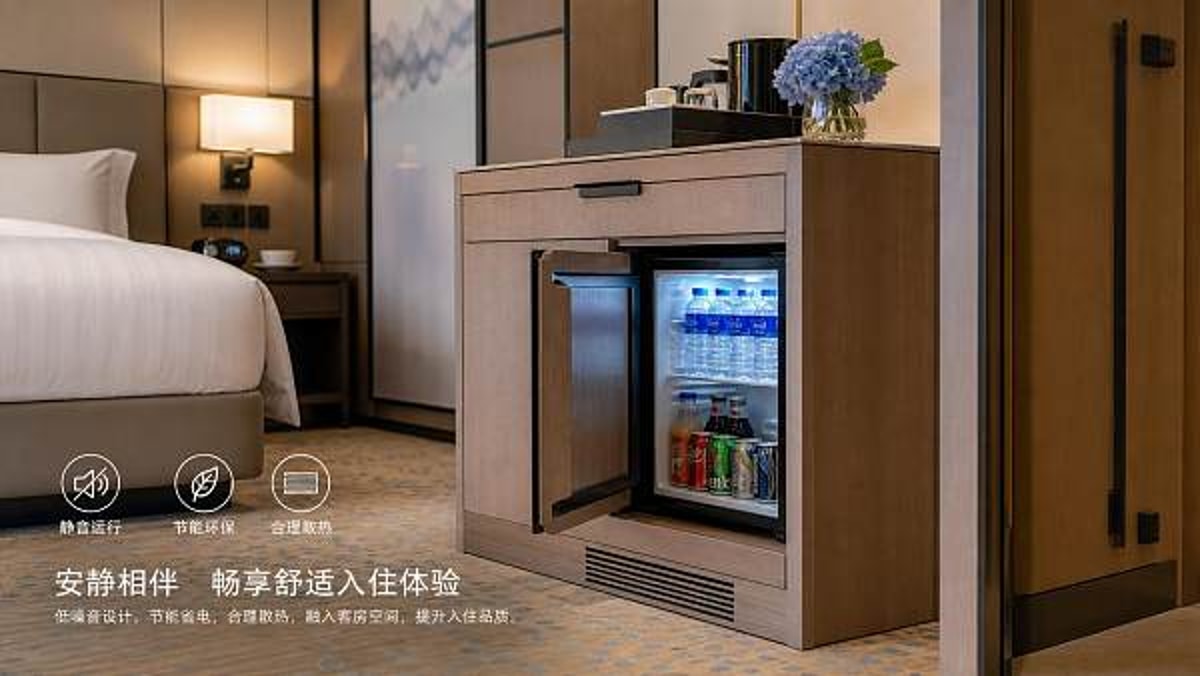
In premium and upper-midscale hospitality, minibar selection increasingly sits at the intersection of procurement, interior design, engineering, and operations. A well-specified unit should complement the room concept, fit millwork correctly, allow ventilation, and align with the brand’s visual standards. If the installation is poor, even a high-quality fridge may underperform.
This matters because guest perception is holistic. A unit that hums less but radiates heat into cabinetry, has a poorly lit interior, or feels cheap in a luxury room still weakens the guest experience. Procurement teams are therefore evaluating finish quality, handle design, reversibility, internal layout, shelving flexibility, and door behavior alongside core refrigeration performance.
For suppliers, this trend raises the bar. Commercial buyers increasingly prefer partners that can support specification drawings, installation guidance, and custom-fit requirements instead of offering standard products without project coordination.
Compliance and sustainability are becoming purchasing filters, not bonus features
One of the strongest changes in the market is that compliance documentation is moving earlier in the sourcing process. For hotel room minibar fridges, procurement teams now expect clarity on electrical safety, energy labeling where applicable, restricted substances, and market-specific certification requirements. This is especially important for cross-border hotel groups, mixed-use developments, and buyers consolidating procurement across regions.
Sustainability is also reshaping the shortlist. Even when regulations differ by market, buyers are asking whether a product contributes to lower room energy loads, longer service life, and reduced replacement frequency. The preferred supplier is no longer only the one with the right price and finish, but the one able to provide reliable technical files, transparent specifications, and realistic lifecycle support.
Key drivers behind the new sourcing mindset
Who feels the impact most in the hotel buying process
The shift in hotel room minibar fridges affects more than procurement managers. Engineering teams care about ventilation, installation, and maintenance access. Finance teams focus on energy and replacement cycles. Designers want visual consistency and cabinet compatibility. Operations teams care about complaint reduction and replenishment practicality. Owners want assets that support long-term value instead of hidden expense.
Because the minibar sits at the junction of guest comfort and room infrastructure, poor decisions create cross-functional problems. A low-cost purchasing win can become an engineering burden, a design compromise, and an operational headache. That is why better organizations are using cross-department evaluation criteria before approving models for rollout.
What smart buyers should evaluate before the next sourcing cycle
The most effective approach is to assess hotel room minibar fridges through a decision framework that reflects current market reality. Procurement teams should verify measured noise performance, but they should also review power consumption, internal usable capacity, ambient operating suitability, cooling recovery, cabinet ventilation requirements, shelf configuration, and service support availability. These points have direct impact on real operating value.
It is also wise to compare products at project level rather than unit level. A minibar that costs slightly more upfront may perform better across hundreds of rooms through lower energy use, fewer service calls, and stronger guest satisfaction. In hospitality procurement, the fleet effect matters. Small specification differences multiply quickly at property and portfolio scale.
Another useful step is pilot testing. Before committing to volume orders, hotels can install shortlisted models in a limited number of rooms and gather input from housekeeping, engineering, and guest service teams. This reduces the risk of choosing hotel room minibar fridges based solely on catalog specifications.
Signals worth watching over the next few buying cycles
Looking ahead, several signals deserve attention. One is the continued demand for products that combine guest-friendly quietness with stronger environmental performance. Another is the growing preference for suppliers that can support customization, documentation, and international project coordination. A third is the rise of procurement models that standardize approved equipment families across brands or ownership groups.
Hotels are also becoming more selective about the actual purpose of the minibar. In some cases, a compact premium cooler remains essential to the room proposition. In others, the hotel may reconsider size, layout, or stocking strategy. This means buyers should not only compare products; they should also question the operational role the product is meant to serve.
A better sourcing direction for procurement teams
The strongest sourcing direction is to treat hotel room minibar fridges as a strategic room equipment category. That means aligning specification with guest promise, operating model, sustainability targets, and maintenance realities. It also means screening suppliers not just for manufacturing capacity, but for documentation quality, responsiveness, and ability to support commercial projects over time.
For procurement leaders, the takeaway is simple: silent operation is still required, but it is no longer the main differentiator. The better decision comes from understanding which market changes are reshaping value and then buying accordingly. If your team is reviewing hotel room minibar fridges for new developments, renovations, or brand-standard updates, the most useful next step is to confirm five points: how the unit performs in real installation conditions, how much energy it consumes across the portfolio, what compliance evidence is available, how easily it can be serviced, and whether it truly supports the guest experience your property is trying to deliver.
For organizations seeking stronger sourcing intelligence, this is exactly where a trusted B2B insight platform adds value: by helping buyers connect product specification with broader market direction, supplier capability, and long-term commercial outcomes.
Search News
Hot Articles
Popular Tags
Need ExpertConsultation?
Connect with our specialized leisureengineering team for procurementstrategies.
Recommended News
 May 03, 2026Hotel room minibar fridges: silent operation is not enoughHotel room minibar fridges now require more than silent operation. Explore how energy efficiency, design fit, compliance, and lifecycle value shape smarter hotel sourcing.● Hospitality Sourcing Dir
 May 03, 2026HVAC systems for hotels: poor zoning raises energy bills quietlyHVAC systems for hotels can silently inflate energy bills when zoning is weak. Learn how smarter controls cut costs, improve guest comfort, and protect long-term hotel asset value.● Hospitality Sourcing Dir
 May 03, 2026Wooden coat hangers hotel projects should not overlook finish qualityWooden coat hangers hotel buyers should not ignore finish quality. Learn how smoothness, coating safety, and color consistency reduce complaints, protect brand image, and lower replacement costs.● Hospitality Sourcing Dir
 May 03, 2026Artificial plants for hotels: where they look premium, not fakeArtificial plants for hotels that look premium, not fake—discover how luxury properties use realistic faux greenery to elevate ambiance, cut maintenance, and protect brand consistency.● Hospitality Sourcing Dir
 May 03, 2026Commercial hand dryers can lower waste, but noise still mattersCommercial hand dryers reduce paper waste and maintenance costs, but noise can shape comfort and brand perception. Discover how to choose the right model for every commercial space.● Hospitality Sourcing Dir
 May 03, 2026Hotel hair dryers wall mounted: safety features worth checkingHotel hair dryers wall mounted: discover the safety features buyers should check first, from overheat protection to tamper resistance, for safer, smarter hotel sourcing.● Hospitality Sourcing Dir
 May 03, 2026Smart hotel room controls work best when systems talk to each otherSmart hotel room controls work best when HVAC, lighting, access, and service platforms connect seamlessly. Learn how interoperability improves efficiency, guest experience, and long-term scalability.● Hospitality Sourcing Dir
 May 03, 2026Automatic soap dispensers: battery life is not the only issueAutomatic soap dispensers are about more than battery life. Discover how sensor accuracy, refill compatibility, maintenance, and durability impact hygiene, cost, and user experience.● Hospitality Sourcing Dir
 May 03, 2026What hotels often miss when sourcing illuminated makeup mirrorsIlluminated makeup mirrors hotel buyers often miss key specs that affect guest satisfaction, maintenance, and brand value. Discover what to check before sourcing.● Hospitality Sourcing Dir
 May 03, 2026Commercial air purifiers: HEPA ratings that matter in hotelsCommercial air purifiers for hotels: learn which HEPA ratings truly matter for guest rooms, lobbies, and wellness zones to improve comfort, compliance, and smarter buying.● Hospitality Sourcing Dir
 May 03, 2026Wholesale toilet paper rolls: what affects true cost per useWholesale toilet paper rolls are not just about low case price. Learn what affects true cost per use, from sheet strength to dispenser fit, and source smarter for long-term savings.● Hospitality Sourcing Dir
 May 02, 2026Memory foam hotel mattresses: when soft comfort leads to faster saggingMemory foam hotel mattresses may feel luxurious at first, but can soft comfort cause faster sagging? Discover how buyers can reduce risk, improve durability, and protect hotel ROI.● Hospitality Sourcing Dir
 May 02, 2026Electronic hotel door locks: battery alerts are often less simple than they seemElectronic hotel door locks battery alerts are more complex than they appear. Learn how firmware, usage, and environment affect reliability, maintenance efficiency, and smarter sourcing.● Hospitality Sourcing Dir
 May 02, 2026Hotel housekeeping carts: the layout detail that saves minutes on every floorHotel housekeeping carts can save minutes on every floor. Discover how smarter cart layout improves workflow, reduces labor strain, and supports faster, more consistent room turnover.● Hospitality Sourcing Dir
 May 02, 2026Wholesale hotel safes: keypad reliability matters more than extra featuresWholesale hotel safes should be judged by keypad reliability first. Discover the checklist that helps buyers reduce lockouts, maintenance costs, and guest complaints.● Hospitality Sourcing Dir
 May 02, 2026Hotel lobby chandeliers: how size mistakes affect the whole arrival experienceHotel lobby chandeliers can make or break first impressions. Learn how sizing mistakes affect luxury, circulation, and brand value—and how to choose the right scale.● Hospitality Sourcing Dir
 May 02, 2026Industrial ironing machines: steam output is not the only thing to compareIndustrial ironing machines should be compared by more than steam output. Discover how temperature control, pressure stability, efficiency, and durability affect real commercial performance.● Hospitality Sourcing Dir
 May 02, 2026Blackout curtains for hotels that block light without trapping heatBlackout curtains for hotels that block light without trapping heat—discover smarter fabrics, thermal comfort benefits, and sourcing tips for better guest sleep and hotel performance.● Hospitality Sourcing Dir
 May 02, 2026Hotel luggage carts: why wheel quality matters more than frame finishHotel luggage carts perform best when wheel quality comes first. Discover how better casters reduce noise, protect floors, improve handling, and lower long-term hotel maintenance costs.● Hospitality Sourcing Dir
 May 02, 2026Custom printed hotel key cards: PVC or wood for a better guest feel?Custom printed hotel key cards: compare PVC and wood to find the best mix of guest feel, durability, sustainability, and brand impact for smarter hotel sourcing.● Hospitality Sourcing Dir
 May 02, 2026Commercial laundry equipment sizing mistakes that raise utility billsCommercial laundry equipment sizing mistakes can quietly drive up water, energy, and labor costs. Learn the biggest planning errors and how smarter sizing protects budgets and efficiency.● Hospitality Sourcing Dir
 May 02, 2026Why some wholesale bath towels for hotels wear out too fastWholesale bath towels for hotels can wear out fast due to fiber quality, GSM, weave, and laundering mismatch. Learn how to choose durable towels that cut replacement costs and protect guest experience.● Hospitality Sourcing Dir
 May 01, 2026Hotel Desks That Work for Both Business Guests and Small RoomsHotel desks for compact rooms: learn how to choose durable, space-saving, business-friendly designs that improve guest satisfaction and simplify hotel procurement.● Hospitality Sourcing Dir
 May 01, 2026Hotel Slippers in Bulk: Cheap Pairs Can Hurt Guest PerceptionHotel slippers bulk choices affect more than cost. Discover how cheap pairs can damage guest perception, comfort, and brand value—and how smarter sourcing improves reviews.● Hospitality Sourcing Dir