Commercial air purifiers: HEPA ratings that matter in hotels
For hotel technical evaluators, selecting commercial air purifiers is not just about cleaner air—it is about verified HEPA performance, guest comfort, noise control, and compliance. This guide highlights the HEPA ratings that truly matter in hotel environments, helping procurement and engineering teams compare specifications with confidence and choose systems that support both operational efficiency and premium guest experience.
Why hotel scenarios change how commercial air purifiers should be evaluated
In hotels, the same air cleaning target rarely applies across all spaces. A guest room, a lobby lounge, a meeting room, a spa corridor, and a back-of-house office all create different airflow patterns, occupancy cycles, acoustic limits, and maintenance constraints. That is why technical evaluation teams should not treat commercial air purifiers as a simple category purchase based only on airflow or a general HEPA claim.
The practical question is not merely whether a unit has a HEPA filter, but which HEPA rating is used, how it is tested, what particle size efficiency is stated, and whether the full system can maintain that performance under real hotel operating conditions. For premium properties, wrong selection can lead to noise complaints, visible equipment mismatch, pressure on housekeeping routines, and poor total cost of ownership. For larger chains, inconsistent specification can also complicate brand standards and regional compliance.
For this reason, the most reliable way to assess commercial air purifiers is through a scenario-based framework. The evaluator should connect HEPA rating, clean air delivery, noise, pressure drop, filter life, controls, and service access to the actual use case inside the hotel.
The HEPA ratings that matter most in hotel projects
Many procurement documents use “HEPA” as a broad requirement, but technical teams need more precision. In commercial air purifiers, the filter grade often follows EN 1822 or ISO 29463 style classifications, with common grades such as H13 and H14. In practical terms, H13 is frequently sufficient for many hotel applications when paired with appropriate airflow, sealing quality, and low leakage design. H14 provides higher capture efficiency and may be justified in spaces where brand positioning, health sensitivity, or duty cycle demands a more conservative specification.
However, the filter grade alone is not enough. Evaluators should confirm at least five points:
- Whether the HEPA rating is stated by recognized test standards rather than marketing language.
- Whether the published efficiency refers to the most penetrating particle size, not only large particles.
- Whether the housing, gasket, and frame design minimize bypass leakage.
- Whether CADR or effective airflow remains acceptable after pressure loss through the final filter.
- Whether replacement filters are traceable, consistently available, and easy for facilities teams to source.
For hotels, this means a verified H13 unit with good acoustics and stable supply support may outperform a poorly engineered H14 product in real deployment. Commercial air purifiers should therefore be evaluated as full systems, not as filter labels.
Typical hotel application scenarios and what to prioritize
Different hotel zones create different buying logic. Technical evaluators should align specification to occupancy intensity, expected guest sensitivity, room volume, and operating schedule.
Scenario 1: Guest rooms require quiet, verified purification rather than maximum fan power
Guest rooms are the most sensitive application for commercial air purifiers because the equipment operates close to occupants during sleep, work, and in-room dining. Here, an H13 HEPA specification is often the baseline that balances efficiency and pressure drop. Technical evaluators should focus on sound levels at the actual operating speed needed to reach target air changes per hour, not only the lowest speed listed in brochures.
In upscale hotels, the best unit is usually not the one with the highest advertised airflow. It is the one that can maintain effective purification quietly, fit discreetly into the room design, and allow simple filter replacement with minimal downtime. If the property has wellness packages, allergy-sensitive guest segments, or brand messaging centered on indoor environmental quality, H14 can be considered. Still, it should be justified by acoustic and maintenance performance, not prestige alone.
Scenario 2: Lobbies and open public spaces need air volume first, then HEPA grade clarity
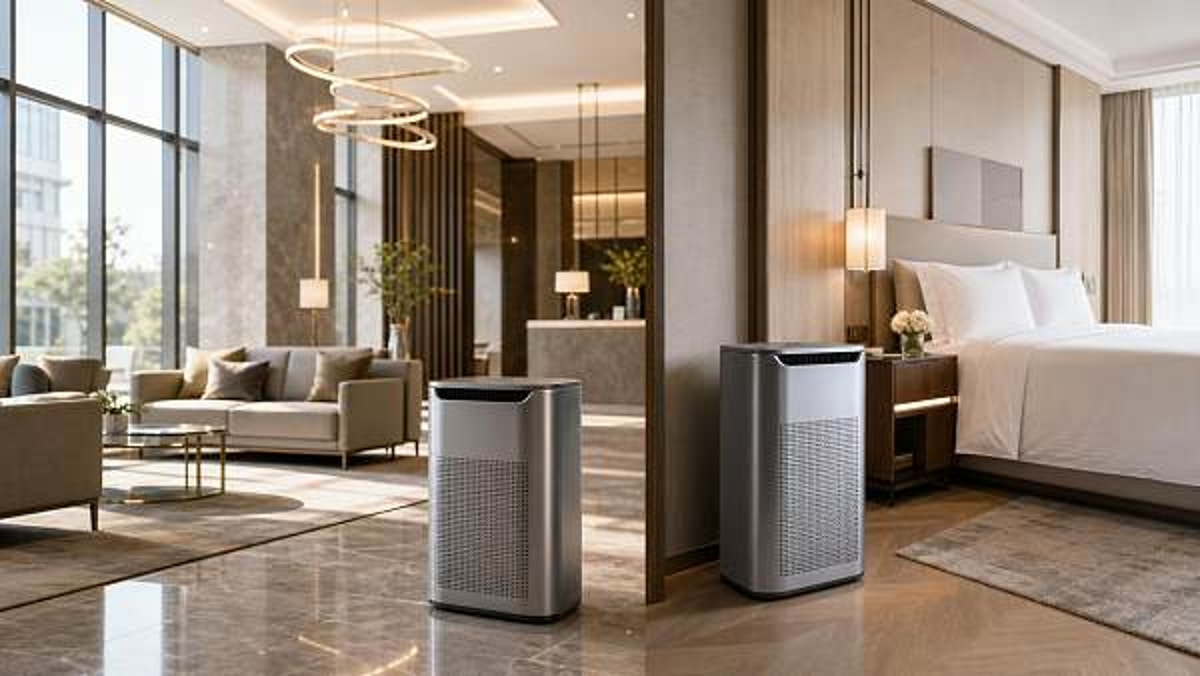
In large reception zones, lounge areas, and waiting spaces, the common mistake is overvaluing the HEPA label while underestimating room volume and air mixing. A beautifully engineered H14 purifier that cannot move enough air across a high-ceiling lobby may deliver less real benefit than multiple well-placed H13 commercial air purifiers with strong CADR and reliable circulation planning.
Evaluators should ask suppliers for recommended coverage under commercial occupancy, not residential-style maximum area claims. They should also check intake and discharge direction, as poor placement near doors, decorative partitions, or soft seating clusters can limit performance. For this scenario, the right answer is often a distributed deployment strategy instead of a single larger unit.
Scenario 3: Meeting rooms and event spaces require response speed and control logic
Conference rooms and ballrooms are dynamic spaces. Occupancy can rise sharply during presentations, then drop between sessions. In such cases, the evaluator should study how quickly commercial air purifiers can restore target air quality after dense use periods. HEPA grade matters, but so do fan ramp-up capability, particulate sensing accuracy, and integration with booking or BMS schedules.
For executive boardrooms, acoustics and appearance may push selection toward quieter H13 or H14 units with refined industrial design. For divisible event halls, modular fleets may be preferable so output can be adjusted by room configuration. The best specification here combines verified filtration with operational flexibility.
Scenario 4: Wellness and premium zones often justify stricter HEPA expectations
Spa treatment rooms, meditation areas, private lounges, and club floors are where guest perception and brand storytelling matter most. In these spaces, technical evaluators may reasonably favor H14-rated commercial air purifiers when the property wants a stronger documented position on indoor cleanliness. Yet even here, a balanced specification is essential.
Some buyers mistakenly expect HEPA filters to solve every air quality issue. They do not remove all gaseous pollutants or odors by themselves. If wellness areas involve aroma oils, cleaning chemicals, or adjacent food and beverage influence, activated carbon or another gas-phase strategy may be needed alongside HEPA filtration. This is a key specification detail in premium hotels where guest expectation is holistic, not particle-only.
How to compare commercial air purifiers beyond the HEPA claim
When technical teams issue RFQs or shortlist suppliers, a structured comparison sheet can prevent brand-led or marketing-led decisions. Commercial air purifiers should be assessed across system performance, service practicality, and scenario fit.
Common hotel-side mistakes when judging HEPA ratings
One frequent mistake is assuming that a higher HEPA grade always means a better commercial air purifier for every scenario. In reality, a tighter filter can increase resistance, require more fan energy, and create more noise if the product is not engineered properly. Another mistake is evaluating only nominal room coverage without checking ceiling height, occupancy peaks, and furniture layout.
Technical teams also sometimes overlook filter lifecycle economics. If replacement media are proprietary, expensive, or hard to source regionally, the hotel may face operational disruption later. Finally, some projects specify particle filtration but forget the difference between PM control and odor or VOC management. In mixed-use hotel environments, this gap can create post-installation dissatisfaction even when the HEPA system itself performs as promised.
A practical decision path for technical evaluators
A strong evaluation process starts with zoning. Group the property into guest rooms, open public areas, event spaces, wellness spaces, and staff areas. Then define the required outcome for each zone: quiet comfort, rapid particle reduction, premium assurance, or economical continuous operation. Only after that should the team match HEPA grade, airflow target, noise threshold, and service model.
For many hotel projects, the answer will not be a single specification across the entire building. A mixed strategy is often more efficient: H13 commercial air purifiers for standard guest rooms and staff zones, stronger airflow units for lobbies and banquet spaces, and selectively upgraded H14 units for wellness or executive settings. This approach aligns capital cost with real business value.
FAQ for selecting commercial air purifiers in hotels
Is H14 always better than H13 for hotels?
Not always. H14 offers higher filtration efficiency, but hotel suitability depends on airflow, acoustics, energy use, and maintenance. In many guestrooms and public areas, a well-designed H13 system can be the better operational choice.
What matters more in a large lobby: HEPA grade or CADR?
Both matter, but inadequate air volume is a common failure point. In large open areas, commercial air purifiers must move enough air to create meaningful turnover, so CADR and placement are often just as important as the HEPA grade.
Do commercial air purifiers solve odors in hotels?
Not by HEPA filtration alone. HEPA is designed for particles. If odor control is a project goal, technical evaluators should review activated carbon or other gas-phase treatment options.
How should multi-property hotel groups standardize specifications?
Use a zone-based standard rather than a single universal model. Define minimum HEPA grade, sound level, control features, and service requirements by scenario, then allow regional sourcing flexibility where compliance and support conditions differ.
Final recommendation: match the HEPA rating to the hotel scenario, not the brochure headline
For technical evaluators, the right commercial air purifiers are those that align verified HEPA performance with the realities of hotel use. Guest rooms demand quiet confidence. Lobbies demand air movement. Event spaces demand adaptability. Wellness zones may justify higher HEPA assurance, but only when integrated into a broader indoor air quality strategy.
The most effective next step is to create a zone-by-zone evaluation matrix before requesting quotations. By comparing H13 and H14 options against airflow, noise, maintenance, controls, and supply continuity, hotel teams can select commercial air purifiers that support both engineering logic and premium guest experience with fewer specification mistakes.
Search News
Hot Articles
Popular Tags
Need ExpertConsultation?
Connect with our specialized leisureengineering team for procurementstrategies.
Recommended News
 May 03, 2026Hotel room minibar fridges: silent operation is not enoughHotel room minibar fridges now require more than silent operation. Explore how energy efficiency, design fit, compliance, and lifecycle value shape smarter hotel sourcing.● Hospitality Sourcing Dir
 May 03, 2026HVAC systems for hotels: poor zoning raises energy bills quietlyHVAC systems for hotels can silently inflate energy bills when zoning is weak. Learn how smarter controls cut costs, improve guest comfort, and protect long-term hotel asset value.● Hospitality Sourcing Dir
 May 03, 2026Wooden coat hangers hotel projects should not overlook finish qualityWooden coat hangers hotel buyers should not ignore finish quality. Learn how smoothness, coating safety, and color consistency reduce complaints, protect brand image, and lower replacement costs.● Hospitality Sourcing Dir
 May 03, 2026Artificial plants for hotels: where they look premium, not fakeArtificial plants for hotels that look premium, not fake—discover how luxury properties use realistic faux greenery to elevate ambiance, cut maintenance, and protect brand consistency.● Hospitality Sourcing Dir
 May 03, 2026Commercial hand dryers can lower waste, but noise still mattersCommercial hand dryers reduce paper waste and maintenance costs, but noise can shape comfort and brand perception. Discover how to choose the right model for every commercial space.● Hospitality Sourcing Dir
 May 03, 2026Hotel hair dryers wall mounted: safety features worth checkingHotel hair dryers wall mounted: discover the safety features buyers should check first, from overheat protection to tamper resistance, for safer, smarter hotel sourcing.● Hospitality Sourcing Dir
 May 03, 2026Smart hotel room controls work best when systems talk to each otherSmart hotel room controls work best when HVAC, lighting, access, and service platforms connect seamlessly. Learn how interoperability improves efficiency, guest experience, and long-term scalability.● Hospitality Sourcing Dir
 May 03, 2026Automatic soap dispensers: battery life is not the only issueAutomatic soap dispensers are about more than battery life. Discover how sensor accuracy, refill compatibility, maintenance, and durability impact hygiene, cost, and user experience.● Hospitality Sourcing Dir
 May 03, 2026What hotels often miss when sourcing illuminated makeup mirrorsIlluminated makeup mirrors hotel buyers often miss key specs that affect guest satisfaction, maintenance, and brand value. Discover what to check before sourcing.● Hospitality Sourcing Dir
 May 03, 2026Commercial air purifiers: HEPA ratings that matter in hotelsCommercial air purifiers for hotels: learn which HEPA ratings truly matter for guest rooms, lobbies, and wellness zones to improve comfort, compliance, and smarter buying.● Hospitality Sourcing Dir
 May 03, 2026Wholesale toilet paper rolls: what affects true cost per useWholesale toilet paper rolls are not just about low case price. Learn what affects true cost per use, from sheet strength to dispenser fit, and source smarter for long-term savings.● Hospitality Sourcing Dir
 May 02, 2026Memory foam hotel mattresses: when soft comfort leads to faster saggingMemory foam hotel mattresses may feel luxurious at first, but can soft comfort cause faster sagging? Discover how buyers can reduce risk, improve durability, and protect hotel ROI.● Hospitality Sourcing Dir
 May 02, 2026Electronic hotel door locks: battery alerts are often less simple than they seemElectronic hotel door locks battery alerts are more complex than they appear. Learn how firmware, usage, and environment affect reliability, maintenance efficiency, and smarter sourcing.● Hospitality Sourcing Dir
 May 02, 2026Hotel housekeeping carts: the layout detail that saves minutes on every floorHotel housekeeping carts can save minutes on every floor. Discover how smarter cart layout improves workflow, reduces labor strain, and supports faster, more consistent room turnover.● Hospitality Sourcing Dir
 May 02, 2026Wholesale hotel safes: keypad reliability matters more than extra featuresWholesale hotel safes should be judged by keypad reliability first. Discover the checklist that helps buyers reduce lockouts, maintenance costs, and guest complaints.● Hospitality Sourcing Dir
 May 02, 2026Hotel lobby chandeliers: how size mistakes affect the whole arrival experienceHotel lobby chandeliers can make or break first impressions. Learn how sizing mistakes affect luxury, circulation, and brand value—and how to choose the right scale.● Hospitality Sourcing Dir
 May 02, 2026Industrial ironing machines: steam output is not the only thing to compareIndustrial ironing machines should be compared by more than steam output. Discover how temperature control, pressure stability, efficiency, and durability affect real commercial performance.● Hospitality Sourcing Dir
 May 02, 2026Blackout curtains for hotels that block light without trapping heatBlackout curtains for hotels that block light without trapping heat—discover smarter fabrics, thermal comfort benefits, and sourcing tips for better guest sleep and hotel performance.● Hospitality Sourcing Dir
 May 02, 2026Hotel luggage carts: why wheel quality matters more than frame finishHotel luggage carts perform best when wheel quality comes first. Discover how better casters reduce noise, protect floors, improve handling, and lower long-term hotel maintenance costs.● Hospitality Sourcing Dir
 May 02, 2026Custom printed hotel key cards: PVC or wood for a better guest feel?Custom printed hotel key cards: compare PVC and wood to find the best mix of guest feel, durability, sustainability, and brand impact for smarter hotel sourcing.● Hospitality Sourcing Dir
 May 02, 2026Commercial laundry equipment sizing mistakes that raise utility billsCommercial laundry equipment sizing mistakes can quietly drive up water, energy, and labor costs. Learn the biggest planning errors and how smarter sizing protects budgets and efficiency.● Hospitality Sourcing Dir
 May 02, 2026Why some wholesale bath towels for hotels wear out too fastWholesale bath towels for hotels can wear out fast due to fiber quality, GSM, weave, and laundering mismatch. Learn how to choose durable towels that cut replacement costs and protect guest experience.● Hospitality Sourcing Dir
 May 01, 2026Hotel Desks That Work for Both Business Guests and Small RoomsHotel desks for compact rooms: learn how to choose durable, space-saving, business-friendly designs that improve guest satisfaction and simplify hotel procurement.● Hospitality Sourcing Dir
 May 01, 2026Hotel Slippers in Bulk: Cheap Pairs Can Hurt Guest PerceptionHotel slippers bulk choices affect more than cost. Discover how cheap pairs can damage guest perception, comfort, and brand value—and how smarter sourcing improves reviews.● Hospitality Sourcing Dir