Commercial hand dryers can lower waste, but noise still matters
Commercial hand dryers are increasingly valued for reducing paper waste, cutting maintenance, and supporting cleaner restroom operations. Yet for facility planners and procurement teams, noise remains a critical factor that can affect user comfort, brand perception, and space suitability. Understanding how commercial hand dryers balance sustainability with acoustic performance is essential when evaluating the right solution for modern commercial environments.
For information-focused buyers in hospitality, education, office, leisure, and premium retail environments, the decision is rarely about drying speed alone. A unit that performs well in a high-traffic airport restroom may feel disruptive in a boutique hotel lobby washroom or a smart campus library building. In B2B sourcing, commercial hand dryers must be assessed through a wider lens that includes operating cost, acoustic profile, hygiene expectations, maintenance workload, and design fit.
This is especially relevant for organizations managing multiple sites or premium guest-facing spaces. In those settings, even a 5 to 10 dB difference can influence perceived comfort, while a change from paper towels to dryers can alter cleaning frequency, waste handling, and restroom traffic flow. The right procurement decision depends on matching product characteristics to the space, not simply choosing the fastest or cheapest machine.
Why commercial hand dryers remain attractive in modern facilities
The strongest business case for commercial hand dryers is operational efficiency over time. In many commercial restrooms, paper systems create recurring costs across 3 areas: consumables, labor, and waste disposal. Hand dryers reduce or eliminate the need to refill dispensers daily, collect wet paper from floors, and manage higher bag volumes during peak use periods. For multi-site operators, those savings can become easier to predict over a 12- to 36-month planning window.
Waste reduction and maintenance advantages
Paper towels still have a role in certain hygiene-sensitive or user-preference-driven environments, but they also create visible waste. In high-footfall spaces such as convention venues, amusement parks, and transport-adjacent hospitality sites, bins may require attention several times per day. Commercial hand dryers can lower that pressure by removing one of the most frequently replaced restroom consumables.
This reduction matters not only for sustainability messaging but also for housekeeping logistics. If a facility team can move from 4 to 6 paper restocking rounds per day down to 1 to 2 general inspection rounds, labor can be redirected toward broader cleaning standards, guest support, or maintenance response. For facilities already working under tight staffing ratios, that operational flexibility is significant.
The comparison below outlines how procurement teams often evaluate the trade-offs between paper-based systems and commercial hand dryers in real operating conditions.
The table shows why commercial hand dryers often appeal to procurement teams seeking lower recurring waste and more predictable servicing. However, the final decision should not stop at maintenance savings. Acoustic performance can directly influence whether the equipment improves or harms the user experience.
Where the sustainability case is strongest
The strongest fit is usually found in restrooms with medium to high daily traffic, stable electrical infrastructure, and cleaning teams that benefit from fewer consumable tasks. Typical examples include hotels with 100 to 300 rooms, office towers with shared washrooms, educational campuses, cinema or theme-park facilities, and large-format specialty retail. In these environments, commercial hand dryers can support a cleaner operating model without requiring continuous supply replenishment.
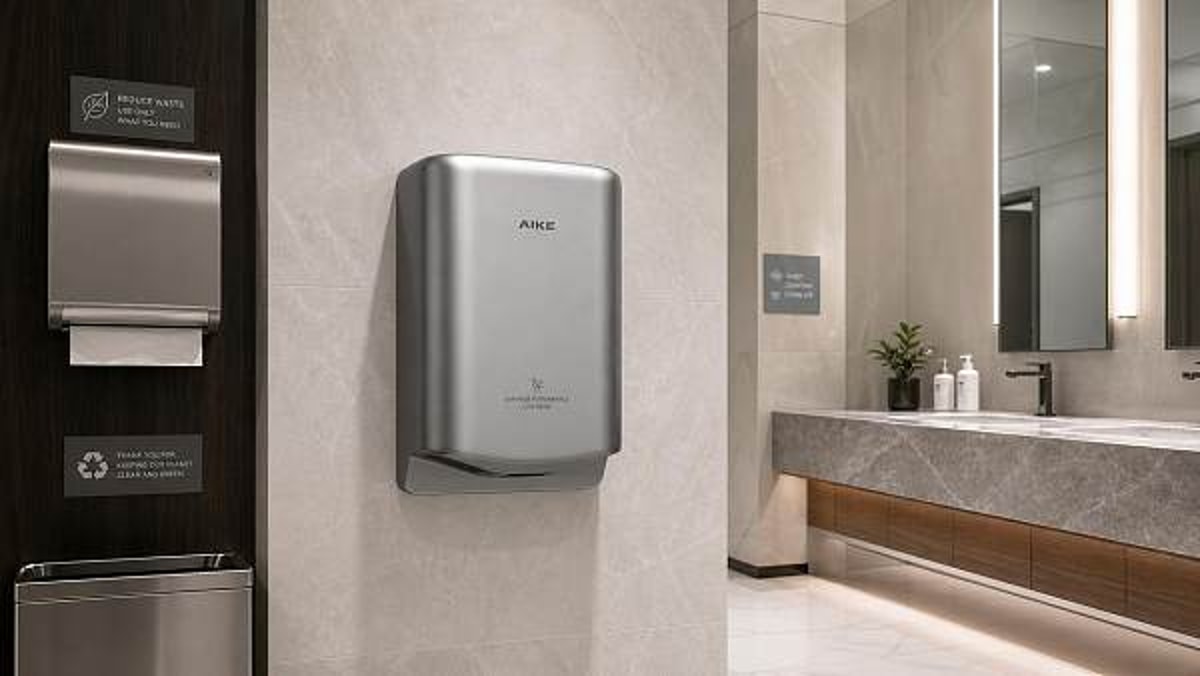
For luxury spaces, the sustainability argument must be matched with design quality and quiet operation. A brushed metal or matte-finish dryer that blends into premium interiors can support the visual standard of the space, but if its noise level is too aggressive, the sustainability benefit may be overshadowed by negative user perception.
Why noise still matters in commercial hand dryer selection
Noise is not a secondary issue. It is a product performance factor with direct implications for guest comfort, accessibility, and brand perception. In B2B environments, sound levels commonly fall within broad ranges such as 65 to 85 dB, depending on motor type, airflow intensity, enclosure design, and mounting conditions. A unit at the upper end may deliver very fast drying, but in quieter spaces it can feel intrusive or even unsuitable.
How sound affects user perception
People do not experience restroom equipment only as a technical system. They experience it as part of the environment. In a five-star hospitality setting, premium office, museum, or luxury showroom, excessive noise can make a restroom feel more industrial than refined. This matters because brand experience is shaped by dozens of small moments, and the hand-drying stage is one of them.
Noise also affects dwell time and willingness to use the device. If users perceive a dryer as too loud, some will shorten drying time, leave with damp hands, or switch preference to any available paper option. That weakens both the hygiene outcome and the sustainability case. In family-focused or education settings, loud activation can also startle children or users with greater sensory sensitivity.
Typical sound considerations by environment
- Hotels and resorts: quieter operation is often preferred in guest-facing public restrooms, especially near lobby, spa, or dining zones.
- Corporate offices: moderate sound may be acceptable, but meeting-floor washrooms usually benefit from lower-noise models.
- Educational campuses: sound control is useful near libraries, faculty areas, and wellness spaces.
- Leisure and amusement sites: higher output models may be acceptable in peak-traffic zones if durability and throughput are top priorities.
A practical way to assess suitability is to compare noise, speed, and use context together rather than separately. The matrix below helps facility teams align commercial hand dryers with common commercial environments.
The key takeaway is that there is no single best commercial hand dryer for every project. The right acoustic target depends on whether the restroom supports premium hospitality, daily institutional use, or high-volume public traffic. Procurement teams that define an acceptable sound range early can avoid expensive mismatches later.
What causes dryers to sound louder
Several design variables influence perceived noise. High-speed motors often increase airflow force, but that may also raise sound output. Narrow nozzles can create sharper air pressure, while enclosure materials and wall-mount conditions affect vibration. Hard wall surfaces such as tile or stone can amplify sound reflection, making a 75 dB unit feel louder in practice than its specification sheet suggests.
This is why mock-up testing is valuable for larger commercial projects. A sample installation in 1 pilot restroom can reveal whether the selected unit performs differently once placed in a finished acoustic environment. For projects across 10, 20, or more locations, that small testing stage can reduce replacement risk and improve rollout consistency.
How to evaluate commercial hand dryers for procurement
A reliable buying process should treat commercial hand dryers as a facilities asset rather than a simple fixture. The best sourcing decisions usually come from evaluating 4 linked factors: sound level, drying time, maintenance needs, and visual suitability. Price remains important, but it should be considered alongside total operating impact over at least 24 months.
Core specification checkpoints
When reviewing offers, technical sheets, or OEM proposals, procurement teams should ask for clear information in measurable terms. This helps buyers compare units on function instead of relying on broad marketing language.
- Noise level in dB under standard operating conditions.
- Approximate drying time range, such as 10 to 15 seconds or 15 to 20 seconds.
- Power consumption range and whether speed or heat settings are adjustable.
- Housing material, finish options, and vandal-resistance suitability.
- Maintenance cycle for filter checks, cleaning, and common replacement parts.
- Sensor response reliability and suitability for high-frequency use.
Questions that improve sourcing accuracy
Good B2B sourcing is often driven by the quality of the questions asked before the order is placed. For example, does the site require quieter performance near guest suites or boardrooms? Will the restroom see 200 users per day or 2,000? Is the operator optimizing for premium feel, lowest manual servicing, or throughput during peak intervals? These questions narrow the product category quickly and reduce the chance of over-specifying or under-specifying the solution.
The following framework can help procurement teams compare commercial hand dryers in a more structured way during RFQ or supplier review.
This structure helps buyers compare suppliers on relevant business outcomes, not just unit price. It is particularly useful for mixed portfolios where one organization manages hotels, offices, campuses, or experiential retail under the same procurement umbrella.
Common selection mistakes
One frequent mistake is choosing the fastest model available without considering sound and location. Another is selecting a low-cost unit for a premium restroom where enclosure quality and acoustic comfort matter more than minor upfront savings. A third mistake is assuming one dryer specification will suit every building type. In practice, many organizations benefit from a 2-tier or 3-tier product strategy based on traffic intensity and brand expectation.
For example, a group may use quieter commercial hand dryers in executive offices and upscale hospitality areas, while deploying more robust high-speed models in staff facilities or entertainment venues. That approach supports better lifecycle fit and avoids forcing one compromise across every site.
Implementation, maintenance, and long-term fit
Successful adoption does not end at purchase. The long-term value of commercial hand dryers depends on installation planning, routine maintenance, and clear expectations for each environment. In many projects, a 3-step process works well: site assessment, pilot installation, and phased rollout. This is especially important when the project includes multiple countries, varied restroom layouts, or different user profiles across the portfolio.
Installation and site-readiness checks
Before rollout, facility teams should confirm power supply compatibility, wall structure, mounting height, and spacing around the unit. Poor placement can create congestion, splash issues, or amplified noise. Even a high-quality dryer may underperform if installed too close to reflective corners or in a layout that forces users to queue awkwardly.
- Review wall surfaces and acoustic reflection risk.
- Check whether traffic flow allows comfortable use during peak periods.
- Confirm maintenance access for inspection and cleaning.
- Align finish and visible hardware with the surrounding interior standard.
Service planning and upkeep
Compared with paper systems, commercial hand dryers generally reduce daily consumable tasks, but they still require scheduled upkeep. Depending on environment and dust conditions, visual cleaning may be weekly, while deeper checks on filters, air inlets, or mounting security may happen monthly or quarterly. High-traffic sites should also keep a basic spare-parts plan to reduce downtime.
For procurement leaders, serviceability should be part of supplier evaluation. Ask how easy it is to access wear components, what support documentation is provided, and whether replacement lead times are measured in days or several weeks. In commercial operations, a product that is slightly more expensive but easier to maintain often creates lower total disruption over time.
Who should prioritize quieter models
Quieter commercial hand dryers deserve stronger consideration in 4 main cases: premium hospitality, high-end retail, executive office floors, and educational or wellness-adjacent spaces. In these environments, acoustic comfort can be as important as speed. By contrast, transport hubs, stadium-linked venues, and some leisure facilities may prioritize fast throughput and ruggedness, provided the sound level remains appropriate for the traffic pattern.
For mixed-use portfolios, the most effective strategy is often selective standardization. Instead of one universal unit, buyers can build an approved range of 2 or 3 models based on noise profile, traffic volume, and design requirement. That supports sourcing efficiency while preserving site-level suitability.
Practical guidance for information-stage buyers
If you are still in the research phase, focus first on defining the operating context. Estimate user volume, identify whether the restroom is guest-facing or back-of-house, and decide how important acoustic comfort is on a scale from basic, balanced, to premium. That simple classification can eliminate unsuitable options before technical comparison begins.
A simple shortlisting approach
- Map the restroom into a traffic band: low, medium, or high use.
- Set a target sound range based on the surrounding environment.
- Compare drying time and maintenance routine, not speed alone.
- Review finish, mounting format, and cleaning practicality.
- Request a sample or pilot installation for sensitive sites.
This method keeps the decision grounded in business reality. It also helps sourcing teams communicate more clearly with suppliers, architects, operators, and internal stakeholders. In sectors where restroom experience influences customer perception, that clarity can prevent costly rework and improve overall facility consistency.
Commercial hand dryers can deliver meaningful value when the product is matched to the right environment. They help reduce paper waste, simplify restroom servicing, and support cleaner operations, but the acoustic dimension should never be treated as an afterthought. For hotels, campuses, offices, leisure venues, and specialty retail projects, the best result comes from balancing 3 priorities at once: sustainability, user comfort, and operational efficiency.
Global Commercial Trade supports buyers who need practical sourcing intelligence across commercial environments where performance, design, and reliability all matter. If you are evaluating commercial hand dryers for a new project, refurbishment, or multi-site procurement plan, contact us to discuss product details, compare sourcing options, or get a tailored solution aligned with your space and operational goals.
Search News
Hot Articles
Popular Tags
Need ExpertConsultation?
Connect with our specialized leisureengineering team for procurementstrategies.
Recommended News
 May 03, 2026Hotel room minibar fridges: silent operation is not enoughHotel room minibar fridges now require more than silent operation. Explore how energy efficiency, design fit, compliance, and lifecycle value shape smarter hotel sourcing.● Hospitality Sourcing Dir
 May 03, 2026HVAC systems for hotels: poor zoning raises energy bills quietlyHVAC systems for hotels can silently inflate energy bills when zoning is weak. Learn how smarter controls cut costs, improve guest comfort, and protect long-term hotel asset value.● Hospitality Sourcing Dir
 May 03, 2026Wooden coat hangers hotel projects should not overlook finish qualityWooden coat hangers hotel buyers should not ignore finish quality. Learn how smoothness, coating safety, and color consistency reduce complaints, protect brand image, and lower replacement costs.● Hospitality Sourcing Dir
 May 03, 2026Artificial plants for hotels: where they look premium, not fakeArtificial plants for hotels that look premium, not fake—discover how luxury properties use realistic faux greenery to elevate ambiance, cut maintenance, and protect brand consistency.● Hospitality Sourcing Dir
 May 03, 2026Commercial hand dryers can lower waste, but noise still mattersCommercial hand dryers reduce paper waste and maintenance costs, but noise can shape comfort and brand perception. Discover how to choose the right model for every commercial space.● Hospitality Sourcing Dir
 May 03, 2026Hotel hair dryers wall mounted: safety features worth checkingHotel hair dryers wall mounted: discover the safety features buyers should check first, from overheat protection to tamper resistance, for safer, smarter hotel sourcing.● Hospitality Sourcing Dir
 May 03, 2026Smart hotel room controls work best when systems talk to each otherSmart hotel room controls work best when HVAC, lighting, access, and service platforms connect seamlessly. Learn how interoperability improves efficiency, guest experience, and long-term scalability.● Hospitality Sourcing Dir
 May 03, 2026Automatic soap dispensers: battery life is not the only issueAutomatic soap dispensers are about more than battery life. Discover how sensor accuracy, refill compatibility, maintenance, and durability impact hygiene, cost, and user experience.● Hospitality Sourcing Dir
 May 03, 2026What hotels often miss when sourcing illuminated makeup mirrorsIlluminated makeup mirrors hotel buyers often miss key specs that affect guest satisfaction, maintenance, and brand value. Discover what to check before sourcing.● Hospitality Sourcing Dir
 May 03, 2026Commercial air purifiers: HEPA ratings that matter in hotelsCommercial air purifiers for hotels: learn which HEPA ratings truly matter for guest rooms, lobbies, and wellness zones to improve comfort, compliance, and smarter buying.● Hospitality Sourcing Dir
 May 03, 2026Wholesale toilet paper rolls: what affects true cost per useWholesale toilet paper rolls are not just about low case price. Learn what affects true cost per use, from sheet strength to dispenser fit, and source smarter for long-term savings.● Hospitality Sourcing Dir
 May 02, 2026Memory foam hotel mattresses: when soft comfort leads to faster saggingMemory foam hotel mattresses may feel luxurious at first, but can soft comfort cause faster sagging? Discover how buyers can reduce risk, improve durability, and protect hotel ROI.● Hospitality Sourcing Dir
 May 02, 2026Electronic hotel door locks: battery alerts are often less simple than they seemElectronic hotel door locks battery alerts are more complex than they appear. Learn how firmware, usage, and environment affect reliability, maintenance efficiency, and smarter sourcing.● Hospitality Sourcing Dir
 May 02, 2026Hotel housekeeping carts: the layout detail that saves minutes on every floorHotel housekeeping carts can save minutes on every floor. Discover how smarter cart layout improves workflow, reduces labor strain, and supports faster, more consistent room turnover.● Hospitality Sourcing Dir
 May 02, 2026Wholesale hotel safes: keypad reliability matters more than extra featuresWholesale hotel safes should be judged by keypad reliability first. Discover the checklist that helps buyers reduce lockouts, maintenance costs, and guest complaints.● Hospitality Sourcing Dir
 May 02, 2026Hotel lobby chandeliers: how size mistakes affect the whole arrival experienceHotel lobby chandeliers can make or break first impressions. Learn how sizing mistakes affect luxury, circulation, and brand value—and how to choose the right scale.● Hospitality Sourcing Dir
 May 02, 2026Industrial ironing machines: steam output is not the only thing to compareIndustrial ironing machines should be compared by more than steam output. Discover how temperature control, pressure stability, efficiency, and durability affect real commercial performance.● Hospitality Sourcing Dir
 May 02, 2026Blackout curtains for hotels that block light without trapping heatBlackout curtains for hotels that block light without trapping heat—discover smarter fabrics, thermal comfort benefits, and sourcing tips for better guest sleep and hotel performance.● Hospitality Sourcing Dir
 May 02, 2026Hotel luggage carts: why wheel quality matters more than frame finishHotel luggage carts perform best when wheel quality comes first. Discover how better casters reduce noise, protect floors, improve handling, and lower long-term hotel maintenance costs.● Hospitality Sourcing Dir
 May 02, 2026Custom printed hotel key cards: PVC or wood for a better guest feel?Custom printed hotel key cards: compare PVC and wood to find the best mix of guest feel, durability, sustainability, and brand impact for smarter hotel sourcing.● Hospitality Sourcing Dir
 May 02, 2026Commercial laundry equipment sizing mistakes that raise utility billsCommercial laundry equipment sizing mistakes can quietly drive up water, energy, and labor costs. Learn the biggest planning errors and how smarter sizing protects budgets and efficiency.● Hospitality Sourcing Dir
 May 02, 2026Why some wholesale bath towels for hotels wear out too fastWholesale bath towels for hotels can wear out fast due to fiber quality, GSM, weave, and laundering mismatch. Learn how to choose durable towels that cut replacement costs and protect guest experience.● Hospitality Sourcing Dir
 May 01, 2026Hotel Desks That Work for Both Business Guests and Small RoomsHotel desks for compact rooms: learn how to choose durable, space-saving, business-friendly designs that improve guest satisfaction and simplify hotel procurement.● Hospitality Sourcing Dir
 May 01, 2026Hotel Slippers in Bulk: Cheap Pairs Can Hurt Guest PerceptionHotel slippers bulk choices affect more than cost. Discover how cheap pairs can damage guest perception, comfort, and brand value—and how smarter sourcing improves reviews.● Hospitality Sourcing Dir