Commercial trash cans: capacity, liners, and lid design all matter
Choosing the right commercial trash cans is not a minor purchasing detail. In busy hospitality, office, education, and retail environments, the wrong bin size, poor liner fit, or inconvenient lid design quickly creates visible mess, higher labor time, odor problems, and a weaker customer impression. For most buyers, the best choice is not simply the biggest or cheapest option. It is the model that matches waste volume, supports fast liner changes, controls contamination, and fits how people actually move through the space.
This guide focuses on the questions commercial buyers most often need answered before sourcing waste receptacles. It explains how to evaluate capacity, liners, and lid design in practical terms, and how those choices affect daily operations, maintenance cost, hygiene, and user experience across hotels, offices, schools, foodservice areas, and public-facing commercial settings.
What buyers are really trying to solve when comparing commercial trash cans
When people search for commercial trash cans, they are usually not looking for a generic product definition. They are trying to solve operational problems. A hotel operator may want to reduce overflow in guest corridors. An office manager may need bins that look professional but are easy for staff to empty. A school administrator may prioritize durability, safety, and high capacity. A retail buyer may care about aesthetics as much as function.
In all of these cases, the purchase decision comes down to a few practical goals: keep spaces cleaner, reduce janitorial effort, improve the appearance of the environment, and avoid buying bins that underperform in real conditions. That is why capacity, liner compatibility, and lid configuration matter so much. They influence how often bins must be serviced, whether waste is contained properly, and whether users dispose of trash correctly in the first place.
For information-stage readers, the most useful approach is to assess trash cans as part of a workflow, not as standalone containers. A bin should fit the volume of waste generated, the available service schedule, the cleaning standard of the site, and the expectations of end users. Buyers who think this way usually make better long-term sourcing decisions and avoid hidden labor costs.
Why capacity is more than a simple gallon or liter number
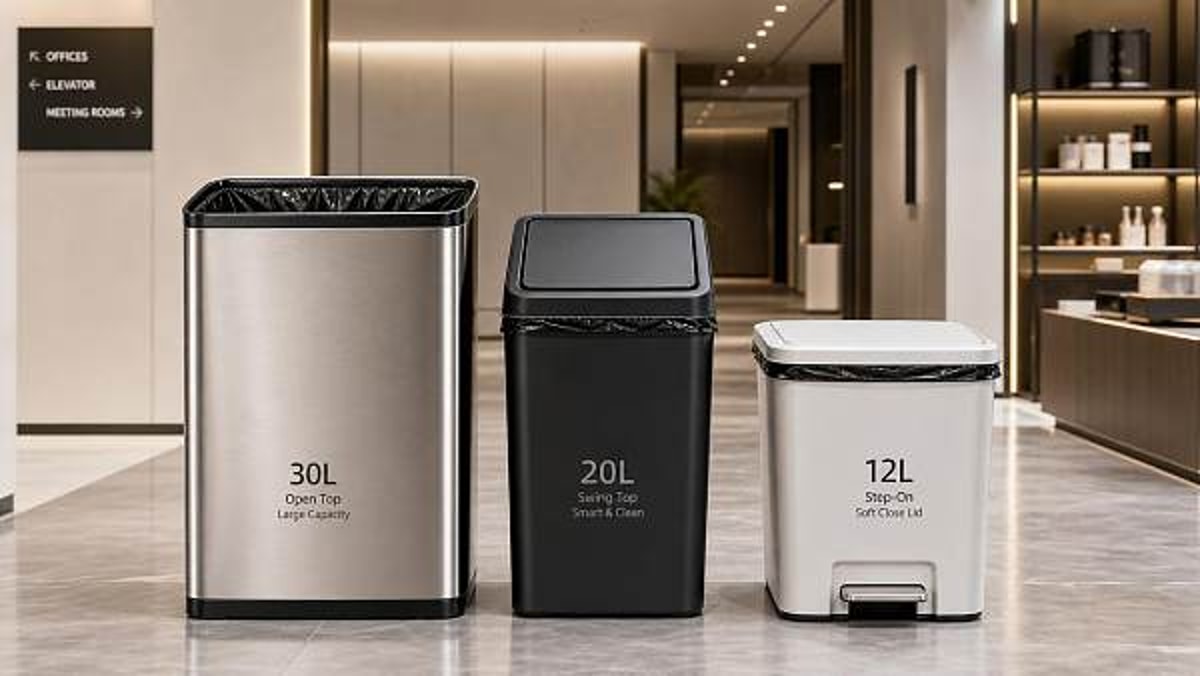
Capacity is often the first specification buyers compare, but published volume alone does not tell the whole story. A 23-gallon receptacle may work very differently from another 23-gallon model depending on shape, opening size, liner retention, and the type of waste being collected. Paper, packaging, cups, food waste, and mixed trash all fill bins differently, so selecting by volume without considering waste stream can lead to overflow or wasted space.
In commercial settings, under-sizing is one of the most common mistakes. Small bins may appear economical at purchase, but if they require frequent emptying, labor costs rise quickly. Overflow also creates a negative visual signal in customer-facing areas. In hospitality and premium retail, that visual issue can be more damaging than the direct maintenance cost.
Over-sizing can also be inefficient. A very large receptacle placed in a low-volume area may lead to liners sitting too long with light waste inside, which can create odor, contamination, or inconsistent servicing routines. In some environments, larger bins are also harder to maneuver, clean, and integrate into a carefully designed interior.
A more effective method is to match capacity to traffic level and waste profile. High-traffic lobbies, food courts, event venues, and school corridors generally need larger units or more frequent service points. Executive offices, meeting rooms, and boutique retail corners may need smaller, design-forward bins with a premium finish. Back-of-house zones often benefit from larger, utilitarian containers optimized for easy servicing rather than appearance.
Buyers should also think about peak periods, not just average daily usage. A bin that works on a typical weekday may fail during conferences, holiday shopping periods, lunch rushes, or school events. If the environment has predictable traffic spikes, it is often smarter to choose capacity with some buffer or to combine multiple receptacles strategically across the space.
How to choose the right size for different commercial environments
Different sectors generate waste in different patterns, which means there is no universal “best” commercial trash can size. Hotels, for example, often need multiple size tiers: small bins for guestrooms and washrooms, medium bins for corridors and lounge spaces, and larger receptacles for dining areas or service zones. The goal is to preserve visual order while supporting housekeeping efficiency.
In offices, desk-side bins may remain small, but shared kitchen, pantry, and breakout areas often require larger centralized containers. Many modern offices also reduce the number of individual bins to encourage waste sorting and simplify cleaning routes. In that case, receptacle capacity becomes closely tied to employee density and how often facility teams can service the area.
Schools and universities usually need robust, high-capacity bins in common spaces because of heavy daily traffic and mixed waste. Durability matters as much as volume. Receptacles in corridors, cafeterias, and sports facilities are subject to impact, quick disposal habits, and sometimes misuse, so stability and material construction deserve close attention.
Retail environments present a different challenge. Trash volume may be lower than in foodservice or education, but visual presentation matters more. A shopper may never notice a well-selected receptacle, which is exactly the point. The right bin supports cleanliness without disrupting the brand atmosphere. In luxury or design-led settings, buyers often balance medium capacity with premium materials and discreet lid styles.
For procurement teams managing multiple sites, standardizing receptacle sizes where possible can simplify liner purchasing, staff training, and replacement planning. However, standardization should not come at the expense of fit-for-purpose performance. A mixed portfolio of sizes is often the more efficient choice when site conditions vary widely.
Liner compatibility has a direct impact on labor, cleanliness, and waste control
Liners are often treated as a secondary detail, but in practice they are central to bin performance. Poor liner fit creates slipping, bunching, tearing, exposed edges, and wasted material. It can also slow down janitorial teams significantly. If staff struggle to fit or remove liners quickly, small inefficiencies multiply across many bins and many service cycles.
The best commercial trash cans are designed with liner management in mind. That may include integrated liner bands, hidden liner systems, bag retention rings, or shapes that allow a liner to sit securely without collapsing into the container. These features improve appearance and reduce the need for constant readjustment.
Correct liner sizing is equally important. A liner that is too small can pull loose or tear under weight. A liner that is too large wastes material and looks untidy, especially in front-of-house spaces. Buyers should confirm not only nominal capacity but also the exact dimensions and recommended liner range for each model. This is especially important when sourcing from multiple suppliers whose size descriptions may not be standardized.
Material thickness matters too. Heavy, wet, or sharp waste requires stronger liners, while light office paper waste can use lighter options. Over-specifying liner strength adds unnecessary operating cost, but under-specifying it causes breakage, leakage, and more cleaning work. The right combination of receptacle design and liner grade can meaningfully improve both hygiene and cost control.
For businesses with sustainability goals, liner decisions also connect to environmental performance. Some organizations want recycled-content liners or reduced plastic use. Others prioritize bins that work well with tighter-fitting liners, helping reduce excess material consumption. In these cases, buyers should test compatibility carefully, because eco-focused liners may behave differently from conventional ones under stress.
What lid design changes in real-world use
Lid design is not just a style choice. It affects hygiene, odor containment, disposal accuracy, accessibility, and how willing people are to use the bin properly. In high-traffic spaces, even small lid differences can influence whether trash ends up inside the receptacle or around it.
Open-top designs are common in offices, lobbies, and public circulation areas because they are intuitive and fast to use. They work well where convenience and speed matter more than odor control. However, they are less effective in food-related environments, and they may expose waste visually in premium settings where a cleaner appearance is preferred.
Swing lids offer partial concealment and can improve visual neatness, but they may become less practical in settings where users carry trays, boxes, or bulky waste. They also require more touch and maintenance than some alternatives. Push-door styles can provide better containment, although they may not be ideal where accessibility or rapid disposal is the top priority.
Step-on lids are valuable in hygiene-sensitive areas because they reduce hand contact. They are often used in kitchens, healthcare-adjacent zones, washrooms, and back-of-house operations. For these applications, mechanical durability is critical. A pedal mechanism that fails under heavy use quickly becomes a maintenance issue.
Self-closing or soft-close lids can support odor control and a more refined user experience, especially in hospitality environments. Touchless sensor lids may appear attractive for premium or hygiene-focused spaces, but buyers should examine power requirements, response reliability, cleaning needs, and total cost of ownership before adopting them at scale.
In recycling stations, lid shape is also a behavioral tool. Slot openings for paper, round holes for bottles, and larger openings for mixed waste can guide disposal decisions and reduce contamination. For institutions trying to improve waste sorting rates, lid design can be as important as signage.
How placement and user behavior influence bin performance
Even the best commercial trash cans underperform when placed poorly. A common mistake is evaluating receptacles only by product specification, without considering user flow. If people need to detour to find a bin, many will leave waste elsewhere. If a receptacle is too hidden, it will be underused. If it is placed in a visible but congested area, it may interrupt movement or create a cluttered look.
Placement should reflect where waste is actually generated. Near elevators, coffee stations, entrances, printer hubs, food counters, and checkout areas, convenience is essential. In hospitality and luxury retail, receptacles should remain accessible without becoming visually dominant. The goal is to support cleanliness while preserving the design language of the environment.
Buyers should also account for service access. A bin may appear well-positioned for guests or employees but be awkward for staff to empty efficiently. Narrow corridors, soft flooring, decorative surrounds, or recessed installations can slow servicing. Reviewing both user behavior and maintenance workflow leads to better placement decisions.
Where waste separation matters, grouping bins together is usually more effective than distributing isolated units for each stream. Centralized multi-stream stations reduce user confusion and make signage clearer. However, these stations need enough capacity for the dominant waste type, not just equal volume across all streams.
Material, durability, and aesthetics should match the environment
Capacity, liners, and lids are the main functional criteria, but material selection also shapes long-term value. Stainless steel, powder-coated metal, heavy-duty plastic, wood-look composites, and fire-safe materials each serve different needs. The right choice depends on traffic level, design standards, cleaning routine, and exposure conditions.
Plastic models are often practical for utility zones, schools, and back-of-house applications because they are lightweight, durable, and cost-effective. Metal finishes may better suit offices, hotel public areas, and high-end retail where appearance matters. In outdoor or semi-outdoor spaces, weather resistance, UV stability, and corrosion performance become essential.
Durability should be judged in context. A bin in a quiet executive suite does not face the same stress as one in a university cafeteria or transportation-adjacent concourse. Buyers should look beyond visual finish and ask how the unit handles impact, repeated liner changes, lid wear, and routine cleaning chemicals. A more expensive model can prove cheaper over time if it reduces replacements and maintenance calls.
Aesthetics matter because waste receptacles are part of the physical experience of a commercial space. In sectors where brand perception is critical, such as hospitality and luxury retail, a poorly matched bin can undermine an otherwise polished environment. The best sourcing decisions align functional performance with architectural and brand expectations.
Questions procurement teams should ask before buying
To make a sound decision, buyers should ask a short list of practical questions before comparing vendors. What type of waste will this bin hold most often? What is the daily and peak waste volume? How often can staff realistically service it? Will the receptacle be front-of-house or back-of-house? Does the lid support the user behavior we want? What liners will fit consistently and cost-effectively?
It is also worth asking whether the product supports standardization across locations. Can replacement parts or matching units be sourced later? Does the design comply with any fire safety, hygiene, accessibility, or institutional requirements relevant to the site? Is the finish easy to clean and maintain over time? These questions matter more than broad marketing claims.
For larger projects, requesting samples or testing a small pilot batch can reveal issues that product sheets do not show. Teams may discover that a lid is awkward, a liner slips, or the opening is too small for actual waste. A short trial in a real operating environment often prevents larger procurement mistakes.
How to balance upfront price with total operating value
Many buyers begin with unit price, but total value is a better measure. A lower-cost receptacle may require more frequent emptying, more liner waste, more cleaning, or faster replacement. A better-designed bin can save labor time every day, keep public areas cleaner, and support a more professional customer experience. Over months or years, those advantages often outweigh a higher purchase price.
This is especially true in labor-intensive industries. If a receptacle design cuts servicing time by even a small amount across dozens or hundreds of units, the operational savings can be substantial. Likewise, in guest-facing environments, avoiding overflow and maintaining visual cleanliness supports reputation, which is harder to quantify but highly valuable.
For information researchers comparing options, the best mindset is to evaluate commercial trash cans as operating assets. Look at the full picture: capacity fit, liner efficiency, lid usability, maintenance burden, design suitability, and expected service life. Products that perform well across these factors usually deliver the strongest long-term return.
Conclusion: the best commercial trash cans are the ones that fit the workflow
The right commercial trash cans help businesses stay cleaner, work more efficiently, and present a better environment to guests, staff, and visitors. Capacity matters because it determines service frequency and overflow risk. Liners matter because they affect labor speed, cleanliness, and ongoing cost. Lid design matters because it shapes hygiene, odor control, accessibility, and how people actually use the bin.
For buyers in hotels, offices, schools, retail spaces, and other commercial settings, the smartest decision is rarely based on appearance or price alone. It comes from matching the receptacle to the waste stream, traffic pattern, service routine, and design expectations of the space. When those factors align, a trash can becomes more than a container. It becomes a small but important part of operational quality.
If you are evaluating options, focus first on real use conditions rather than generic specifications. That approach will make it much easier to identify which products offer genuine value, which features matter most, and which trade-offs are worth making for your environment.
Search News
Hot Articles
Popular Tags
Need ExpertConsultation?
Connect with our specialized leisureengineering team for procurementstrategies.
Recommended News
 May 03, 2026Commercial trash cans: capacity, liners, and lid design all matterCommercial trash cans impact cleanliness, labor, and guest experience. Learn how capacity, liner fit, and lid design help buyers choose smarter, cleaner, cost-effective solutions.● Institutional Buyer
 May 03, 2026Wet and dry vacuum cleaners: when tank size slows teams downWet and dry vacuum cleaners can boost flexibility, but the wrong tank size cuts productivity. Learn how to choose capacity that reduces downtime, labor costs, and workflow friction.● Institutional Buyer
 May 03, 2026Commercial floor scrubbers: ride-on or walk-behind for large sitesCommercial floor scrubbers for large sites: compare ride-on and walk-behind models by productivity, maneuverability, labor efficiency, and cost to choose the best fit.● Institutional Buyer
 May 03, 2026Decorative room dividers that improve layout without blocking lightDecorative room dividers improve layout, define zones, and preserve natural light in modern interiors. Explore stylish, flexible solutions for commercial and hospitality spaces.● Institutional Buyer
 May 03, 2026Why wholesale ironing boards vary so much in frame qualityWholesale ironing boards vary in frame quality due to steel grade, weld strength, stability, coating, and QC. Learn what smart buyers should check before placing bulk orders.● Institutional Buyer
 Apr 30, 2026Contract furniture specs that reduce replacement cyclesContract furniture specs that cut replacement cycles: learn how durability, cleanability, compliance, and serviceable design help buyers lower lifecycle costs and protect brand standards.● Institutional Buyer
 Apr 28, 2026Luxury Furniture Materials That Age Well and Those That Do NotLuxury furniture guide for hotel furniture, custom furniture, hotel beds, hotel chairs, hotel tables, and park benches—learn which materials age well, cut lifecycle costs, and protect premium spaces.● Institutional Buyer
 Apr 28, 2026Custom Furniture Orders Go Wrong When Samples Skip Real TestingCustom furniture mistakes start when samples skip real testing. Learn how hotel furniture, hotel beds, hotel chairs, hotel tables, luxury furniture and park benches avoid costly failures.● Institutional Buyer
 Apr 28, 2026Are Park Benches With Backrests Always the Better Choice?Park benches with backrests are not always best. Explore how custom furniture choices align with luxury furniture, hotel furniture, hotel chairs, hotel tables, and hotel equipment needs.● Institutional Buyer
 Apr 28, 2026How to Tell if Custom Furniture Is Worth the Extra Lead TimeCustom furniture, hotel furniture, hotel beds, hotel chairs, hotel tables, park benches and luxury furniture—learn when longer lead times deliver better value, durability and ROI.● Institutional Buyer
 Apr 28, 2026Custom Furniture Delays Often Start at the Drawing StageCustom furniture delays often begin in drawings. Learn how hotel furniture, luxury furniture, hotel beds, hotel chairs, hotel tables, and park benches avoid costly sourcing delays.● Institutional Buyer
 Apr 28, 2026When Does Luxury Furniture Feel Premium and When Is It Overpriced?Luxury furniture, hotel furniture, custom furniture, hotel beds, hotel chairs, hotel tables, and park benches: learn when premium quality delivers value vs overpriced design, with smart sourcing tips.● Institutional Buyer
 Apr 28, 2026Luxury Furniture Trends Shaping Premium Interiors in 2026Explore 2026 luxury furniture trends, from custom furniture and hotel furniture to hotel beds, hotel chairs, hotel tables, and park benches—smart sourcing for premium interiors.● Institutional Buyer
 Apr 28, 2026Park Benches: Which Materials Need Less Maintenance Outdoors?Park benches made of aluminum, recycled plastic, and stainless steel need less upkeep outdoors. Ideal for luxury furniture, custom furniture, hotel furniture, and resort projects.● Institutional Buyer
 Apr 28, 2026What Makes Park Benches Hold Up Better in High-Traffic Areas?Park benches built for heavy use need smart materials, strong design, and low upkeep. Discover how they compare with luxury furniture, custom furniture, hotel furniture, and hotel equipment.● Institutional Buyer
 Apr 21, 2026What size hotel desks work in compact guest roomsHotel desks for compact guest rooms: discover the right hotel furniture sizes, layouts, and hospitality procurement tips to maximize space, comfort, and luxury furniture appeal.● Institutional Buyer
 Apr 21, 2026Hotel desks with built in power are now expectedHotel desks with built in power are redefining hotel furniture and hotel room furniture. Explore smarter commercial furniture choices for hospitality procurement and better guest satisfaction.● Institutional Buyer
 Apr 23, 2026Commercial Furniture Buying Mistakes to AvoidCommercial furniture buying mistakes can impact hotel tables, amusement equipment, playground borders, sensory playground safety, and more. Learn how to source smarter and avoid costly errors.● Institutional Buyer
 Apr 23, 2026Commercial Furniture Materials That Hold Up Better OutdoorsCommercial furniture that lasts outdoors: compare hotel tables, amusement equipment, playground borders, sensory playground seating, and playground safety-focused materials.● Institutional Buyer
 Apr 23, 2026Custom Furniture or Stock Which WinsCompare custom furniture vs stock for hotels and leisure park projects. From hotel beds, catering equipment, and soundproofing materials to playground swings and theme park rides, find the best-fit solution.● Institutional Buyer
 Apr 20, 2026Commercial furniture upholstery stains that won’t lift—even with pro cleanersCommercial furniture stains won’t lift? Discover stain-resistant solutions for hotel beds, park benches, luxury furniture & more—backed by lab data & real-world performance.● Institutional Buyer
 Apr 19, 2026Commercial furniture fire ratings that change mid-projectCommercial furniture fire ratings—especially for hotel beds, park benches, hotel chairs, and luxury custom furniture—can shift mid-project. Avoid delays, cost overruns, and non-compliance with real-time, E-E-A-T–validated fire safety intelligence.● Institutional Buyer
 Apr 17, 2026Why commercial furniture specs matter more than price in 2026Commercial furniture, playground borders, sensory playgrounds & more—why specs trump price in 2026 for safety, ROI & brand trust. Discover how.● Institutional Buyer
 Apr 17, 2026Office furniture & equip: How ‘modular’ claims fall apart after three reconfigurationscommercial furniture, playground safety & sensory playground systems—why 'modular' fails after 3 reconfigurations. Get data-backed validation for amusement equipment, hotel tables & educational supplies.● Institutional Buyer