Why wholesale ironing boards vary so much in frame quality
For procurement teams, comparing wholesale ironing boards often reveals major differences in frame quality, even when products look similar online. The reason goes far beyond price. From steel grade and weld strength to load capacity, coating performance, and supplier quality control, frame construction directly affects durability, safety, and long-term value. Understanding these factors helps buyers reduce sourcing risk and make more reliable commercial purchasing decisions.
Why frame quality matters more than appearance in wholesale ironing boards
In commercial sourcing, a wholesale ironing board is not just a surface for pressing garments. It is a functional asset used in hotels, laundries, staff housing, serviced apartments, educational facilities, and institutional housekeeping environments. For buyers, frame quality determines whether the product remains stable under repeated use or turns into a maintenance issue after a short deployment cycle.
Many low-cost units look nearly identical in product images because covers, tops, and color finishes are easy to imitate. The frame tells the real story. A weak frame can flex under load, wobble on uneven floors, collapse prematurely, or develop corrosion around joints. In high-turnover environments, these failures increase replacement frequency, safety risk, and hidden labor cost.
- Hotels need consistent in-room or back-of-house performance with minimal complaints and low service interruption.
- Institutional buyers often require uniform specifications across multi-site purchasing programs.
- Importers and distributors must protect margin by reducing returns, claims, and post-shipment disputes tied to structural defects.
This is why GCT approaches wholesale ironing boards from a sourcing intelligence perspective. Instead of comparing only catalog photos and FOB pricing, procurement teams should evaluate the full frame system: material, structure, fabrication method, finish, compliance, packing integrity, and supplier process control.
What causes large frame quality differences in wholesale ironing boards?
Material grade and tube specification
The first major variable is steel quality. Two wholesale ironing boards may both list a steel frame, yet one may use heavier-wall tubing with more consistent metallurgy while the other relies on thinner, lower-cost material. Tube diameter, wall thickness, and dimensional consistency all influence rigidity and fatigue resistance.
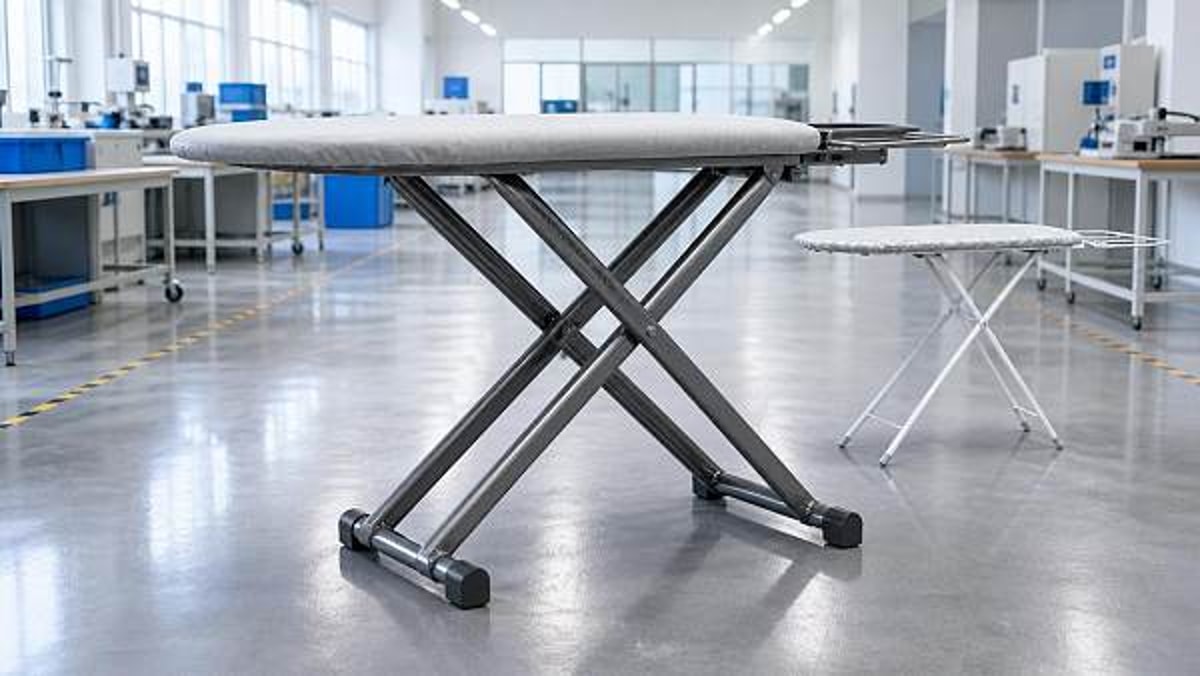
Buyers should be careful with listings that mention steel without clarifying whether the frame uses round tube, oval tube, or rectangular section. The shape affects torsional stability. A larger cross-section can improve stiffness, but only when paired with proper wall thickness and sound joint design.
Welding and joint construction
Frame failure often starts at the weld. In lower-quality wholesale ironing boards, weld beads may look rough, inconsistent, or overly localized, which can create stress concentration. Spot welding in non-critical areas may be acceptable, but load-bearing joints need reliable fusion and repeatable workmanship.
Mechanical joints also matter. Rivets, hinges, locking points, and leg brackets must maintain tolerance after thousands of open-close cycles. If these parts loosen quickly, the whole board feels unstable even when the tabletop remains intact.
Load design, stability, and geometry
Some wholesale ironing boards are engineered for light domestic use, while others are intended for higher-duty commercial operation. The difference is often found in leg spread, cross-bracing, center of gravity, anti-slip feet, and locking mechanism design. A frame can look strong in a static photo but still perform poorly when pressure is applied repeatedly during ironing.
Surface treatment and corrosion resistance
Powder coating, plating, and pre-treatment quality vary widely. In humid hospitality environments or coastal markets, insufficient surface preparation can lead to rust at weld points, edges, and moving parts. Once corrosion begins, it not only affects appearance but also weakens structural integrity over time.
How procurement teams can compare frame quality quickly
When evaluating wholesale ironing boards from multiple suppliers, a structured review matrix helps prevent decisions based only on price or product photos. The table below highlights practical comparison points for commercial buyers.
For wholesale ironing boards, this type of side-by-side review is more useful than broad claims such as heavy duty or premium quality. Buyers need evidence tied to frame construction, not only marketing language.
Which application scenarios require stronger ironing board frames?
Hospitality and guest accommodation
In hotels and serviced apartments, wholesale ironing boards may be placed in guest rooms, housekeeping stores, or laundry support zones. Here, the frame must balance durability with space efficiency. Foldability matters, but not at the expense of stable leg action. Frequent opening, closing, and relocation place continuous stress on hinges and foot components.
Commercial laundry and uniform care
Where staff uniforms, table linens, or garments are handled daily, lightweight domestic frames usually underperform. Higher-duty wholesale ironing boards are better suited because operators apply more downward pressure and use them for longer sessions. Fatigue resistance becomes more important than cosmetic finish alone.
Education, dormitory, and institutional projects
For universities, training facilities, or worker accommodation, procurement teams often purchase in bulk. Units may be used less carefully than in private households. In these settings, robust frames help reduce damage caused by improper handling, rough storage, and repeated relocation.
The following table shows how wholesale ironing boards should be matched to common commercial environments.
This scenario-based view helps buyers avoid over-specifying for light-use locations or under-specifying for demanding operational spaces. The right wholesale ironing boards should match actual use intensity, not generic assumptions.
What technical questions should buyers ask suppliers?
Procurement teams often receive quotations that mention only size, cover fabric, and packing. That is not enough for frame assessment. To compare wholesale ironing boards properly, buyers should request technical clarification before sample approval or mass order commitment.
- What is the frame tube shape and nominal thickness? Ask for the actual specification rather than generic steel frame wording.
- What is the declared load approach? Even if no universal load rating is published, the supplier should explain intended use and stability performance.
- How are critical joints made? Clarify whether the structure uses welding, rivets, hinge pins, or mixed methods.
- What anti-corrosion process is used? Ask about pre-treatment, powder coating, plating, or other protective finishing steps.
- Can the supplier provide photos or video of production, assembly checks, and drop-test style packing verification?
Buyers sourcing wholesale ironing boards for multiple markets should also ask whether rubber feet, moving parts, coatings, and packaging components are aligned with destination-market compliance expectations. Requirements vary, but proactive review reduces customs, safety, and post-delivery problems.
Why price gaps happen: cost drivers behind better frame construction
Procurement teams often see a large price spread between visually similar wholesale ironing boards. In most cases, frame cost explains a significant share of that gap. Better frame construction requires more than thicker metal. It can include tighter fabrication tolerance, slower welding cycles, stronger hinge hardware, more reliable coating, and more protective packaging.
The key is not to assume the highest-priced item is automatically best. Instead, determine whether the extra cost directly improves service life and lowers replacement frequency in your use case. A lower unit price may become more expensive if the boards fail early, trigger guest complaints, or require frequent maintenance checks.
This cost-oriented table helps evaluate where price differences in wholesale ironing boards may be justified.
For procurement professionals, total cost of ownership is more useful than unit price alone. In bulk hospitality or institutional sourcing, even a modest reduction in defect rate can justify selecting better wholesale ironing boards.
Common sourcing mistakes when buying wholesale ironing boards
- Approving based only on appearance. Similar covers and tops can hide major structural differences underneath.
- Ignoring sample stress checks. Buyers should open, close, press, tilt, and inspect the frame during evaluation instead of treating the sample as a visual reference only.
- Using household specifications for commercial projects. High-use environments need more durable wholesale ironing boards with stronger frame geometry and moving parts.
- Overlooking packing protection. A sound frame can still arrive damaged if export packaging does not prevent deformation at leg sections or corners.
- Failing to align quality expectations across departments. Procurement, operations, and end users should agree on performance priorities before final selection.
These mistakes are common in cross-border buying because product pages simplify complexity. GCT helps procurement teams move from assumption-based selection to criteria-based sourcing by connecting technical review with actual commercial use scenarios.
FAQ about wholesale ironing boards and frame quality
How can I tell if wholesale ironing boards are commercial grade?
Look beyond labels. Review frame tube specification, hinge and leg stability, weld consistency, locking design, and coating quality. Ask for close-up product images, sample handling videos, and packing details. A commercial-grade unit should remain stable through repeated opening and operating cycles, not just look presentable in a catalog.
Do thicker frames always mean better wholesale ironing boards?
Not always. Thickness helps, but structural design, joint quality, and anti-corrosion treatment matter just as much. A poorly welded thick frame may fail sooner than a well-engineered moderate-gauge frame. Buyers should assess the complete structural system rather than one specification in isolation.
What compliance topics should importers review?
Requirements depend on destination market and sales channel, but buyers should generally review mechanical safety, coating and material restrictions where applicable, packaging suitability, and labeling consistency. For hospitality and institutional projects, it is also wise to confirm whether any buyer-specific standards apply to moving parts, stability, or environmental performance.
How many samples should be checked before a bulk order?
One visual sample is rarely enough for a high-volume order. If the project value or deployment risk is meaningful, buyers should review at least one pre-production sample and confirm the mass-production standard through final inspection criteria. For wholesale ironing boards, consistency between samples and bulk output is often more important than the first sample alone.
Why work with GCT when sourcing wholesale ironing boards?
Wholesale ironing boards may seem like a straightforward category, yet frame quality proves how much sourcing risk can hide behind simple visuals. GCT supports procurement teams by translating product differences into decision-ready sourcing intelligence. That includes use-case analysis, supplier comparison logic, quality checkpoint design, and cross-sector understanding drawn from hospitality, institutional, and specialty commercial environments.
If you are comparing suppliers, refining a tender specification, or trying to reduce quality disputes on wholesale ironing boards, GCT can help structure the review process around practical procurement outcomes. You can discuss frame parameters, sample evaluation points, delivery timelines, OEM or ODM needs, packaging expectations, certification-related questions, and quotation comparison methods before committing to volume orders.
- Request support for parameter confirmation and supplier shortlist evaluation.
- Discuss product selection based on hotel, laundry, dormitory, or institutional usage intensity.
- Review delivery schedule risks, sample planning, and packaging requirements for export programs.
- Clarify customization scope, from frame finish and leg design to project-specific sourcing criteria.
For buyers who need more than a basic product list, GCT offers a more strategic path: better product understanding, clearer supplier evaluation, and more confident commercial purchasing decisions.
Search News
Hot Articles
Popular Tags
Need ExpertConsultation?
Connect with our specialized leisureengineering team for procurementstrategies.
Recommended News
 May 03, 2026Commercial trash cans: capacity, liners, and lid design all matterCommercial trash cans impact cleanliness, labor, and guest experience. Learn how capacity, liner fit, and lid design help buyers choose smarter, cleaner, cost-effective solutions.● Institutional Buyer
 May 03, 2026Wet and dry vacuum cleaners: when tank size slows teams downWet and dry vacuum cleaners can boost flexibility, but the wrong tank size cuts productivity. Learn how to choose capacity that reduces downtime, labor costs, and workflow friction.● Institutional Buyer
 May 03, 2026Commercial floor scrubbers: ride-on or walk-behind for large sitesCommercial floor scrubbers for large sites: compare ride-on and walk-behind models by productivity, maneuverability, labor efficiency, and cost to choose the best fit.● Institutional Buyer
 May 03, 2026Decorative room dividers that improve layout without blocking lightDecorative room dividers improve layout, define zones, and preserve natural light in modern interiors. Explore stylish, flexible solutions for commercial and hospitality spaces.● Institutional Buyer
 May 03, 2026Why wholesale ironing boards vary so much in frame qualityWholesale ironing boards vary in frame quality due to steel grade, weld strength, stability, coating, and QC. Learn what smart buyers should check before placing bulk orders.● Institutional Buyer
 Apr 30, 2026Contract furniture specs that reduce replacement cyclesContract furniture specs that cut replacement cycles: learn how durability, cleanability, compliance, and serviceable design help buyers lower lifecycle costs and protect brand standards.● Institutional Buyer
 Apr 28, 2026Luxury Furniture Materials That Age Well and Those That Do NotLuxury furniture guide for hotel furniture, custom furniture, hotel beds, hotel chairs, hotel tables, and park benches—learn which materials age well, cut lifecycle costs, and protect premium spaces.● Institutional Buyer
 Apr 28, 2026Custom Furniture Orders Go Wrong When Samples Skip Real TestingCustom furniture mistakes start when samples skip real testing. Learn how hotel furniture, hotel beds, hotel chairs, hotel tables, luxury furniture and park benches avoid costly failures.● Institutional Buyer
 Apr 28, 2026Are Park Benches With Backrests Always the Better Choice?Park benches with backrests are not always best. Explore how custom furniture choices align with luxury furniture, hotel furniture, hotel chairs, hotel tables, and hotel equipment needs.● Institutional Buyer
 Apr 28, 2026How to Tell if Custom Furniture Is Worth the Extra Lead TimeCustom furniture, hotel furniture, hotel beds, hotel chairs, hotel tables, park benches and luxury furniture—learn when longer lead times deliver better value, durability and ROI.● Institutional Buyer
 Apr 28, 2026Custom Furniture Delays Often Start at the Drawing StageCustom furniture delays often begin in drawings. Learn how hotel furniture, luxury furniture, hotel beds, hotel chairs, hotel tables, and park benches avoid costly sourcing delays.● Institutional Buyer
 Apr 28, 2026When Does Luxury Furniture Feel Premium and When Is It Overpriced?Luxury furniture, hotel furniture, custom furniture, hotel beds, hotel chairs, hotel tables, and park benches: learn when premium quality delivers value vs overpriced design, with smart sourcing tips.● Institutional Buyer
 Apr 28, 2026Luxury Furniture Trends Shaping Premium Interiors in 2026Explore 2026 luxury furniture trends, from custom furniture and hotel furniture to hotel beds, hotel chairs, hotel tables, and park benches—smart sourcing for premium interiors.● Institutional Buyer
 Apr 28, 2026Park Benches: Which Materials Need Less Maintenance Outdoors?Park benches made of aluminum, recycled plastic, and stainless steel need less upkeep outdoors. Ideal for luxury furniture, custom furniture, hotel furniture, and resort projects.● Institutional Buyer
 Apr 28, 2026What Makes Park Benches Hold Up Better in High-Traffic Areas?Park benches built for heavy use need smart materials, strong design, and low upkeep. Discover how they compare with luxury furniture, custom furniture, hotel furniture, and hotel equipment.● Institutional Buyer
 Apr 21, 2026What size hotel desks work in compact guest roomsHotel desks for compact guest rooms: discover the right hotel furniture sizes, layouts, and hospitality procurement tips to maximize space, comfort, and luxury furniture appeal.● Institutional Buyer
 Apr 21, 2026Hotel desks with built in power are now expectedHotel desks with built in power are redefining hotel furniture and hotel room furniture. Explore smarter commercial furniture choices for hospitality procurement and better guest satisfaction.● Institutional Buyer
 Apr 23, 2026Commercial Furniture Buying Mistakes to AvoidCommercial furniture buying mistakes can impact hotel tables, amusement equipment, playground borders, sensory playground safety, and more. Learn how to source smarter and avoid costly errors.● Institutional Buyer
 Apr 23, 2026Commercial Furniture Materials That Hold Up Better OutdoorsCommercial furniture that lasts outdoors: compare hotel tables, amusement equipment, playground borders, sensory playground seating, and playground safety-focused materials.● Institutional Buyer
 Apr 23, 2026Custom Furniture or Stock Which WinsCompare custom furniture vs stock for hotels and leisure park projects. From hotel beds, catering equipment, and soundproofing materials to playground swings and theme park rides, find the best-fit solution.● Institutional Buyer
 Apr 20, 2026Commercial furniture upholstery stains that won’t lift—even with pro cleanersCommercial furniture stains won’t lift? Discover stain-resistant solutions for hotel beds, park benches, luxury furniture & more—backed by lab data & real-world performance.● Institutional Buyer
 Apr 19, 2026Commercial furniture fire ratings that change mid-projectCommercial furniture fire ratings—especially for hotel beds, park benches, hotel chairs, and luxury custom furniture—can shift mid-project. Avoid delays, cost overruns, and non-compliance with real-time, E-E-A-T–validated fire safety intelligence.● Institutional Buyer
 Apr 17, 2026Why commercial furniture specs matter more than price in 2026Commercial furniture, playground borders, sensory playgrounds & more—why specs trump price in 2026 for safety, ROI & brand trust. Discover how.● Institutional Buyer
 Apr 17, 2026Office furniture & equip: How ‘modular’ claims fall apart after three reconfigurationscommercial furniture, playground safety & sensory playground systems—why 'modular' fails after 3 reconfigurations. Get data-backed validation for amusement equipment, hotel tables & educational supplies.● Institutional Buyer