What Makes Park Benches Hold Up Better in High-Traffic Areas?
In high-traffic commercial spaces, not all park benches perform the same. From material strength and surface finish to structural design and maintenance costs, buyers comparing park benches alongside luxury furniture, custom furniture, hotel furniture, hotel chairs, hotel tables, hotel beds, hotel equipment, and even amusement equipment need solutions that balance durability, style, and long-term value. This guide explores what truly makes park benches last longer in demanding environments.
For procurement teams, distributors, and commercial evaluators, a bench is rarely a standalone item. It is part of a broader furniture and décor strategy that must align with brand image, pedestrian flow, cleaning routines, safety expectations, and lifecycle cost targets. In plazas, resort walkways, campuses, transit-adjacent retail, and leisure parks, bench failure often appears first through wobble, coating breakdown, fastener corrosion, or surface damage long before the product reaches its theoretical service life.
That is why high-performance park benches are defined by more than looks. They depend on a combination of the right substrate, sound engineering, weather-resistant detailing, sensible installation, and maintenance planning. For commercial buyers sourcing through global supply networks, the best results come from evaluating benches with the same discipline used for hotel furniture, custom seating, and other high-use decorative furnishings.
Material Selection Is the First Durability Filter
In high-traffic areas, material choice usually explains 40% to 60% of real-world durability outcomes. A visually appealing bench can still fail early if the slats crack under repeated loading, if the metal frame rusts in coastal air, or if UV exposure causes rapid fading and brittleness. Buyers should start by matching material properties to actual environmental stress rather than catalog appearance alone.
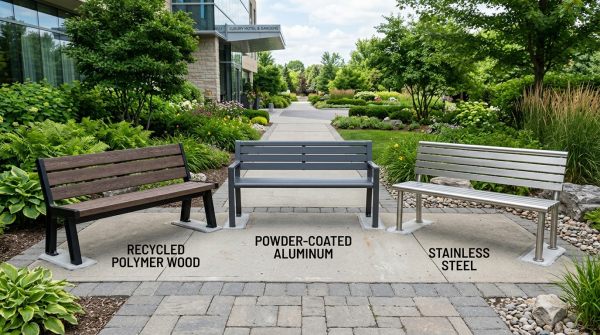
Wood remains attractive for hospitality landscapes and premium public décor, but species and treatment matter. Dense hardwoods often provide better wear resistance than softwoods, yet they still require sealing intervals of roughly 12 to 24 months in exposed installations. In wet climates, poor grain stability can lead to swelling, splitting, and fastener loosening. For projects seeking a warm aesthetic with lower upkeep, wood-plastic composite or high-grade recycled plastic can be more consistent over a 5- to 10-year maintenance cycle.
Metal frames are common in commercial park benches because they support higher load ranges and cleaner structural forms. Powder-coated steel offers strength and cost efficiency, but it performs best when the coating system includes proper pretreatment and sufficient film thickness. Aluminum resists corrosion better in humid and coastal zones, though it may need section reinforcement to prevent flex in benches above 1.8 meters. Stainless steel is durable and premium, but it is not automatically the best value if the project must control unit cost across 100 to 500 pieces.
Surface temperature also matters in public-facing furniture. Dark metal or dense stone accents may become uncomfortable in direct sun, especially in climates above 30°C. Composite slats, thermally modified wood, and lighter powder-coat colors can improve user comfort without sacrificing durability. In hospitality and leisure settings, the comfort-to-maintenance ratio is often a more practical indicator than raw hardness alone.
Common Bench Materials Compared
The table below outlines typical material choices used in commercial park benches and how they compare across wear, maintenance, and application fit.
For many buyers, the most durable specification is not a single material but a hybrid approach: a corrosion-resistant frame with replaceable slats or seating surfaces. This simplifies repairs, reduces downtime, and improves lifecycle economics when benches are deployed in batches of 20, 50, or more across a site.
What to Ask Suppliers About Materials
- What is the frame thickness range, such as 2.0 mm to 4.0 mm, and how does it vary by bench length?
- Is the wood kiln-dried or otherwise stabilized before fabrication?
- What pretreatment is used before powder coating, and what is the target coating thickness?
- Are slats, armrests, and legs individually replaceable, or is full-unit replacement required?
Structural Design Determines How Benches Age Under Repeated Use
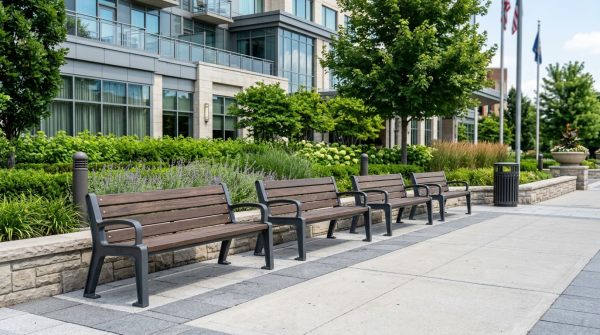
Even high-grade materials underperform when structural design is weak. In commercial furniture, repeated stress is often more destructive than occasional overload. A park bench in a busy mixed-use development may experience hundreds of sit-stand cycles per day. Over 12 months, that can translate into tens of thousands of load events concentrated at the seat rail, leg joint, and anchoring points.
The most durable benches distribute weight through triangulated or reinforced support geometry rather than relying on long unsupported spans. Bench lengths around 1.5 to 1.8 meters are generally easier to stabilize than extra-long units above 2 meters unless center supports are added. If the design prioritizes a floating appearance, buyers should verify whether hidden reinforcement compensates for the visual lightness.
Fastener strategy is another overlooked factor. Exposed screws may simplify assembly, but they can loosen faster in high-vibration or high-misuse settings. Tamper-resistant hardware, lock washers, concealed fixings, and welded frame sections often improve long-term stability. However, fully welded assemblies should still allow access to replace wear components, especially in custom furniture programs where maintenance teams need practical field service options.
Ergonomics also affects durability. A seat height around 430 to 460 mm and depth around 400 to 500 mm helps users sit naturally rather than perching on the front edge. When people use the bench as intended, impact stress decreases. Poor ergonomics can unintentionally increase concentrated loading, twisting, and misuse, which shortens furniture life even if the frame is technically strong.
Design Features That Usually Improve Service Life
- Center support or reinforced under-seat rails for benches longer than 1800 mm.
- Rounded edges and contoured slats to reduce chipping and improve user comfort.
- Drainage gaps of approximately 5 to 10 mm to avoid standing water after rain or washing.
- Replaceable seat and back slats for lower maintenance cost over 3 to 7 years.
- Anchoring provisions suited to concrete pads, pavers, or deck-mounted installations.
Commercial buyers should request load guidance in practical terms rather than generic claims. Instead of asking whether a bench is “heavy-duty,” ask how the frame performs under distributed loads, point loads, and repetitive use. A supplier that can explain stress points, joinery details, and installation assumptions is usually better prepared for project-grade supply.
Red Flags in Bench Engineering
Common warning signs include very thin metal sections on long benches, decorative side panels carrying structural load without reinforcement, wide slat spacing that traps heels or debris, and base plates too small for stable anchoring. These issues may not be obvious in showroom photography but become costly after 6 to 18 months of public use.
Surface Protection, Finishes, and Weather Resistance Matter More Than Buyers Expect
A durable bench must survive more than weight. In real commercial environments, it faces UV exposure, rain cycles, cleaning chemicals, abrasion from bags and belts, and occasional vandalism. Surface protection is therefore not a cosmetic detail. It is a functional barrier that determines how quickly deterioration becomes visible and how often maintenance teams must intervene.
For metal benches, corrosion protection starts before the final color coat. Good performance usually depends on substrate cleaning, pretreatment, and a stable coating application process. In inland applications, a well-executed powder-coat system may perform satisfactorily for years, but in coastal or poolside hospitality zones, salt exposure can accelerate failure if edges, welds, and drainage details are not properly handled.
For wood or wood-look surfaces, sealers and topcoats should be selected based on UV and moisture cycles, not just color retention. Some finishes look rich at delivery but become patchy after one rainy season. Buyers should ask whether field touch-up is possible and whether the original sheen can be matched without stripping the full bench. This is especially important in hotels, resorts, and premium retail landscapes where visual consistency affects brand presentation.
Anti-graffiti and easy-clean coatings can be useful in transit, municipal, and amusement-adjacent settings. Although they add upfront cost, they may reduce labor over a 24- to 36-month period. In public furniture programs, cleaning cost often matters as much as replacement cost, particularly when the bench count exceeds 50 units across multiple zones.
Finish Selection by Operating Environment
The table below helps match finish strategy to exposure conditions commonly seen in commercial furniture and décor projects.
The key takeaway is that “outdoor suitable” is too vague for procurement. Buyers need finish decisions tied to climate, cleaning protocol, and appearance retention goals. This is especially true when park benches are specified alongside other decorative furnishings and branded architectural elements.
A Practical Finish Checklist
- Confirm whether edges, welds, and concealed cavities are protected against moisture ingress.
- Ask how the finish behaves after repeated detergent cleaning over 12 to 24 months.
- Review color stability expectations for dark, mid-tone, and light finishes in direct sun.
- Check whether replacement parts can match the original finish lot closely enough for visible areas.
Installation Quality and Maintenance Planning Protect Long-Term Value
A well-built park bench can still fail if it is installed on an unstable base or maintained inconsistently. In high-traffic areas, movement at the anchor point often leads to progressive loosening, frame fatigue, and accelerated finish damage. That makes installation method part of the durability specification, not an afterthought.
Commercial sites vary widely. Concrete slabs, pavers, timber decks, and landscaped hardscape zones each require different anchoring logic. For example, direct anchoring into weak pavers without proper sub-base support can create wobble within weeks. In contrast, correctly aligned anchors on stable concrete pads can significantly extend service life and reduce safety complaints. Procurement teams should confirm whether the supplier provides anchor templates, bolt recommendations, and tolerance guidance, ideally within a 3-step installation package.
Maintenance planning should also be built into the purchase decision. A bench that costs 12% less upfront may become more expensive after 2 years if cleaning takes longer, replacement parts are unavailable, or refinishing requires specialist labor. In hospitality, education, and leisure projects, furniture managers often benefit from a scheduled maintenance matrix covering cleaning frequency, fastener inspection, coating touch-up, and slat replacement thresholds.
For distributors and project buyers, spare-part policy is a critical commercial detail. If lead time for replacement slats or armrests is 6 to 10 weeks, damaged units may remain out of service too long. A smarter sourcing strategy is to hold 2% to 5% spare components on hand for larger projects. This approach works especially well when park benches are one element in a larger furniture and décor package delivered across multiple public or hospitality zones.
Installation and Maintenance Decision Matrix
The following matrix can help buyers assess whether a bench program is operationally efficient after handover, not just attractive at installation.
When installation and maintenance are planned from the start, commercial benches often retain function and appearance for significantly longer. This is one reason experienced sourcing teams evaluate operations, not just product samples, before approving a supplier.
A Simple 4-Step Post-Installation Routine
- Inspect anchors and leveling 2 to 4 weeks after installation.
- Check joints, slats, and coating damage at the 3-month mark.
- Adjust cleaning frequency by season, visitor volume, and local climate.
- Record replacement parts used so recurring failure patterns can be identified early.
How Buyers Should Evaluate Park Benches in a Broader Furniture and Décor Procurement Strategy
For B2B buyers, park bench selection should align with the same sourcing criteria used for hotel chairs, hotel tables, custom furniture, and other public-use furnishings. The key is not simply to buy the strongest bench, but to source the right balance of durability, design language, lead time, and after-sales support. This is especially important when benches contribute to a unified commercial environment rather than serving as isolated outdoor fixtures.
A useful procurement framework includes at least 5 dimensions: material performance, structural design, finish suitability, installation compatibility, and lifecycle serviceability. Buyers should also evaluate project variables such as MOQ, sample lead time, customization scope, packaging protection, and delivery sequencing. In global sourcing, a bench specified for 200 units across hotels, campuses, or leisure properties must be consistent not only in appearance but also in assembly tolerances and replacement part availability.
Customization is often desirable in commercial décor, but excessive customization can create supply risk. Non-standard slat profiles, special colors, or decorative castings may improve brand fit, yet they can extend production by 2 to 4 weeks and complicate spare-part stocking. The best sourcing outcome usually comes from a modular bench platform with controlled custom elements, such as finish, armrest style, logo application, or slat color.
This is where a sourcing partner with cross-sector visibility adds value. Buyers comparing benches with hospitality furniture, public seating, and amusement-area décor benefit from benchmarked insight across usage scenarios. A bench that works in a luxury resort garden may not be efficient for a theme-park queue zone, while a municipal-grade bench may not satisfy the design requirements of a premium retail frontage.
Questions to Use in Supplier Evaluation
- What is the typical production lead time for standard versus customized bench orders, such as 3 to 5 weeks compared with 5 to 8 weeks?
- Can the supplier coordinate bench design with adjacent furniture and décor collections for a consistent visual language?
- What packaging method is used to protect coatings, slats, and corners during international shipping?
- Is there a documented process for replacement parts, finish matching, and installation support after delivery?
FAQ for Procurement and Commercial Evaluation
How long should a commercial park bench last in a high-traffic environment?
Service life varies by material, climate, maintenance, and misuse level, but many well-specified commercial benches are planned around a multi-year lifecycle rather than a short seasonal replacement cycle. The practical question is not just total lifespan, but how long the bench remains stable, attractive, and cost-efficient under daily use.
Are wood benches always less durable than metal or composite benches?
Not necessarily. Hardwood benches can perform well in hospitality and premium décor settings when properly sealed and maintained. However, in sites with limited maintenance staffing or heavy weather exposure, composite or metal-heavy designs often offer more predictable upkeep.
What matters more: thickness or coating?
Both matter, but they solve different problems. Thickness supports structural strength, while coating helps resist corrosion and wear. A thick frame with poor finishing can still fail early, and a good coating cannot compensate for weak engineering.
Should buyers choose fully assembled or knock-down benches?
It depends on freight cost, installation capability, and finish sensitivity. Knock-down designs may reduce shipping volume, while assembled benches can reduce site labor and assembly errors. The right choice depends on project scale and local installation resources.
The park benches that hold up best in high-traffic areas do so because every layer of the specification works together: fit-for-purpose materials, reinforced structure, durable finishes, correct anchoring, and realistic maintenance planning. For commercial buyers in furniture and décor, durability is not one feature but a coordinated sourcing decision.
If you are evaluating park benches for hospitality, campus, leisure, retail, or public-space projects, Global Commercial Trade can help you compare options with a broader commercial sourcing perspective. Contact us to discuss product details, request a tailored sourcing plan, or explore bench solutions that align with your wider furniture and décor program.
Search News
Hot Articles
- Stage Lighting & Truss2026 FIBA Women's World Cup Draw Sparks LED Timing Screen Upgrade DemandApr 28, 2026
- Pro Stage AudioKenyan Marathon WR Break Drives Demand for Timing Chips & Track SensorsApr 28, 2026
- Smart Campus Tech2026 Shanghai Smart Campus Expo: VR Teaching Devices Gain ITU & ISO/IEC 23053 CertificationApr 28, 2026
Popular Tags
Need ExpertConsultation?
Connect with our specialized leisureengineering team for procurementstrategies.
Recommended News
 Apr 28, 2026How to Tell if Custom Furniture Is Worth the Extra Lead TimeCustom furniture, hotel furniture, hotel beds, hotel chairs, hotel tables, park benches and luxury furniture—learn when longer lead times deliver better value, durability and ROI.● Institutional Buyer
 Apr 28, 2026Custom Furniture Delays Often Start at the Drawing StageCustom furniture delays often begin in drawings. Learn how hotel furniture, luxury furniture, hotel beds, hotel chairs, hotel tables, and park benches avoid costly sourcing delays.● Institutional Buyer
 Apr 28, 2026When Does Luxury Furniture Feel Premium and When Is It Overpriced?Luxury furniture, hotel furniture, custom furniture, hotel beds, hotel chairs, hotel tables, and park benches: learn when premium quality delivers value vs overpriced design, with smart sourcing tips.● Institutional Buyer
 Apr 28, 2026Luxury Furniture Trends Shaping Premium Interiors in 2026Explore 2026 luxury furniture trends, from custom furniture and hotel furniture to hotel beds, hotel chairs, hotel tables, and park benches—smart sourcing for premium interiors.● Institutional Buyer
 Apr 28, 2026Park Benches: Which Materials Need Less Maintenance Outdoors?Park benches made of aluminum, recycled plastic, and stainless steel need less upkeep outdoors. Ideal for luxury furniture, custom furniture, hotel furniture, and resort projects.● Institutional Buyer
 Apr 28, 2026What Makes Park Benches Hold Up Better in High-Traffic Areas?Park benches built for heavy use need smart materials, strong design, and low upkeep. Discover how they compare with luxury furniture, custom furniture, hotel furniture, and hotel equipment.● Institutional Buyer
 Apr 21, 2026What size hotel desks work in compact guest roomsHotel desks for compact guest rooms: discover the right hotel furniture sizes, layouts, and hospitality procurement tips to maximize space, comfort, and luxury furniture appeal.● Institutional Buyer
 Apr 21, 2026Hotel desks with built in power are now expectedHotel desks with built in power are redefining hotel furniture and hotel room furniture. Explore smarter commercial furniture choices for hospitality procurement and better guest satisfaction.● Institutional Buyer
 Apr 23, 2026Commercial Furniture Buying Mistakes to AvoidCommercial furniture buying mistakes can impact hotel tables, amusement equipment, playground borders, sensory playground safety, and more. Learn how to source smarter and avoid costly errors.● Institutional Buyer
 Apr 23, 2026Commercial Furniture Materials That Hold Up Better OutdoorsCommercial furniture that lasts outdoors: compare hotel tables, amusement equipment, playground borders, sensory playground seating, and playground safety-focused materials.● Institutional Buyer
 Apr 23, 2026Custom Furniture or Stock Which WinsCompare custom furniture vs stock for hotels and leisure park projects. From hotel beds, catering equipment, and soundproofing materials to playground swings and theme park rides, find the best-fit solution.● Institutional Buyer
 Apr 20, 2026Commercial furniture upholstery stains that won’t lift—even with pro cleanersCommercial furniture stains won’t lift? Discover stain-resistant solutions for hotel beds, park benches, luxury furniture & more—backed by lab data & real-world performance.● Institutional Buyer
 Apr 19, 2026Commercial furniture fire ratings that change mid-projectCommercial furniture fire ratings—especially for hotel beds, park benches, hotel chairs, and luxury custom furniture—can shift mid-project. Avoid delays, cost overruns, and non-compliance with real-time, E-E-A-T–validated fire safety intelligence.● Institutional Buyer
 Apr 17, 2026Why commercial furniture specs matter more than price in 2026Commercial furniture, playground borders, sensory playgrounds & more—why specs trump price in 2026 for safety, ROI & brand trust. Discover how.● Institutional Buyer
 Apr 17, 2026Office furniture & equip: How ‘modular’ claims fall apart after three reconfigurationscommercial furniture, playground safety & sensory playground systems—why 'modular' fails after 3 reconfigurations. Get data-backed validation for amusement equipment, hotel tables & educational supplies.● Institutional Buyer
 Apr 14, 2026Fuzhou Hospital's Office Supply Tender Fails Due to Lack of BiddersFuzhou Hospital's office supply tender failed due to lack of qualified bidders, exposing gaps in regional suppliers' compliance and procurement experience. Learn key considerations for international buyers evaluating Chinese vendors.● Institutional Buyer
 Apr 14, 2026Chongqing Launches Office Supplies Procurement with 2-Hour Delivery FocusChongqing's office supplies procurement (KZQ26A00105) sets new standards with 2-hour delivery focus and 60% SME quota. Discover how this 886,700 RMB tender impacts logistics and supply chains in China's evolving B2B market.● Institutional Buyer
 Apr 16, 2026Custom fabrication for office furniture: Why CAD files alone don’t guarantee fit-on-siteCustom fabrication for hotel furniture, designer eyewear & luxury watches demands real-world fit—not just CAD files. Discover why OEM manufacturing, supply chain solutions & precision matter on-site.● Institutional Buyer
 Apr 16, 2026Luxury furniture finishes that resist UV fading outdoorsDiscover UV-resistant luxury furniture finishes for park benches, music stands & outdoor playgrounds—engineered for colorfastness, compliance, and premium aesthetics under harsh sun.● Institutional Buyer
 Apr 15, 2026Luxury furniture materials that age well — and those that don’tDiscover luxury furniture materials that age gracefully—ideal for park benches, music stands, orchestral instruments & more. Avoid costly failures.● Institutional Buyer
 Apr 15, 2026Why commercial furniture specs matter more than price in 2026Commercial furniture specs—playground borders, sensory playgrounds, music accessories & more—drive safety, durability & experience in 2026. Stop choosing by price alone.● Institutional Buyer
") Apr 13, 2026Why contract furniture quotes vary by 40%—and what’s really included (or missing)Discover why hotel desks, commercial playgrounds & trampoline park manufacturer quotes vary by 40%—and what’s truly included in hospitality furniture, outdoor play structures, microphone systems & more.● Institutional Buyer
Apr 13, 2026Why contract furniture quotes vary by 40%—and what’s really included (or missing)Discover why hotel desks, commercial playgrounds & trampoline park manufacturer quotes vary by 40%—and what’s truly included in hospitality furniture, outdoor play structures, microphone systems & more.● Institutional Buyer Apr 13, 2026Contract furniture lead times in 2026: why ‘standard’ delivery now means 14+ weeksHotel desks, hospitality furniture & commercial playgrounds now face 14+ week lead times in 2026. Discover why—and how to mitigate delays for outdoor play structures, trampoline park manufacturing, stage equipment & more.● Institutional Buyer
 Apr 14, 2026Office furniture & equip that supports hybrid work—but fails silently in summer heatOffice supplies, arcade games & percussion instruments—engineered for hybrid work AND summer heat. Discover heat-resilient office furniture that won’t fail silently.● Institutional Buyer