Commercial floor scrubbers: ride-on or walk-behind for large sites
For project managers overseeing large facilities, choosing between ride-on and walk-behind commercial floor scrubbers can directly affect cleaning speed, labor efficiency, and operational costs. The right machine depends on site size, traffic patterns, and maintenance goals. This guide helps you compare both options clearly, so you can make a practical investment decision for demanding commercial environments.
Why a checklist approach works better for large-site equipment decisions
When project leaders compare commercial floor scrubbers, the wrong starting point is often the machine brochure. The better starting point is a decision checklist tied to the site itself. Large facilities rarely have one uniform cleaning condition. A logistics hall may have long open aisles, an airport concourse may combine heavy pedestrian traffic with strict cleaning windows, and a mixed-use campus may include narrow corridors, elevators, loading bays, and polished public areas. Because of that complexity, the best choice between a ride-on and a walk-behind unit is not about which machine looks more advanced. It is about which one matches daily operating reality.
For project managers, this checklist method helps reduce procurement mistakes in three ways. First, it forces clear evaluation criteria before supplier discussions begin. Second, it translates cleaning needs into measurable factors such as square footage per hour, operator availability, maneuvering limits, battery runtime, and water recovery performance. Third, it supports long-term cost control by looking beyond purchase price and into labor load, downtime risk, maintenance effort, and replacement cycles.
Start here: the first checks before comparing ride-on and walk-behind models
Before reviewing any catalog of commercial floor scrubbers, confirm the following site-level facts. These checks create the foundation for a realistic procurement plan.
- Measure the actual cleanable floor area per shift, not the total building area. Exclude fixed equipment zones and inaccessible spaces.
- Identify whether the cleaning route is mostly open and linear or fragmented with frequent turns, obstacles, and door transitions.
- Confirm the available cleaning time window. A site cleaned overnight may allow larger ride-on commercial floor scrubbers, while a site cleaned during business hours may need quieter, more maneuverable units.
- Review operator resources. If staffing is tight, productivity per operator becomes a major factor.
- Check floor materials and contamination types, including dust, fine grit, food residue, oils, or moisture-sensitive surfaces.
- Map practical restrictions such as elevators, ramps, storage rooms, charging areas, and water refill points.
- Clarify whether the goal is routine maintenance cleaning, restorative deep cleaning, or a combination of both.
Once these points are documented, the comparison becomes much clearer. In many projects, one machine type is ideal for the main floor plate, while another is better for edge zones and congested sections. That is why some large sites ultimately deploy both types of commercial floor scrubbers as part of a layered cleaning strategy.
Core decision checklist: when ride-on commercial floor scrubbers make more sense
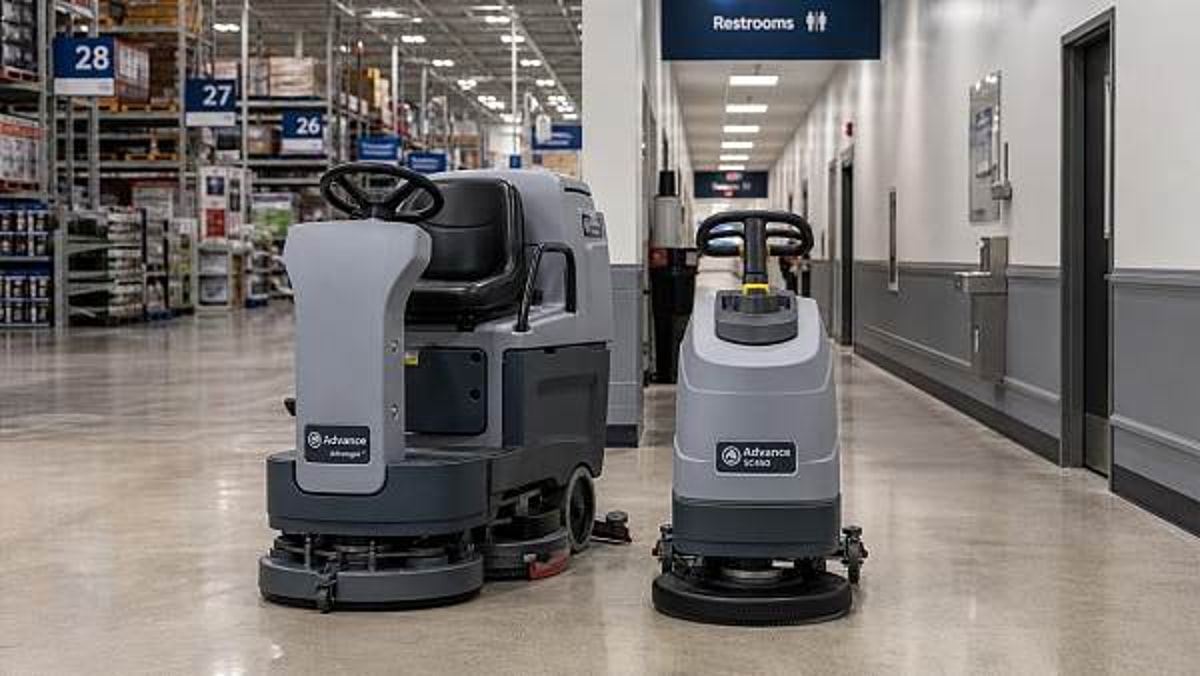
Ride-on units are usually favored when speed, labor efficiency, and operator endurance are top priorities. They are particularly strong in large uninterrupted spaces where turning frequency is low and the cleaning path remains predictable.
- Large open coverage requirement: If the site includes warehouses, exhibition halls, concourses, parking structures, distribution centers, or expansive retail floors, ride-on commercial floor scrubbers typically deliver better square-meter output per shift.
- Labor reduction target: Where one operator must clean a very large area within a tight window, ride-on machines can reduce total labor hours.
- Operator fatigue concern: For long shifts, seated operation often improves comfort and consistency, especially on hard surfaces that require daily cleaning.
- Heavier debris or repeated traffic soil: Many ride-on units offer larger tanks, stronger recovery, and more sustained performance in demanding environments.
- Fewer storage or transport limitations: If the site has direct floor-level access, dedicated storage, and charging infrastructure, larger equipment is easier to support.
The main caution is maneuverability. Ride-on commercial floor scrubbers may underperform in narrow passages, crowded furniture layouts, classrooms, guest corridor networks, or facilities with frequent door thresholds. They also require more planning for parking, charging, and operator training.
Core decision checklist: when walk-behind commercial floor scrubbers are the smarter fit
Walk-behind machines remain highly relevant for large facilities because many “large sites” contain a high percentage of detailed, constrained, or mixed-use spaces. They are often the better choice when layout complexity matters more than raw speed.
- Tighter floor plan: If the site includes corridors, classrooms, meeting spaces, dining zones, wash areas, or closely arranged shelving, walk-behind commercial floor scrubbers generally provide better access.
- Frequent obstacle avoidance: Machines that must move around columns, displays, desks, or seating benefit from a smaller footprint.
- Multi-level buildings: Sites that depend on elevators or have limited equipment storage often find walk-behind units more practical.
- Budget sensitivity: Initial capital cost is often lower, making walk-behind machines attractive for phased procurement.
- Detail cleaning priority: Edges, corners, and narrow circulation routes are easier to manage with a compact machine.
The trade-off is productivity per operator. In very large open areas, relying only on walk-behind commercial floor scrubbers may increase cleaning time, labor requirements, and fatigue. For high-throughput environments, that can turn into a recurring operating cost issue rather than a one-time equipment choice.
A practical comparison table for project evaluation
Use this quick comparison as a screening tool before requesting quotations or demos from suppliers of commercial floor scrubbers.
Scenario-based guidance for different large facilities
Hotels and hospitality complexes
Hospitality properties often need both presentation quality and operational flexibility. Public lobbies, banquet pre-function areas, service corridors, and back-of-house logistics zones rarely share the same cleaning profile. Walk-behind commercial floor scrubbers usually suit guest-facing corridors and detailed zones, while compact ride-on models may add value in large event floors, convention spaces, or basement service circulation areas.
Schools, campuses, and institutional buildings
Educational sites often combine wide common areas with dense room networks. Here, the key checks are doorway widths, elevator capacity, class schedule constraints, and noise tolerance. Walk-behind commercial floor scrubbers frequently win for flexibility, but large atriums or sports facilities may justify a ride-on machine for productivity.
Retail centers and commercial complexes
Shopping environments require rapid cleaning, especially before opening and after close. If the floor plate is open and broad, ride-on commercial floor scrubbers can improve cleaning speed significantly. However, kiosks, promotional displays, and seasonal traffic patterns can reduce usable turning space, so route mapping is essential before final selection.
Industrial and logistics sites
In factories and warehouses, ride-on equipment is often the natural first option because of long travel distances and repetitive open-area cleaning. Still, project managers should verify floor contamination types, especially where oils, dust, pallet debris, or moisture may affect brush choice, squeegee wear, and recovery performance.
Commonly overlooked risks that change the buying decision
Many procurement teams compare commercial floor scrubbers on tank size and cleaning path alone. That leaves several important risks unaddressed.
- Battery strategy: Runtime, charging time, battery chemistry, and shift overlap can affect actual usability more than listed productivity.
- Water and chemical logistics: Long refill trips reduce output. On very large sites, refill access points can alter which machine is genuinely efficient.
- Drainage and drying expectations: Poor water recovery creates slip risk and customer disruption, especially in public commercial settings.
- Operator skill variability: A technically capable machine may still underperform if controls are complex or training is weak.
- Service support and spare parts: Downtime on a single critical machine can disrupt an entire cleaning schedule.
- Noise and daytime use: In hospitals, campuses, and hospitality spaces, low-noise operation may be a non-negotiable requirement.
Execution advice: how to evaluate suppliers and models properly
To make a confident investment in commercial floor scrubbers, move beyond brochure comparisons and create a controlled evaluation process.
- Prepare a site profile with floor area, route type, shift timing, floor material, and contamination pattern.
- Shortlist both ride-on and walk-behind options if the facility contains mixed-use zones.
- Request live demonstrations on your actual floor, not only showroom tests.
- Measure cleaning time, refill frequency, drying result, turning ease, and operator feedback.
- Ask for total cost of ownership data covering consumables, battery life, wear parts, and planned maintenance.
- Confirm after-sales support, response times, and local spare part availability.
For many project managers, the most cost-effective path is not choosing one category universally, but assigning each machine type to its strongest environment. That approach often delivers better labor efficiency and more consistent cleaning standards across a complex facility.
FAQ for project managers comparing commercial floor scrubbers
Is a ride-on machine always better for large sites?
No. Large sites can still contain narrow, obstructed, or multi-level sections where walk-behind commercial floor scrubbers are more efficient in practice. Site layout matters as much as total area.
Should we buy one machine or a mixed fleet?
If the facility includes both open and constrained zones, a mixed fleet is often the best operational solution. One ride-on unit may handle high-output open areas, while one or more walk-behind units cover detail zones.
What is the biggest mistake during selection?
The biggest mistake is choosing commercial floor scrubbers based only on claimed productivity or upfront price without testing route suitability, operator practicality, and support requirements.
Final decision guidance and next-step questions
For project managers responsible for demanding facilities, the choice between ride-on and walk-behind commercial floor scrubbers should be driven by measurable site conditions rather than assumptions. Prioritize actual cleanable area, route density, labor availability, operating windows, and service support. Ride-on units usually win on productivity in open spaces, while walk-behind units excel where maneuverability and flexibility are more important. In many commercial environments, the strongest solution is a planned combination of both.
If you are preparing to move forward, gather these details before engaging suppliers: floor area by zone, cleaning frequency, access constraints, shift schedule, floor material, expected runtime, storage conditions, and budget range. Then ask suppliers to recommend suitable commercial floor scrubbers based on your real operating map, not generic category advice. That will give you a more accurate view of machine fit, lifecycle cost, delivery timeline, and long-term maintenance practicality.
Search News
Hot Articles
Popular Tags
Need ExpertConsultation?
Connect with our specialized leisureengineering team for procurementstrategies.
Recommended News
 May 03, 2026Commercial trash cans: capacity, liners, and lid design all matterCommercial trash cans impact cleanliness, labor, and guest experience. Learn how capacity, liner fit, and lid design help buyers choose smarter, cleaner, cost-effective solutions.● Institutional Buyer
 May 03, 2026Wet and dry vacuum cleaners: when tank size slows teams downWet and dry vacuum cleaners can boost flexibility, but the wrong tank size cuts productivity. Learn how to choose capacity that reduces downtime, labor costs, and workflow friction.● Institutional Buyer
 May 03, 2026Commercial floor scrubbers: ride-on or walk-behind for large sitesCommercial floor scrubbers for large sites: compare ride-on and walk-behind models by productivity, maneuverability, labor efficiency, and cost to choose the best fit.● Institutional Buyer
 May 03, 2026Decorative room dividers that improve layout without blocking lightDecorative room dividers improve layout, define zones, and preserve natural light in modern interiors. Explore stylish, flexible solutions for commercial and hospitality spaces.● Institutional Buyer
 May 03, 2026Why wholesale ironing boards vary so much in frame qualityWholesale ironing boards vary in frame quality due to steel grade, weld strength, stability, coating, and QC. Learn what smart buyers should check before placing bulk orders.● Institutional Buyer
 Apr 30, 2026Contract furniture specs that reduce replacement cyclesContract furniture specs that cut replacement cycles: learn how durability, cleanability, compliance, and serviceable design help buyers lower lifecycle costs and protect brand standards.● Institutional Buyer
 Apr 28, 2026Luxury Furniture Materials That Age Well and Those That Do NotLuxury furniture guide for hotel furniture, custom furniture, hotel beds, hotel chairs, hotel tables, and park benches—learn which materials age well, cut lifecycle costs, and protect premium spaces.● Institutional Buyer
 Apr 28, 2026Custom Furniture Orders Go Wrong When Samples Skip Real TestingCustom furniture mistakes start when samples skip real testing. Learn how hotel furniture, hotel beds, hotel chairs, hotel tables, luxury furniture and park benches avoid costly failures.● Institutional Buyer
 Apr 28, 2026Are Park Benches With Backrests Always the Better Choice?Park benches with backrests are not always best. Explore how custom furniture choices align with luxury furniture, hotel furniture, hotel chairs, hotel tables, and hotel equipment needs.● Institutional Buyer
 Apr 28, 2026How to Tell if Custom Furniture Is Worth the Extra Lead TimeCustom furniture, hotel furniture, hotel beds, hotel chairs, hotel tables, park benches and luxury furniture—learn when longer lead times deliver better value, durability and ROI.● Institutional Buyer
 Apr 28, 2026Custom Furniture Delays Often Start at the Drawing StageCustom furniture delays often begin in drawings. Learn how hotel furniture, luxury furniture, hotel beds, hotel chairs, hotel tables, and park benches avoid costly sourcing delays.● Institutional Buyer
 Apr 28, 2026When Does Luxury Furniture Feel Premium and When Is It Overpriced?Luxury furniture, hotel furniture, custom furniture, hotel beds, hotel chairs, hotel tables, and park benches: learn when premium quality delivers value vs overpriced design, with smart sourcing tips.● Institutional Buyer
 Apr 28, 2026Luxury Furniture Trends Shaping Premium Interiors in 2026Explore 2026 luxury furniture trends, from custom furniture and hotel furniture to hotel beds, hotel chairs, hotel tables, and park benches—smart sourcing for premium interiors.● Institutional Buyer
 Apr 28, 2026Park Benches: Which Materials Need Less Maintenance Outdoors?Park benches made of aluminum, recycled plastic, and stainless steel need less upkeep outdoors. Ideal for luxury furniture, custom furniture, hotel furniture, and resort projects.● Institutional Buyer
 Apr 28, 2026What Makes Park Benches Hold Up Better in High-Traffic Areas?Park benches built for heavy use need smart materials, strong design, and low upkeep. Discover how they compare with luxury furniture, custom furniture, hotel furniture, and hotel equipment.● Institutional Buyer
 Apr 21, 2026What size hotel desks work in compact guest roomsHotel desks for compact guest rooms: discover the right hotel furniture sizes, layouts, and hospitality procurement tips to maximize space, comfort, and luxury furniture appeal.● Institutional Buyer
 Apr 21, 2026Hotel desks with built in power are now expectedHotel desks with built in power are redefining hotel furniture and hotel room furniture. Explore smarter commercial furniture choices for hospitality procurement and better guest satisfaction.● Institutional Buyer
 Apr 23, 2026Commercial Furniture Buying Mistakes to AvoidCommercial furniture buying mistakes can impact hotel tables, amusement equipment, playground borders, sensory playground safety, and more. Learn how to source smarter and avoid costly errors.● Institutional Buyer
 Apr 23, 2026Commercial Furniture Materials That Hold Up Better OutdoorsCommercial furniture that lasts outdoors: compare hotel tables, amusement equipment, playground borders, sensory playground seating, and playground safety-focused materials.● Institutional Buyer
 Apr 23, 2026Custom Furniture or Stock Which WinsCompare custom furniture vs stock for hotels and leisure park projects. From hotel beds, catering equipment, and soundproofing materials to playground swings and theme park rides, find the best-fit solution.● Institutional Buyer
 Apr 20, 2026Commercial furniture upholstery stains that won’t lift—even with pro cleanersCommercial furniture stains won’t lift? Discover stain-resistant solutions for hotel beds, park benches, luxury furniture & more—backed by lab data & real-world performance.● Institutional Buyer
 Apr 19, 2026Commercial furniture fire ratings that change mid-projectCommercial furniture fire ratings—especially for hotel beds, park benches, hotel chairs, and luxury custom furniture—can shift mid-project. Avoid delays, cost overruns, and non-compliance with real-time, E-E-A-T–validated fire safety intelligence.● Institutional Buyer
 Apr 17, 2026Why commercial furniture specs matter more than price in 2026Commercial furniture, playground borders, sensory playgrounds & more—why specs trump price in 2026 for safety, ROI & brand trust. Discover how.● Institutional Buyer
 Apr 17, 2026Office furniture & equip: How ‘modular’ claims fall apart after three reconfigurationscommercial furniture, playground safety & sensory playground systems—why 'modular' fails after 3 reconfigurations. Get data-backed validation for amusement equipment, hotel tables & educational supplies.● Institutional Buyer