Artificial plants for hotels: where they look premium, not fake
In hospitality design, artificial plants for hotels are no longer a cheap substitute—they are a strategic choice for creating polished, low-maintenance interiors that feel upscale and brand-consistent. From grand lobbies to guest suites and dining areas, the right faux greenery can elevate ambiance, reduce upkeep, and meet commercial durability needs without looking obviously artificial.
What artificial plants for hotels really mean in modern hospitality
Artificial plants for hotels refer to commercial-grade faux trees, potted plants, hanging greenery, preserved-look botanical arrangements, and decorative foliage installations designed specifically for hospitality environments. They are not the same as low-cost home décor pieces. In a hotel setting, these products must support brand image, daily traffic, cleaning routines, fire-safety expectations, and visual consistency across multiple guest touchpoints.
The reason this category matters more today is simple: hotel interiors are expected to look curated at all times. Guests photograph lobbies, restaurants, corridors, wellness spaces, and suites constantly. Any decorative element that appears dusty, poorly proportioned, or obviously plastic can damage the premium impression a property is trying to build. By contrast, high-quality artificial plants for hotels can create a refined biophilic effect without the operational unpredictability of live plants.
For information researchers, this topic sits at the intersection of interior styling, facility management, guest experience, and commercial sourcing. It is not only about decoration. It is about how hotels create atmosphere efficiently while protecting design standards across many locations, seasons, and service conditions.
Why the hotel industry is paying closer attention
Hospitality has shifted toward experience-led design. Guests increasingly expect spaces that feel calming, natural, and visually layered. Greenery supports that expectation, but maintaining live plants at scale can be difficult. Watering schedules, inconsistent light, pest control, soil spills, leaf drop, and plant replacement all create hidden labor and cost. In luxury and upper-upscale properties, inconsistency is especially risky because every corner contributes to perceived quality.
This is where artificial plants for hotels have become strategically relevant. They allow operators to preserve a “fresh” design language in areas where live plants struggle, such as windowless corridors, air-conditioned ballrooms, spa waiting rooms, elevator lobbies, or guestrooms with irregular housekeeping access. They also support visual continuity across international hotel groups that need the same look in multiple properties regardless of climate.
From a broader commercial sourcing perspective, platforms such as GCT highlight a growing demand for solutions that combine aesthetics, compliance, and supply reliability. Hotel buyers are no longer looking only for attractive products. They are evaluating finish realism, OEM or custom capability, packaging quality, project delivery timelines, and alignment with commercial-grade standards.
The business value behind premium faux greenery
The strongest case for artificial plants for hotels is operational consistency. A premium hotel cannot have one lobby corner looking lush and another looking tired. Faux plants make the visual outcome more predictable. Once selected and installed correctly, they keep their shape, color balance, and design intent with much less maintenance volatility than live alternatives.
They also support cost control over time. While the upfront cost of commercial-grade artificial greenery can be higher than basic decorative pieces, ongoing maintenance is usually lower. Hotels avoid frequent replacement due to plant stress, specialized horticultural service, accidental overwatering, drainage issues, and disruptions to guests during care routines.
Another key value is placement flexibility. Designers can use statement olive trees, tropical foliage, sculptural branches, or low-profile tabletop arrangements in places where real plants would not survive. This opens more options for zoning large spaces, softening hard architectural lines, and creating upscale visual warmth in contemporary interiors.
Finally, artificial plants for hotels can support brand standardization. Whether a hotel concept emphasizes resort relaxation, urban luxury, wellness minimalism, or classic elegance, faux greenery can be customized to fit the intended narrative and repeated across properties without seasonal variation.
A practical overview of what hotels usually evaluate
When researching artificial plants for hotels, decision-makers usually review more than appearance. The following overview shows the factors that matter most in commercial use.
Where artificial plants for hotels create the most impact
Not every hotel area requires the same greenery strategy. The best results come from matching the plant type, scale, and styling to the purpose of each zone.
How to make faux greenery look premium instead of fake
The difference between decorative clutter and refined artificial plants for hotels usually comes down to design discipline. First, avoid overly glossy leaves and uniform coloring. Real plants have variation: some leaves curl slightly, veins are visible, and tones shift from lighter new growth to deeper mature foliage. Premium faux products mimic this irregularity.
Second, scale matters. A small plant can disappear in a double-height lobby, while an oversized tropical arrangement can overwhelm a boutique suite. Proportion should relate to ceiling height, furniture massing, and viewing distance. In hospitality design, plants should support the architecture rather than compete with it.
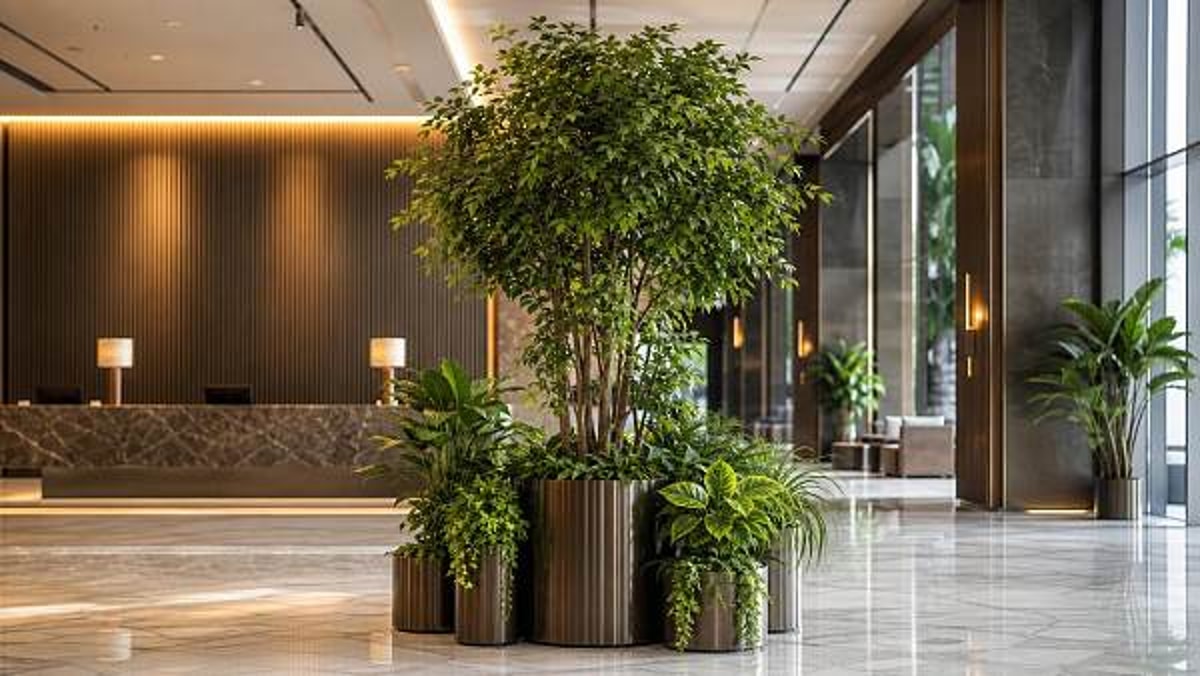
Third, the planter is part of the message. Even high-end greenery can look inexpensive in a weak container. Stone-look, metal, ceramic, composite, or custom-clad planters often determine whether the final composition reads as luxury hospitality or generic retail décor.
Fourth, placement should feel intentional. Grouping plants to frame seating, anchor circulation points, or soften transitions between public and semi-private zones creates a natural design logic. Randomly placing faux plants in leftover corners often makes them look fake because they appear decorative rather than spatially useful.
Finally, maintenance still matters. Artificial plants for hotels are low-maintenance, not no-maintenance. Dust, bent stems, faded surfaces, and poorly cleaned leaves can quickly break the illusion. A simple inspection routine is essential for preserving a premium effect.
Common product categories used in hospitality projects
Hotels typically work with several categories of faux greenery depending on the project type. Artificial trees such as olive, ficus, palm, or maple styles are often used in arrival zones and large public areas. Medium-height potted plants are common in guestrooms, lounge corners, and spa spaces. Hanging vines and green wall elements appear in restaurants, rooftop bars, and event backdrops. Floral accents may be used selectively, but in many premium interiors, foliage-focused schemes feel more timeless and easier to standardize.
There is also a distinction between decorative stock products and custom project solutions. Stock lines may work well for smaller properties or quick refresh programs. Custom artificial plants for hotels are more relevant when a brand wants signature forms, specific species references, coordinated planter finishes, or large-scale replicated installations across multiple sites.
Practical considerations before specifying artificial plants for hotels
Before a hotel team or design consultant specifies faux greenery, several practical checkpoints should be reviewed. Confirm the target atmosphere first: resort-like, urban contemporary, heritage luxury, wellness-focused, or family-friendly. The same plant style will not suit every property concept.
Then assess operational realities. Will the item be placed in a high-touch public area? Does it need flame-retardant treatment? Will housekeeping move it regularly? Is there exposure to sunlight that could affect fading? These questions shape material and construction decisions.
It is also wise to request physical samples or detailed close-up photography before approving large quantities. In digital catalogs, many products look convincing from a distance. Commercial buyers should evaluate leaf edges, stem transitions, trunk texture, and the top dressing around the base. Small details often determine whether artificial plants for hotels look credible in person.
For multi-property groups, consistency documentation is useful. This can include approved SKUs, finish references, replacement procedures, and care instructions. Such standardization helps preserve visual identity and simplifies future replenishment.
Frequently asked questions
Are artificial plants for hotels suitable for luxury properties?
Yes, if the quality, scale, and styling are appropriate. Luxury hotels usually avoid obviously synthetic products, but well-specified faux greenery can perform exceptionally well in lobbies, suites, spas, and dining spaces where consistency and finish control are critical.
Do faux plants reduce hotel maintenance costs?
In many cases, yes. Artificial plants for hotels can reduce watering labor, replacement cycles, pest issues, and disruptions tied to live plant care. However, they still require routine dusting, inspection, and occasional refurbishment to remain presentable.
What makes a faux plant look realistic in hospitality spaces?
Realistic texture, tonal variation, natural asymmetry, quality trunk construction, and suitable planters all contribute. Placement and maintenance are equally important. Even a high-end product can look artificial if it is badly positioned or poorly cleaned.
Can hotel groups customize artificial greenery for brand consistency?
Absolutely. Many suppliers support OEM or project customization, including plant species selection, size, arrangement density, planter materials, and packaging for rollout across multiple locations. This is especially valuable for chains, resorts, and branded residences.
A clear path forward for researchers and project teams
Artificial plants for hotels should be understood as a commercial design solution rather than a shortcut. When chosen carefully, they help hotels deliver polished ambiance, reduce operational friction, and preserve brand consistency in spaces where live plants may be impractical. Their value is strongest when design realism, compliance, durability, and sourcing reliability are considered together.
For researchers, designers, and hospitality procurement teams, the next step is to evaluate not only what looks attractive in a catalog, but what will perform convincingly in a real hotel environment. A trusted sourcing approach—supported by credible market insight, supplier verification, and project-level detail—makes it far easier to identify artificial plants for hotels that look premium, not fake, and that truly support long-term commercial experience goals.
Search News
Hot Articles
Popular Tags
Need ExpertConsultation?
Connect with our specialized leisureengineering team for procurementstrategies.
Recommended News
 May 03, 2026Hotel room minibar fridges: silent operation is not enoughHotel room minibar fridges now require more than silent operation. Explore how energy efficiency, design fit, compliance, and lifecycle value shape smarter hotel sourcing.● Hospitality Sourcing Dir
 May 03, 2026HVAC systems for hotels: poor zoning raises energy bills quietlyHVAC systems for hotels can silently inflate energy bills when zoning is weak. Learn how smarter controls cut costs, improve guest comfort, and protect long-term hotel asset value.● Hospitality Sourcing Dir
 May 03, 2026Wooden coat hangers hotel projects should not overlook finish qualityWooden coat hangers hotel buyers should not ignore finish quality. Learn how smoothness, coating safety, and color consistency reduce complaints, protect brand image, and lower replacement costs.● Hospitality Sourcing Dir
 May 03, 2026Artificial plants for hotels: where they look premium, not fakeArtificial plants for hotels that look premium, not fake—discover how luxury properties use realistic faux greenery to elevate ambiance, cut maintenance, and protect brand consistency.● Hospitality Sourcing Dir
 May 03, 2026Commercial hand dryers can lower waste, but noise still mattersCommercial hand dryers reduce paper waste and maintenance costs, but noise can shape comfort and brand perception. Discover how to choose the right model for every commercial space.● Hospitality Sourcing Dir
 May 03, 2026Hotel hair dryers wall mounted: safety features worth checkingHotel hair dryers wall mounted: discover the safety features buyers should check first, from overheat protection to tamper resistance, for safer, smarter hotel sourcing.● Hospitality Sourcing Dir
 May 03, 2026Smart hotel room controls work best when systems talk to each otherSmart hotel room controls work best when HVAC, lighting, access, and service platforms connect seamlessly. Learn how interoperability improves efficiency, guest experience, and long-term scalability.● Hospitality Sourcing Dir
 May 03, 2026Automatic soap dispensers: battery life is not the only issueAutomatic soap dispensers are about more than battery life. Discover how sensor accuracy, refill compatibility, maintenance, and durability impact hygiene, cost, and user experience.● Hospitality Sourcing Dir
 May 03, 2026What hotels often miss when sourcing illuminated makeup mirrorsIlluminated makeup mirrors hotel buyers often miss key specs that affect guest satisfaction, maintenance, and brand value. Discover what to check before sourcing.● Hospitality Sourcing Dir
 May 03, 2026Commercial air purifiers: HEPA ratings that matter in hotelsCommercial air purifiers for hotels: learn which HEPA ratings truly matter for guest rooms, lobbies, and wellness zones to improve comfort, compliance, and smarter buying.● Hospitality Sourcing Dir
 May 03, 2026Wholesale toilet paper rolls: what affects true cost per useWholesale toilet paper rolls are not just about low case price. Learn what affects true cost per use, from sheet strength to dispenser fit, and source smarter for long-term savings.● Hospitality Sourcing Dir
 May 02, 2026Memory foam hotel mattresses: when soft comfort leads to faster saggingMemory foam hotel mattresses may feel luxurious at first, but can soft comfort cause faster sagging? Discover how buyers can reduce risk, improve durability, and protect hotel ROI.● Hospitality Sourcing Dir
 May 02, 2026Electronic hotel door locks: battery alerts are often less simple than they seemElectronic hotel door locks battery alerts are more complex than they appear. Learn how firmware, usage, and environment affect reliability, maintenance efficiency, and smarter sourcing.● Hospitality Sourcing Dir
 May 02, 2026Hotel housekeeping carts: the layout detail that saves minutes on every floorHotel housekeeping carts can save minutes on every floor. Discover how smarter cart layout improves workflow, reduces labor strain, and supports faster, more consistent room turnover.● Hospitality Sourcing Dir
 May 02, 2026Wholesale hotel safes: keypad reliability matters more than extra featuresWholesale hotel safes should be judged by keypad reliability first. Discover the checklist that helps buyers reduce lockouts, maintenance costs, and guest complaints.● Hospitality Sourcing Dir
 May 02, 2026Hotel lobby chandeliers: how size mistakes affect the whole arrival experienceHotel lobby chandeliers can make or break first impressions. Learn how sizing mistakes affect luxury, circulation, and brand value—and how to choose the right scale.● Hospitality Sourcing Dir
 May 02, 2026Industrial ironing machines: steam output is not the only thing to compareIndustrial ironing machines should be compared by more than steam output. Discover how temperature control, pressure stability, efficiency, and durability affect real commercial performance.● Hospitality Sourcing Dir
 May 02, 2026Blackout curtains for hotels that block light without trapping heatBlackout curtains for hotels that block light without trapping heat—discover smarter fabrics, thermal comfort benefits, and sourcing tips for better guest sleep and hotel performance.● Hospitality Sourcing Dir
 May 02, 2026Hotel luggage carts: why wheel quality matters more than frame finishHotel luggage carts perform best when wheel quality comes first. Discover how better casters reduce noise, protect floors, improve handling, and lower long-term hotel maintenance costs.● Hospitality Sourcing Dir
 May 02, 2026Custom printed hotel key cards: PVC or wood for a better guest feel?Custom printed hotel key cards: compare PVC and wood to find the best mix of guest feel, durability, sustainability, and brand impact for smarter hotel sourcing.● Hospitality Sourcing Dir
 May 02, 2026Commercial laundry equipment sizing mistakes that raise utility billsCommercial laundry equipment sizing mistakes can quietly drive up water, energy, and labor costs. Learn the biggest planning errors and how smarter sizing protects budgets and efficiency.● Hospitality Sourcing Dir
 May 02, 2026Why some wholesale bath towels for hotels wear out too fastWholesale bath towels for hotels can wear out fast due to fiber quality, GSM, weave, and laundering mismatch. Learn how to choose durable towels that cut replacement costs and protect guest experience.● Hospitality Sourcing Dir
 May 01, 2026Hotel Desks That Work for Both Business Guests and Small RoomsHotel desks for compact rooms: learn how to choose durable, space-saving, business-friendly designs that improve guest satisfaction and simplify hotel procurement.● Hospitality Sourcing Dir
 May 01, 2026Hotel Slippers in Bulk: Cheap Pairs Can Hurt Guest PerceptionHotel slippers bulk choices affect more than cost. Discover how cheap pairs can damage guest perception, comfort, and brand value—and how smarter sourcing improves reviews.● Hospitality Sourcing Dir