Commercial bread slicers: slice consistency affects more than looks
In commercial bakeries, hotels, and foodservice operations, commercial bread slicers do far more than create neat presentation. Slice consistency directly influences portion control, waste reduction, production speed, and customer experience. For technical evaluators comparing equipment, understanding how blade design, feed stability, and machine precision affect daily performance is essential to selecting a slicer that supports both operational efficiency and product quality.
Why do commercial bread slicers matter beyond product appearance?
For technical evaluation teams, the first mistake is treating slicing as a purely finishing step. In reality, commercial bread slicers influence several measurable operating outcomes. Uniform slices improve portion consistency in breakfast service, sandwich production, retail packaging, and buffet replenishment. When every loaf yields predictable portions, purchasing teams can forecast food cost more accurately and kitchen managers can standardize serving sizes across shifts and sites.
Slice quality also affects waste. If a machine crushes soft sandwich bread, tears artisan crusts, or produces uneven end slices, the reject rate increases quickly. In high-volume environments, even a small percentage of damaged slices translates into meaningful annual loss. This is especially relevant for hotels and institutional catering operations where bread is prepared in batches and waste compounds across multiple service periods.
There is also a workflow issue. Consistent slicing reduces downstream handling problems. Staff can stack, tray, wrap, or plate products faster when slices are even and separated cleanly. In other words, commercial bread slicers are not just about visual neatness; they are part of production control, labor efficiency, and customer satisfaction.
What actually determines slice consistency in commercial bread slicers?
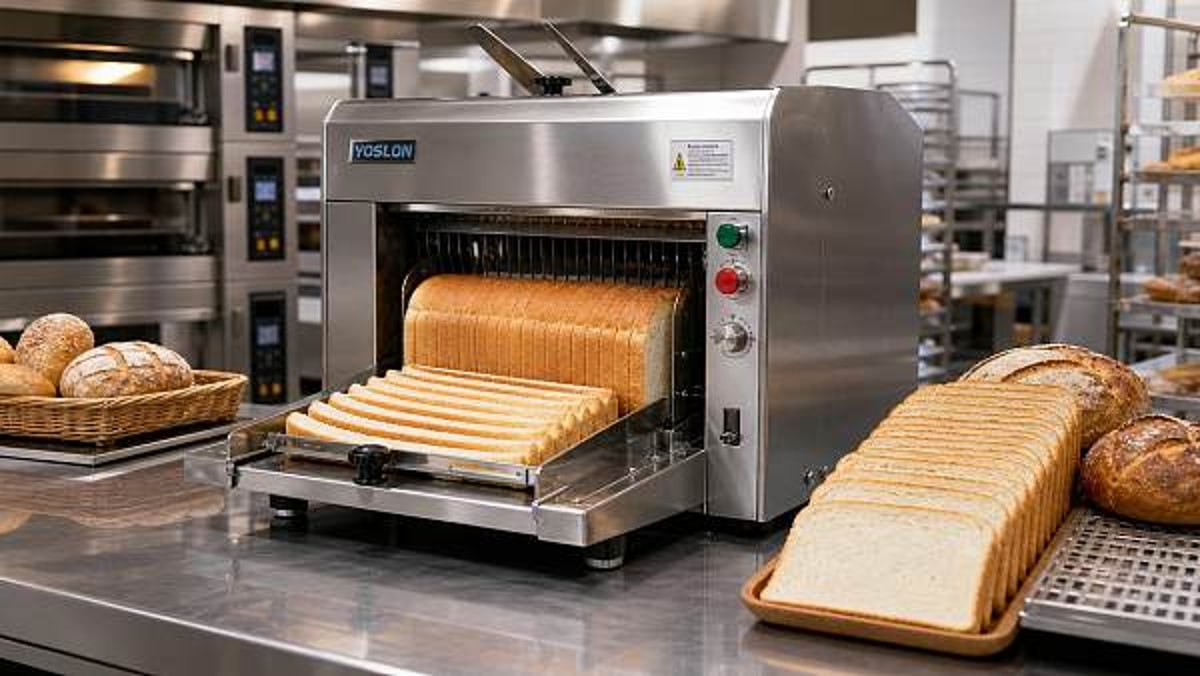
Slice consistency comes from the interaction of several machine elements rather than from blade count alone. The most visible factor is blade configuration. Blade thickness, spacing, tension, and cutting edge geometry all affect how the loaf moves through the cutting path. Machines designed for soft pan bread often prioritize gentle cutting and reduced compression, while units intended for crusty loaves need stronger resistance to lateral movement and better crust penetration.
The feed system is equally important. If the loaf enters the cutting zone at an unstable angle or with inconsistent pressure, even a sharp blade set may produce irregular slices. Technical evaluators should look closely at guides, hold-down assemblies, conveyors, and gravity-fed mechanisms. A stable feed path helps maintain slice thickness from the first cut to the last.
Machine rigidity matters as well. Frame vibration, loose assemblies, or poor alignment can reduce precision over time, especially in busy operations. What appears acceptable during a short demonstration may become inconsistent after months of heavy use. This is why build quality, component tolerance, and maintenance access are not secondary issues; they directly affect slicing results.
Finally, bread characteristics themselves must be considered. Product temperature, moisture level, crust hardness, loaf shape, and proofing consistency all influence results. The best commercial bread slicers perform well across normal product variation, but no slicer can fully compensate for unstable upstream baking quality. Evaluators should therefore assess equipment using real production samples rather than idealized test loaves.
Which performance indicators should technical evaluators compare first?
When reviewing commercial bread slicers, evaluators should begin with application-specific performance indicators instead of only comparing motor power or purchase price. The most useful starting point is output consistency under expected operating conditions. A slicer that performs well for 20 loaves in a showroom may behave differently in a breakfast kitchen, bakery backroom, or institutional production line.
The following table summarizes practical evaluation priorities.
For many buyers in hospitality and institutional foodservice, sanitation and usability deserve as much attention as output. If cleaning is difficult or blade access is unsafe, staff may delay maintenance, and performance will decline. A technically strong machine should support repeatable operation by ordinary staff, not only by experienced bakery personnel.
How should buyers compare commercial bread slicers for different operating scenarios?
Not all commercial bread slicers are designed for the same production logic. A hotel with breakfast buffet service may need moderate output, quiet operation, easy cleaning, and reliable slicing for sandwich loaves and occasional specialty bread. A retail bakery may prioritize product appearance, flexibility across loaf sizes, and low crumb generation in customer-facing areas. A central kitchen or industrial bakery is more likely to value continuous throughput, integration with packaging steps, and highly durable components.
This means technical evaluators should define the operating scenario before shortlisting equipment. The right question is not “Which slicer is best?” but “Which slicer best matches our loaf profile, labor skill level, sanitation routine, and service rhythm?” In sourcing environments, this distinction prevents overspecification and underspecification at the same time.
It is also helpful to compare manual-assisted, semi-automatic, and more automated feeding solutions in terms of labor dependency. A lower-cost unit may seem efficient on paper, but if it requires constant operator adjustment to avoid tearing or misalignment, its true cost is higher. Conversely, a more advanced machine can justify investment when it cuts labor variability and supports predictable output during peak demand.
What are the most common mistakes when selecting commercial bread slicers?
One common mistake is focusing too heavily on initial purchase price. Low-cost commercial bread slicers may appear attractive for budget-sensitive projects, but if they produce irregular slices, require frequent blade changes, or create excessive waste, the long-term cost is much higher. Technical evaluation should always include ownership cost, downtime risk, and expected maintenance burden.
Another mistake is testing with only one bread type. Many operations handle multiple loaf styles over a week or season. A slicer that performs well on uniform white bread may struggle with seeded loaves, brioche, rye, or crust-heavy artisan products. Evaluators should simulate realistic product diversity.
A third mistake is ignoring ergonomics and workflow fit. If loading height is awkward, crumb disposal is inconvenient, or discharge handling interrupts adjacent tasks, staff efficiency declines. Equipment should be assessed as part of the workstation, not as an isolated machine. This is especially true in commercial environments where space is tight and operations involve quick transitions between tasks.
Finally, buyers sometimes overlook supplier support. Blade replacement parts, service response, operator training, and documentation quality all influence real-world performance. For global sourcing projects, these factors become even more important because technical support must align with local operating conditions and compliance expectations.
How can technical evaluators verify whether a slicer will stay accurate over time?
Long-term consistency depends on mechanical durability and maintenance discipline. During evaluation, ask how blade tension is maintained, what wear points are expected, and how often calibration or replacement is required. Machines with easy inspection access generally support better preventive maintenance, which helps preserve slicing precision.
Request evidence from comparable installations whenever possible. That may include service records, operating hour estimates, customer references, or application cases from bakery, hotel, or catering environments similar to your own. A strong supplier should be able to explain not only rated capacity, but also how the equipment behaves after sustained commercial use.
Trial methodology matters too. Instead of evaluating a machine on perfect loaves only, use products from different batches and at different cooling stages. Measure first slice, middle slice, and end slice quality. Observe crumbs, compression, slice separation, and operator adjustments required during the process. These details reveal whether the machine is inherently stable or only performs well under ideal conditions.
What questions should be asked before procurement, sourcing, or supplier discussions?
Before moving forward with commercial bread slicers, technical teams should prepare a structured question list. This improves supplier comparison and reduces the risk of selecting equipment that looks capable but does not fit operational reality. Start with loaf dimensions, bread varieties, target slice thickness, expected hourly volume, and available installation space. Then confirm cleaning frequency, operator skill level, local electrical standards, and safety requirements.
It is also wise to clarify whether the supplier can support OEM or market-specific requirements, especially for international hospitality and institutional procurement. In many sourcing programs, the commercial value of the machine is tied not only to cutting performance but also to reliability of spare parts, training materials, inspection documentation, and after-sales communication.
For organizations evaluating multiple global suppliers, a practical checklist can simplify early-stage filtering.
So, how should decision-makers approach the final choice?
The most effective approach is to evaluate commercial bread slicers as productivity assets rather than simple prep equipment. Slice consistency affects cost control, waste, labor efficiency, presentation, and user experience in ways that are easy to underestimate during early sourcing. Technical evaluators should therefore balance cutting precision, product adaptability, sanitation design, safety, maintenance burden, and supplier support instead of focusing on a single specification.
For commercial buyers working across hospitality, catering, bakery, and institutional foodservice, the strongest procurement outcomes usually come from scenario-based testing and structured supplier comparison. If further confirmation is needed on suitable models, blade setup, output targets, implementation timeline, pricing logic, or sourcing options, the best next step is to discuss actual loaf types, daily volume, cleaning expectations, service support, and compliance requirements before requesting final quotations.
Search News
Hot Articles
Popular Tags
Need ExpertConsultation?
Connect with our specialized leisureengineering team for procurementstrategies.
Recommended News
 May 03, 2026Commercial pizza ovens that save labor may cost more to ventCommercial pizza ovens can cut labor, but venting, code compliance, and installation may raise total costs. See the key checks before you buy.● Hospitality Sourcing Dir
 May 03, 2026Commercial juicers: cold press or centrifugal for daily serviceCommercial juicers: compare cold press and centrifugal models for daily service. Discover the best fit for speed, juice quality, yield, cleaning, and operating costs.● Hospitality Sourcing Dir
 May 03, 2026Commercial water boilers: recovery time matters more than listed capacityCommercial water boilers perform best when recovery time matches peak demand. Learn why faster reheating beats listed capacity for reliable, efficient commercial hot water service.● Hospitality Sourcing Dir
 May 03, 2026Cotton candy machines wholesale: small details that affect cleaning timeCotton candy machines wholesale guide: discover the small design details that cut cleaning time, reduce labor costs, and improve hygiene for busy commercial operations.● Hospitality Sourcing Dir
 May 03, 2026Dough sheeters wholesale: thickness control is where quality showsDough sheeters wholesale buyers: see why thickness control defines real quality, repeatability, and long-term value. Compare key evaluation points for smarter sourcing.● Hospitality Sourcing Dir
 May 03, 2026Slushy machines wholesale: what causes flavor crossover problemsSlushy machines wholesale buyers should understand what causes flavor crossover, from poor sealing to weak cleaning design, to protect drink quality and choose more reliable equipment.● Hospitality Sourcing Dir
 May 03, 2026Commercial bread slicers: slice consistency affects more than looksCommercial bread slicers do more than improve appearance—they boost portion control, reduce waste, and support faster service. Learn what drives slice consistency before you buy.● Hospitality Sourcing Dir
 May 03, 2026Wood fired pizza ovens need more space than most plans allowWood fired pizza ovens often require more space than expected. Learn how to avoid redesigns, protect workflow, and plan compliant, high-performance hospitality projects.● Hospitality Sourcing Dir
 May 03, 2026Commercial pizza ovens: gas or electric for steady outputCommercial pizza ovens: compare gas vs. electric for steady output, faster recovery, precise control, and smarter installation choices across real kitchen scenarios.● Hospitality Sourcing Dir
 May 03, 2026Commercial popcorn machines: kettle size vs serving rush realityCommercial popcorn machines should be chosen by real rush-hour output, not kettle size alone. Learn how to match serving peaks, staffing, and workflow for smarter buying.● Hospitality Sourcing Dir
 May 03, 2026Commercial insect killers: indoor placement changes results fastCommercial insect killers perform very differently based on indoor placement. Discover how small positioning changes can boost control, reduce pest activity, and improve operational results fast.● Hospitality Sourcing Dir
 May 03, 2026Hotel & Catering Equipment lists often hide installation costsHotel & Catering Equipment lists often hide installation costs. Learn where budgets slip, what to verify early, and how to compare total installed value before approval.● Hospitality Sourcing Dir
 May 03, 2026Bakery display cases: glass fogging, lighting, and product appealBakery display cases guide: compare anti-fog glass, lighting quality, and temperature stability to boost product appeal, hygiene, and sales with smarter sourcing decisions.● Hospitality Sourcing Dir
 May 03, 2026Commercial milkshake mixers: when motor power changes drink textureCommercial milkshake mixers directly shape texture, aeration, and consistency. Learn how motor power affects shake quality and choose the right mixer for your menu and volume.● Hospitality Sourcing Dir
 May 03, 2026Hot dog rollers that clean faster can cut downtime more than expectedHot dog rollers that clean faster can reduce downtime, improve sanitation, and save labor. Learn which features matter most before you buy for busy commercial service.● Hospitality Sourcing Dir
 May 03, 2026Conveyor pizza ovens or deck ovens for high-volume service?Conveyor pizza ovens vs deck ovens: discover which option delivers better throughput, consistency, labor efficiency, and site-fit for high-volume commercial pizza service.● Hospitality Sourcing Dir
 May 03, 2026Shawarma machines commercial buyers compare heat control firstShawarma machines commercial buyers compare heat control first. Learn how gas, electric, and multi-zone systems affect consistency, efficiency, safety, and sourcing decisions.● Hospitality Sourcing Dir
 May 02, 2026Stainless steel GN pans with reinforced corners last longer in busy kitchensStainless steel GN pans with reinforced corners help busy kitchens reduce warping, improve hygiene, and cut replacement costs. See why buyers choose longer-lasting performance.● Hospitality Sourcing Dir
 May 02, 2026Commercial induction cookers: power ratings that mislead first-time buyersCommercial induction cookers are not as simple as wattage labels suggest. Learn how to compare real performance, efficiency, pan fit, and reliability before you buy.● Hospitality Sourcing Dir
 May 02, 2026Beverage dispensers wholesale: what causes dripping after heavy useBeverage dispensers wholesale guide: learn what causes dripping after heavy use, how to spot seal, valve, and pressure issues, and choose durable suppliers with confidence.● Hospitality Sourcing Dir
 May 02, 2026Disposable wooden cutlery and the taste issue customers noticeDisposable wooden cutlery can affect taste, texture, and customer perception. Learn what causes woody aftertaste, how to test suppliers, and how to choose better options.● Hospitality Sourcing Dir
 May 02, 2026Sushi display cases: curved glass looks better, but is it practical?Sushi display cases with curved glass look premium, but are they practical? Compare visibility, cleaning, temperature control, and ROI before you buy.● Hospitality Sourcing Dir
 May 02, 2026Vacuum sealing machines food businesses can scale withVacuum sealing machines food businesses can scale with improve shelf life, workflow, and cost control. Explore reliable, compliant solutions for growing food operations.● Hospitality Sourcing Dir
 May 02, 2026Chafing fuel gel bulk: storage and burn-time issues to check firstChafing fuel gel bulk buyers should check storage stability, seal integrity, and real burn-time performance first. Reduce waste, avoid service disruption, and source with more confidence.● Hospitality Sourcing Dir