Commercial pizza ovens: gas or electric for steady output
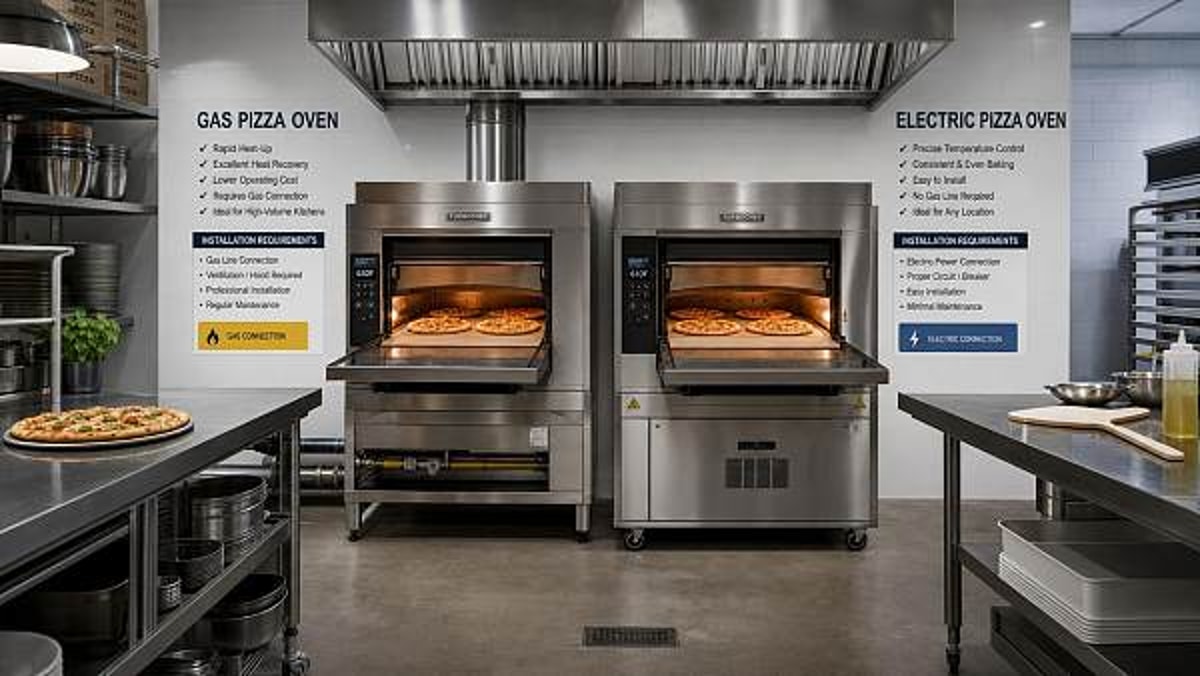
Choosing between gas and electric commercial pizza ovens can directly affect output consistency, energy planning, and kitchen workflow. For technical evaluators comparing performance under real service conditions, the right oven is not just about peak temperature—it is about heat recovery, bake uniformity, installation demands, and long-term operating efficiency. This guide examines both options through a practical commercial lens to support confident sourcing decisions.
Why scenario differences matter when evaluating commercial pizza ovens
For technical assessment teams, the question is rarely whether gas or electric can bake good pizza. Both can. The real issue is whether a specific oven type can deliver stable output in the exact environment where it will operate. A high-volume urban delivery kitchen, a hotel all-day dining outlet, a themed entertainment venue, and a premium open-kitchen restaurant may all buy commercial pizza ovens, yet their operational priorities differ sharply.
In one scenario, the critical factor may be fast recovery during nonstop service. In another, it may be installation simplicity in a property with limited gas access. Some buyers need flexible deployment across multiple sites with standardized training. Others prioritize artisan-style crust development, utility cost predictability, or compliance with site-specific ventilation rules. That is why technical evaluation should start with application context, not with a generic preference for gas or electric.
Core performance factors that change by application
Before comparing scenarios, evaluators should align on the metrics that most influence steady production. These metrics provide a practical framework for judging commercial pizza ovens beyond marketing claims.
- Heat recovery: how quickly the baking chamber returns to target conditions after each load.
- Bake uniformity: consistency of crust color, cheese melt, and internal doneness across deck positions or conveyor travel.
- Temperature control precision: ability to maintain stable settings through long production windows.
- Energy profile: utility consumption under partial load, peak demand, and all-day operation.
- Installation requirements: gas piping, electrical load, ventilation, clearance, and commissioning complexity.
- Serviceability: parts availability, technician familiarity, and downtime risk.
In many cases, gas commercial pizza ovens are chosen for strong high-temperature performance and responsive heat characteristics, while electric models are favored for control accuracy, cleaner installation pathways, and easier standardization across properties. However, these tendencies only become meaningful when matched to a real business scenario.
Scenario comparison: where gas or electric usually fits best
The table below gives a practical starting point for shortlisting commercial pizza ovens according to use case, service rhythm, and operational constraints.
Scenario 1: high-volume pizza operations that cannot afford slow recovery
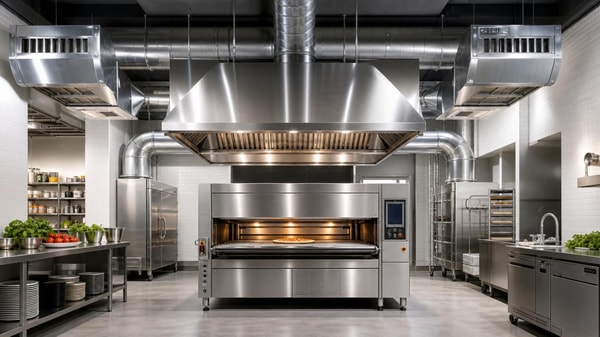
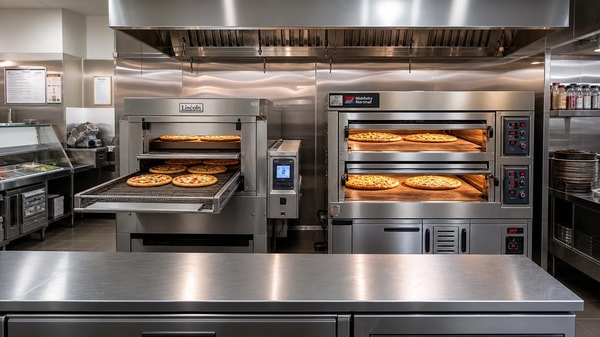
For delivery-first brands, food courts with lunch spikes, and dense urban pizzerias, steady output means surviving sustained demand without quality drift. In these environments, commercial pizza ovens must handle frequent door openings, repeated loading, and compressed ticket times. Gas ovens often perform well because they can support aggressive heat replenishment, especially in heavy-duty deck or conveyor formats designed for continuous service.
That said, the evaluator should not assume gas automatically wins. Modern electric commercial pizza ovens with strong element design, insulation, and chamber management can also maintain production effectively, particularly when paired with conveyor systems and standardized menu profiles. The correct question is: after the twentieth pizza in a rush, does the bake still match the first? If yes, the energy source is secondary to proven load stability.
In this scenario, test criteria should include hourly output, temperature drop after repeated loading, floor recovery, and consistency across peak windows of at least 60 to 90 minutes.
Scenario 2: hospitality and mixed-menu kitchens that need precision and flexibility
Hotels, resorts, premium cafés, and institutional foodservice sites often operate with broader menus and less predictable pizza demand. Here, the oven may need to switch between thin crust, flatbreads, reheating, and smaller batch production. Electric commercial pizza ovens frequently align well with this profile because they can offer tighter control, programmable settings, and easier repeatability for teams with varying skill levels.
A technical evaluator in hospitality should pay special attention to integration rather than raw heat alone. Questions include whether the unit can maintain quality during partial-load operation, whether it supports menu diversification, and whether service staff can reproduce results during breakfast, lunch, and evening periods. In properties where kitchen layouts are fixed and MEP changes are costly, electric installation may also reduce project complexity.
For these reasons, electric commercial pizza ovens often become the lower-risk choice in projects where operational consistency across shifts matters more than extreme peak firepower.
Scenario 3: artisan concepts where product identity depends on bake character
Independent pizzerias and premium restaurant concepts may evaluate ovens not just as production equipment, but as tools that shape signature texture, blistering, moisture retention, and finish. In such settings, many chefs and technical teams lean toward gas commercial pizza ovens, especially if the concept relies on pronounced top heat response, stone-deck behavior, or a specific traditional baking style.
However, this is one of the most misunderstood scenarios. Product identity does not come from fuel type alone. Deck material, chamber geometry, airflow, insulation, operator rhythm, and dough formulation all affect results. An electric deck oven with excellent zoning and stable chamber control may outperform a poorly matched gas unit for the intended product. Evaluators should therefore conduct side-by-side bake trials using actual dough hydration, sauce load, topping density, and service cadence.
Scenario 4: compact commercial sites where installation drives the decision
Not every project begins with culinary preference. Many begin with site limits. Mall kiosks, transport hubs, smart campus retail points, and retrofit locations may have constrained utility access, strict landlord approvals, or ventilation restrictions. In these conditions, electric commercial pizza ovens often move ahead because they can simplify planning, shorten approval timelines, and reduce dependency on gas infrastructure.
For technical evaluators, installation should be quantified early. Compare incoming electrical capacity, three-phase availability, local code requirements, gas routing feasibility, exhaust design, and commissioning lead time. A gas oven with excellent performance can still be the wrong sourcing choice if site adaptation costs erase operational benefits or delay opening schedules.
Scenario 5: multi-site chain deployment where standardization outweighs preference
Chains and franchise groups evaluate commercial pizza ovens differently from single-site operators. They need repeatable output across geographies, training simplicity, scalable maintenance, and stable procurement. Electric models often support this strategy through digital controls, menu presets, and more uniform operation across teams. Gas units may still be preferred in markets with favorable energy pricing or strong service networks, but they can introduce more site variation if local gas conditions or installation standards differ.
In a chain environment, the best sourcing decision usually comes from total system thinking: utility profile, operator skill, expansion speed, spare parts planning, and quality assurance. The most suitable commercial pizza ovens are the ones that produce the same result in site number one and site number fifty.
Common misjudgments when comparing gas and electric
Several evaluation mistakes can distort buying decisions:
- Focusing only on maximum temperature instead of loaded performance under service conditions.
- Ignoring utility infrastructure costs during early comparison.
- Using short demo tests that do not reflect actual production intensity.
- Assuming artisan quality is only possible with gas.
- Comparing purchase price without modeling downtime risk, maintenance access, and staff training impact.
These errors matter because technical evaluation is not just equipment comparison. It is risk management for food quality, service continuity, and site economics.
A practical checklist for final sourcing decisions
When narrowing down commercial pizza ovens, technical teams should validate five points before approval:
- Define the dominant operating scenario: rush-heavy, mixed menu, artisan, compact site, or chain rollout.
- Run bake tests under realistic production loads, not single-pizza demonstrations.
- Measure full installed cost, including utilities, ventilation, and commissioning.
- Review service network depth, lead times for critical parts, and local technical support.
- Confirm whether the oven supports future menu, throughput, or site expansion plans.
FAQ: how technical evaluators often frame the choice
Are gas commercial pizza ovens always better for volume?
Not always. Gas often performs strongly in heavy continuous service, but some electric systems deliver excellent throughput and consistency. The decision should be based on validated recovery and output data.
Are electric commercial pizza ovens more consistent?
They often provide highly repeatable control, which is valuable in hospitality and multi-site operations. Still, consistency depends on the full oven design, not just the power source.
What matters most for a retrofit project?
Usually installation feasibility, utility readiness, ventilation, and approval speed. In retrofit environments, those factors can outweigh theoretical baking advantages.
Conclusion: match the oven to the operating reality
For steady output, there is no universal winner between gas and electric commercial pizza ovens. Gas may be the stronger fit for some high-demand or style-driven operations, while electric may be the smarter choice for controlled, flexible, or rollout-oriented environments. The best result comes from matching the oven to the actual service pattern, site conditions, staff capability, and long-term business model.
If your team is comparing commercial pizza ovens for a new build, chain expansion, hospitality upgrade, or specialty retail food concept, build the specification around the scenario first. Once the operational context is clear, performance data becomes easier to interpret, and sourcing decisions become far more reliable.
Search News
Hot Articles
Popular Tags
Need ExpertConsultation?
Connect with our specialized leisureengineering team for procurementstrategies.
Recommended News
 May 03, 2026Commercial pizza ovens that save labor may cost more to ventCommercial pizza ovens can cut labor, but venting, code compliance, and installation may raise total costs. See the key checks before you buy.● Hospitality Sourcing Dir
 May 03, 2026Commercial juicers: cold press or centrifugal for daily serviceCommercial juicers: compare cold press and centrifugal models for daily service. Discover the best fit for speed, juice quality, yield, cleaning, and operating costs.● Hospitality Sourcing Dir
 May 03, 2026Commercial water boilers: recovery time matters more than listed capacityCommercial water boilers perform best when recovery time matches peak demand. Learn why faster reheating beats listed capacity for reliable, efficient commercial hot water service.● Hospitality Sourcing Dir
 May 03, 2026Cotton candy machines wholesale: small details that affect cleaning timeCotton candy machines wholesale guide: discover the small design details that cut cleaning time, reduce labor costs, and improve hygiene for busy commercial operations.● Hospitality Sourcing Dir
 May 03, 2026Dough sheeters wholesale: thickness control is where quality showsDough sheeters wholesale buyers: see why thickness control defines real quality, repeatability, and long-term value. Compare key evaluation points for smarter sourcing.● Hospitality Sourcing Dir
 May 03, 2026Slushy machines wholesale: what causes flavor crossover problemsSlushy machines wholesale buyers should understand what causes flavor crossover, from poor sealing to weak cleaning design, to protect drink quality and choose more reliable equipment.● Hospitality Sourcing Dir
 May 03, 2026Commercial bread slicers: slice consistency affects more than looksCommercial bread slicers do more than improve appearance—they boost portion control, reduce waste, and support faster service. Learn what drives slice consistency before you buy.● Hospitality Sourcing Dir
 May 03, 2026Wood fired pizza ovens need more space than most plans allowWood fired pizza ovens often require more space than expected. Learn how to avoid redesigns, protect workflow, and plan compliant, high-performance hospitality projects.● Hospitality Sourcing Dir
 May 03, 2026Commercial pizza ovens: gas or electric for steady outputCommercial pizza ovens: compare gas vs. electric for steady output, faster recovery, precise control, and smarter installation choices across real kitchen scenarios.● Hospitality Sourcing Dir
 May 03, 2026Commercial popcorn machines: kettle size vs serving rush realityCommercial popcorn machines should be chosen by real rush-hour output, not kettle size alone. Learn how to match serving peaks, staffing, and workflow for smarter buying.● Hospitality Sourcing Dir
 May 03, 2026Commercial insect killers: indoor placement changes results fastCommercial insect killers perform very differently based on indoor placement. Discover how small positioning changes can boost control, reduce pest activity, and improve operational results fast.● Hospitality Sourcing Dir
 May 03, 2026Hotel & Catering Equipment lists often hide installation costsHotel & Catering Equipment lists often hide installation costs. Learn where budgets slip, what to verify early, and how to compare total installed value before approval.● Hospitality Sourcing Dir
 May 03, 2026Bakery display cases: glass fogging, lighting, and product appealBakery display cases guide: compare anti-fog glass, lighting quality, and temperature stability to boost product appeal, hygiene, and sales with smarter sourcing decisions.● Hospitality Sourcing Dir
 May 03, 2026Commercial milkshake mixers: when motor power changes drink textureCommercial milkshake mixers directly shape texture, aeration, and consistency. Learn how motor power affects shake quality and choose the right mixer for your menu and volume.● Hospitality Sourcing Dir
 May 03, 2026Hot dog rollers that clean faster can cut downtime more than expectedHot dog rollers that clean faster can reduce downtime, improve sanitation, and save labor. Learn which features matter most before you buy for busy commercial service.● Hospitality Sourcing Dir
 May 03, 2026Conveyor pizza ovens or deck ovens for high-volume service?Conveyor pizza ovens vs deck ovens: discover which option delivers better throughput, consistency, labor efficiency, and site-fit for high-volume commercial pizza service.● Hospitality Sourcing Dir
 May 03, 2026Shawarma machines commercial buyers compare heat control firstShawarma machines commercial buyers compare heat control first. Learn how gas, electric, and multi-zone systems affect consistency, efficiency, safety, and sourcing decisions.● Hospitality Sourcing Dir
 May 02, 2026Stainless steel GN pans with reinforced corners last longer in busy kitchensStainless steel GN pans with reinforced corners help busy kitchens reduce warping, improve hygiene, and cut replacement costs. See why buyers choose longer-lasting performance.● Hospitality Sourcing Dir
 May 02, 2026Commercial induction cookers: power ratings that mislead first-time buyersCommercial induction cookers are not as simple as wattage labels suggest. Learn how to compare real performance, efficiency, pan fit, and reliability before you buy.● Hospitality Sourcing Dir
 May 02, 2026Beverage dispensers wholesale: what causes dripping after heavy useBeverage dispensers wholesale guide: learn what causes dripping after heavy use, how to spot seal, valve, and pressure issues, and choose durable suppliers with confidence.● Hospitality Sourcing Dir
 May 02, 2026Disposable wooden cutlery and the taste issue customers noticeDisposable wooden cutlery can affect taste, texture, and customer perception. Learn what causes woody aftertaste, how to test suppliers, and how to choose better options.● Hospitality Sourcing Dir
 May 02, 2026Sushi display cases: curved glass looks better, but is it practical?Sushi display cases with curved glass look premium, but are they practical? Compare visibility, cleaning, temperature control, and ROI before you buy.● Hospitality Sourcing Dir
 May 02, 2026Vacuum sealing machines food businesses can scale withVacuum sealing machines food businesses can scale with improve shelf life, workflow, and cost control. Explore reliable, compliant solutions for growing food operations.● Hospitality Sourcing Dir
 May 02, 2026Chafing fuel gel bulk: storage and burn-time issues to check firstChafing fuel gel bulk buyers should check storage stability, seal integrity, and real burn-time performance first. Reduce waste, avoid service disruption, and source with more confidence.● Hospitality Sourcing Dir