Commercial juicers: cold press or centrifugal for daily service
Choosing between commercial juicers for daily service can directly affect speed, yield, flavor, and long-term operating costs. Whether you run a hotel breakfast station, café, or catering business, understanding the differences between cold press and centrifugal models helps you match equipment performance to service volume, menu goals, and customer expectations.
What has changed in recent years is not simply the technology inside commercial juicers, but the way buyers evaluate them. For daily service environments, procurement teams are no longer choosing equipment based on headline power alone. They are comparing labor efficiency, menu flexibility, perceived freshness, noise, cleaning time, waste control, and total cost over the equipment lifecycle. This shift matters because juice service has moved from being a minor add-on to a visible part of guest experience in hotels, cafés, healthy fast-casual outlets, premium office canteens, and event catering.
As experiential consumption grows, beverage equipment is expected to support both operational reliability and brand positioning. A breakfast buffet that promises wellness, a café that markets clean-label drinks, or a catering operator serving high-volume morning traffic may all need commercial juicers, but not the same type. The cold press versus centrifugal decision has become a signal of broader operational intent: speed-first service, quality-first positioning, or a balanced hybrid strategy.
Why the market is rethinking commercial juicers for daily service
Several trend signals are reshaping equipment selection. First, customers increasingly associate visible preparation and fresh ingredients with premium value. Second, operators are facing tighter labor conditions, making cleaning complexity and workflow design more important than before. Third, foodservice margins remain under pressure, so juice yield and produce waste now receive more attention in purchasing decisions. Finally, menu innovation has expanded beyond basic orange and apple juice toward leafy greens, functional blends, nut milks, immunity shots, and low-foam presentations.
These changes create a more nuanced buying environment. Centrifugal machines still appeal to businesses that need rapid throughput and lower upfront investment. Cold press units continue to attract operators focused on premium quality, broader ingredient compatibility, and stronger wellness positioning. The question is no longer which technology is universally better. The better question is which type of commercial juicer fits the service pattern, customer promise, and staffing reality of a specific business.
The main forces driving the cold press vs centrifugal debate
The debate around commercial juicers is being pushed by a mix of commercial, technical, and operational factors. Businesses that once treated juicing equipment as a simple back-bar appliance now see it as part of a larger performance system.
For information researchers, the most useful takeaway is that commercial juicers are increasingly assessed through a strategic lens. Procurement teams are asking how a machine supports service flow, guest perception, and future menu changes, not just whether it produces juice.
What cold press and centrifugal models signal about service strategy
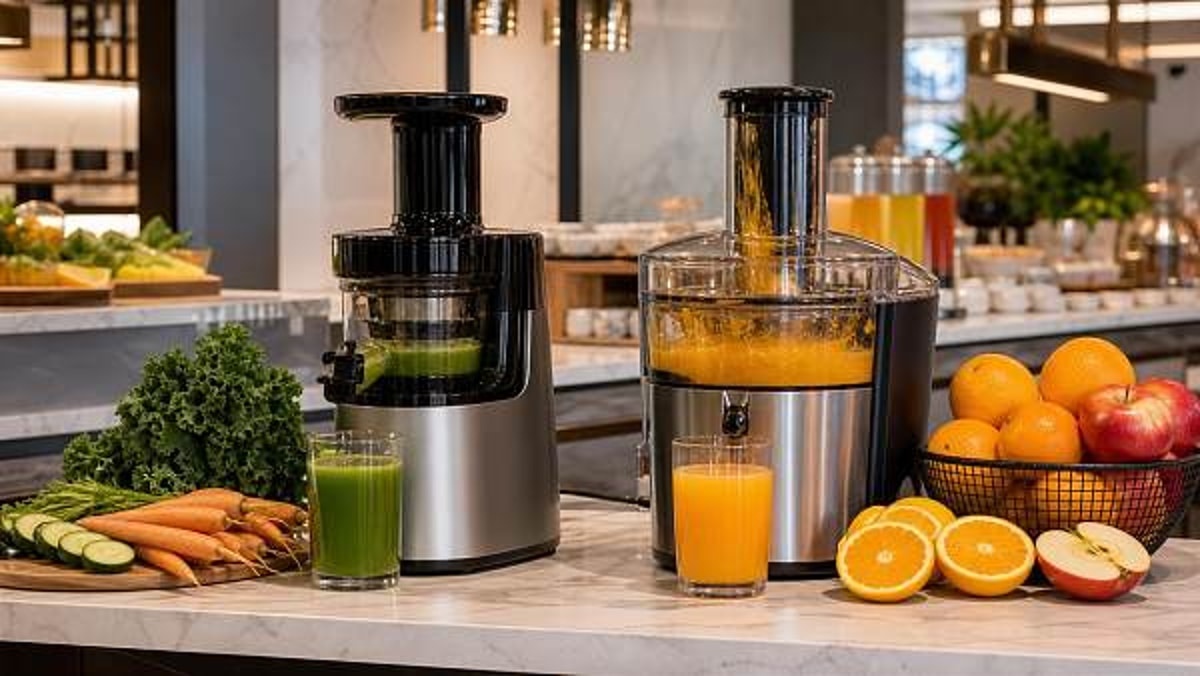
Cold press commercial juicers usually reflect a quality-led or concept-led strategy. They tend to run at lower speeds, generate less heat, and are often selected when operators want stronger flavor retention, lower oxidation, broader produce compatibility, and a more premium product story. These advantages align well with wellness bars, boutique hotels, upscale cafés, and operators serving nutrient-focused beverages throughout the day.
Centrifugal commercial juicers usually reflect a speed-led strategy. They are often preferred in environments where quick output, easy staff adoption, and lower capital cost matter most. For breakfast rushes, event preparation, or grab-and-go formats serving familiar fruit juices, centrifugal units can remain highly practical. They are not outdated; they simply fit a different business model.
In other words, the cold press versus centrifugal choice is often a proxy for a broader operating philosophy. If the beverage program is designed to drive premium spend and brand differentiation, cold press becomes more compelling. If the main objective is handling daily service volume quickly and consistently, centrifugal often remains the stronger fit.
How the impact differs across hospitality and foodservice settings
The effect of this equipment choice is not equal across all business types. Different service environments experience different risks and benefits from each type of commercial juicer.
This is where buyers often make a costly mistake: they compare commercial juicers in isolation instead of comparing them against real service conditions. A machine that looks efficient in a showroom may create bottlenecks in a compact breakfast station. A model praised for premium juice quality may underperform in a labor-light operation with little time for cleaning and assembly.
Technology upgrades are changing the decision, but not eliminating trade-offs
Equipment innovation is narrowing some of the historic gap between the two categories. Newer cold press systems have improved feed design, safety features, and easier disassembly. At the same time, many centrifugal models now offer better pulp management, stronger durability, and smarter ergonomics. Some manufacturers also position hybrid or semi-commercial options for operators that want more versatility without stepping into the highest investment tier.
Still, trade-offs remain. Cold press commercial juicers typically ask for more deliberate workflow planning. Centrifugal models may still produce more foam and may be less ideal for certain ingredient profiles. The market trend is not that one technology is replacing the other. The real trend is that procurement standards are getting more detailed, and buyers are becoming more precise about use-case fit.
The overlooked decision factors that now matter more
For daily service, the most decisive factors are often not the most advertised ones. Yield, for example, is important, but only if it offsets slower operation or higher labor demand. Noise may be irrelevant in a back-of-house prep room but critical in an open café counter or a luxury breakfast lounge. Cleaning time may seem secondary until shift changes become rushed and sanitation standards tighten.
Buyers evaluating commercial juicers should pay closer attention to the following practical questions:
- How many service peaks occur per day, and how long do they last?
- Is the menu limited to common fruits, or does it include leafy greens, roots, and functional ingredients?
- Will the machine operate front-of-house, where noise and visual impression affect the guest experience?
- How much staff training time is realistic?
- Is the goal to maximize output, reduce waste, strengthen premium pricing, or balance all three?
These questions help convert a generic equipment comparison into a relevant purchasing judgment. In today’s market, that is far more valuable than relying on product labels alone.
How to judge which direction the market is moving for your business
One of the strongest signals in foodservice and hospitality is segmentation. Businesses are not moving together toward one type of commercial juicer. Instead, the market is splitting into clearer use cases. Premium health-forward concepts are leaning more toward cold press. High-traffic and efficiency-led operations still rely heavily on centrifugal technology. Multi-format operators are increasingly standardizing different juicing setups by outlet type rather than forcing one machine type across all locations.
For procurement teams, this means future-ready buying is less about choosing the most advanced machine and more about choosing the most scalable service model. If your beverage program may expand into wellness blends, detox offers, or high-margin signature drinks, cold press may support that direction. If your priority is dependable breakfast output across multiple sites, centrifugal may offer better rollout practicality.
What businesses should monitor before making the next equipment move
The next step is not to rush into a binary decision. Instead, businesses should monitor a small set of performance indicators over several weeks or service cycles. Track juice demand by time of day, ingredient mix, cleaning downtime, produce waste, guest feedback, and average selling price by beverage type. This evidence often reveals whether current demand is operationally simple or strategically evolving.
It is also wise to assess supplier support, spare parts availability, sanitation design, and after-sales training. In commercial environments, the most attractive machine on paper may become a weak asset if maintenance support is slow or operator training is poor. For global buyers and sourcing teams, dependable compliance documentation and stable manufacturing quality are equally important, especially when equipment is deployed across multiple regions or managed under brand standards.
A practical action path for information researchers and sourcing teams
If you are researching commercial juicers for daily service, the most useful approach is to build your comparison around operating scenarios rather than product categories alone. Start with actual demand patterns. Then compare cold press and centrifugal options against speed, yield, labor, cleaning, menu ambition, and guest-facing value. This structure gives a clearer picture than feature-by-feature comparison without context.
For businesses sourcing internationally, this decision also fits a broader commercial trend: equipment procurement is becoming more integrated with brand strategy, service design, and operational resilience. Commercial juicers are a small category, but they reflect a bigger shift in hospitality and specialty retail procurement. Buyers increasingly want equipment that is not only functional, but also aligned with experience quality, efficiency pressure, and future menu direction.
If your business wants to judge which direction is right, focus on a few core questions: Are you selling freshness as a premium experience or delivering juice as a fast service staple? Is your demand stable or concentrated in short rush periods? Do you need menu versatility more than raw speed? And can your staffing model support the equipment you choose? The answers will do more than identify the right commercial juicers. They will clarify how your beverage program should evolve in the next stage of daily service.
Search News
Hot Articles
Popular Tags
Need ExpertConsultation?
Connect with our specialized leisureengineering team for procurementstrategies.
Recommended News
 May 03, 2026Commercial pizza ovens that save labor may cost more to ventCommercial pizza ovens can cut labor, but venting, code compliance, and installation may raise total costs. See the key checks before you buy.● Hospitality Sourcing Dir
 May 03, 2026Commercial juicers: cold press or centrifugal for daily serviceCommercial juicers: compare cold press and centrifugal models for daily service. Discover the best fit for speed, juice quality, yield, cleaning, and operating costs.● Hospitality Sourcing Dir
 May 03, 2026Commercial water boilers: recovery time matters more than listed capacityCommercial water boilers perform best when recovery time matches peak demand. Learn why faster reheating beats listed capacity for reliable, efficient commercial hot water service.● Hospitality Sourcing Dir
 May 03, 2026Cotton candy machines wholesale: small details that affect cleaning timeCotton candy machines wholesale guide: discover the small design details that cut cleaning time, reduce labor costs, and improve hygiene for busy commercial operations.● Hospitality Sourcing Dir
 May 03, 2026Dough sheeters wholesale: thickness control is where quality showsDough sheeters wholesale buyers: see why thickness control defines real quality, repeatability, and long-term value. Compare key evaluation points for smarter sourcing.● Hospitality Sourcing Dir
 May 03, 2026Slushy machines wholesale: what causes flavor crossover problemsSlushy machines wholesale buyers should understand what causes flavor crossover, from poor sealing to weak cleaning design, to protect drink quality and choose more reliable equipment.● Hospitality Sourcing Dir
 May 03, 2026Commercial bread slicers: slice consistency affects more than looksCommercial bread slicers do more than improve appearance—they boost portion control, reduce waste, and support faster service. Learn what drives slice consistency before you buy.● Hospitality Sourcing Dir
 May 03, 2026Wood fired pizza ovens need more space than most plans allowWood fired pizza ovens often require more space than expected. Learn how to avoid redesigns, protect workflow, and plan compliant, high-performance hospitality projects.● Hospitality Sourcing Dir
 May 03, 2026Commercial pizza ovens: gas or electric for steady outputCommercial pizza ovens: compare gas vs. electric for steady output, faster recovery, precise control, and smarter installation choices across real kitchen scenarios.● Hospitality Sourcing Dir
 May 03, 2026Commercial popcorn machines: kettle size vs serving rush realityCommercial popcorn machines should be chosen by real rush-hour output, not kettle size alone. Learn how to match serving peaks, staffing, and workflow for smarter buying.● Hospitality Sourcing Dir
 May 03, 2026Commercial insect killers: indoor placement changes results fastCommercial insect killers perform very differently based on indoor placement. Discover how small positioning changes can boost control, reduce pest activity, and improve operational results fast.● Hospitality Sourcing Dir
 May 03, 2026Hotel & Catering Equipment lists often hide installation costsHotel & Catering Equipment lists often hide installation costs. Learn where budgets slip, what to verify early, and how to compare total installed value before approval.● Hospitality Sourcing Dir
 May 03, 2026Bakery display cases: glass fogging, lighting, and product appealBakery display cases guide: compare anti-fog glass, lighting quality, and temperature stability to boost product appeal, hygiene, and sales with smarter sourcing decisions.● Hospitality Sourcing Dir
 May 03, 2026Commercial milkshake mixers: when motor power changes drink textureCommercial milkshake mixers directly shape texture, aeration, and consistency. Learn how motor power affects shake quality and choose the right mixer for your menu and volume.● Hospitality Sourcing Dir
 May 03, 2026Hot dog rollers that clean faster can cut downtime more than expectedHot dog rollers that clean faster can reduce downtime, improve sanitation, and save labor. Learn which features matter most before you buy for busy commercial service.● Hospitality Sourcing Dir
 May 03, 2026Conveyor pizza ovens or deck ovens for high-volume service?Conveyor pizza ovens vs deck ovens: discover which option delivers better throughput, consistency, labor efficiency, and site-fit for high-volume commercial pizza service.● Hospitality Sourcing Dir
 May 03, 2026Shawarma machines commercial buyers compare heat control firstShawarma machines commercial buyers compare heat control first. Learn how gas, electric, and multi-zone systems affect consistency, efficiency, safety, and sourcing decisions.● Hospitality Sourcing Dir
 May 02, 2026Stainless steel GN pans with reinforced corners last longer in busy kitchensStainless steel GN pans with reinforced corners help busy kitchens reduce warping, improve hygiene, and cut replacement costs. See why buyers choose longer-lasting performance.● Hospitality Sourcing Dir
 May 02, 2026Commercial induction cookers: power ratings that mislead first-time buyersCommercial induction cookers are not as simple as wattage labels suggest. Learn how to compare real performance, efficiency, pan fit, and reliability before you buy.● Hospitality Sourcing Dir
 May 02, 2026Beverage dispensers wholesale: what causes dripping after heavy useBeverage dispensers wholesale guide: learn what causes dripping after heavy use, how to spot seal, valve, and pressure issues, and choose durable suppliers with confidence.● Hospitality Sourcing Dir
 May 02, 2026Disposable wooden cutlery and the taste issue customers noticeDisposable wooden cutlery can affect taste, texture, and customer perception. Learn what causes woody aftertaste, how to test suppliers, and how to choose better options.● Hospitality Sourcing Dir
 May 02, 2026Sushi display cases: curved glass looks better, but is it practical?Sushi display cases with curved glass look premium, but are they practical? Compare visibility, cleaning, temperature control, and ROI before you buy.● Hospitality Sourcing Dir
 May 02, 2026Vacuum sealing machines food businesses can scale withVacuum sealing machines food businesses can scale with improve shelf life, workflow, and cost control. Explore reliable, compliant solutions for growing food operations.● Hospitality Sourcing Dir
 May 02, 2026Chafing fuel gel bulk: storage and burn-time issues to check firstChafing fuel gel bulk buyers should check storage stability, seal integrity, and real burn-time performance first. Reduce waste, avoid service disruption, and source with more confidence.● Hospitality Sourcing Dir