Commercial milkshake mixers: when motor power changes drink texture
In busy foodservice settings, commercial milkshake mixers do far more than speed up drink preparation—they directly influence texture, aeration, and consistency. When motor power changes, the result can be anything from a light, silky shake to a dense, spoonable blend. For buyers comparing equipment, understanding this relationship is essential to selecting machines that match menu goals, service volume, and customer expectations.
For most information-stage buyers, the short answer is this: motor power does affect drink texture, but not in a simple “more power is always better” way. In commercial milkshake mixers, power interacts with spindle speed, cup design, ingredient viscosity, and operator technique. A high-powered machine can produce smoother results and recover faster during peak hours, yet it can also over-aerate delicate recipes or create unnecessary noise and energy costs if it is oversized for the application.
That is why buyers should not evaluate commercial milkshake mixers by wattage alone. The better decision comes from matching motor output to the style of shakes on the menu, the expected serving volume, and the consistency standards of the business. A diner serving classic hand-dipped shakes has different needs from a quick-service chain, a dessert bar, or a hotel lounge offering premium frozen beverages.
What searchers usually want to know before comparing commercial milkshake mixers
When people search for “commercial milkshake mixers” alongside questions about motor power and texture, they are usually trying to solve a practical buying problem. They want to know whether a stronger motor will improve drink quality, whether low-powered models can handle thick mixes, and how to avoid buying equipment that disappoints during service.
These readers also tend to worry about product consistency. A mixer that performs well in a showroom test may struggle when staff prepare shakes continuously, use frozen ingredients, or switch between recipes with different viscosities. Buyers therefore want a clearer link between technical specifications and real-world beverage outcomes.
For this audience, the most useful content is not a generic overview of mixers. What helps most is a decision framework: how motor power changes texture, when extra power adds business value, when it does not, and which related features deserve equal attention during sourcing.
How motor power actually changes milkshake texture
Motor power influences how effectively the mixer can move thick ingredients, break down ice cream or inclusions, and maintain rotational force under load. In simple terms, a stronger motor resists slowing down when the mixture becomes dense. That stability helps create a more uniform texture, especially in recipes with hard-frozen dairy, syrups, cookies, fruit pieces, or protein add-ins.
In lower-powered machines, the spindle may lose speed as resistance increases. When that happens, blending becomes less even. Operators may need more time to complete the shake, scrape the sides, or restart the mix. The final drink can show inconsistencies such as small lumps, uneven sweetness distribution, or a thin top layer with a heavier bottom.
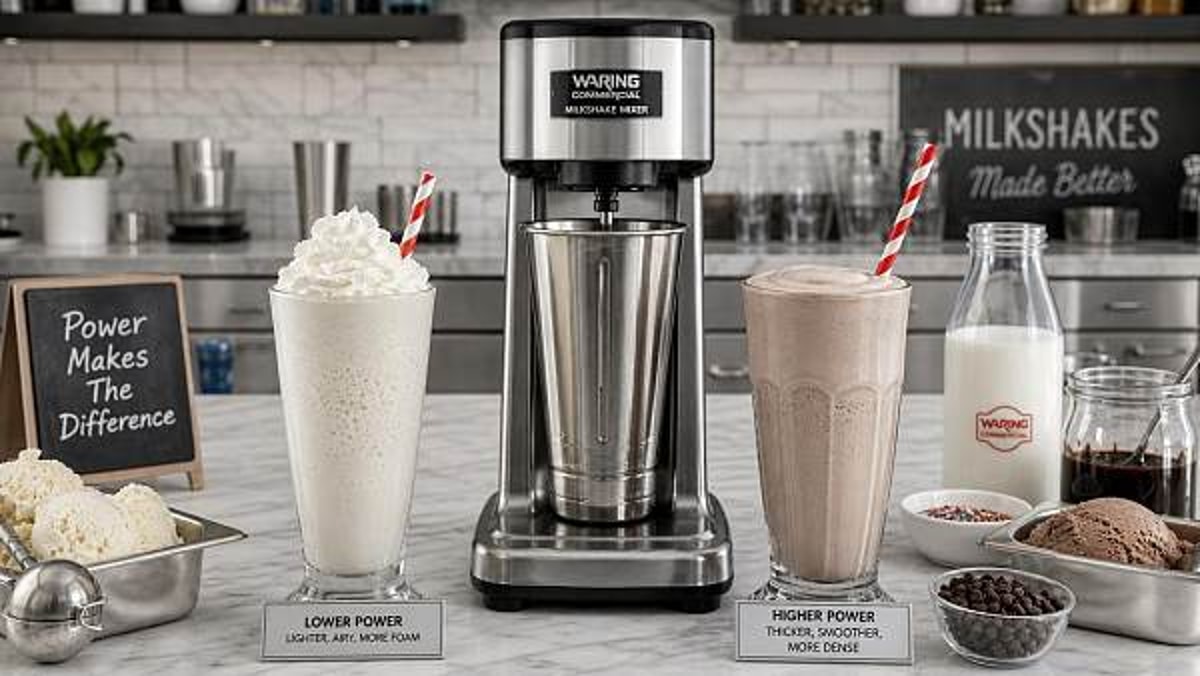
However, texture is not only about brute force. Higher motor power can introduce more air into the mixture, particularly when paired with high spindle speeds and longer mix times. This may be desirable for old-fashioned fountain-style shakes that should feel light and fluffy. But for premium shakes marketed as rich, dense, and indulgent, too much aeration can reduce the perceived quality and make the beverage feel less substantial.
That is the core takeaway: motor power changes texture by affecting shear force, mixing stability, and aeration. The right level depends on the drink experience the operator wants to deliver.
Why “more powerful” is not always “better” for every menu
A common buying mistake is assuming the highest-powered commercial milkshake mixers will automatically produce the best shakes. In reality, the ideal machine is the one that aligns with the menu concept. A business focused on traditional milkshakes may prefer a balanced machine that creates smooth texture without overworking the product. A concept built around extra-thick dessert shakes may need stronger torque and better load handling, but still require careful speed control.
Excessive power in a simple operation can create side effects. It may increase splashing risk, overmix thin recipes, warm the product through prolonged agitation, or produce a foamier texture than intended. It can also raise the purchase price and, in some cases, maintenance requirements.
For operations with straightforward recipes and moderate output, a mid-range motor often offers the best practical value. It can deliver stable results without forcing staff to adapt every recipe around the machine. On the other hand, high-volume locations, stores with thick signature shakes, and outlets that use frozen mix-ins often benefit from more robust equipment because consistency under pressure matters more than minimum upfront cost.
What buyers should compare besides motor wattage
If you are evaluating commercial milkshake mixers, motor wattage is only one part of the buying decision. Torque behavior under load is just as important, although not every supplier presents it clearly. Two machines with similar rated power may perform very differently once they are mixing thick ingredients repeatedly during a lunch rush.
Speed options are another major factor. Single-speed machines can work well in standardized operations, but variable-speed or multi-speed models provide more flexibility across different drink styles. Lower speeds may help reduce foam and preserve density, while higher speeds may improve smoothness and ingredient integration.
The spindle design also matters. Different agitators create different mixing actions, affecting how much air enters the drink and how quickly ingredients are dispersed. Cup shape and cup material influence circulation patterns as well. A well-designed cup can help the machine produce a more even blend with less operator intervention.
Durability, ease of cleaning, and workflow fit should also be assessed. A mixer that produces excellent texture but slows down sanitation or creates staff frustration may not be the right commercial choice. For information-stage buyers, this is where sourcing decisions become more strategic: the best unit is the one that balances beverage quality, labor efficiency, and operational reliability.
Matching motor power to different service scenarios
Different foodservice environments experience motor power in different ways. In a small café or dessert kiosk with occasional shake orders, the machine may spend more time idle than blending. Here, a very high-powered unit may be unnecessary unless the menu specifically calls for thick frozen creations. Consistency still matters, but throughput pressure is lower.
In diners, burger chains, and family restaurants, the machine often needs to support recurring demand spikes. During these periods, a stronger motor helps maintain consistent texture from the first drink to the twentieth. It recovers faster between orders and is less likely to bog down when staff move quickly and use slightly varied ingredient portions.
Hotels and premium hospitality venues usually have a different set of priorities. They may require lower noise, polished presentation, and the ability to support both classic milkshakes and upgraded beverage concepts. In this setting, buyers should look beyond raw power and focus on control, finish quality, and recipe versatility.
For institutional settings such as educational foodservice or large-volume catering, reliability and repeatability are often more important than artisanal customization. A machine with adequate motor power and simple operation can reduce training demands and lower the risk of inconsistency across shifts.
How texture goals should shape your equipment shortlist
One of the fastest ways to narrow a shortlist of commercial milkshake mixers is to define the target texture before reviewing specifications. If the goal is a light, nostalgic shake with visible volume and a fast-drinkable body, buyers should favor machines that blend efficiently without creating excessive density. Moderate power and controlled aeration may be ideal.
If the goal is a thick, premium shake that can hold toppings, support takeaway delivery, or be served with a spoon, stronger mixing capability becomes more valuable. The machine must be able to process dense ice cream and inclusions while preserving body. In this case, underpowered units often create inconsistency, leaving chunks or forcing operators to add more liquid than the recipe intends.
For businesses offering multiple shake styles, flexibility becomes the priority. Adjustable speed settings, reliable motor performance, and compatible cup systems may contribute more to long-term value than simply moving to the highest output tier. Buyers should think in terms of texture range, not just one ideal recipe.
Operational signs that a mixer is underpowered or overpowered
Even before a formal equipment test, operators can often identify whether a machine’s motor profile matches their needs. An underpowered mixer usually reveals itself through longer blend times, inconsistent incorporation, stalled rotation in thick recipes, and the need for staff to manually assist the product too often. These signs indicate that the machine is struggling against resistance.
Customer-facing symptoms may include shakes that separate quickly, have uneven mouthfeel, or vary significantly depending on who prepared them. These are not just culinary issues; they affect brand trust and repeat orders.
An overpowered mixer is less common as a failure point, but it can still create problems. It may whip too much air into recipes, reduce the intended richness, or create avoidable mess and noise. In some cases, operators compensate by shortening blend times inconsistently, which can bring back texture variation in another form.
For procurement teams and business owners, these warning signs matter because they translate directly into waste, slower service, staff retraining, and menu underperformance.
Why testing with real recipes matters more than spec-sheet comparisons
Spec sheets can help eliminate unsuitable models, but they rarely tell the full story. A commercial milkshake mixer should be tested using the actual ingredients, serving temperatures, and target recipes the operation intends to use. This is especially important when the menu includes hard-frozen ice cream, branded syrups, cookie pieces, fruit purées, or non-dairy alternatives, all of which change resistance and blending behavior.
During testing, buyers should observe more than whether the machine can finish the drink. They should assess blend time, texture uniformity, foam level, product temperature after mixing, ease of cleaning, and operator comfort. A unit that looks strong on paper may still produce the wrong mouthfeel for the concept.
It is also wise to test back-to-back production. Some machines perform well on a single serving but show weakness during repeated cycles. Motor heat, recovery speed, and consistency across several drinks reveal far more about commercial suitability than a one-off demo.
Questions B2B buyers should ask suppliers before sourcing
For information-stage readers moving toward vendor comparison, asking better questions can quickly improve decision quality. Start by asking what drink types the machine is designed for: classic fountain shakes, extra-thick premium shakes, frozen desserts, or multi-format beverage programs. This frames the conversation around outcomes rather than abstract power ratings.
Then ask how the motor performs under sustained load, whether multiple speed settings are available, and what cup and spindle configurations are recommended for different textures. If possible, request demonstration data or recipe-specific testing support.
Other practical sourcing questions include expected duty cycle, cleaning procedure, spare parts availability, compliance certifications for your market, warranty terms, and after-sales service coverage. For global buyers, voltage compatibility and regional service support are especially important.
In a B2B context, the best supplier is not only selling commercial milkshake mixers. They should also help buyers connect machine capability with menu performance, labor realities, and long-term ownership cost.
The business impact of choosing the right mixer power
Choosing the correct motor power affects more than texture alone. It influences ticket value, speed of service, recipe discipline, and customer satisfaction. A properly matched mixer allows businesses to execute signature beverages as intended, which supports pricing confidence and brand differentiation.
It can also reduce hidden costs. When operators are not forced to compensate for weak mixing with extra liquid, longer blend times, or repeated remakes, ingredient control improves. When the machine does not over-aerate drinks, businesses avoid serving a product that feels less premium than its menu description suggests.
For growing chains or hospitality groups, consistency across locations is especially valuable. Equipment that delivers repeatable texture helps protect the customer experience from store to store. That makes mixer selection a procurement decision with marketing consequences, not just a back-of-house technical purchase.
Conclusion: evaluate motor power through texture goals, not numbers alone
When motor power changes in commercial milkshake mixers, drink texture changes too—but the effect depends on the application. More power can improve smoothness, reduce strain in thick recipes, and support high-volume consistency. At the same time, too much power for the wrong menu can over-aerate products, increase costs, and complicate execution.
The smartest buying approach is to begin with the desired shake style, expected throughput, and service environment. From there, compare power together with speed control, spindle design, cup compatibility, and real-recipe performance. That is how buyers move beyond generic specifications and choose equipment that truly fits their operation.
For information-stage decision makers, the clearest conclusion is simple: do not ask only how powerful a mixer is. Ask what kind of texture it helps you deliver, consistently, during real commercial service. That is the measure that matters most.
Search News
Hot Articles
Popular Tags
Need ExpertConsultation?
Connect with our specialized leisureengineering team for procurementstrategies.
Recommended News
 May 03, 2026Commercial pizza ovens that save labor may cost more to ventCommercial pizza ovens can cut labor, but venting, code compliance, and installation may raise total costs. See the key checks before you buy.● Hospitality Sourcing Dir
 May 03, 2026Commercial juicers: cold press or centrifugal for daily serviceCommercial juicers: compare cold press and centrifugal models for daily service. Discover the best fit for speed, juice quality, yield, cleaning, and operating costs.● Hospitality Sourcing Dir
 May 03, 2026Commercial water boilers: recovery time matters more than listed capacityCommercial water boilers perform best when recovery time matches peak demand. Learn why faster reheating beats listed capacity for reliable, efficient commercial hot water service.● Hospitality Sourcing Dir
 May 03, 2026Cotton candy machines wholesale: small details that affect cleaning timeCotton candy machines wholesale guide: discover the small design details that cut cleaning time, reduce labor costs, and improve hygiene for busy commercial operations.● Hospitality Sourcing Dir
 May 03, 2026Dough sheeters wholesale: thickness control is where quality showsDough sheeters wholesale buyers: see why thickness control defines real quality, repeatability, and long-term value. Compare key evaluation points for smarter sourcing.● Hospitality Sourcing Dir
 May 03, 2026Slushy machines wholesale: what causes flavor crossover problemsSlushy machines wholesale buyers should understand what causes flavor crossover, from poor sealing to weak cleaning design, to protect drink quality and choose more reliable equipment.● Hospitality Sourcing Dir
 May 03, 2026Commercial bread slicers: slice consistency affects more than looksCommercial bread slicers do more than improve appearance—they boost portion control, reduce waste, and support faster service. Learn what drives slice consistency before you buy.● Hospitality Sourcing Dir
 May 03, 2026Wood fired pizza ovens need more space than most plans allowWood fired pizza ovens often require more space than expected. Learn how to avoid redesigns, protect workflow, and plan compliant, high-performance hospitality projects.● Hospitality Sourcing Dir
 May 03, 2026Commercial pizza ovens: gas or electric for steady outputCommercial pizza ovens: compare gas vs. electric for steady output, faster recovery, precise control, and smarter installation choices across real kitchen scenarios.● Hospitality Sourcing Dir
 May 03, 2026Commercial popcorn machines: kettle size vs serving rush realityCommercial popcorn machines should be chosen by real rush-hour output, not kettle size alone. Learn how to match serving peaks, staffing, and workflow for smarter buying.● Hospitality Sourcing Dir
 May 03, 2026Commercial insect killers: indoor placement changes results fastCommercial insect killers perform very differently based on indoor placement. Discover how small positioning changes can boost control, reduce pest activity, and improve operational results fast.● Hospitality Sourcing Dir
 May 03, 2026Hotel & Catering Equipment lists often hide installation costsHotel & Catering Equipment lists often hide installation costs. Learn where budgets slip, what to verify early, and how to compare total installed value before approval.● Hospitality Sourcing Dir
 May 03, 2026Bakery display cases: glass fogging, lighting, and product appealBakery display cases guide: compare anti-fog glass, lighting quality, and temperature stability to boost product appeal, hygiene, and sales with smarter sourcing decisions.● Hospitality Sourcing Dir
 May 03, 2026Commercial milkshake mixers: when motor power changes drink textureCommercial milkshake mixers directly shape texture, aeration, and consistency. Learn how motor power affects shake quality and choose the right mixer for your menu and volume.● Hospitality Sourcing Dir
 May 03, 2026Hot dog rollers that clean faster can cut downtime more than expectedHot dog rollers that clean faster can reduce downtime, improve sanitation, and save labor. Learn which features matter most before you buy for busy commercial service.● Hospitality Sourcing Dir
 May 03, 2026Conveyor pizza ovens or deck ovens for high-volume service?Conveyor pizza ovens vs deck ovens: discover which option delivers better throughput, consistency, labor efficiency, and site-fit for high-volume commercial pizza service.● Hospitality Sourcing Dir
 May 03, 2026Shawarma machines commercial buyers compare heat control firstShawarma machines commercial buyers compare heat control first. Learn how gas, electric, and multi-zone systems affect consistency, efficiency, safety, and sourcing decisions.● Hospitality Sourcing Dir
 May 02, 2026Stainless steel GN pans with reinforced corners last longer in busy kitchensStainless steel GN pans with reinforced corners help busy kitchens reduce warping, improve hygiene, and cut replacement costs. See why buyers choose longer-lasting performance.● Hospitality Sourcing Dir
 May 02, 2026Commercial induction cookers: power ratings that mislead first-time buyersCommercial induction cookers are not as simple as wattage labels suggest. Learn how to compare real performance, efficiency, pan fit, and reliability before you buy.● Hospitality Sourcing Dir
 May 02, 2026Beverage dispensers wholesale: what causes dripping after heavy useBeverage dispensers wholesale guide: learn what causes dripping after heavy use, how to spot seal, valve, and pressure issues, and choose durable suppliers with confidence.● Hospitality Sourcing Dir
 May 02, 2026Disposable wooden cutlery and the taste issue customers noticeDisposable wooden cutlery can affect taste, texture, and customer perception. Learn what causes woody aftertaste, how to test suppliers, and how to choose better options.● Hospitality Sourcing Dir
 May 02, 2026Sushi display cases: curved glass looks better, but is it practical?Sushi display cases with curved glass look premium, but are they practical? Compare visibility, cleaning, temperature control, and ROI before you buy.● Hospitality Sourcing Dir
 May 02, 2026Vacuum sealing machines food businesses can scale withVacuum sealing machines food businesses can scale with improve shelf life, workflow, and cost control. Explore reliable, compliant solutions for growing food operations.● Hospitality Sourcing Dir
 May 02, 2026Chafing fuel gel bulk: storage and burn-time issues to check firstChafing fuel gel bulk buyers should check storage stability, seal integrity, and real burn-time performance first. Reduce waste, avoid service disruption, and source with more confidence.● Hospitality Sourcing Dir