Cotton candy machines wholesale: small details that affect cleaning time
When evaluating cotton candy machines wholesale options, buyers often focus on output, price, and design—but cleaning time can quietly shape daily labor costs and hygiene efficiency. Small structural details, from bowl attachment systems to heating head accessibility, can make routine maintenance either fast and manageable or unexpectedly time-consuming, especially for operators comparing suppliers and commercial use scenarios.
Why cleaning time matters more than many buyers expect
For information-stage buyers, the biggest challenge in cotton candy machines wholesale research is not identifying a machine that can spin sugar. It is understanding how that machine performs during repeated daily use in concession stands, amusement venues, hotel event stations, school fairs, or indoor entertainment spaces. Cleaning time affects staffing, queue management, food safety routines, and machine uptime.
In commercial settings, a few extra minutes after each service cycle can add up quickly. If an operator must partially disassemble sticky components, scrape hardened sugar from awkward corners, or wait for slow-cooling parts before wipe-down, the hidden labor cost grows. This is why experienced sourcing teams look beyond headline output and compare maintenance-friendly construction.
- Shorter cleaning cycles help reduce labor hours during peak trading periods and event turnovers.
- Better access to contact surfaces supports more consistent hygiene routines.
- Simpler disassembly lowers the risk of operator error, bent parts, or lost fasteners.
- Faster restart after cleaning helps operators maintain serving continuity in high-footfall environments.
For B2B sourcing teams, especially those working across hospitality, leisure, and specialty retail projects, maintenance detail is not a minor issue. It can influence total cost of ownership and the practicality of a machine in real operating conditions.
Which small design details in cotton candy machines wholesale have the biggest cleaning impact?
Many wholesale listings present machines in broad terms such as “stainless steel bowl,” “high efficiency,” or “commercial type.” Those descriptions are not enough. Cleaning speed is shaped by component geometry, access points, attachment design, and residue behavior under heat.
Key structural points to inspect
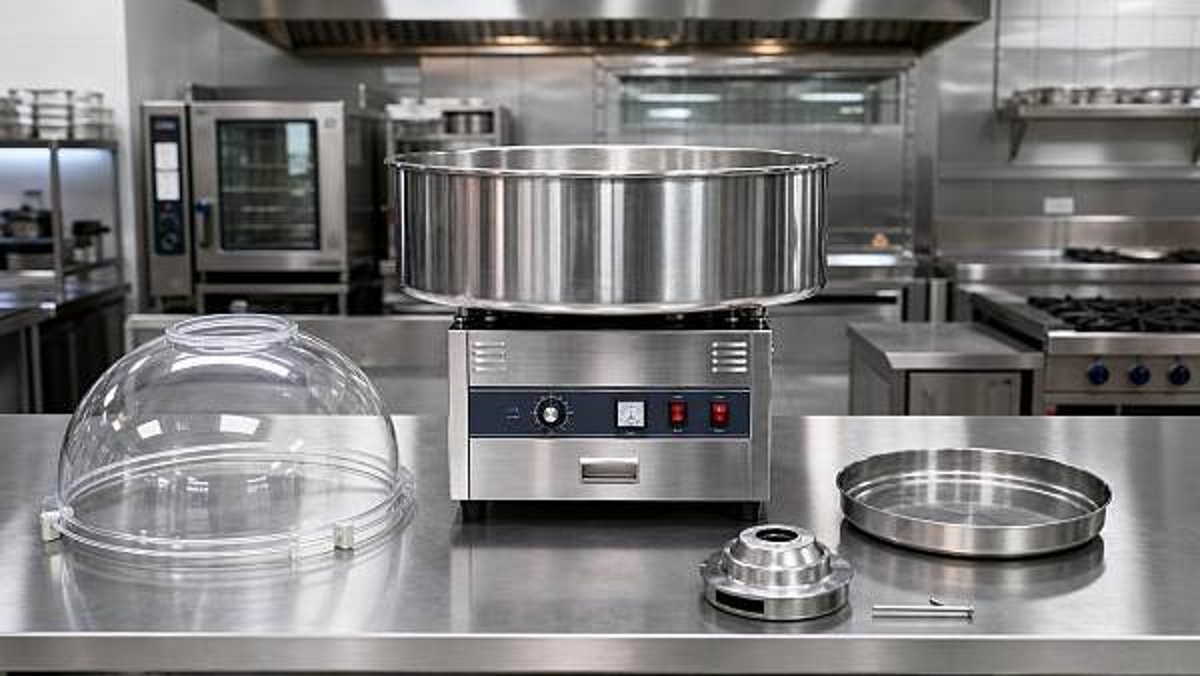
- Bowl attachment system: Clip-on or quick-release bowls are usually easier to remove than multi-screw assemblies, especially when cleaning is frequent.
- Heating head accessibility: If the spinning head is difficult to reach, sugar carbonization can build up and lengthen cleaning intervals.
- Surface finish: Smooth stainless surfaces generally release sticky residue more easily than rough finishes or poorly joined seams.
- Gap design: Narrow crevices around switches, brackets, and bowl supports can trap sugar dust and syrup splatter.
- Removable guards and trays: Machines with detachable sugar catch areas are often simpler to wipe down between batches.
- Drainage and spill control: A design that channels excess sugar or cleaning water away from electrical sections reduces cleanup complexity.
The table below helps buyers compare small design features in cotton candy machines wholesale offers and estimate how each feature may affect routine cleaning effort.
This comparison shows why two machines with similar output can perform very differently in day-to-day maintenance. A buyer reviewing cotton candy machines wholesale proposals should request close-up photos or videos of these areas, not just full product shots.
How application scenarios change the right cleaning-focused machine choice
Not every operator needs the same machine structure. A shopping mall kiosk, a seasonal park vendor, and a hotel banquet team have different service rhythms, staffing models, and hygiene expectations. Matching the machine to the scenario is often more useful than comparing price alone.
Typical commercial scenarios
For cotton candy machines wholesale buyers, scenario-based evaluation can prevent overbuying or choosing a unit that looks attractive but slows operations after installation.
This scenario table highlights a common sourcing mistake: choosing a machine based on nominal capacity while ignoring who will clean it, where, and how often. In multi-site procurement, standardizing around easier-to-clean structures can also simplify staff training.
What procurement teams should ask suppliers before placing a wholesale order
A strong cotton candy machines wholesale decision starts with better supplier questions. Product listings rarely explain maintenance friction in enough detail, so buyers should move beyond general claims and request operational evidence.
Practical supplier question list
- Ask how long routine post-service cleaning typically takes under normal commercial use, and what parts must be removed.
- Request photos or short videos of bowl removal, head access, and cleaning around switches and brackets.
- Confirm which parts are food-contact surfaces and what materials are used in those areas.
- Check whether spare bowls, heating heads, or shields are available for replacement planning.
- Ask whether the supplier provides cleaning instructions, exploded diagrams, and operator manuals in the destination market language.
- Clarify whether the machine design helps isolate electrical components from splash-prone cleaning zones.
Global sourcing often involves OEM or ODM variations, so the same machine category may have meaningful differences in bowl depth, fastener type, or guard construction. GCT’s role in this process is to help buyers compare commercial suitability, supply reliability, and sourcing risk across more than a simple catalog description.
Cleaning time, labor cost, and total ownership: where the real difference appears
When comparing cotton candy machines wholesale options, budget-conscious buyers sometimes choose the lowest purchase price without considering maintenance labor. Yet in repeated commercial use, a machine that requires longer disassembly or more residue scraping can become more expensive over time than a slightly higher-priced unit with better cleanability.
This is especially relevant for operators with extended trading hours, seasonal surges, or staff turnover. If the cleaning process is difficult, consistency often declines. That can affect hygiene standards, service quality, and equipment lifespan.
Cost areas influenced by cleaning design
- Direct labor cost from daily wipe-down, end-of-day sanitation, and periodic deep cleaning.
- Training cost when operators need extra instruction to dismantle or reassemble the machine correctly.
- Downtime cost if residue buildup causes performance inconsistency or delays during service.
- Replacement cost for parts damaged by forced scraping or repeated removal of poorly designed fittings.
For information researchers preparing procurement recommendations, this is an important internal communication point. A maintenance-friendly machine may not be the cheapest line item, but it can be easier to justify when labor efficiency and operational reliability are included in the evaluation.
What standards and compliance points should buyers keep in mind?
Although specific certification needs vary by destination market, commercial food equipment buyers should still review general compliance and hygiene-related considerations before confirming a cotton candy machines wholesale order. This is particularly important for importers, hospitality groups, and institutional purchasers working across multiple jurisdictions.
Common compliance checkpoints
- Food-contact material suitability and cleanable surface design.
- Electrical safety conformity appropriate to the target market.
- Clear operating and cleaning documentation for end users.
- Reasonable guarding around rotating or heated parts.
- Parts availability and after-sales support for maintenance continuity.
Buyers should not assume that every wholesale-ready machine is equally suitable for every commercial market. If the project involves hotels, campuses, leisure parks, or public-facing venues, the ability to document cleaning procedures and material details can be just as important as basic performance claims.
Common mistakes when comparing cotton candy machines wholesale listings
Research-stage buyers often face a flood of similar-looking offers. That makes it easy to overlook details that directly affect operations. The following mistakes appear frequently in sourcing discussions.
Misconceptions to avoid
- Assuming stainless steel alone means easy cleaning: material matters, but seam quality, shape, and access matter too.
- Focusing only on production speed: high output loses value if the machine needs long downtime to clean.
- Ignoring operator skill level: a machine that is simple for a trained technician may frustrate temporary event staff.
- Overlooking replacement parts: cleaning-related wear on bowls, heads, or shields can affect long-term use.
- Skipping visual proof: catalog claims should be backed by real product images, maintenance videos, or sample evaluation.
A careful sourcing process reduces these risks. This is where an intelligence-led platform such as GCT adds value: not by replacing supplier contact, but by helping commercial buyers frame better questions, compare use cases, and identify hidden operational trade-offs earlier.
FAQ: practical questions buyers ask during early research
How do I evaluate cleaning difficulty if I cannot inspect the machine in person?
Request close-up images of the bowl rim, spinning head, underside supports, and control panel area. Ask for a short removal-and-cleaning video. In cotton candy machines wholesale sourcing, visual evidence often reveals more than specification sheets, especially around crevices, fasteners, and access limitations.
Are larger machines always harder to clean?
Not necessarily. A larger bowl can create more surface area, but a well-designed machine with fast-release parts and accessible components may still clean faster than a smaller unit with awkward geometry. Structure is usually more important than overall size alone.
What matters most for event and rental operators?
Portability, quick setup, simplified wipe-down, and resistance to operator handling errors are major priorities. Event-based buyers should pay close attention to bowl mounting, loose accessory count, and how easily sugar residue can be removed between jobs.
Should I request samples or a pilot order before a full wholesale purchase?
If your order volume is meaningful or your project involves multiple sites, a sample or pilot unit is often helpful. It allows you to assess cleaning time, operator usability, noise, finish quality, and practical maintenance needs before committing to a broader cotton candy machines wholesale agreement.
Why choose us for sourcing support and next-step evaluation
Global Commercial Trade supports commercial buyers who need more than a simple product list. For cotton candy machines wholesale research, we help connect sourcing decisions to real-world use cases across hospitality, leisure, education, and specialty retail environments. That means looking at maintenance practicality, supplier responsiveness, compliance fit, and project-level purchasing logic together.
You can contact us to discuss specific evaluation points such as bowl structure comparison, cleaning-friendly design review, target capacity by venue type, delivery timelines, OEM or customization questions, destination-market documentation needs, sample support, and quotation matching across shortlisted suppliers.
If you are still narrowing down cotton candy machines wholesale options, share your intended application, expected daily throughput, preferred machine format, and compliance concerns. We can help structure a clearer comparison path so your final sourcing conversation is based on operational fit, not just headline price.
Search News
Hot Articles
Popular Tags
Need ExpertConsultation?
Connect with our specialized leisureengineering team for procurementstrategies.
Recommended News
 May 03, 2026Commercial pizza ovens that save labor may cost more to ventCommercial pizza ovens can cut labor, but venting, code compliance, and installation may raise total costs. See the key checks before you buy.● Hospitality Sourcing Dir
 May 03, 2026Commercial juicers: cold press or centrifugal for daily serviceCommercial juicers: compare cold press and centrifugal models for daily service. Discover the best fit for speed, juice quality, yield, cleaning, and operating costs.● Hospitality Sourcing Dir
 May 03, 2026Commercial water boilers: recovery time matters more than listed capacityCommercial water boilers perform best when recovery time matches peak demand. Learn why faster reheating beats listed capacity for reliable, efficient commercial hot water service.● Hospitality Sourcing Dir
 May 03, 2026Cotton candy machines wholesale: small details that affect cleaning timeCotton candy machines wholesale guide: discover the small design details that cut cleaning time, reduce labor costs, and improve hygiene for busy commercial operations.● Hospitality Sourcing Dir
 May 03, 2026Dough sheeters wholesale: thickness control is where quality showsDough sheeters wholesale buyers: see why thickness control defines real quality, repeatability, and long-term value. Compare key evaluation points for smarter sourcing.● Hospitality Sourcing Dir
 May 03, 2026Slushy machines wholesale: what causes flavor crossover problemsSlushy machines wholesale buyers should understand what causes flavor crossover, from poor sealing to weak cleaning design, to protect drink quality and choose more reliable equipment.● Hospitality Sourcing Dir
 May 03, 2026Commercial bread slicers: slice consistency affects more than looksCommercial bread slicers do more than improve appearance—they boost portion control, reduce waste, and support faster service. Learn what drives slice consistency before you buy.● Hospitality Sourcing Dir
 May 03, 2026Wood fired pizza ovens need more space than most plans allowWood fired pizza ovens often require more space than expected. Learn how to avoid redesigns, protect workflow, and plan compliant, high-performance hospitality projects.● Hospitality Sourcing Dir
 May 03, 2026Commercial pizza ovens: gas or electric for steady outputCommercial pizza ovens: compare gas vs. electric for steady output, faster recovery, precise control, and smarter installation choices across real kitchen scenarios.● Hospitality Sourcing Dir
 May 03, 2026Commercial popcorn machines: kettle size vs serving rush realityCommercial popcorn machines should be chosen by real rush-hour output, not kettle size alone. Learn how to match serving peaks, staffing, and workflow for smarter buying.● Hospitality Sourcing Dir
 May 03, 2026Commercial insect killers: indoor placement changes results fastCommercial insect killers perform very differently based on indoor placement. Discover how small positioning changes can boost control, reduce pest activity, and improve operational results fast.● Hospitality Sourcing Dir
 May 03, 2026Hotel & Catering Equipment lists often hide installation costsHotel & Catering Equipment lists often hide installation costs. Learn where budgets slip, what to verify early, and how to compare total installed value before approval.● Hospitality Sourcing Dir
 May 03, 2026Bakery display cases: glass fogging, lighting, and product appealBakery display cases guide: compare anti-fog glass, lighting quality, and temperature stability to boost product appeal, hygiene, and sales with smarter sourcing decisions.● Hospitality Sourcing Dir
 May 03, 2026Commercial milkshake mixers: when motor power changes drink textureCommercial milkshake mixers directly shape texture, aeration, and consistency. Learn how motor power affects shake quality and choose the right mixer for your menu and volume.● Hospitality Sourcing Dir
 May 03, 2026Hot dog rollers that clean faster can cut downtime more than expectedHot dog rollers that clean faster can reduce downtime, improve sanitation, and save labor. Learn which features matter most before you buy for busy commercial service.● Hospitality Sourcing Dir
 May 03, 2026Conveyor pizza ovens or deck ovens for high-volume service?Conveyor pizza ovens vs deck ovens: discover which option delivers better throughput, consistency, labor efficiency, and site-fit for high-volume commercial pizza service.● Hospitality Sourcing Dir
 May 03, 2026Shawarma machines commercial buyers compare heat control firstShawarma machines commercial buyers compare heat control first. Learn how gas, electric, and multi-zone systems affect consistency, efficiency, safety, and sourcing decisions.● Hospitality Sourcing Dir
 May 02, 2026Stainless steel GN pans with reinforced corners last longer in busy kitchensStainless steel GN pans with reinforced corners help busy kitchens reduce warping, improve hygiene, and cut replacement costs. See why buyers choose longer-lasting performance.● Hospitality Sourcing Dir
 May 02, 2026Commercial induction cookers: power ratings that mislead first-time buyersCommercial induction cookers are not as simple as wattage labels suggest. Learn how to compare real performance, efficiency, pan fit, and reliability before you buy.● Hospitality Sourcing Dir
 May 02, 2026Beverage dispensers wholesale: what causes dripping after heavy useBeverage dispensers wholesale guide: learn what causes dripping after heavy use, how to spot seal, valve, and pressure issues, and choose durable suppliers with confidence.● Hospitality Sourcing Dir
 May 02, 2026Disposable wooden cutlery and the taste issue customers noticeDisposable wooden cutlery can affect taste, texture, and customer perception. Learn what causes woody aftertaste, how to test suppliers, and how to choose better options.● Hospitality Sourcing Dir
 May 02, 2026Sushi display cases: curved glass looks better, but is it practical?Sushi display cases with curved glass look premium, but are they practical? Compare visibility, cleaning, temperature control, and ROI before you buy.● Hospitality Sourcing Dir
 May 02, 2026Vacuum sealing machines food businesses can scale withVacuum sealing machines food businesses can scale with improve shelf life, workflow, and cost control. Explore reliable, compliant solutions for growing food operations.● Hospitality Sourcing Dir
 May 02, 2026Chafing fuel gel bulk: storage and burn-time issues to check firstChafing fuel gel bulk buyers should check storage stability, seal integrity, and real burn-time performance first. Reduce waste, avoid service disruption, and source with more confidence.● Hospitality Sourcing Dir