Custom Hotel Signage That Looks Premium and Stays Readable
In hospitality projects, custom hotel signage must do more than look elegant—it needs to stay clear, durable, and easy to read across every guest touchpoint. For project managers balancing brand standards, timelines, and installation demands, the right signage solution supports both premium design and operational efficiency. This guide explores how to achieve signage that enhances guest experience while meeting real-world project requirements.
Why a checklist approach works better for custom hotel signage
For project managers, signage decisions rarely fail because the concept was weak. They fail because one critical detail was missed: viewing distance, finish durability, mounting conditions, code compliance, multilingual readability, or lead time coordination with fit-out trades. A checklist approach helps turn custom hotel signage from a design conversation into a controlled project outcome.
Premium-looking signage is not only about selecting brass, acrylic, stone, wood veneer, or illuminated metal letters. It is about ensuring that every sign remains legible under real lighting conditions, survives cleaning cycles, aligns with brand standards, and arrives ready for efficient installation. In hotel projects, wayfinding errors also affect guest satisfaction, staff efficiency, and even safety. That is why the smartest procurement and project teams review signage through a structured set of decision points before approving artwork or production.
The first things to confirm before approving any signage package
Before comparing suppliers or materials, confirm the project basics that drive the entire custom hotel signage scope. These early checks reduce redesign, rework, and installation conflicts later in the schedule.
- Define the signage hierarchy. Separate exterior identity signs, directional signs, room numbers, amenity signs, regulatory signs, and back-of-house labels. Each type has different readability and durability requirements.
- Map the guest journey. Review arrival, lobby check-in, elevator transitions, corridor navigation, spa, dining, meeting rooms, parking, and emergency egress. Signage should support natural movement, not merely decorate walls.
- Confirm brand expression. Determine whether the visual target is understated luxury, heritage elegance, modern minimalism, or resort-style warmth. Premium appearance depends on coherence, not just expensive materials.
- Identify local code and accessibility rules. Requirements for tactile lettering, Braille, contrast ratios, emergency signage, fire safety coordination, and mounting heights must be built into the design from the beginning.
- Check the installation environment. Humidity, cleaning chemicals, UV exposure, salt air, guest contact frequency, and wall substrate all affect material choice and fixing method.
- Align the schedule with other trades. Custom hotel signage often depends on final paint, stone, millwork, electrical rough-in, and room numbering confirmation. Late coordination causes avoidable delays.
Core checklist: how to judge whether custom hotel signage looks premium and stays readable
1. Readability must come before decoration
A premium sign that guests struggle to read is a project failure. Assess typeface clarity, letter spacing, contrast, and sign size at actual viewing distance. Thin elegant fonts may work for close-range suite plaques but fail in dim corridors or busy lobby zones. For directional signs, clarity should win over visual novelty every time.
Ask for mockups under realistic lighting, not only digital renders. Review signs during daytime, warm evening lighting, and mixed lighting conditions. If the sign includes metallic finishes, test glare and reflection. Brushed metal can look refined, but excessive reflectivity may reduce legibility.
2. Material quality should support the intended luxury level
Premium custom hotel signage often uses layered materials, precise edge finishing, and controlled color consistency. The key question is not whether a material is expensive, but whether it performs well in the setting. Metal, engineered stone, timber veneer, tempered glass, and high-grade acrylic can all look premium when specified correctly.
Check edge treatments, coating resistance, thickness consistency, and tactile feel. A sign may appear attractive from a distance yet reveal poor fabrication up close through uneven painting, weak adhesion, rough corners, or mismatched grain direction. In luxury hospitality, close-up quality matters because guests interact with signs at arm’s length.
3. Contrast and lighting determine real usability
Contrast is one of the most overlooked factors in custom hotel signage. Gold lettering on beige stone may fit the concept board but disappear in low light. White text on frosted glass can look elegant but become unreadable from an angle. Contrast should be tested in context, especially for room identification, lift lobbies, conference floors, and wellness areas where lighting is intentionally soft.
If using illuminated signs, confirm LED temperature, hotspot control, maintenance access, dimming compatibility, and emergency power coordination where relevant. Illumination should enhance readability, not create halo distortion or color inconsistency.
4. Durability is part of the premium experience
Guests interpret scratches, peeling film, tarnished finishes, and loose letters as poor quality. Project teams should review abrasion resistance, moisture resistance, chemical cleaning tolerance, and UV stability. Signage in spas, pools, outdoor drop-off zones, kitchens, and housekeeping areas needs stronger performance specifications than signage in low-contact executive floors.
Also verify maintenance procedures. Premium custom hotel signage should not require delicate cleaning methods that are unrealistic for daily operations. If a finish fingerprints easily or loses color after routine cleaning, the initial aesthetic value will not last.
5. Installation method affects both appearance and lifecycle
The same sign can look world-class or mediocre depending on installation quality. Review fixing details early: concealed studs, adhesive systems, stand-offs, recessed mounting, or integrated millwork installation. Ask whether wall unevenness, expansion joints, wet areas, and maintenance access have been considered.
For project managers, signage should arrive with clear location coding, templates, hardware packs, and installation drawings. This is especially important in multi-floor hotels where room numbering and directional logic must remain consistent.
A practical comparison table for project evaluation
Use the following matrix when comparing custom hotel signage options during design review, tender evaluation, or value engineering discussions.
Scene-by-scene guidance: what changes across hotel areas
Not all custom hotel signage should be specified the same way. Project leaders should adapt priorities by location and user behavior.
Arrival and exterior zones
Focus on long-distance visibility, weather resistance, nighttime recognition, and brand impact. Exterior signs must withstand UV, rain, pollution, and cleaning while still appearing refined. Test finish fading and structural mounting.
Lobby and public circulation
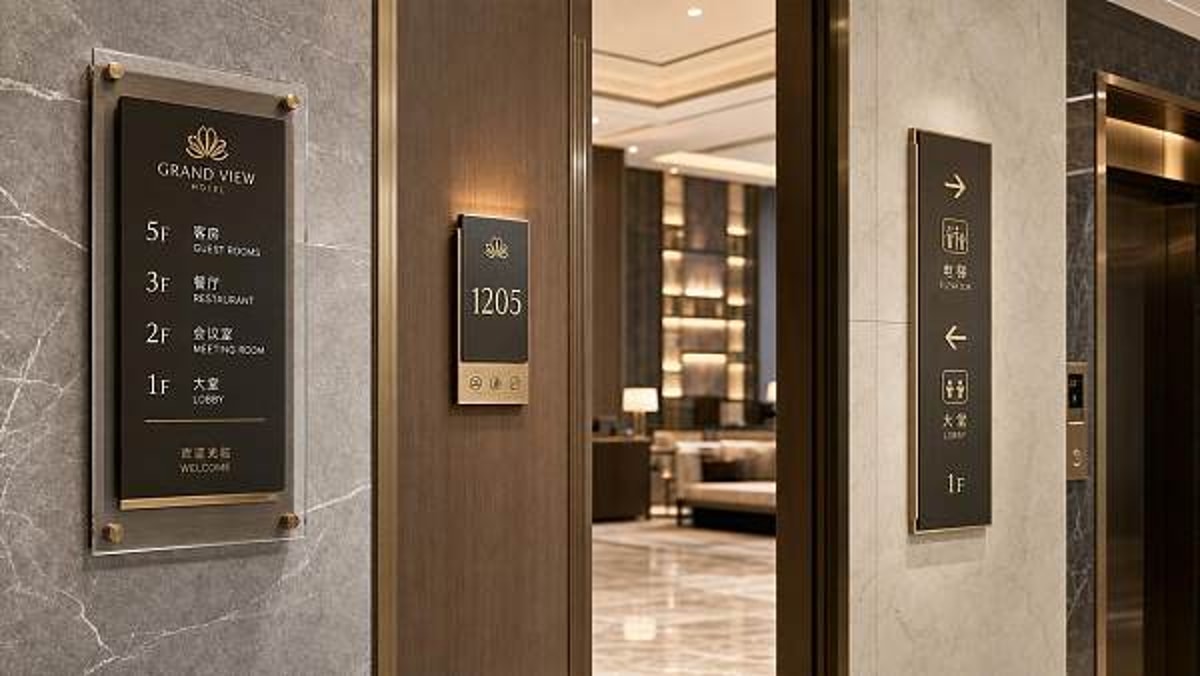
Prioritize clear directional logic, multilingual readability where needed, and harmony with interior design. Public-area custom hotel signage should feel integrated, not visually noisy. The sign system should quietly guide guests without creating clutter.
Guest room corridors
This is where readability often breaks down. Corridor lighting is softer, walls may repeat visually, and guests are often carrying luggage. Room numbers and directional signs need strong contrast, consistent placement, and enough projection or presence to be spotted quickly.
Restaurants, spas, and premium amenities
These areas allow for more expressive material selection, but not at the cost of function. Decorative signage should still be readable to first-time visitors. In wet or aromatic environments, check corrosion resistance, cleaning compatibility, and concealed fixing performance.
Back-of-house and service areas
Even when aesthetics are simpler, operational signage must be clear, robust, and fast to read. Service corridors, loading zones, housekeeping rooms, and staff circulation points benefit from durable, standardized sign formats that reduce operational friction.
Common oversights that make premium signage underperform
- Approving finishes from small samples only, without reviewing full-size prototypes in actual lighting.
- Using brand fonts that are elegant in print but weak in directional signage applications.
- Ignoring cleaning chemicals used by hotel operations teams, leading to early finish damage.
- Treating accessibility compliance as a late-stage add-on instead of a design requirement.
- Failing to coordinate sign locations with millwork joints, switch plates, wall sconces, and fire devices.
- Underestimating replacement strategy for damaged room signs or future rebranding updates.
Execution advice for project managers and engineering leads
To keep custom hotel signage on schedule and on standard, structure the procurement and review process around decision gates. First, freeze the signage schedule by location and type. Second, approve design intent with readability testing. Third, confirm compliance and technical details before mass production. Fourth, request sample boards and full-scale prototypes for critical sign families. Fifth, lock packaging, labeling, and installation sequencing before shipment.
It is also wise to request a supplier capability review that covers OEM or ODM flexibility, quality control checkpoints, international shipping protection, replacement part policy, and documentation standards. In hospitality projects, the best custom hotel signage partner is not only a fabricator with visual skills, but one that can support coordinated delivery across multiple stakeholders, including design consultants, fit-out contractors, procurement teams, and operators.
A final decision checklist before you place the order
- Have all sign types been categorized by function, location, and performance requirement?
- Has every critical custom hotel signage item been reviewed at actual scale?
- Are readability, contrast, and lighting performance validated on site or through realistic mockups?
- Are accessibility, code, and safety requirements fully integrated into drawings?
- Have material durability and cleaning compatibility been checked with operations teams?
- Do installation drawings, fixing details, and location schedules match current site conditions?
- Is there a documented plan for spare units, future replacements, and phased updates?
Conclusion: what to prepare before moving forward
Successful custom hotel signage combines premium design language with practical readability, compliance, and lifecycle performance. For project managers, the priority is not simply choosing attractive sign concepts, but controlling the details that determine whether signage works in real guest environments. A structured review process helps protect brand value, reduce installation surprises, and support smoother handover.
If you are preparing to move a signage package forward, the most useful next step is to gather your sign schedule, brand guidelines, finish references, accessibility requirements, location plans, target lead time, and budget parameters. With those inputs clarified early, it becomes much easier to compare suppliers, confirm technical feasibility, and develop custom hotel signage that truly looks premium and stays readable over time.
Search News
Hot Articles
Popular Tags
Need ExpertConsultation?
Connect with our specialized leisureengineering team for procurementstrategies.
Recommended News
 May 04, 2026Commercial Carpet Tiles for Hotels: What Wears Out First?Commercial carpet tiles hotel buyers: discover what wears out first in entrances, corridors, and transition zones, and learn how to specify longer-lasting, guest-ready flooring.● Hospitality Sourcing Dir
 May 04, 2026Custom Hotel Signage That Looks Premium and Stays ReadableCustom hotel signage that balances premium aesthetics with readability, durability, and compliance. Discover a practical checklist to improve guest experience and streamline hotel projects.● Hospitality Sourcing Dir
 May 04, 2026Luxury Vinyl Tile Commercial Flooring in High-Traffic AreasLuxury vinyl tile commercial flooring for high-traffic spaces: discover how to compare durability, maintenance, installation risks, and lifecycle value before you specify.● Hospitality Sourcing Dir
 May 03, 2026AC Milan’s Smart Locker Room Procurement Triggers UNI 11743 Compliance ReviewAC Milan’s smart locker room procurement triggers UNI 11743:2025 compliance review — critical for sports infrastructure suppliers, EU exporters & integrators.● Hospitality Sourcing Dir
 May 03, 2026Hotel room minibar fridges: silent operation is not enoughHotel room minibar fridges now require more than silent operation. Explore how energy efficiency, design fit, compliance, and lifecycle value shape smarter hotel sourcing.● Hospitality Sourcing Dir
 May 03, 2026HVAC systems for hotels: poor zoning raises energy bills quietlyHVAC systems for hotels can silently inflate energy bills when zoning is weak. Learn how smarter controls cut costs, improve guest comfort, and protect long-term hotel asset value.● Hospitality Sourcing Dir
 May 03, 2026Wooden coat hangers hotel projects should not overlook finish qualityWooden coat hangers hotel buyers should not ignore finish quality. Learn how smoothness, coating safety, and color consistency reduce complaints, protect brand image, and lower replacement costs.● Hospitality Sourcing Dir
 May 03, 2026Artificial plants for hotels: where they look premium, not fakeArtificial plants for hotels that look premium, not fake—discover how luxury properties use realistic faux greenery to elevate ambiance, cut maintenance, and protect brand consistency.● Hospitality Sourcing Dir
 May 03, 2026Commercial hand dryers can lower waste, but noise still mattersCommercial hand dryers reduce paper waste and maintenance costs, but noise can shape comfort and brand perception. Discover how to choose the right model for every commercial space.● Hospitality Sourcing Dir
 May 03, 2026Hotel hair dryers wall mounted: safety features worth checkingHotel hair dryers wall mounted: discover the safety features buyers should check first, from overheat protection to tamper resistance, for safer, smarter hotel sourcing.● Hospitality Sourcing Dir
 May 03, 2026Smart hotel room controls work best when systems talk to each otherSmart hotel room controls work best when HVAC, lighting, access, and service platforms connect seamlessly. Learn how interoperability improves efficiency, guest experience, and long-term scalability.● Hospitality Sourcing Dir
 May 03, 2026Automatic soap dispensers: battery life is not the only issueAutomatic soap dispensers are about more than battery life. Discover how sensor accuracy, refill compatibility, maintenance, and durability impact hygiene, cost, and user experience.● Hospitality Sourcing Dir
 May 03, 2026What hotels often miss when sourcing illuminated makeup mirrorsIlluminated makeup mirrors hotel buyers often miss key specs that affect guest satisfaction, maintenance, and brand value. Discover what to check before sourcing.● Hospitality Sourcing Dir
 May 03, 2026Commercial air purifiers: HEPA ratings that matter in hotelsCommercial air purifiers for hotels: learn which HEPA ratings truly matter for guest rooms, lobbies, and wellness zones to improve comfort, compliance, and smarter buying.● Hospitality Sourcing Dir
 May 03, 2026Wholesale toilet paper rolls: what affects true cost per useWholesale toilet paper rolls are not just about low case price. Learn what affects true cost per use, from sheet strength to dispenser fit, and source smarter for long-term savings.● Hospitality Sourcing Dir
 May 02, 2026Memory foam hotel mattresses: when soft comfort leads to faster saggingMemory foam hotel mattresses may feel luxurious at first, but can soft comfort cause faster sagging? Discover how buyers can reduce risk, improve durability, and protect hotel ROI.● Hospitality Sourcing Dir
 May 02, 2026Electronic hotel door locks: battery alerts are often less simple than they seemElectronic hotel door locks battery alerts are more complex than they appear. Learn how firmware, usage, and environment affect reliability, maintenance efficiency, and smarter sourcing.● Hospitality Sourcing Dir
 May 02, 2026Hotel housekeeping carts: the layout detail that saves minutes on every floorHotel housekeeping carts can save minutes on every floor. Discover how smarter cart layout improves workflow, reduces labor strain, and supports faster, more consistent room turnover.● Hospitality Sourcing Dir
 May 02, 2026Wholesale hotel safes: keypad reliability matters more than extra featuresWholesale hotel safes should be judged by keypad reliability first. Discover the checklist that helps buyers reduce lockouts, maintenance costs, and guest complaints.● Hospitality Sourcing Dir
 May 02, 2026Hotel lobby chandeliers: how size mistakes affect the whole arrival experienceHotel lobby chandeliers can make or break first impressions. Learn how sizing mistakes affect luxury, circulation, and brand value—and how to choose the right scale.● Hospitality Sourcing Dir
 May 02, 2026Industrial ironing machines: steam output is not the only thing to compareIndustrial ironing machines should be compared by more than steam output. Discover how temperature control, pressure stability, efficiency, and durability affect real commercial performance.● Hospitality Sourcing Dir
 May 02, 2026Blackout curtains for hotels that block light without trapping heatBlackout curtains for hotels that block light without trapping heat—discover smarter fabrics, thermal comfort benefits, and sourcing tips for better guest sleep and hotel performance.● Hospitality Sourcing Dir
 May 02, 2026Hotel luggage carts: why wheel quality matters more than frame finishHotel luggage carts perform best when wheel quality comes first. Discover how better casters reduce noise, protect floors, improve handling, and lower long-term hotel maintenance costs.● Hospitality Sourcing Dir
 May 02, 2026Custom printed hotel key cards: PVC or wood for a better guest feel?Custom printed hotel key cards: compare PVC and wood to find the best mix of guest feel, durability, sustainability, and brand impact for smarter hotel sourcing.● Hospitality Sourcing Dir