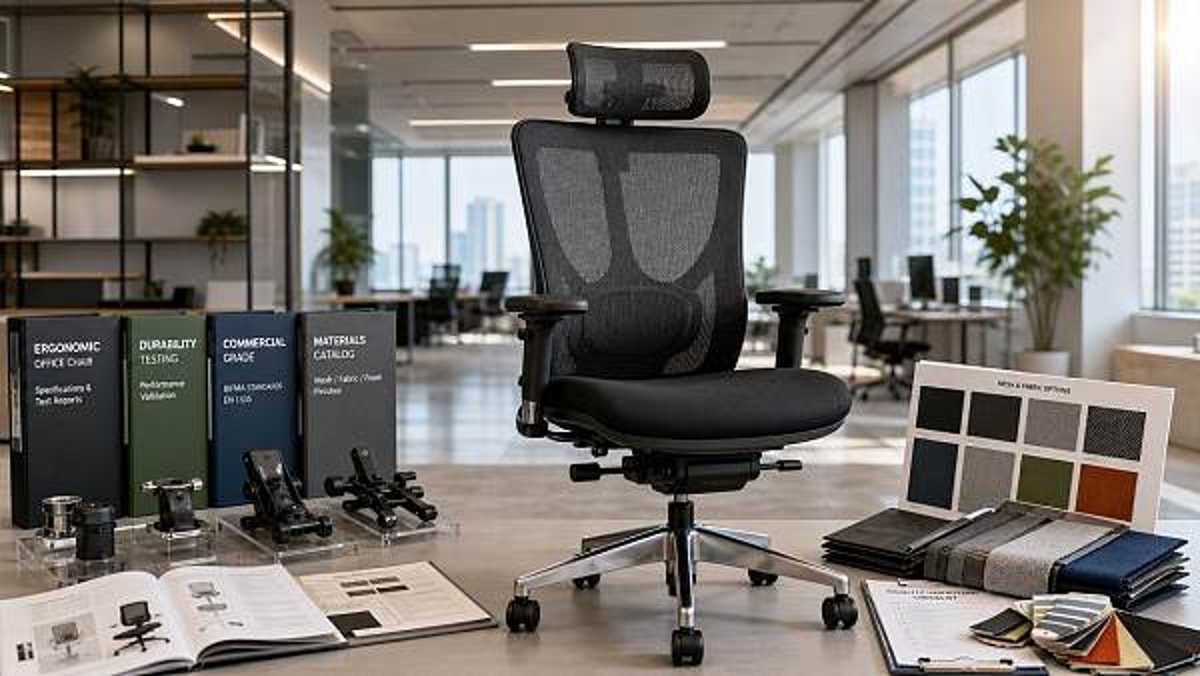
Ergonomic Office Chairs Wholesale: Comfort Claims vs Real Support
In ergonomic office chairs wholesale, bold comfort claims often outpace measurable support performance. For technical evaluators, the real challenge is separating marketing language from verifiable design factors such as lumbar geometry, adjustment range, load testing, and long-term durability. This article examines how to assess whether a chair delivers genuine ergonomic support in commercial environments where compliance, user fit, and lifecycle value matter most.
For buyers evaluating ergonomic office chairs wholesale programs, the central question is not whether a chair feels comfortable in a five-minute showroom test. It is whether the product can provide repeatable support across a diverse user population, survive heavy-duty commercial use, and maintain its adjustment integrity over time. In most sourcing scenarios, this distinction is where marketing claims begin to break down.
Technical evaluators usually approach this category with a different mindset than end users or general procurement teams. They need evidence, not adjectives. Terms such as “ergonomic,” “orthopedic,” “dynamic support,” or “premium comfort” have limited value unless they are backed by test data, dimensional logic, material specifications, and proof of durability under realistic commercial conditions.
The most useful way to assess a wholesale chair offer is to treat ergonomics as an engineering and fit problem rather than a branding exercise. Real support depends on how the chair interacts with body dimensions, movement patterns, task duration, and maintenance conditions. A strong wholesale decision therefore combines product-level technical review with supplier-level risk evaluation.
What Technical Evaluators Are Really Trying to Verify
When people search for ergonomic office chairs wholesale, they are often looking beyond catalog comparisons. The practical intent is to identify which products can be trusted for commercial deployment in offices, educational institutions, coworking spaces, control rooms, or hybrid work environments. The concern is not just comfort. It is the ability to defend a specification decision with objective criteria.
Technical evaluators generally care about five issues above all. First, does the chair support a broad enough user range in terms of height, weight, posture, and working style? Second, are the adjustment systems meaningful or merely decorative? Third, what compliance and test standards support the supplier’s claims? Fourth, how likely is the chair to fail in high-use conditions? Fifth, does the total cost of ownership still make sense after warranty risk, replacement rates, and service demands are considered?
This is why generic content about “healthy sitting” or “workplace wellness” often adds little value during wholesale evaluation. Buyers in this segment already understand that seating affects productivity and fatigue. What they need is a decision framework that converts vague ergonomic language into measurable indicators they can compare across factories, brands, and OEM or ODM proposals.
Why Comfort Claims Often Sound Convincing but Mean Very Little
Many wholesale chair listings are built around subjective language because it sells quickly across digital channels. Phrases such as “all-day comfort,” “pressure relief,” “spine support,” and “human-centered design” are easy to publish and difficult to challenge. Yet these statements do not automatically tell a technical evaluator whether the chair will perform well over twelve months in an open-plan office or a university faculty workspace.
Comfort is also highly context-dependent. A soft seat may feel pleasant at first contact but create heat buildup, pressure concentration, or postural instability during extended use. A prominent lumbar pad may feel supportive to one user and intrusive to another. A reclining mechanism may seem smooth when new but lose consistency after repeated cycles if the internal construction is weak.
In wholesale sourcing, claims become even less reliable because product descriptions are often reused across multiple factories, private labels, and export distributors. Two chairs can present nearly identical marketing text while differing significantly in foam density, back frame rigidity, synchro mechanism quality, gas lift class, mesh tension stability, and armrest fastening strength.
For that reason, the right question is not “Does this chair claim ergonomic comfort?” but “What technical features create support, and what evidence proves those features work in sustained commercial use?” That shift in framing immediately improves sourcing discipline.
How to Judge Real Ergonomic Support Instead of Surface-Level Features
True ergonomic support starts with fit. A chair should accommodate a meaningful percentage of the intended user population without forcing extreme postures. This means evaluators should review seat height range, seat depth or sliding seat travel, backrest height relationship to the pelvis and thoracic region, armrest adjustment dimensions, and the interaction between recline tension and user body weight.
Lumbar support deserves especially close review because it is one of the most overclaimed features in the category. Real lumbar design is not simply a bump in the lower back area. Evaluators should examine whether the lumbar structure aligns with the natural inward curve of the lower spine, whether its height range suits different body types, whether depth or firmness can be tuned, and whether the support remains stable when the user reclines or shifts position.
Seat pan design is another critical area. The front edge should reduce pressure behind the knees, while the seat depth should allow users to sit back against the backrest without compressing the popliteal region. If the seat is too long, shorter users lose lumbar contact. If too short, larger users lose thigh support. In a wholesale environment serving many users, that dimensional balance matters more than visual styling.
Backrest movement also reveals a lot about real support. Better chairs usually allow the back to move with the user rather than forcing a static upright posture. A well-tuned synchro-tilt or advanced dynamic mechanism helps preserve contact between the back and the chair through movement, which supports micro-adjustment and reduces prolonged fixed loading. Evaluators should ask whether the ratio of seat-to-back movement is documented and whether tension control is usable for lighter and heavier users alike.
Armrests are often treated as secondary, but in task-intensive environments they affect shoulder loading, keyboard posture, and user adaptability. Four-dimensional armrests are not automatically better if they wobble, drift, or fail under repeated side loading. The practical question is whether the adjustment positions lock reliably and support common workstation configurations.
Adjustment Range Matters More Than Feature Count
One of the most common mistakes in ergonomic office chairs wholesale evaluation is equating more controls with better ergonomics. A chair may advertise many functions, yet still fail to fit users well if the ranges are too narrow, the controls are difficult to access, or the settings do not hold position under load.
Technical evaluators should focus on effective adjustment range, not feature quantity. For instance, seat height should align with the intended desk and floor setup while supporting different leg lengths. Seat depth adjustment should offer enough travel to accommodate both smaller and larger users. Lumbar height, if adjustable, should move enough to make a real difference across body sizes. Recline tension should not be so stiff that lighter users cannot engage it or so weak that heavier users cannot stabilize their posture.
It is also important to verify whether adjustments can be made intuitively. In shared workspaces, educational facilities, and hot-desking environments, users often do not spend time studying controls. If settings are hidden, confusing, or physically difficult to operate, practical ergonomic value drops sharply. A technically advanced chair that users cannot or do not adjust behaves like a poorly designed one.
This is where product trials with mixed user groups can be more revealing than laboratory descriptions alone. Short test protocols involving different heights, weights, and working tasks often expose whether a chair’s adjustment design is genuinely functional or merely impressive on paper.
Materials and Mechanism Quality Determine Whether Support Lasts
A chair can be ergonomically well designed at launch and still become a poor seating solution if key components degrade quickly. In commercial procurement, long-term support performance depends heavily on mechanism engineering, frame stiffness, foam resilience, mesh recovery, caster quality, and fastening durability.
Mechanisms deserve detailed scrutiny because they control movement and load transfer. Evaluators should ask about steel thickness, spring design, cycle testing, locking positions, and failure history. Excessive play in the tilt assembly, noisy movement, inconsistent tension response, or premature lock failure are all signs that initial comfort may not translate into operational reliability.
Foam specification is equally important, especially for upholstered seats. Density, hardness, rebound characteristics, and compression set all influence how the seat performs over time. Low-grade foam may feel acceptable initially but collapse under repetitive use, changing posture support and increasing replacement frequency. Mesh seating and backs also require caution. Not all mesh behaves the same, and tension loss can reduce support integrity long before the chair appears visibly damaged.
Frame and base materials matter as well. Nylon, reinforced polymer, aluminum, and steel can all be viable, but the engineering details determine outcome. Load-bearing joints, back frame anchoring points, armrest mounts, and base leg construction should be reviewed with an eye toward commercial stress, not residential usage assumptions.
For technical teams, the practical takeaway is simple: support is not only a design feature. It is a durability outcome. If materials and mechanisms cannot preserve geometry and adjustment stability, the chair’s ergonomic promise will decline quickly in real deployment.
Which Tests, Certifications, and Compliance Signals Actually Matter
Because ergonomic claims are easy to make, documented testing is one of the best filters in wholesale sourcing. However, evaluators should distinguish between relevant evidence and marketing decoration. The presence of a certificate icon on a product page is not enough. What matters is whether the chair has been tested to recognized standards, by credible laboratories, with documentation that matches the exact model being offered.
Depending on target markets, buyers may review standards such as BIFMA, EN 1335, ANSI-related criteria, or other regional seating requirements. These standards can cover strength, stability, durability, dimensions, and safety. They do not guarantee perfect ergonomics, but they provide an important baseline for commercial suitability and help reduce structural risk.
Material compliance can be just as important as structural testing. Technical evaluators may need to verify fire performance, restricted substance compliance, VOC considerations, upholstery abrasion resistance, colorfastness, and other interior environment requirements. In project-based procurement, these factors often influence approval more than broad comfort messaging.
It is also wise to ask for test reports, not just declarations. A supplier that can provide dated reports, laboratory names, model numbers, and bill-of-material consistency is easier to trust than one relying on generic statements. In wholesale scenarios, product substitutions sometimes occur between sample stage and production stage. Documentation helps control that risk.
How to Compare Chairs for Diverse User Populations
Commercial seating rarely serves a single body type or task pattern. A chair that works well for a design studio may be less suitable for a call center, an executive office, or a university administration team. Technical evaluators should therefore begin with use-case mapping before comparing products.
Start by defining the actual user mix. What is the expected height and weight spread? How long will users sit continuously? Are tasks keyboard-intensive, collaborative, supervisory, or mobile? Will the chairs be individually assigned or shared? Are there flooring, desk height, or mobility constraints? These operational questions help determine which chair features are essential and which are optional.
Then compare models using a structured matrix. Include dimensional fit ranges, mechanism type, armrest functionality, support adjustability, tested load capacity, warranty terms, replaceable parts availability, and cleaning or maintenance compatibility. This approach makes it easier to separate technically robust products from those that simply present a premium image.
For broad population use, balanced adjustability is usually more valuable than highly specialized contouring. Chairs with moderate but well-executed ergonomic geometry often outperform aggressively shaped designs that only fit a narrow portion of users. This is especially true in wholesale supply for multi-site organizations.
Total Cost of Ownership Is a Better Metric Than Unit Price
In wholesale buying, unit cost is visible, but lifecycle cost is what determines whether the decision was technically sound. A chair priced slightly lower may create larger downstream costs through failures, comfort complaints, returns, service calls, replacement parts, and shorter refresh cycles. Technical evaluators should help procurement teams quantify these factors early.
Useful cost questions include: What is the expected service life under the intended duty cycle? Are parts such as arm pads, casters, gas lifts, or mesh backs replaceable? How quickly can warranty claims be resolved across regions? Does the supplier maintain spare stock? Are field repairs practical, or is full-unit replacement the default response?
For large commercial deployments, consistency also has financial value. If a chair line changes components frequently or experiences unstable production quality, organizations may face mismatched fleets and maintenance complexity. A more reliable supplier with tighter quality control may produce lower total cost even if initial pricing is higher.
This is particularly relevant in ergonomic office chairs wholesale because product performance affects both furniture budgets and user satisfaction. Poor seating creates hidden operational costs that are rarely visible in an RFQ spreadsheet but become obvious after installation.
Questions Technical Evaluators Should Ask Wholesale Suppliers
Supplier assessment is as important as product assessment. Even a strong sample can become a weak sourcing choice if the factory lacks process discipline or substitutes components during scaled production. The best evaluators therefore go beyond brochures and ask direct technical and operational questions.
Useful questions include: What standards has this exact model passed? Can you provide full test reports? What are the seat and back dimensions, adjustment ranges, and recommended user size ranges? What are the foam density and compression specifications? What class of gas lift is used? What are the cycle test results for the mechanism? Which parts are interchangeable or field-replaceable?
It is also worth asking about quality consistency. Does the supplier control key components in-house or rely on multiple external vendors? What incoming inspection and final inspection procedures are used? Is there a locked bill of materials for repeat orders? Can the supplier support OEM customization without compromising tested performance?
For multinational or project-based buyers, after-sales infrastructure matters too. Ask about warranty administration, regional support, packaging durability for export, installation guidance, and documentation support for tenders or compliance reviews. A technically credible supplier should be able to answer these questions clearly and consistently.
A Practical Decision Framework for Wholesale Evaluation
The most effective evaluation process usually follows a sequence. First, define the use case and user population. Second, screen suppliers for compliance readiness and production credibility. Third, compare technical specifications with emphasis on fit range, mechanism quality, and durability. Fourth, request sample units and conduct structured trials with multiple users. Fifth, verify test reports and material data. Sixth, assess warranty and service support before final commercial negotiation.
During sample review, evaluators should document more than first impressions. They should note lumbar contact quality across users, ease of adjustment, recline behavior, seat pressure perception after extended sitting, armrest stability, caster movement, noise, and visible deflection in loaded conditions. Repeating these observations across users provides much better insight than relying on one executive demo.
If possible, involve stakeholders from ergonomics, facilities, procurement, and actual user groups. Each sees different risk. The technical evaluator’s role is to connect these views into a sourcing decision that is defensible not only in terms of comfort claims, but also in terms of engineering logic, compliance confidence, and asset longevity.
Conclusion: Real Support Is Measurable, Repeatable, and Durable
In ergonomic office chairs wholesale, the gap between marketing comfort and real support is often wide. The most reliable chairs are not necessarily the ones with the loudest ergonomic language or the longest feature lists. They are the products that combine sound body-fit geometry, usable adjustment ranges, durable mechanisms, credible testing, and supplier consistency.
For technical evaluators, the right mindset is to translate every comfort claim into a verification question. What design element creates the promised support? What data proves it? How does it fit diverse users? How long will that performance last under commercial use? When these questions are answered well, sourcing decisions become clearer and less vulnerable to branding noise.
Ultimately, a worthwhile wholesale chair program should deliver more than attractive specification sheets. It should provide measurable ergonomic function, lower lifecycle risk, and confidence that the seating solution will continue to support users long after the initial purchase order is complete.
Search News
Hot Articles
Popular Tags
Need ExpertConsultation?
Connect with our specialized leisureengineering team for procurementstrategies.
Recommended News
 May 04, 2026Ergonomic Office Chairs Wholesale: Comfort Claims vs Real SupportErgonomic office chairs wholesale: learn how to verify real support beyond comfort claims with fit, adjustability, durability, and compliance insights for smarter commercial buying.● Institutional Buyer
 May 04, 2026Modular Office Workstations: Flexibility Can Add Setup CostsModular office workstations can improve flexibility, but setup costs often rise through installation, power, data, and rework. Learn when the added investment truly pays off.● Institutional Buyer
 May 04, 2026Steel Filing Cabinets: Why Some Drawers Jam Too EarlySteel filing cabinets often jam early due to weak slides, poor leveling, overload, or lock issues. Discover what to check before buying and how to avoid costly drawer failures.● Institutional Buyer
 May 04, 2026Office Network Racks: Airflow Problems Start With Bad PlanningOffice network racks can fail early when airflow is ignored. Learn the key planning checklist to prevent overheating, reduce maintenance risks, and build a more reliable office network.● Institutional Buyer
 May 04, 2026Office Partitions Wholesale: Open Plan Savings, Closed Office NeedsOffice partitions wholesale helps project managers cut fit-out costs, speed delivery, and balance open-plan efficiency with private office performance. Explore smarter commercial workspace solutions.● Institutional Buyer
 May 04, 2026Conference Room Tables: Common Layout Mistakes to AvoidConference room tables can make or break meeting flow. Discover common layout mistakes to avoid and plan smarter spaces for collaboration, AV integration, and professional results.● Institutional Buyer
 May 04, 2026Mobile Pedestals Wholesale: Why Drawer Slides Matter MoreMobile pedestals wholesale buyers should look beyond price—drawer slides shape durability, load capacity, and maintenance costs. Learn what to compare before ordering.● Institutional Buyer
 May 04, 2026Height Adjustable Standing Desks: Stability Matters More Than SpeedHeight adjustable standing desks should be judged by stability, not just speed. Learn how stronger frames improve safety, user confidence, and long-term value in commercial spaces.● Institutional Buyer
 May 04, 2026Executive Office Desks: When Looks Start to Hurt FunctionExecutive office desks should do more than look impressive. Discover how to balance prestige, ergonomics, storage, and tech support for smarter office buying decisions.● Institutional Buyer
 May 04, 2026Server Cabinets Wholesale: How to Avoid Ordering the Wrong DepthServer cabinets wholesale guide: avoid costly depth mistakes by checking usable internal space, rail fit, cable clearance, and expansion needs before placing bulk orders.● Institutional Buyer
 May 04, 2026Commercial Paper Shredders and the Hidden Cost of DowntimeCommercial paper shredders do more than destroy documents—they protect uptime, compliance, and budgets. Discover how to avoid hidden downtime costs and choose smarter for busy workplaces.● Institutional Buyer
 May 04, 2026Mesh Office Chairs OEM Orders: Specs That Cause ReworkMesh office chairs OEM projects often face rework from vague specs, certification gaps, and component mismatches. Learn what to verify before production to avoid delays and protect budgets.● Institutional Buyer
 May 04, 2026Stackable Visitor Chairs That Save Space Without Looking CheapStackable visitor chairs that save space without looking cheap—discover how to choose stylish, durable seating for offices, schools, and hospitality spaces.● Institutional Buyer
 May 04, 2026What Makes Commercial Acoustic Panels Worth the Cost?Commercial acoustic panels help buyers balance cost with performance, compliance, durability, and design. Learn what makes them worth the investment across offices, schools, hotels, and more.● Institutional Buyer
 May 04, 2026Biometric Time Attendance Systems: Where Accuracy Gains FadeBiometric time attendance systems deliver stronger tracking, but where do accuracy gains fade? Explore real-world limits, privacy risks, and smarter deployment choices.● Institutional Buyer
 May 03, 2026Commercial trash cans: capacity, liners, and lid design all matterCommercial trash cans impact cleanliness, labor, and guest experience. Learn how capacity, liner fit, and lid design help buyers choose smarter, cleaner, cost-effective solutions.● Institutional Buyer
 May 03, 2026Wet and dry vacuum cleaners: when tank size slows teams downWet and dry vacuum cleaners can boost flexibility, but the wrong tank size cuts productivity. Learn how to choose capacity that reduces downtime, labor costs, and workflow friction.● Institutional Buyer
 May 03, 2026Commercial floor scrubbers: ride-on or walk-behind for large sitesCommercial floor scrubbers for large sites: compare ride-on and walk-behind models by productivity, maneuverability, labor efficiency, and cost to choose the best fit.● Institutional Buyer
 May 03, 2026Decorative room dividers that improve layout without blocking lightDecorative room dividers improve layout, define zones, and preserve natural light in modern interiors. Explore stylish, flexible solutions for commercial and hospitality spaces.● Institutional Buyer
 May 03, 2026Why wholesale ironing boards vary so much in frame qualityWholesale ironing boards vary in frame quality due to steel grade, weld strength, stability, coating, and QC. Learn what smart buyers should check before placing bulk orders.● Institutional Buyer
 Apr 30, 2026Contract furniture specs that reduce replacement cyclesContract furniture specs that cut replacement cycles: learn how durability, cleanability, compliance, and serviceable design help buyers lower lifecycle costs and protect brand standards.● Institutional Buyer
 Apr 28, 2026Luxury Furniture Materials That Age Well and Those That Do NotLuxury furniture guide for hotel furniture, custom furniture, hotel beds, hotel chairs, hotel tables, and park benches—learn which materials age well, cut lifecycle costs, and protect premium spaces.● Institutional Buyer
 Apr 28, 2026Custom Furniture Orders Go Wrong When Samples Skip Real TestingCustom furniture mistakes start when samples skip real testing. Learn how hotel furniture, hotel beds, hotel chairs, hotel tables, luxury furniture and park benches avoid costly failures.● Institutional Buyer
 Apr 28, 2026Are Park Benches With Backrests Always the Better Choice?Park benches with backrests are not always best. Explore how custom furniture choices align with luxury furniture, hotel furniture, hotel chairs, hotel tables, and hotel equipment needs.● Institutional Buyer