Stackable Visitor Chairs That Save Space Without Looking Cheap
Choosing stackable visitor chairs no longer means compromising on style, comfort, or durability. For offices, schools, hospitality venues, and multi-use commercial spaces, the right seating must maximize floor efficiency while maintaining a polished professional look. This guide explores how stackable visitor chairs can help buyers save space, control costs, and elevate interiors without settling for furniture that feels flimsy or low-end.
For information-stage buyers, the challenge is rarely about finding chairs that stack. The real task is identifying models that can survive daily commercial use, fit brand aesthetics, meet budget targets, and reduce operational friction over a 3- to 7-year ownership cycle. In B2B projects, seating decisions affect layout flexibility, storage density, cleaning efficiency, and even how visitors perceive a business within the first 30 seconds of entering a room.
Across reception zones, training rooms, meeting suites, education facilities, banquet overflow areas, and event-ready lounges, stackable visitor chairs have evolved from purely functional seating into a strategic procurement category. Well-specified products can cut storage footprint by 40% to 70%, reduce room reset time, and support a more premium visual standard without forcing buyers into custom furniture budgets.
Why Stackable Visitor Chairs Matter in Modern Commercial Spaces
Commercial buyers increasingly need furniture that performs across more than one use case. A training room may become a recruitment venue by noon, a client presentation suite by afternoon, and an internal workshop area the next day. In this context, stackable visitor chairs support operational flexibility while helping facilities teams manage square footage more efficiently.
Space efficiency is now a financial issue
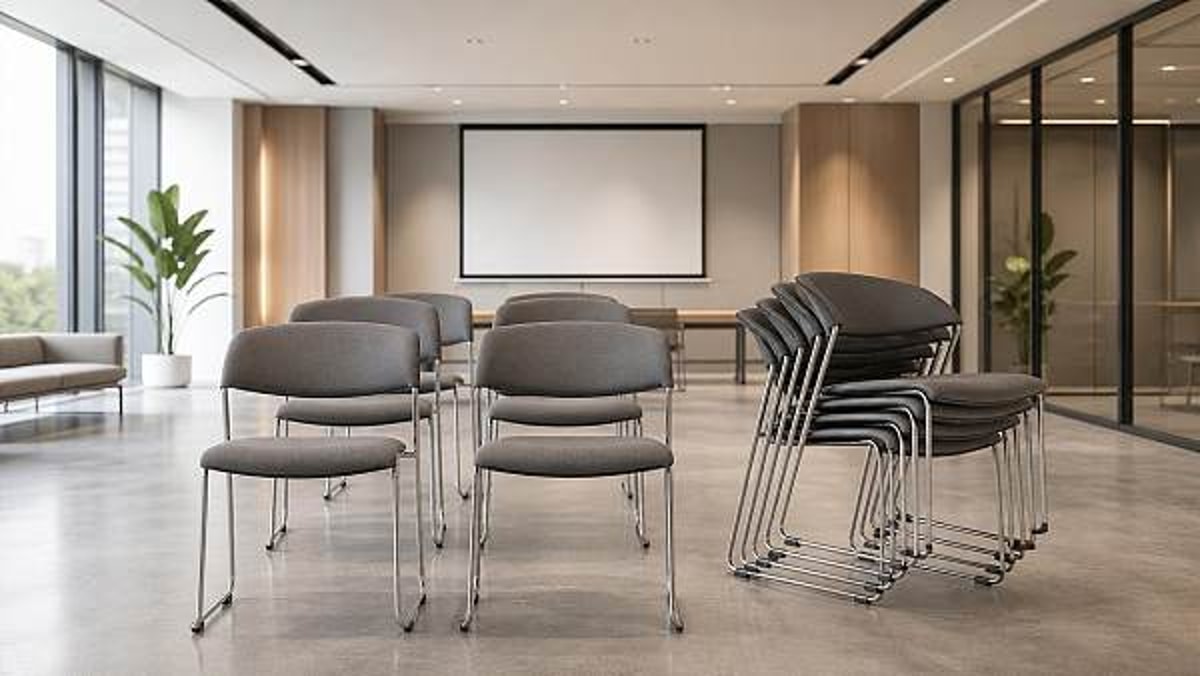
In many offices, schools, and hospitality settings, underused floor area carries a direct cost. A chair that stacks 8 to 12 high can free up significant storage volume compared with fixed-leg seating that cannot be nested. For venues with frequent setup changes, that difference can mean one small storage room instead of two, or a cleaner circulation route that improves safety and workflow.
Typical commercial applications
- Visitor seating in reception and waiting areas
- Flexible conference and training spaces with weekly reconfiguration
- Educational classrooms, lecture overflow rooms, and exam halls
- Hotel meeting rooms, banquet support areas, and business centers
- Healthcare administrative spaces and interview rooms
For procurement teams, the value extends beyond storage. Commercial-grade stackable visitor chairs can reduce handling time, lower the risk of accidental wall damage during room resets, and improve labor efficiency. In high-turnover spaces, even saving 10 to 15 minutes per setup can matter when multiplied across 4 to 6 room changes per week.
The table below compares the most common commercial scenarios and the chair features that matter most in each one.
A key takeaway is that stackability alone is not enough. Buyers should evaluate the chair in relation to labor time, brand image, storage limits, and user comfort. A model suited to a campus hall may look too utilitarian in a hospitality lounge, while a premium upholstered chair may be too maintenance-heavy for a high-volume classroom environment.
Cheap-looking chairs create hidden costs
Low-end seating often appears inexpensive only at purchase stage. Thin frames, unstable stacking geometry, weak weld points, and poor-quality finishes can lead to visible wear in 6 to 18 months. Once chairs begin wobbling, scratching, or fading, businesses may face replacement costs earlier than expected and risk damaging the perceived quality of their environment.
In customer-facing settings, appearance matters as much as function. Visitors notice uneven upholstery, discoloration, exposed fasteners, and noisy floor contact. For that reason, well-designed stackable visitor chairs should be judged as part of the interior experience, not just as a facilities purchase.
How to Choose Stackable Visitor Chairs That Look Premium
A strong specification process usually balances 5 factors: appearance, comfort, durability, stackability, and total cost of ownership. Buyers who skip any one of these often end up with seating that looks attractive in the catalog but underperforms in real-world conditions.
1. Start with frame quality and weight capacity
Commercial stackable visitor chairs typically use steel, aluminum, or reinforced polypropylene structures. Steel frames generally offer higher rigidity and better long-term stability, while aluminum can reduce handling weight. A practical commercial target is a static load capacity in the 110 kg to 150 kg range, depending on the expected user profile and setting.
Frame joints should be inspected carefully. Weld consistency, corner reinforcement, anti-splay design, and foot glide quality all influence lifespan. For projects with frequent movement, lightweight is useful, but chairs that are too light can feel unstable or visually insubstantial in executive or hospitality contexts.
2. Evaluate seat comfort for actual dwell time
Comfort requirements vary with use. A reception visitor may sit for 10 to 20 minutes, while a training participant may remain seated for 2 to 4 hours. For short-duration use, molded shells and slim foam pads may be sufficient. For longer sessions, look for shaped back support, seat waterfall edges, and upholstered contact surfaces that improve comfort without making stacking bulky.
Comfort checkpoints for commercial procurement
- Seat depth that accommodates varied body types without forcing a slouched posture
- Backrest angle that supports a natural seated position over 30+ minutes
- Surface materials that stay presentable after repeated cleaning cycles
- Noise control from glides when chairs are moved across hard flooring
3. Choose finishes that signal quality
A chair can be budget-conscious without looking cheap. Visual quality often comes from proportion, detailing, and finish consistency rather than high-cost materials alone. Matte black, charcoal, warm gray, taupe, and muted metallic finishes remain widely compatible with commercial interiors. Upholstery in tightly woven fabric or easy-clean vinyl can also help the chair feel more substantial.
Avoid over-styled elements that date quickly. In B2B spaces, timeless design usually outperforms trend-driven shapes. Clean lines, balanced frame thickness, hidden fasteners, and subtle contouring are often better long-term choices than decorative details that add cost without improving performance.
The following table outlines common specification points buyers can use to separate entry-level models from better-value commercial options.
This comparison shows why the cheapest unit price is rarely the best buying strategy. A moderate increase in frame quality, finish consistency, and comfort can deliver noticeably better performance over hundreds or even thousands of seating cycles.
Key Procurement Criteria for B2B Buyers
Information-stage buyers often benefit from using a structured shortlist before requesting samples or quotations. This helps prevent overbuying on aesthetics alone or underbuying on durability. In commercial sourcing, at least 6 checkpoints should be reviewed before final approval.
Essential checklist before placing an order
- Confirm stacking height and whether chairs can be moved safely by one person
- Check if the chair footprint suits your storage room depth and aisle width
- Review material suitability for daily cleaning, especially in hospitality or education
- Ask about replacement parts such as glides, pads, or linking components
- Request finish samples under actual lighting conditions
- Verify lead time, batch consistency, and reorder availability for future expansion
Lead time, packaging, and logistics matter more than buyers expect
For international or multi-site sourcing, the logistics profile of stackable visitor chairs should be evaluated early. Standard lead times may range from 2 to 6 weeks for stock programs and 6 to 12 weeks for custom upholstery or color matching. Poor packaging can lead to scuffed frames, crushed corners, or fabric marking before the chairs ever reach site.
Buyers should also ask whether chairs ship assembled, partially assembled, or fully knocked down. While knocked-down packing can reduce freight volume, assembly time on arrival may offset those savings if dozens or hundreds of units are involved. For many commercial projects, the best balance is often a ready-to-use product with efficient stack transport protection.
Questions worth raising with suppliers
- What is the recommended maximum stack height for daily use versus storage use?
- How many cleaning cycles can the upholstery or finish tolerate without visible degradation?
- Are replacement components available within 12 to 24 months?
- Can the same finish be reordered for project phase two or site expansion?
These questions help buyers move beyond brochure-level claims and assess operational fit. In commercial furniture sourcing, consistency is often more valuable than novelty. A supplier who can support phased purchases, finish continuity, and practical after-sales service usually creates less risk than one offering only a low initial price.
Common Mistakes When Buying Stackable Visitor Chairs
Even experienced teams can make avoidable mistakes when seating is treated as a secondary line item. Because stackable visitor chairs sit at the intersection of design, operations, and budget, small oversights can create recurring frustration after installation.
Mistake 1: Prioritizing storage count over user experience
A chair that stacks 15 high may look efficient on paper, but if comfort drops sharply after 20 minutes, it may not suit training, interview, or meeting environments. Buyers should define expected seated duration first, then assess stackability second. In many cases, stacking 8 to 10 high is more than sufficient if the chair delivers better support and appearance.
Mistake 2: Ignoring visual fit with the broader interior
Visitor seating often appears alongside reception desks, meeting tables, partitions, and brand graphics. A mismatched chair can make a newly fitted room look pieced together. This is especially important in hospitality, premium education, and client-facing corporate environments, where the chair acts as a visible part of the experience.
Mistake 3: Underestimating wear points
The first visible failures usually occur at feet, edges, corners, and contact surfaces between stacked chairs. If anti-scratch buffers, glides, or edge protection are weak, chairs can look aged after only a few months of high-frequency handling. Buyers should ask for close-up images or physical samples of these details rather than judging only overall appearance.
Mistake 4: Buying without a phased deployment plan
Some organizations buy 20 chairs for immediate use and later need 40 more for expansion, only to find the finish has changed or the model has been discontinued. When sourcing stackable visitor chairs, it is wise to confirm whether the product line is stable enough for 12- to 24-month reorder planning, particularly for campuses, hotel groups, and growing office networks.
Best-Fit Recommendations by Commercial Environment
The right chair specification depends heavily on setting. Rather than asking for a universal best model, buyers should match features to operational patterns, user expectations, and maintenance realities.
Office and corporate reception
Look for stackable visitor chairs with a polished but restrained design language. Upholstered seats, slim metal frames, and easy-clean surfaces usually work well. A stack height of 6 to 8 is often enough for reception overflow, interview rooms, and occasional meeting support. Visual consistency with meeting furniture should be prioritized.
Education and training venues
Durability and reset speed usually matter most. Molded polymer shells or mixed-material chairs with robust steel frames can perform well where use frequency is high. If chairs are moved daily, a lighter frame can reduce strain for facilities staff. Replaceable feet and scratch-resistant finishes are practical advantages over a 2- to 5-year period.
Hospitality and multi-use event spaces
These projects need stackable visitor chairs that support both aesthetics and fast turnover. Fabrics should resist staining, and frames should look refined under event lighting. Stack density matters because back-of-house storage can be limited, but not at the expense of appearance. In these settings, seating often contributes directly to guest perception and venue versatility.
From Research to Sourcing: A Practical Next Step
For buyers comparing options across office, education, hospitality, and other commercial sectors, stackable visitor chairs should be evaluated as an operational asset rather than a simple commodity. The best options save space, hold up under repeated use, and maintain a credible design standard that supports the wider environment.
A sound sourcing process usually includes 3 stages: define the use case, test shortlist samples, and confirm supply continuity. That approach helps decision-makers balance aesthetics, handling efficiency, durability, and price without falling into the trap of buying chairs that look acceptable at delivery but disappoint within the first year.
If you are evaluating stackable visitor chairs for a commercial project, a clear specification brief can shorten procurement time and reduce risk across design, logistics, and lifecycle cost. To explore tailored sourcing options for offices, schools, hospitality venues, and flexible commercial spaces, contact us today to get a customized solution, discuss product details, or learn more about broader commercial furniture sourcing strategies.
Search News
Hot Articles
Popular Tags
Need ExpertConsultation?
Connect with our specialized leisureengineering team for procurementstrategies.
Recommended News
 May 04, 2026Ergonomic Office Chairs Wholesale: Comfort Claims vs Real SupportErgonomic office chairs wholesale: learn how to verify real support beyond comfort claims with fit, adjustability, durability, and compliance insights for smarter commercial buying.● Institutional Buyer
 May 04, 2026Modular Office Workstations: Flexibility Can Add Setup CostsModular office workstations can improve flexibility, but setup costs often rise through installation, power, data, and rework. Learn when the added investment truly pays off.● Institutional Buyer
 May 04, 2026Steel Filing Cabinets: Why Some Drawers Jam Too EarlySteel filing cabinets often jam early due to weak slides, poor leveling, overload, or lock issues. Discover what to check before buying and how to avoid costly drawer failures.● Institutional Buyer
 May 04, 2026Office Network Racks: Airflow Problems Start With Bad PlanningOffice network racks can fail early when airflow is ignored. Learn the key planning checklist to prevent overheating, reduce maintenance risks, and build a more reliable office network.● Institutional Buyer
 May 04, 2026Office Partitions Wholesale: Open Plan Savings, Closed Office NeedsOffice partitions wholesale helps project managers cut fit-out costs, speed delivery, and balance open-plan efficiency with private office performance. Explore smarter commercial workspace solutions.● Institutional Buyer
 May 04, 2026Conference Room Tables: Common Layout Mistakes to AvoidConference room tables can make or break meeting flow. Discover common layout mistakes to avoid and plan smarter spaces for collaboration, AV integration, and professional results.● Institutional Buyer
 May 04, 2026Mobile Pedestals Wholesale: Why Drawer Slides Matter MoreMobile pedestals wholesale buyers should look beyond price—drawer slides shape durability, load capacity, and maintenance costs. Learn what to compare before ordering.● Institutional Buyer
 May 04, 2026Height Adjustable Standing Desks: Stability Matters More Than SpeedHeight adjustable standing desks should be judged by stability, not just speed. Learn how stronger frames improve safety, user confidence, and long-term value in commercial spaces.● Institutional Buyer
 May 04, 2026Executive Office Desks: When Looks Start to Hurt FunctionExecutive office desks should do more than look impressive. Discover how to balance prestige, ergonomics, storage, and tech support for smarter office buying decisions.● Institutional Buyer
 May 04, 2026Server Cabinets Wholesale: How to Avoid Ordering the Wrong DepthServer cabinets wholesale guide: avoid costly depth mistakes by checking usable internal space, rail fit, cable clearance, and expansion needs before placing bulk orders.● Institutional Buyer
 May 04, 2026Commercial Paper Shredders and the Hidden Cost of DowntimeCommercial paper shredders do more than destroy documents—they protect uptime, compliance, and budgets. Discover how to avoid hidden downtime costs and choose smarter for busy workplaces.● Institutional Buyer
 May 04, 2026Mesh Office Chairs OEM Orders: Specs That Cause ReworkMesh office chairs OEM projects often face rework from vague specs, certification gaps, and component mismatches. Learn what to verify before production to avoid delays and protect budgets.● Institutional Buyer
 May 04, 2026Stackable Visitor Chairs That Save Space Without Looking CheapStackable visitor chairs that save space without looking cheap—discover how to choose stylish, durable seating for offices, schools, and hospitality spaces.● Institutional Buyer
 May 04, 2026What Makes Commercial Acoustic Panels Worth the Cost?Commercial acoustic panels help buyers balance cost with performance, compliance, durability, and design. Learn what makes them worth the investment across offices, schools, hotels, and more.● Institutional Buyer
 May 04, 2026Biometric Time Attendance Systems: Where Accuracy Gains FadeBiometric time attendance systems deliver stronger tracking, but where do accuracy gains fade? Explore real-world limits, privacy risks, and smarter deployment choices.● Institutional Buyer
 May 03, 2026Commercial trash cans: capacity, liners, and lid design all matterCommercial trash cans impact cleanliness, labor, and guest experience. Learn how capacity, liner fit, and lid design help buyers choose smarter, cleaner, cost-effective solutions.● Institutional Buyer
 May 03, 2026Wet and dry vacuum cleaners: when tank size slows teams downWet and dry vacuum cleaners can boost flexibility, but the wrong tank size cuts productivity. Learn how to choose capacity that reduces downtime, labor costs, and workflow friction.● Institutional Buyer
 May 03, 2026Commercial floor scrubbers: ride-on or walk-behind for large sitesCommercial floor scrubbers for large sites: compare ride-on and walk-behind models by productivity, maneuverability, labor efficiency, and cost to choose the best fit.● Institutional Buyer
 May 03, 2026Decorative room dividers that improve layout without blocking lightDecorative room dividers improve layout, define zones, and preserve natural light in modern interiors. Explore stylish, flexible solutions for commercial and hospitality spaces.● Institutional Buyer
 May 03, 2026Why wholesale ironing boards vary so much in frame qualityWholesale ironing boards vary in frame quality due to steel grade, weld strength, stability, coating, and QC. Learn what smart buyers should check before placing bulk orders.● Institutional Buyer
 Apr 30, 2026Contract furniture specs that reduce replacement cyclesContract furniture specs that cut replacement cycles: learn how durability, cleanability, compliance, and serviceable design help buyers lower lifecycle costs and protect brand standards.● Institutional Buyer
 Apr 28, 2026Luxury Furniture Materials That Age Well and Those That Do NotLuxury furniture guide for hotel furniture, custom furniture, hotel beds, hotel chairs, hotel tables, and park benches—learn which materials age well, cut lifecycle costs, and protect premium spaces.● Institutional Buyer
 Apr 28, 2026Custom Furniture Orders Go Wrong When Samples Skip Real TestingCustom furniture mistakes start when samples skip real testing. Learn how hotel furniture, hotel beds, hotel chairs, hotel tables, luxury furniture and park benches avoid costly failures.● Institutional Buyer
 Apr 28, 2026Are Park Benches With Backrests Always the Better Choice?Park benches with backrests are not always best. Explore how custom furniture choices align with luxury furniture, hotel furniture, hotel chairs, hotel tables, and hotel equipment needs.● Institutional Buyer