When paper guillotines become a safety risk in daily use
Paper guillotines are often treated as routine office tools, yet in daily commercial use they can quickly become a serious safety risk. For project managers and facility decision-makers, understanding where design flaws, poor maintenance, and operator habits create hazards is essential to protecting staff, meeting compliance standards, and avoiding costly disruptions across educational, office, and mixed-use environments.
Why safety risks vary so much by application scenario
For project leaders, the biggest mistake is to treat all paper guillotines as interchangeable. A cutter used occasionally in a controlled print room presents a very different risk profile from one placed in a shared office, school administration area, copy center, retail back office, or multi-tenant business hub. The same blade mechanism may be acceptable in one environment and completely unsuitable in another because exposure, supervision, traffic flow, training levels, and user turnover all change the real level of danger.
This matters in procurement and site planning because a paper guillotine is not judged only by cutting accuracy or price. It must be evaluated as a workplace device that can cause lacerations, crush injuries, near misses, and compliance failures if selected for the wrong setting. In practical terms, project managers need to ask not just “Does it cut efficiently?” but “Who will use it, how often, under what supervision, and with what built-in safeguards?”
In mixed-use commercial projects, the risk can also be indirect. Unsafe paper guillotines may trigger staff downtime, internal investigations, insurance concerns, and reputational damage. In schools or hospitality-adjacent business centers, they can expose visitors, temporary staff, or inexperienced users to hazards that should have been prevented through better equipment choice and operating controls.
Where paper guillotines most often become a safety problem
Paper guillotines usually become dangerous not because the tool is inherently defective, but because the operating context amplifies weaknesses. Below are the most common commercial scenarios where safety risk rises quickly.
Shared office floors and open administrative areas
In general offices, paper guillotines are often placed on copy tables or near printers for convenience. This seems efficient, but open access encourages untrained use. Staff may rush between tasks, reach across the blade line, remove offcuts by hand, or operate the device while distracted by calls or conversations. Because no single person “owns” the machine, maintenance and inspection are also often neglected.
Schools, training centers, and smart campus admin spaces
Educational settings create a high-risk combination: high foot traffic, multiple user groups, and varying levels of maturity and supervision. Even if students are not intended users, devices in staff rooms, resource centers, or classrooms may still be accessed at the wrong moment. For project managers responsible for campus outfitting, paper guillotines should never be evaluated only as office supplies. They are controlled cutting devices that require access planning, guarding, and policy enforcement.
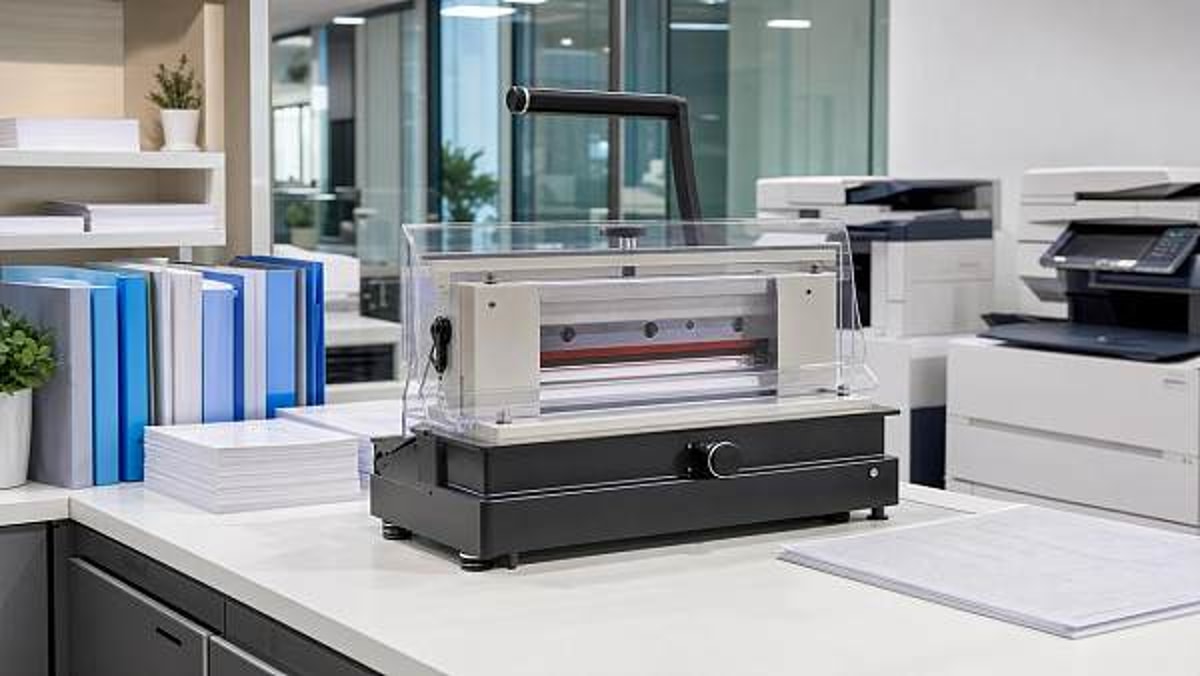
Central reprographics rooms and in-house print departments
These environments often have more experienced operators, but the frequency of use is far higher. Repetitive cutting increases the chance of fatigue, shortcut behavior, and wear-related failure. A machine that is mechanically safe at low volume may become dangerous under sustained daily production if hold-down clamps, guards, blade return systems, or alignment guides begin to degrade.
Retail back offices, service counters, and hospitality business centers
In these spaces, paper guillotines are often secondary tools used during busy operational peaks. Staff may be multitasking, handling guests, processing signage, or preparing documentation under time pressure. The risk here comes from intermittent but careless use. Equipment may also be stored in cramped areas, making safe positioning difficult and increasing the chance of unstable handling.
Scenario comparison: what changes the level of risk
A useful way to assess paper guillotines is to compare scenarios by user control, volume, and exposure. This helps project teams decide whether standard models, enhanced safety models, or restricted-access placement are appropriate.
The most common safety failures in daily use
Across sectors, several patterns appear repeatedly when paper guillotines become a safety risk. These are especially relevant during equipment selection, fit-out planning, and ongoing facilities management.
Inadequate blade guarding
If the blade path is too exposed, users can position fingers dangerously close during alignment or scrap removal. In low-discipline environments, reliance on user caution alone is not enough. Better paper guillotines for commercial use should include robust finger guards, controlled blade movement, and anti-bypass design features.
Poor equipment placement
A safe machine can become unsafe if installed on an unstable surface, in a narrow corridor, next to a busy printer queue, or at an unsuitable working height. For project managers, placement should be treated as part of the risk control strategy. Access, reach distance, lighting, and surrounding traffic all affect how safely paper guillotines are used.
Lack of maintenance and inspection
Loose components, worn blades, sticking handles, and misaligned clamps can make operation unpredictable. Users may apply extra force, improvise technique, or perform unsafe adjustments during use. In commercial settings, paper guillotines should be added to an inspection schedule rather than treated as maintenance-free stationery equipment.
No user ownership or training
When everyone can use a device, nobody is accountable for its condition. This is one of the main reasons paper guillotines create hidden risk in offices and education facilities. A named owner, a simple use protocol, and visible restrictions can significantly reduce unsafe behavior.
How different environments should assess paper guillotines before approval
Project managers rarely buy in isolation. They coordinate with procurement, HSE teams, facility operators, and end users. To support better decisions, paper guillotines should be assessed against actual use conditions rather than catalog descriptions.
For office fit-outs and corporate campuses
Prioritize low-exposure deployment. If cutting is occasional, consider whether centralized supervised access is safer than multiple open-access devices. If paper guillotines must be placed on office floors, choose models with clear guards, controlled handles, and stable bases, then place them away from casual traffic.
For schools and institutional buyers
The threshold for acceptable risk should be higher. Restrict use to designated staff zones, document operating rules, and confirm that the product design supports safer handling under non-industrial conditions. In many campus settings, paper guillotines should be locked away when not in use.
For print-heavy departments
Focus on repetitive-use reliability. Commercial teams should verify serviceability, spare-part availability, blade-change procedures, and the supplier’s maintenance guidance. Safety performance over time matters more than initial cutting sharpness.
For hospitality, retail, and mixed-use operations
Select paper guillotines only where there is a clearly defined operational need. If use is rare but urgent, operators are more likely to make mistakes. In these settings, simple controls, visible warnings, and secure storage can be more valuable than advanced capacity specifications.
A practical checklist for scenario-based selection
Before approving paper guillotines for any commercial environment, use a short decision framework that links the equipment to the space and user profile.
Common misjudgments that increase risk
Many incidents involving paper guillotines can be traced back to predictable decision errors. One is assuming that a small-format cutter is automatically low risk. In reality, compact devices are often used casually and placed in open areas, which can increase exposure. Another is assuming that experienced office staff do not need instruction. Familiarity with paperwork does not equal competence with cutting equipment.
A further misjudgment is focusing solely on unit cost. Low-cost paper guillotines may lack durable safety features or develop instability under routine commercial use. For project budgets, the apparent saving can disappear quickly if a single injury leads to lost time, reporting obligations, replacement purchases, or internal corrective action.
Another overlooked issue is procurement without lifecycle planning. If blade servicing, spare parts, user guidance, and inspection records are unavailable, the organization inherits a higher operational risk. This is particularly important for global buyers who need consistency across multiple sites and must align purchasing with broader safety and compliance expectations.
What project managers should do next
For project managers and engineering leads, the safest approach is to evaluate paper guillotines as part of workplace system design, not as minor accessories. Start by mapping where cutting tasks actually happen, who performs them, and whether the current location encourages rushed or unsupervised use. Then compare the risk by scenario: open office, controlled print room, education facility, or back-of-house service area.
If a paper guillotine remains necessary, specify the device around the environment. Ask suppliers for safety feature details, maintenance recommendations, and suitability for the intended usage pattern. Confirm whether the model supports your compliance expectations and whether replacement parts and technical support are available over time. For larger programs, standardizing approved models across sites can improve both safety governance and procurement consistency.
Ultimately, paper guillotines become a safety risk in daily use when organizations overlook the gap between simple function and real-world context. The right decision is rarely about choosing the sharpest or cheapest cutter. It is about choosing a solution that fits the people, pace, and physical conditions of the space. When commercial buyers align equipment selection with scenario-specific risk, they protect staff, reduce disruption, and create safer, more reliable operational environments.
Search News
Hot Articles
Popular Tags
Need ExpertConsultation?
Connect with our specialized leisureengineering team for procurementstrategies.
Recommended News
 May 06, 2026Office tape dispensers that stay stable on fast-paced desksOffice tape dispensers that stay stable on fast-paced desks improve workflow, reduce tape waste, and support one-handed use. Compare smart, durable options now.● Institutional Buyer
 May 06, 2026Bubble envelopes bulk: the size mismatch that wastes shipping spendBubble envelopes bulk can cut costs—or quietly increase them. Learn how size mismatch drives shipping waste, damage risk, and packing delays, and how right-sizing protects margins.● Institutional Buyer
 May 06, 2026Office staplers bulk orders: why jam rates matter more than priceOffice staplers bulk buyers should compare jam rates before unit price. Learn how reliability, durability, and staple compatibility reduce hidden costs and improve workflow.● Institutional Buyer
 May 06, 2026Custom rubber stamps: what affects imprint clarity the mostCustom rubber stamps deliver the best imprint clarity when material quality, engraving depth, ink performance, and surface match work together. Learn what to compare before you buy.● Institutional Buyer
 May 06, 2026When paper guillotines become a safety risk in daily usePaper guillotines can become serious daily safety risks in offices, schools, and print rooms. Learn how to spot hazards, improve compliance, and choose safer models.● Institutional Buyer
 May 06, 2026Why wholesale packing tape performance changes by climateWholesale packing tape performance shifts with cold, heat, and humidity. Learn how climate affects adhesion, unwind, and seal reliability to choose the right tape and reduce shipping failures.● Institutional Buyer
 May 06, 2026Self inking stamps wholesale: what users notice after six monthsSelf inking stamps wholesale buyers often learn the truth after six months. Discover what users notice about durability, imprint quality, refills, and supplier reliability before you source.● Institutional Buyer
 May 06, 2026Hole punches wholesale: metal build or low-cost plastic?Hole punches wholesale: compare durable metal and low-cost plastic models for offices, schools, and bulk buyers. Discover which option delivers better value, fit, and long-term savings.● Institutional Buyer
 May 05, 2026Cork bulletin boards: why frame quality matters over board sizeCork bulletin boards deliver better long-term value when frame quality comes first. Learn how stronger materials, secure corners, and stable mounting improve durability, safety, and appearance.● Institutional Buyer
 May 05, 2026Soundproof phone booths: when sound ratings mislead office plansSoundproof phone booths can mislead office plans when ratings are taken at face value. Learn how to compare privacy, ventilation, placement, and compliance before you buy.● Institutional Buyer
 May 05, 2026Laser printer toner bulk: what affects page yield mostLaser printer toner bulk page yield depends on more than toner volume. Discover the top factors affecting real output and make smarter, lower-cost sourcing decisions.● Institutional Buyer
 May 05, 2026Science lab furniture: small design choices with big safety impactScience lab furniture shapes lab safety in ways many teams overlook. Discover smart design choices that reduce risk, improve compliance, and support efficient long-term performance.● Institutional Buyer
 May 05, 2026Wholesale ink cartridges: remanufactured vs compatible in real useWholesale ink cartridges compared in real use: remanufactured vs compatible on print quality, yield, firmware risk, and sourcing value—helping procurement teams buy smarter.● Institutional Buyer
 May 05, 2026Cash drawers wholesale: what causes jams at checkoutCash drawers wholesale guide: uncover the real causes of checkout jams, from latch design to POS compatibility, and learn how to source reliable drawers that reduce downtime.● Institutional Buyer
 May 05, 2026Office acoustic pods or open booths: which solves noise betterOffice acoustic pods vs. open booths: discover which solution controls noise better for privacy, focus, and hybrid calls, and make a smarter office planning decision.● Institutional Buyer
 May 05, 2026Office LED panel lights that cut glare without dim workspacesOffice LED panel lights that reduce glare without sacrificing brightness. Discover how to choose low-glare, high-comfort lighting for productive, compliant, and modern office spaces.● Institutional Buyer
 May 05, 2026Chemical resistant lab tops: which materials hold up bestChemical resistant lab tops compared: discover whether epoxy resin, phenolic resin, or stainless steel holds up best for harsh chemicals, heat, and daily lab demands.● Institutional Buyer
 May 05, 2026How to compare drafting tables wholesale without overbuyingDrafting tables wholesale comparison starts with MOQ, specs, and supplier reliability. Learn how to avoid overbuying, reduce inventory risk, and choose better-value sourcing options.● Institutional Buyer
 May 04, 2026Ergonomic Office Chairs Wholesale: Comfort Claims vs Real SupportErgonomic office chairs wholesale: learn how to verify real support beyond comfort claims with fit, adjustability, durability, and compliance insights for smarter commercial buying.● Institutional Buyer
 May 04, 2026Modular Office Workstations: Flexibility Can Add Setup CostsModular office workstations can improve flexibility, but setup costs often rise through installation, power, data, and rework. Learn when the added investment truly pays off.● Institutional Buyer
 May 04, 2026Steel Filing Cabinets: Why Some Drawers Jam Too EarlySteel filing cabinets often jam early due to weak slides, poor leveling, overload, or lock issues. Discover what to check before buying and how to avoid costly drawer failures.● Institutional Buyer
 May 04, 2026Office Network Racks: Airflow Problems Start With Bad PlanningOffice network racks can fail early when airflow is ignored. Learn the key planning checklist to prevent overheating, reduce maintenance risks, and build a more reliable office network.● Institutional Buyer
 May 04, 2026Office Partitions Wholesale: Open Plan Savings, Closed Office NeedsOffice partitions wholesale helps project managers cut fit-out costs, speed delivery, and balance open-plan efficiency with private office performance. Explore smarter commercial workspace solutions.● Institutional Buyer
 May 04, 2026Conference Room Tables: Common Layout Mistakes to AvoidConference room tables can make or break meeting flow. Discover common layout mistakes to avoid and plan smarter spaces for collaboration, AV integration, and professional results.● Institutional Buyer