Office staplers bulk orders: why jam rates matter more than price
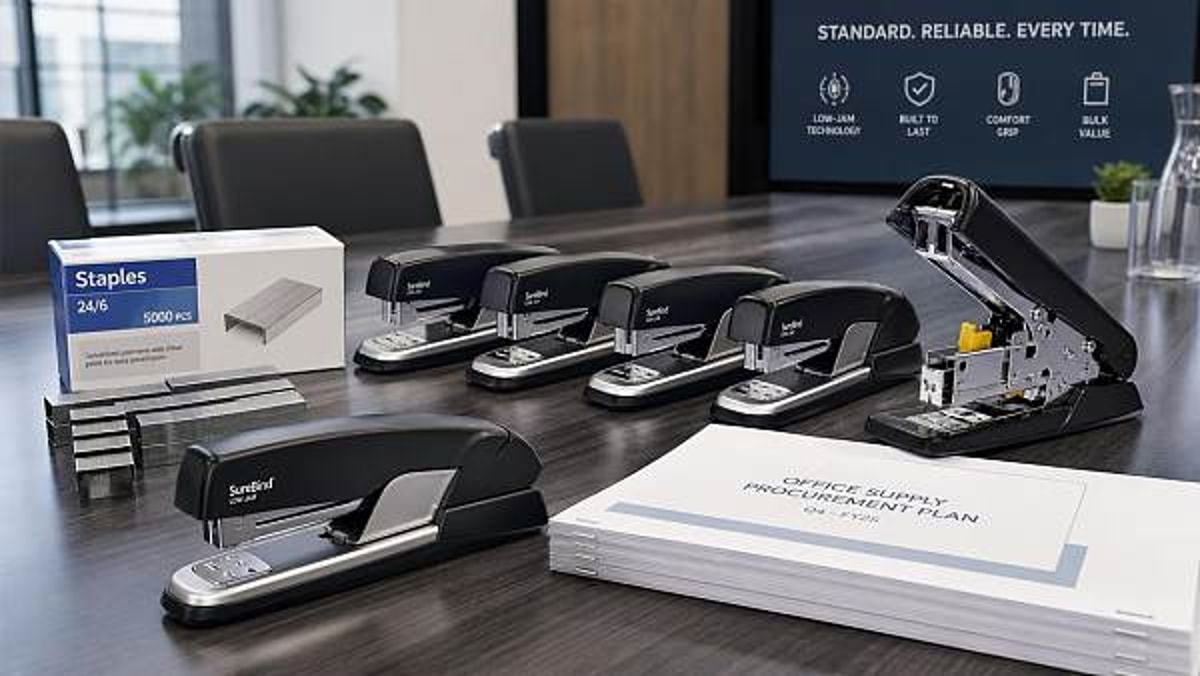
When evaluating office staplers bulk purchases, smart procurement teams know the lowest unit price rarely delivers the lowest total cost. Jam rates directly affect workflow speed, staff frustration, maintenance time, and replacement frequency across offices, schools, and commercial environments. Before placing large-volume orders, buyers need to compare reliability, material quality, and long-term performance—not just quotations.
For procurement teams, the core search intent behind “office staplers bulk” is not simply finding a cheap supplier. It is finding a stapler that performs consistently at scale, stays reliable across hundreds or thousands of users, and reduces hidden operating costs over time. Buyers want confidence that a bulk order will support daily workflow rather than create recurring friction.
The most important questions usually come down to four issues: how often the stapler jams, how long it lasts under regular use, whether it fits the actual paper-stacking needs of the workplace, and how easily it can be supported with compatible staples and after-sales service. Price matters, but in most commercial settings, reliability matters more because the cost of interruptions compounds quickly.
This article focuses on what helps procurement professionals make a better buying decision: how jam rates affect total cost of ownership, what technical and material factors influence stapler performance, how to compare models in a bulk sourcing process, and what specifications should appear on an RFQ or supplier evaluation checklist. General product descriptions are less useful here, so they are intentionally minimized.
Why jam rates deserve more attention than the quoted unit price
In high-volume office supply procurement, unit price is the easiest number to compare and often the least informative. A stapler that costs 10% less upfront can become the more expensive option if it jams frequently, breaks under moderate use, or requires staff to spend time clearing misfeeds and replacing worn parts.
Jam rates matter because they affect labor efficiency. In a busy office, administrative center, school, or shared service department, a stapler is a small tool used repeatedly throughout the day. If dozens or hundreds of employees lose even a small amount of time dealing with jams, that lost productivity quickly exceeds the savings from a lower purchase price.
There is also a user-behavior cost. When staplers jam often, people begin to avoid them, hoard the “good” units, or apply extra force that causes further damage. This creates uneven usage, more breakage, internal complaints, and more frequent replacement requests. Procurement may then appear to have saved money on paper while increasing operating frustration in practice.
For buyers managing office staplers bulk programs, jam rates are therefore a practical proxy for product quality. They indicate whether the feed mechanism, spring tension, magazine alignment, base stability, and staple compatibility are engineered for routine commercial use. Low jam performance is not just an inconvenience; it is a sign of broader reliability risk.
What procurement teams are really buying in a bulk stapler order
A bulk stapler order is not only a purchase of handheld tools. It is a purchase of workflow continuity. Procurement teams are effectively buying consistency across workstations, predictable maintenance levels, lower complaint rates, and easier replenishment planning. This is why the right evaluation criteria must go beyond the catalog photo and carton price.
In most organizations, staplers are distributed widely and used by people with different habits and skill levels. That means the product must tolerate imperfect use. It should feed staples smoothly, resist bending under pressure, and work without requiring users to load staples in a very precise way. Products that perform only in controlled demonstrations rarely perform well in actual office conditions.
Buyers are also purchasing standardization. If one stapler model is deployed across multiple departments or sites, procurement benefits from simpler inventory control, simpler staff training, and more efficient replenishment of compatible staples. A standardized product with low jam rates often produces more value than a mixed fleet of low-cost models sourced opportunistically.
From a sourcing perspective, office staplers bulk decisions should be treated similarly to other routine-use consumable-adjacent tools: evaluate not only acquisition cost, but also durability, compatibility, replacement cycle, supportability, and user acceptance. These are the variables that determine whether the purchase performs well after delivery.
How stapler jams create hidden costs across commercial environments
The financial impact of jams is often underestimated because it is dispersed. A jam does not usually trigger a formal incident report, but it does create repeated micro-delays. Employees stop to reopen the magazine, remove crushed staples, realign the feed track, restack papers, and try again. Across a large organization, these interruptions add up.
For example, imagine a procurement team buying 1,000 staplers for offices, education departments, or administrative service centers. If a lower-cost model jams just a few extra times per week per unit, and each jam consumes one to three minutes of employee time, the annual labor cost can easily exceed the difference between a cheap model and a more reliable one.
Jams also increase indirect maintenance costs. Facilities teams, office administrators, and procurement support staff spend time handling complaints, issuing replacements, or investigating whether the issue comes from product quality or incompatible staples. In environments where internal service teams are already stretched, even small equipment failures can create disproportionate management overhead.
In customer-facing or high-throughput environments, the damage is larger. Front desks, admissions offices, finance counters, educational administration offices, and legal document processing departments often depend on quick document handling. A jam at the wrong moment can slow service, create visible inefficiency, and undermine the perception of operational professionalism.
That is why experienced buyers assess stapler jams not as isolated annoyances but as recurring process losses. The real comparison is not “Which stapler is cheaper?” but “Which stapler delivers the lowest cost per successful use over its service life?”
What causes high jam rates in office staplers
Stapler jams usually come from a combination of design weaknesses, material limitations, and misuse tolerance issues. Understanding these causes helps procurement teams ask better supplier questions and avoid products that look acceptable in a sample but fail in deployment.
One major factor is poor feed-path alignment. If the staple strip does not move cleanly through the magazine and into the driving position, staples can skew, overlap, or crush. Low-tolerance manufacturing and inconsistent assembly often increase this risk, especially in very low-cost models.
Another common cause is weak or inconsistent spring performance. The spring must maintain stable pressure on the staple strip as the magazine empties. If tension drops too quickly or varies between production lots, the last portion of the staple strip may not feed properly, leading to intermittent jams that are difficult for users to predict.
Material quality also matters. Thin metal components can flex under pressure, while brittle plastic housings may warp or crack. This can affect magazine alignment, anvil contact, and the force transferred through the mechanism. In bulk procurement, small material compromises become major quality issues because they are multiplied across hundreds of units.
Staple compatibility is another overlooked issue. Some staplers are marketed as universal but perform reliably only with tightly matched staple dimensions. If a supplier does not clearly specify compatible staple sizes, crown width tolerances, and recommended brands or standards, buyers may face avoidable jam rates after rollout.
Finally, capacity mismatch causes many field problems. A stapler designed for light desktop use may jam when employees regularly staple thicker document sets near or above its claimed sheet capacity. Procurement teams should verify actual use conditions rather than rely on the nominal specification alone.
How to evaluate staplers for bulk purchase beyond price sheets
A strong sourcing process starts with defining the use case. Procurement should first segment demand by environment: general office desks, shared print stations, reception counters, schools, administration hubs, or records departments. Different environments place different demands on capacity, frequency, and durability.
Next, request performance evidence, not just brochure claims. Suppliers should be able to provide details on sheet capacity, jam testing, material composition, staple compatibility, cycle-life expectations, and warranty terms. If a supplier cannot explain why its stapler resists jams, the risk is usually higher than the quotation suggests.
Sampling is essential for office staplers bulk orders. A useful trial should not be limited to a few desk tests. It should simulate real use over time, including repeated stapling, mixed paper qualities, partial staple strips, near-capacity document stacks, and use by multiple employees. Procurement should capture not only failures but also user feedback on force, comfort, and loading ease.
It is also important to compare like for like. Some suppliers quote aggressively on a basic model that uses lighter construction or a narrower performance range than the buyer actually needs. Procurement teams should normalize comparisons by matching sheet capacity, construction type, mechanism design, warranty, and expected service life.
For institutional or multinational buyers, supplier consistency matters as much as product design. Ask whether the product is manufactured in one facility or multiple plants, whether quality control is lot-based or batch-tested, and whether the supplier can maintain the same specification across reorders. The best first order has limited value if follow-up shipments vary in performance.
The procurement metrics that matter most in office staplers bulk sourcing
To make a sound decision, buyers should build a simple scorecard. This shifts the conversation away from headline pricing and toward measurable value. The most useful metrics include jam frequency, successful staple penetration rate, average force required, durability over repeated cycles, and defect rate on arrival.
Total cost of ownership should include at least five categories: unit price, estimated replacement rate, labor time lost to jams, compatible staple cost, and administrative support time. Even a rough model will usually show that reliability has a larger financial effect than a minor price difference.
Buyers should also track service-life assumptions. How many months or staple cycles is the stapler expected to last under actual use? What percentage is likely to fail early? Does the supplier offer spare parts, replacements, or warranty support? These questions are particularly relevant for organizations deploying standardized products across multiple locations.
Another helpful metric is user adoption or complaint rate during pilot testing. A stapler can meet technical specifications and still perform poorly if users find it awkward, too stiff, or prone to incomplete closure on everyday document stacks. Procurement decisions should include real-world acceptance, not only engineering claims.
For large buyers, reorder stability should be added to the scorecard. A product that performs well once but cannot maintain quality, lead time, or staple compatibility in future shipments creates downstream risk. In sourcing, repeatability is part of product value.
Questions buyers should ask suppliers before placing a large order
Procurement professionals can reduce risk significantly by asking precise questions early. Start with performance: What is the tested jam rate under normal office use? Under what sheet count? Using which staple specification? Was the testing internal, third-party, or customer-validated?
Then move to construction details. Ask what materials are used in the magazine, driver, base, and housing. Is the main mechanism metal or mixed metal-plastic? Are there reinforced wear points? What is the expected cycle life? Can the supplier provide consistency data across production batches?
Compatibility questions are equally important. Which staple sizes are recommended? Are local-market staples likely to perform well, or does the stapler require proprietary or tightly controlled formats? Will the supplier also provide compatible staples at scale to maintain performance consistency?
Do not ignore quality assurance and logistics. Ask about acceptable quality limits, pre-shipment inspection procedures, packaging durability, carton quantity optimization, and defect handling after delivery. For international buyers, confirm compliance documentation, labeling standards, and whether the supplier has experience with institutional procurement requirements.
Finally, ask about after-sales support. If 3% of units fail in the first few months, what is the replacement process? Is there a local distribution partner? Can the supplier support mixed deliveries, private labeling, or ongoing replenishment programs? Good answers here often distinguish strategic suppliers from price-driven traders.
When paying more is justified—and when it is not
Paying more for a stapler is justified when the product operates in high-frequency environments, supports many users, or serves departments where document flow is time-sensitive. In such settings, lower jam rates and longer service life produce a clear return through reduced interruptions and fewer replacement cycles.
It is also worth paying more when standardization matters. Organizations with multiple sites often save money by using one reliable model rather than rotating through cheaper alternatives. Standardization improves ordering efficiency, simplifies staple replenishment, and reduces user confusion.
However, a premium model is not automatically the right choice for every application. Light-duty, low-frequency use areas may not need the most robust mechanism on the market. The key is fit-for-purpose procurement. Buyers should avoid both underbuying and overbuying by matching the product to the actual usage profile.
The best sourcing outcome often comes from a mid-range model with verified low jam performance, stable manufacturing quality, compatible staple availability, and reasonable warranty coverage. This type of product typically delivers stronger value than either the cheapest offer or the most feature-heavy premium option.
Practical buying framework for procurement teams
If your organization is preparing an office staplers bulk purchase, a practical framework can improve decision quality. First, define user groups and expected sheet counts. Second, shortlist models that match those needs. Third, request samples and performance data. Fourth, run a controlled pilot with real users. Fifth, compare total cost, not just unit price.
During the pilot, track jams, user complaints, loading issues, hand-force comfort, and visible wear. Test with the actual staple supply you plan to use after rollout. A stapler that performs well only under ideal conditions should not pass a commercial procurement review.
Then evaluate suppliers on repeatability: quality consistency, reorder support, packaging standards, and claims handling. A dependable supplier relationship matters because bulk purchases are rarely one-time events. Future replenishment and SKU continuity should be considered from the start.
Finally, document the decision rationale internally. Procurement stakeholders respond better when the choice is linked to measurable business outcomes such as reduced disruption, lower replacement rates, and better employee efficiency. This is especially important when the selected product is not the lowest-priced bid.
Conclusion: the best bulk stapler buy is the one that works every day
In commercial purchasing, the cheapest office stapler is often the most expensive mistake. For procurement teams, jam rates are a more meaningful decision factor than unit price because they directly influence productivity, user satisfaction, maintenance effort, and replacement cost.
The right office staplers bulk strategy is to evaluate reliability, material quality, staple compatibility, and supplier consistency together. Buyers who focus only on quotation tables may save a little upfront and lose much more across the life of the product.
A reliable stapler is not a glamorous purchase, but it is a high-frequency tool that shapes everyday workflow. When procurement treats jam resistance as a core value metric rather than a minor feature, bulk orders become smarter, operations run smoother, and total cost becomes easier to control.
Search News
Hot Articles
Popular Tags
Need ExpertConsultation?
Connect with our specialized leisureengineering team for procurementstrategies.
Recommended News
 May 06, 2026Office tape dispensers that stay stable on fast-paced desksOffice tape dispensers that stay stable on fast-paced desks improve workflow, reduce tape waste, and support one-handed use. Compare smart, durable options now.● Institutional Buyer
 May 06, 2026Bubble envelopes bulk: the size mismatch that wastes shipping spendBubble envelopes bulk can cut costs—or quietly increase them. Learn how size mismatch drives shipping waste, damage risk, and packing delays, and how right-sizing protects margins.● Institutional Buyer
 May 06, 2026Office staplers bulk orders: why jam rates matter more than priceOffice staplers bulk buyers should compare jam rates before unit price. Learn how reliability, durability, and staple compatibility reduce hidden costs and improve workflow.● Institutional Buyer
 May 06, 2026Custom rubber stamps: what affects imprint clarity the mostCustom rubber stamps deliver the best imprint clarity when material quality, engraving depth, ink performance, and surface match work together. Learn what to compare before you buy.● Institutional Buyer
 May 06, 2026When paper guillotines become a safety risk in daily usePaper guillotines can become serious daily safety risks in offices, schools, and print rooms. Learn how to spot hazards, improve compliance, and choose safer models.● Institutional Buyer
 May 06, 2026Why wholesale packing tape performance changes by climateWholesale packing tape performance shifts with cold, heat, and humidity. Learn how climate affects adhesion, unwind, and seal reliability to choose the right tape and reduce shipping failures.● Institutional Buyer
 May 06, 2026Self inking stamps wholesale: what users notice after six monthsSelf inking stamps wholesale buyers often learn the truth after six months. Discover what users notice about durability, imprint quality, refills, and supplier reliability before you source.● Institutional Buyer
 May 06, 2026Hole punches wholesale: metal build or low-cost plastic?Hole punches wholesale: compare durable metal and low-cost plastic models for offices, schools, and bulk buyers. Discover which option delivers better value, fit, and long-term savings.● Institutional Buyer
 May 05, 2026Cork bulletin boards: why frame quality matters over board sizeCork bulletin boards deliver better long-term value when frame quality comes first. Learn how stronger materials, secure corners, and stable mounting improve durability, safety, and appearance.● Institutional Buyer
 May 05, 2026Soundproof phone booths: when sound ratings mislead office plansSoundproof phone booths can mislead office plans when ratings are taken at face value. Learn how to compare privacy, ventilation, placement, and compliance before you buy.● Institutional Buyer
 May 05, 2026Laser printer toner bulk: what affects page yield mostLaser printer toner bulk page yield depends on more than toner volume. Discover the top factors affecting real output and make smarter, lower-cost sourcing decisions.● Institutional Buyer
 May 05, 2026Science lab furniture: small design choices with big safety impactScience lab furniture shapes lab safety in ways many teams overlook. Discover smart design choices that reduce risk, improve compliance, and support efficient long-term performance.● Institutional Buyer
 May 05, 2026Wholesale ink cartridges: remanufactured vs compatible in real useWholesale ink cartridges compared in real use: remanufactured vs compatible on print quality, yield, firmware risk, and sourcing value—helping procurement teams buy smarter.● Institutional Buyer
 May 05, 2026Cash drawers wholesale: what causes jams at checkoutCash drawers wholesale guide: uncover the real causes of checkout jams, from latch design to POS compatibility, and learn how to source reliable drawers that reduce downtime.● Institutional Buyer
 May 05, 2026Office acoustic pods or open booths: which solves noise betterOffice acoustic pods vs. open booths: discover which solution controls noise better for privacy, focus, and hybrid calls, and make a smarter office planning decision.● Institutional Buyer
 May 05, 2026Office LED panel lights that cut glare without dim workspacesOffice LED panel lights that reduce glare without sacrificing brightness. Discover how to choose low-glare, high-comfort lighting for productive, compliant, and modern office spaces.● Institutional Buyer
 May 05, 2026Chemical resistant lab tops: which materials hold up bestChemical resistant lab tops compared: discover whether epoxy resin, phenolic resin, or stainless steel holds up best for harsh chemicals, heat, and daily lab demands.● Institutional Buyer
 May 05, 2026How to compare drafting tables wholesale without overbuyingDrafting tables wholesale comparison starts with MOQ, specs, and supplier reliability. Learn how to avoid overbuying, reduce inventory risk, and choose better-value sourcing options.● Institutional Buyer
 May 04, 2026Ergonomic Office Chairs Wholesale: Comfort Claims vs Real SupportErgonomic office chairs wholesale: learn how to verify real support beyond comfort claims with fit, adjustability, durability, and compliance insights for smarter commercial buying.● Institutional Buyer
 May 04, 2026Modular Office Workstations: Flexibility Can Add Setup CostsModular office workstations can improve flexibility, but setup costs often rise through installation, power, data, and rework. Learn when the added investment truly pays off.● Institutional Buyer
 May 04, 2026Steel Filing Cabinets: Why Some Drawers Jam Too EarlySteel filing cabinets often jam early due to weak slides, poor leveling, overload, or lock issues. Discover what to check before buying and how to avoid costly drawer failures.● Institutional Buyer
 May 04, 2026Office Network Racks: Airflow Problems Start With Bad PlanningOffice network racks can fail early when airflow is ignored. Learn the key planning checklist to prevent overheating, reduce maintenance risks, and build a more reliable office network.● Institutional Buyer
 May 04, 2026Office Partitions Wholesale: Open Plan Savings, Closed Office NeedsOffice partitions wholesale helps project managers cut fit-out costs, speed delivery, and balance open-plan efficiency with private office performance. Explore smarter commercial workspace solutions.● Institutional Buyer
 May 04, 2026Conference Room Tables: Common Layout Mistakes to AvoidConference room tables can make or break meeting flow. Discover common layout mistakes to avoid and plan smarter spaces for collaboration, AV integration, and professional results.● Institutional Buyer