Tablet charging carts with locking doors still need these checks
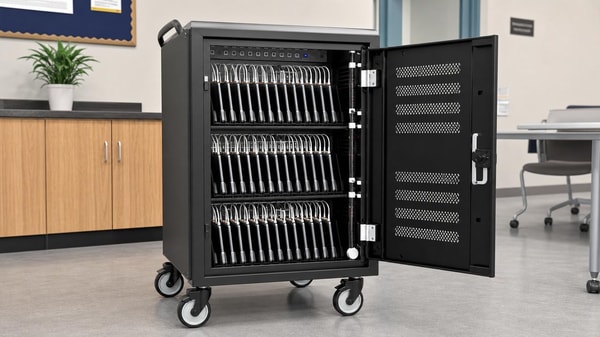
Tablet charging carts with locking doors are often treated as a complete security solution, but experienced procurement teams know that physical locks are only one part of risk control. Before purchasing or deploying tablet charging carts, buyers should also verify ventilation, cable management, power safety, mobility, device compatibility, and compliance standards to protect assets, support daily operations, and avoid costly failures.
Why scenario differences matter before buying tablet charging carts
For procurement professionals, the same product category can perform very differently depending on where and how it is used. Tablet charging carts in a K-12 classroom face one risk profile, while carts deployed in a hotel training center, a smart campus, a healthcare education lab, or a corporate meeting facility face another. A locking door may discourage casual access, but it does not solve overheating, overloaded circuits, wheel failure, poor cable routing, or mismatch between the cart slots and actual tablet cases.
This is why sourcing decisions should begin with application context rather than brochure claims. Buyers need to assess not only how many devices must be stored and charged, but also who moves the cart, how often it is relocated, whether devices return with rugged cases, what the local power environment is, and whether the unit must comply with school, hospitality, or institutional safety requirements. In practical terms, the best tablet charging carts are not simply the most secure-looking models. They are the models that fit the daily workflow without creating operational bottlenecks or hidden maintenance issues.
Common business scenarios where tablet charging carts are used
Tablet charging carts appear across a broad range of commercial and institutional settings. In each scenario, the core purpose is similar: centralize charging, storage, transport, and device protection. However, the purchasing priorities can change substantially. The table below helps procurement teams compare typical usage environments before shortlisting suppliers.
What schools need beyond a locking door
In educational environments, tablet charging carts are often rolled between classrooms, media rooms, and storage areas. Here, the purchase decision should focus on repeated daily handling rather than occasional use. Locks matter because many users interact with the same equipment, but the larger issue is whether the cart supports high-frequency circulation without creating confusion or damage.
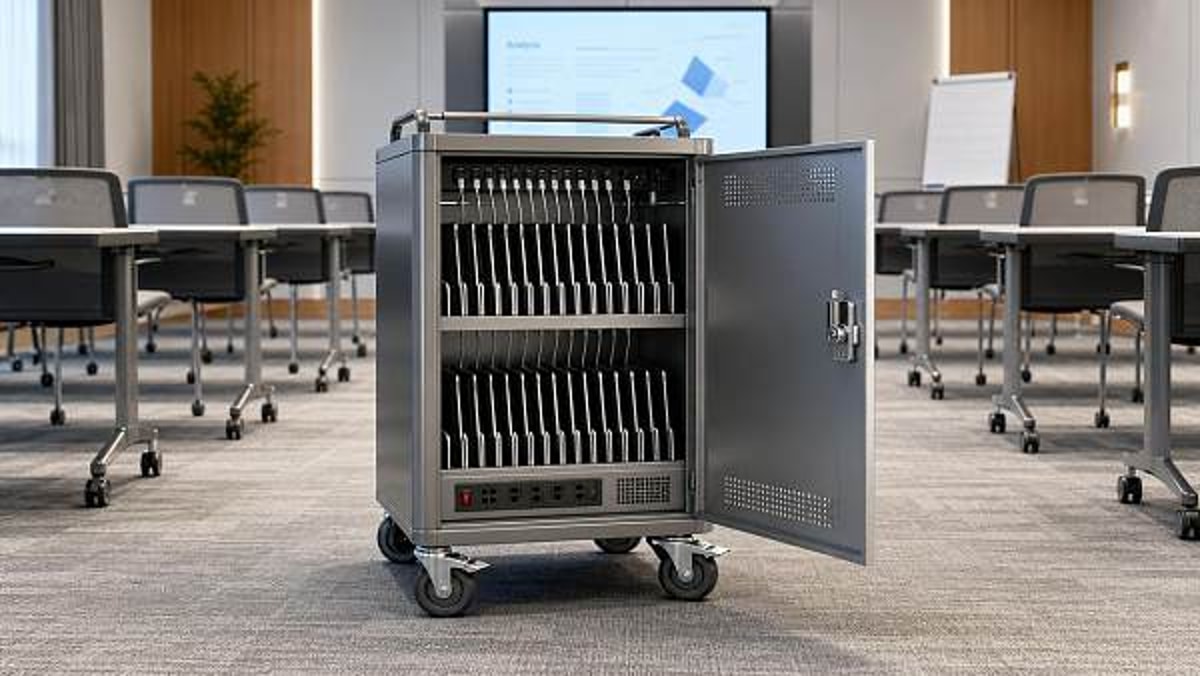
For schools, one of the first checks is slot spacing. Many tablets are used with rugged protective cases, keyboard covers, or asset tags. If slot dimensions are based on bare-device measurements, tablets may not fit smoothly, increasing wear on screens, ports, and charging cables. Procurement teams should request exact usable slot dimensions rather than overall cart dimensions.
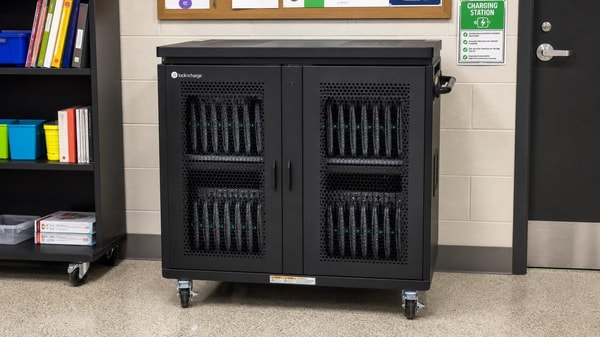
Ventilation is equally important. Charging dozens of devices in a closed cabinet can generate heat, especially during end-of-day full-charge cycles. Tablet charging carts with locking doors should still provide deliberate airflow paths and thermal design that match the charging load. A lock without ventilation creates a false sense of security because overheated devices can reduce battery lifespan and trigger charging interruptions.
Schools should also examine cable management carefully. Younger users and busy teaching staff need clearly separated, easy-to-reconnect cables. Internal cable clutter raises replacement costs and lengthens turnaround time between classes. If a supplier cannot show how the cables are secured, labeled, and protected from bending stress, the design may not hold up under daily educational use.
What hotels, event venues, and hospitality operators should prioritize
In hospitality and event settings, tablet charging carts often support check-in systems, digital menus, conference registration, training sessions, and premium guest experiences. The usage pattern is less about student traffic and more about presentation quality, service continuity, and rapid setup. A lock helps protect devices after hours, but procurement teams in this sector should evaluate mobility and finish quality with equal rigor.
A cart used in conference operations may be moved across carpet, hard flooring, elevators, and back-of-house service corridors. Weak casters or poor wheel locks can quickly become a service issue. Buyers should confirm wheel material, brake performance, directional stability, and whether the cart remains easy to maneuver when fully loaded. A unit that looks robust in a catalog can still be difficult for one staff member to move safely during event turnover.
Hospitality teams should also inspect noise and aesthetics. Rattling doors, exposed wiring, rough finishes, or industrial-looking construction may not fit premium brand environments. Since GCT serves buyers focused on commercial experiences, this detail matters: a sourcing decision should align not just with technical function but with the visual and operational standards of the venue. Tablet charging carts placed near guest-facing spaces should support both asset control and brand presentation.
Corporate and institutional scenarios: efficiency, compliance, and inventory control
In corporate offices, universities, and public institutions, device fleets are often managed by IT, facilities, and procurement together. That means charging carts are evaluated not only for storage but also for fleet accountability. In these environments, a locking door is useful, yet buyers should look deeper into access control methods, power architecture, and maintenance practicality.
One common mistake is assuming all tablet charging carts deliver the same charging performance. Some rely on simple power strip arrangements, while others integrate intelligent charging, power sequencing, or load balancing. Where many carts may operate in the same building, electrical load planning becomes critical. Procurement teams should verify voltage compatibility, plug types, surge protection, circuit demands, and any thermal or overload safeguards relevant to the installation site.
Compliance should not be treated as a final checkbox. In many institutional bids, certification status can affect risk acceptance, insurance, and procurement approval. Ask suppliers to provide documentation for applicable electrical and safety standards, material durability, and manufacturing quality processes. Reliable vendors should be able to provide testing evidence rather than vague claims of being “built to standard.”
The six checks every buyer should make before approving tablet charging carts
Across all scenarios, the following six checks deserve priority because they directly affect lifecycle cost and user satisfaction.
1. Ventilation and heat management
Confirm airflow design, vent placement, and whether the unit has been evaluated under full charging conditions. A locked enclosure without proper heat control can shorten battery life and reduce operational reliability.
2. Cable organization and serviceability
Look for separated cable channels, strain relief, and easy replacement access. Well-designed tablet charging carts reduce cable tangles and minimize maintenance labor.
3. Power safety and electrical design
Check charging method, circuit protection, plug quality, and certifications. If carts will operate in dense deployments, review aggregate electrical impact as part of the sourcing process.
4. Mobility and physical durability
Assess wheel quality, handle placement, door hinges, welds, and overall frame rigidity. A secure cart that fails during transport creates both safety and asset risks.
5. Device compatibility
Match the cart to actual device dimensions, cases, adapters, and charging connectors. Request a loading test if your fleet uses mixed tablet models.
6. Compliance and documentation
Require supplier documentation covering safety certifications, quality control, warranties, spare part support, and after-sales response procedures.
Scenario-based buying guidance for different procurement priorities
Common purchasing mistakes when evaluating tablet charging carts
A frequent mistake is comparing only capacity and price. Two tablet charging carts may both hold 30 devices, but one may be easier to service, safer under full load, and more compatible with protective cases. Another mistake is overvaluing the lock while undervaluing the operating environment. If staff must leave doors open during charging because the unit overheats, the security advantage is already compromised.
Buyers also sometimes overlook lifecycle support. Replacement keys, hinges, casters, power modules, and charging cables matter over time. Ask whether spare parts are available and how quickly the supplier can support international or multi-site deployments. For B2B buyers, especially those managing hotels, campuses, or institutional rollouts, consistent after-sales performance is part of the sourcing decision, not a separate issue.
FAQ for procurement teams
Are locking doors enough to secure tablet charging carts?
No. Locks help control physical access, but buyers must also review ventilation, electrical safety, mobility, and compatibility. Security without operational safety is incomplete.
Do all tablet charging carts support tablets with cases?
No. Many do not. Always request internal slot dimensions and test against your actual device-and-case combination.
When should mobility be a top concern?
Whenever the cart moves between rooms, floors, or departments. In schools and hospitality settings, mobility can affect staff productivity and safety more than expected.
Final sourcing advice: match the cart to the workflow, not just the specification sheet
The right tablet charging carts should fit the realities of your environment: how devices are issued, how often they are returned, who transports them, how quickly they must recharge, and what standards your organization must meet. Locking doors remain valuable, but they should be evaluated as one component within a broader operational and safety framework.
For procurement teams, the best next step is to build a short scenario-based checklist before requesting quotations. Include site conditions, device dimensions, charging volume, mobility needs, compliance requirements, and maintenance expectations. That approach leads to better supplier conversations, fewer deployment surprises, and a more defensible purchasing decision. In competitive commercial environments, especially those shaped by technology-enabled guest, learning, or workplace experiences, a well-chosen tablet charging cart protects both devices and service quality.
Search News
Hot Articles
Popular Tags
Need ExpertConsultation?
Connect with our specialized leisureengineering team for procurementstrategies.
Recommended News
 May 06, 2026Tablet charging carts with locking doors still need these checksTablet charging carts with locking doors still need key checks. Learn how to evaluate ventilation, power safety, mobility, and compatibility before you buy.● Institutional Buyer
 May 06, 2026Document cameras for teachers: image quality or software first?Document cameras for teachers: should you prioritize image quality or software? Explore a practical checklist to compare clarity, workflow, compatibility, and long-term value.● Institutional Buyer
 May 06, 2026Smart podiums for classrooms that fit hybrid teaching betterSmart podiums for classrooms designed for hybrid teaching: compare integration, durability, ergonomics, and serviceability to choose scalable solutions that cut support issues and improve teaching efficiency.● Institutional Buyer
 May 06, 2026Chromebook charging stations and the airflow issue many missChromebook charging stations often look efficient, but airflow is the hidden factor that impacts battery life, safety, and charging performance. Learn what smart buyers should inspect before choosing.● Institutional Buyer
 May 06, 2026Language lab equipment features that improve speaking practiceLanguage lab equipment features can dramatically improve speaking practice. Discover which tools best fit schools, universities, exam centers, and training programs.● Institutional Buyer
 May 06, 2026Wireless presentation systems that solve lag in larger roomsWireless presentation systems for larger rooms: discover how to reduce lag, improve stability, strengthen security, and ensure smooth sharing across enterprise AV and IT environments.● Institutional Buyer
 May 06, 2026Tablet charging carts and the hidden issue of cable wearTablet charging carts face a hidden reliability risk: cable wear. Learn how smarter evaluation can reduce downtime, lower maintenance costs, and improve long-term device performance.● Institutional Buyer
 May 06, 2026Scientific calculators wholesale: when cheaper models cost moreScientific calculators wholesale is not just about the lowest quote. Learn how defects, compliance, batch consistency, and supplier reliability affect true cost—and how smarter sourcing protects margin.● Institutional Buyer
 May 06, 2026IOC Selects Chinese University’s Athlete Support Model as Global Procurement BenchmarkIOC adopts Chinese university's AI psychological coaching + wearable load monitoring model as global procurement benchmark — a strategic opportunity for edtech, sports health tech, and data security providers.● Institutional Buyer
 May 05, 2026Liaoning Tieren Appoints Korean Coach Xu Zhengyuan, Signals Shift in K-League Equipment ProcurementLiaoning Tieren appoints Korean coach Xu Zhengyuan — sparking interest in K-League equipment procurement and KFA 2026-certified smart training tech.● Institutional Buyer
 May 05, 2026Physics lab apparatus: where low-cost kits usually fall shortPhysics lab apparatus buying on price alone often leads to poor accuracy, weak durability, and higher lifecycle costs. Learn what low-cost kits miss and how to source safer, better-value solutions.● Institutional Buyer
 May 05, 2026School laboratory equipment: what should be replaced firstSchool laboratory equipment replacement starts with safety-critical assets. Learn what to replace first to improve compliance, reduce downtime, and maximize tight budgets.● Institutional Buyer
 May 05, 2026Thermal receipt printers: hidden upkeep costs before large rolloutThermal receipt printers may look affordable, but hidden upkeep costs can erode rollout budgets. Learn how to reduce downtime, control maintenance, and choose smarter for scale.● Institutional Buyer
 May 05, 2026Human anatomy models that improve hands-on teaching, not storageHuman anatomy models built for hands-on teaching, not storage. Discover durable, classroom-ready options that improve engagement, simplify setup, and support smarter education sourcing.● Institutional Buyer
 May 05, 2026Ceiling mount projector brackets: where installation mistakes happenCeiling mount projector brackets: discover where installation mistakes happen, how to avoid safety and alignment issues, and the checklist that helps teams deliver smoother AV projects.● Institutional Buyer
 May 05, 2026Barcode scanners for library: common issues with older systemsBarcode scanners for library upgrades can solve slow checkouts, read errors, and compatibility issues in older systems. Learn what fails first and how to choose a reliable replacement.● Institutional Buyer
 May 05, 2026What to check before ordering wholesale projector screensWholesale projector screens buyers should check material, gain, aspect ratio, installation, and supplier consistency before ordering. Reduce sourcing risk and choose reliable commercial solutions.● Institutional Buyer
 May 05, 2026Geography globes wholesale: what makes one model classroom-readyGeography globes wholesale buyers: discover what makes a model truly classroom-ready, from durability and readability to safety, compliance, and reliable bulk supply.● Institutional Buyer
 May 05, 2026Microscope slides wholesale: where quality gaps usually show upMicroscope slides wholesale buyers should watch for hidden quality gaps in flatness, edge finishing, cleanliness, and batch consistency—learn how to reduce waste and choose reliable suppliers.● Institutional Buyer
 May 05, 2026POS touch screens: what affects response speed and lifespanPOS touch screens directly impact checkout speed, uptime, and total cost. Learn what affects response speed and lifespan to choose the right solution for every business scenario.● Institutional Buyer
 May 04, 2026Kindergarten Furniture Bulk Orders and the Safety Details MissedKindergarten furniture bulk buyers: discover the hidden safety checks suppliers often miss, from emissions and stability to ergonomics and compliance, before placing large orders.● Institutional Buyer
 May 04, 2026School Desks and Chairs Wholesale: Matching Age to Size CorrectlySchool desks and chairs wholesale guide: learn how to match age to size correctly for better comfort, safety, compliance, and smarter school furniture purchasing.● Institutional Buyer
 May 04, 2026Library Bookshelves Wholesale: How Much Load Is Really Enough?Library bookshelves wholesale guide: learn how much load is truly enough for safety, durability, and compliance. Compare ratings, avoid costly mistakes, and choose the right shelving with confidence.● Institutional Buyer
 May 04, 2026Smart Interactive Whiteboards: Which Features Get Used Daily?Smart interactive whiteboards: discover which features teams and teachers actually use daily, from touch accuracy and wireless casting to easy collaboration, ROI, and smarter buying decisions.● Institutional Buyer