Geography globes wholesale: what makes one model classroom-ready
When evaluating geography globes wholesale for schools, price alone is never enough. Buyers, distributors, and educators need to know which models can withstand daily classroom use, support curriculum goals, and meet safety expectations. This guide explores the practical features that make a globe truly classroom-ready, helping information-focused readers compare options with greater confidence.
In institutional purchasing, a classroom globe is not a decorative desktop item. It is a teaching aid expected to survive repeated handling by students aged 6 to 18, remain legible from 1.5 to 3 meters away, and fit within school budgets that often cover dozens or even hundreds of units per order. That is why geography globes wholesale decisions should be based on performance, specification consistency, and supplier reliability rather than unit cost alone.
For importers, school suppliers, and procurement teams, the most useful question is simple: what makes one model genuinely classroom-ready? The answer usually involves 4 practical dimensions: educational accuracy, physical durability, student safety, and deployment efficiency. Each of these affects total value over a 12- to 36-month usage cycle.
Why classroom-ready standards matter in geography globes wholesale
Schools use globes differently from gift shops, executive offices, or home décor buyers. In a classroom, the globe may be rotated 20 to 50 times per day, moved between desks, stored on open shelving, and handled by multiple students in a single lesson. A model that performs well in retail display can fail quickly in an educational setting.
This distinction matters for geography globes wholesale because bulk buyers are responsible for reducing replacement rates, complaint frequency, and maintenance burden. A low-cost globe that cracks after one semester may double the real cost of ownership once repurchase, freight, and administrative time are included.
The operational difference between retail and school use
A classroom model is usually expected to deliver stable performance across 3 use conditions: teacher-led demonstration, student desk activity, and storage or transport between rooms. That means the base must remain balanced, the axis must turn smoothly, and printed labels must stay readable under daily lighting conditions, including LED classroom lights that can create glare on highly glossy surfaces.
What buyers risk when specifications are too vague
Many catalog listings mention only size and color style. For B2B buyers, that is not enough. If a quotation omits sphere diameter tolerance, stand material, lamination type, or carton drop protection, the shipment may arrive with inconsistent products across the same batch. In orders of 100 to 500 units, even a 5% defect rate can create significant downstream service issues.
The table below shows how common school-use requirements differ from general retail expectations, making it easier to assess geography globes wholesale offers with a procurement lens.
The key takeaway is that school purchasing is a use-case-driven category. Buyers comparing geography globes wholesale options should request operational specifications, not just visual photos and ex-works pricing.
Core features that make a globe classroom-ready
A classroom-ready globe usually combines correct cartographic design with durable physical construction. In practical sourcing terms, buyers should inspect at least 6 checkpoints before approving a model for school distribution: diameter, print clarity, surface finish, stand structure, rotational stability, and age-appropriate information density.
1. Size and visibility for different teaching formats
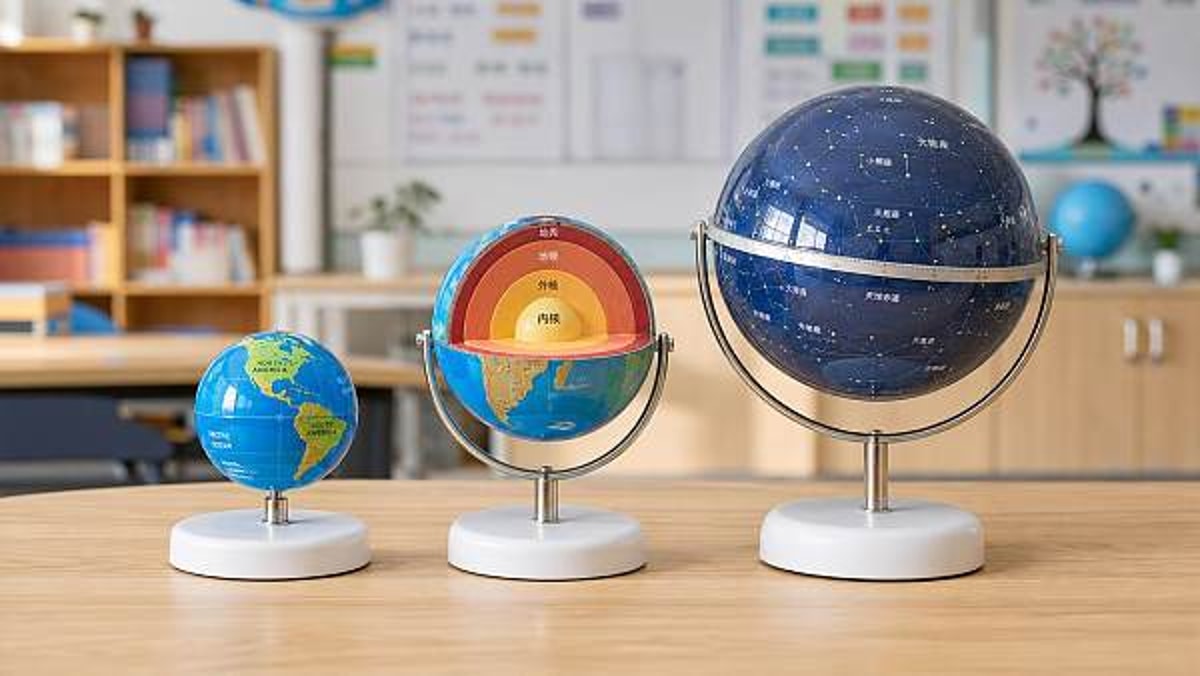
Common school globe diameters range from 20 cm to 30 cm. A 20 to 22 cm model works for individual desks or library reference, while 25 to 30 cm is more suitable for teacher demonstration and upper-grade classrooms. Below 18 cm, labels often become too small for practical group instruction unless the content design is simplified.
2. Map readability and curriculum alignment
Legibility is more than font size. Students need distinct borders, consistent color coding, visible latitude and longitude lines, and enough spacing between labels to avoid visual crowding. For primary schools, a less dense political map may improve comprehension. For middle and secondary levels, buyers may prefer models with additional topographic cues or ocean current markings depending on curriculum needs.
Political, physical, or dual-purpose versions
In geography globes wholesale, one frequent mistake is choosing a globe type without matching it to teaching goals. Political globes help with country recognition and capitals. Physical globes emphasize landforms, mountain ranges, and ocean depth visualization. Dual-purpose or illuminated variants may offer broader use, but they also increase component complexity and price by roughly 15% to 40% depending on materials and electrical parts.
3. Construction materials and rotational performance
For classroom use, the sphere shell should resist dents from light impacts, and the stand should stay stable on standard desks. Plastic bases are common at entry level, but thicker molded structures generally outperform thin decorative designs. Metal meridians can improve rigidity, though coating quality matters because chipped paint creates a worn appearance quickly in high-use settings.
Rotation should be smooth but not loose. If the axis is too tight, younger students may force movement and stress the structure. If too loose, the globe may wobble, reducing teaching usability. In sample evaluation, buyers often test 10 to 20 full rotations and check whether the sphere remains centered and whether any scraping occurs at the support ring.
4. Surface protection and cleanability
A classroom globe should tolerate regular dusting and occasional wiping with a soft dry or slightly damp cloth. Laminated or coated surfaces help prevent print wear, especially near high-touch regions around the equator and commonly referenced continents. Very glossy coatings may look attractive in catalogs, but moderate glare control often improves classroom readability.
The following table organizes the most practical feature benchmarks for school buyers reviewing geography globes wholesale offers.
For most educational distributors, the best value is usually not the most feature-rich globe. It is the model that achieves a stable balance between map clarity, durability, and replenishment simplicity across repeated orders.
Safety, compliance, and age-appropriate design
In school procurement, safety review should be part of the product-selection process from the start. Geography globes wholesale buyers often focus heavily on print design, but product safety details can determine whether a model is acceptable for kindergarten, primary, or secondary educational environments.
Key safety points buyers should check
- Rounded or smooth stand edges to reduce scratch risk during handling.
- Secure connection between globe sphere, axis, and base with no loose parts.
- Low-odor materials and coatings appropriate for enclosed indoor learning spaces.
- Stable base footprint that helps prevent tipping when touched from one side.
- Packaging strong enough to prevent damage that could create sharp cracks on arrival.
Matching design to age bands
For children under roughly 8 years old, simpler content and stronger physical stability are often more important than map detail density. For ages 9 to 12, buyers can consider more labels and clearer coordinate lines. Secondary schools may accept more advanced political or physical information, but even then, readability and sturdy construction remain more important than decorative complexity.
If illuminated models are under consideration, buyers should apply extra review to switch quality, cable routing, and classroom storage practicality. Electrical features can add teaching value, but they also introduce more failure points than non-illuminated models.
Bulk buying factors beyond the product itself
A good product can still become a poor procurement choice if supply terms are weak. In geography globes wholesale, repeatability matters almost as much as the first sample. Institutional buyers should therefore compare vendors not only by unit price, but also by packaging consistency, lead time discipline, documentation quality, and after-sales responsiveness.
Questions to ask before placing a larger order
- What is the standard MOQ for the selected size and map version?
- Can the supplier keep the same print specification across 2 or 3 replenishment cycles?
- What is the usual production lead time, such as 15 to 30 days, for school-season demand?
- How are products packed: individual box, master carton count, and corner protection level?
- What inspection points are confirmed before shipment?
The table below highlights procurement checkpoints that matter when moving from sample review to wholesale execution.
For many buyers, a slightly higher landed cost is justified when it reduces breakage, claim handling, and emergency restocking. That is especially true when shipping internationally, where a single damaged pallet can disrupt delivery schedules by 2 to 6 weeks.
A practical evaluation workflow for information-focused buyers
For readers in the research stage, comparing geography globes wholesale suppliers becomes easier when the evaluation process is standardized. Instead of relying on catalog photos or one-line quotations, use a simple 5-step workflow that connects product specification with classroom use reality.
Step 1: Define the end-use profile
Identify grade range, whether the globes are for desk use or teacher display, and expected quantity per site. A 30-unit primary-school order may need different features than a 300-unit district purchase for mixed age groups.
Step 2: Build a short specification sheet
List non-negotiable requirements such as 20–25 cm diameter, political map type, stable base, easy-clean finish, and safe edge construction. This helps suppliers quote against the same baseline and reduces comparison errors.
Step 3: Request sample checks
During sample review, check printing clarity, stand rigidity, rotation smoothness, odor level after unpacking, and carton protection. A 10-minute hands-on inspection often reveals more than several pages of sales specification.
Step 4: Compare total procurement risk
Do not compare only FOB or EXW price. Add expected damage risk, likely replacement effort, and lead time reliability. In wholesale school supply, the cheaper quote may become the more expensive option after delivery issues are factored in.
Step 5: Prepare for reorder continuity
If the first order performs well, schools often want the same model again. Confirm whether the supplier can maintain map artwork, color scheme, and stand design over future 6- to 12-month replenishment cycles. That continuity is highly valuable for distributors serving education tenders or institutional contracts.
Common buying mistakes and how to avoid them
Even experienced buyers can misjudge classroom suitability when reviewing geography globes wholesale catalogs. Several issues appear repeatedly in school-oriented sourcing projects.
Choosing by appearance instead of teaching function
A premium-looking finish does not automatically support better learning. If labels are too dense, colors too dark, or reflections too strong, classroom performance declines despite attractive product photography.
Ignoring packaging and transit durability
A globe may pass sample review but fail in shipment if the inner support and outer carton are weak. For larger international orders, asking about packing method and carton drop protection is as important as checking the globe itself.
Overbuying advanced features for basic classroom needs
Not every school needs illuminated or highly detailed specialty versions. If the teaching objective is basic country recognition and location awareness, a simpler and sturdier model may provide better long-term value.
For buyers researching geography globes wholesale for educational supply, the most reliable classroom-ready models are those that combine 4 essentials: readable mapping, durable structure, safe student handling, and dependable repeat supply. These factors matter far more than headline price alone, especially when the product must perform across a full school year and multiple classrooms.
Global Commercial Trade supports information-focused buyers with sourcing intelligence designed for real commercial decisions. If you are comparing educational globe options, planning a school supply range, or refining a tender-ready specification, contact us to get a tailored sourcing perspective, discuss product details, or explore broader office and educational supply solutions.
Search News
Hot Articles
Popular Tags
Need ExpertConsultation?
Connect with our specialized leisureengineering team for procurementstrategies.
Recommended News
 May 05, 2026Physics lab apparatus: where low-cost kits usually fall shortPhysics lab apparatus buying on price alone often leads to poor accuracy, weak durability, and higher lifecycle costs. Learn what low-cost kits miss and how to source safer, better-value solutions.● Institutional Buyer
 May 05, 2026School laboratory equipment: what should be replaced firstSchool laboratory equipment replacement starts with safety-critical assets. Learn what to replace first to improve compliance, reduce downtime, and maximize tight budgets.● Institutional Buyer
 May 05, 2026Thermal receipt printers: hidden upkeep costs before large rolloutThermal receipt printers may look affordable, but hidden upkeep costs can erode rollout budgets. Learn how to reduce downtime, control maintenance, and choose smarter for scale.● Institutional Buyer
 May 05, 2026Human anatomy models that improve hands-on teaching, not storageHuman anatomy models built for hands-on teaching, not storage. Discover durable, classroom-ready options that improve engagement, simplify setup, and support smarter education sourcing.● Institutional Buyer
 May 05, 2026Ceiling mount projector brackets: where installation mistakes happenCeiling mount projector brackets: discover where installation mistakes happen, how to avoid safety and alignment issues, and the checklist that helps teams deliver smoother AV projects.● Institutional Buyer
 May 05, 2026Barcode scanners for library: common issues with older systemsBarcode scanners for library upgrades can solve slow checkouts, read errors, and compatibility issues in older systems. Learn what fails first and how to choose a reliable replacement.● Institutional Buyer
 May 05, 2026What to check before ordering wholesale projector screensWholesale projector screens buyers should check material, gain, aspect ratio, installation, and supplier consistency before ordering. Reduce sourcing risk and choose reliable commercial solutions.● Institutional Buyer
 May 05, 2026Geography globes wholesale: what makes one model classroom-readyGeography globes wholesale buyers: discover what makes a model truly classroom-ready, from durability and readability to safety, compliance, and reliable bulk supply.● Institutional Buyer
 May 05, 2026Microscope slides wholesale: where quality gaps usually show upMicroscope slides wholesale buyers should watch for hidden quality gaps in flatness, edge finishing, cleanliness, and batch consistency—learn how to reduce waste and choose reliable suppliers.● Institutional Buyer
 May 05, 2026POS touch screens: what affects response speed and lifespanPOS touch screens directly impact checkout speed, uptime, and total cost. Learn what affects response speed and lifespan to choose the right solution for every business scenario.● Institutional Buyer
 May 04, 2026Kindergarten Furniture Bulk Orders and the Safety Details MissedKindergarten furniture bulk buyers: discover the hidden safety checks suppliers often miss, from emissions and stability to ergonomics and compliance, before placing large orders.● Institutional Buyer
 May 04, 2026School Desks and Chairs Wholesale: Matching Age to Size CorrectlySchool desks and chairs wholesale guide: learn how to match age to size correctly for better comfort, safety, compliance, and smarter school furniture purchasing.● Institutional Buyer
 May 04, 2026Library Bookshelves Wholesale: How Much Load Is Really Enough?Library bookshelves wholesale guide: learn how much load is truly enough for safety, durability, and compliance. Compare ratings, avoid costly mistakes, and choose the right shelving with confidence.● Institutional Buyer
 May 04, 2026Smart Interactive Whiteboards: Which Features Get Used Daily?Smart interactive whiteboards: discover which features teams and teachers actually use daily, from touch accuracy and wireless casting to easy collaboration, ROI, and smarter buying decisions.● Institutional Buyer
 May 04, 2026Student Chairs With Writing Pad: Which Sizes Fit Best?Student chairs with writing pad: discover which sizes best support comfort, posture, room capacity, and tablet use. Compare fit options for schools, universities, and training spaces.● Institutional Buyer
 May 03, 2026Beijing Women's FC Win Spurs AI Training System Export to UKBeijing Women's FC win sparks UK demand for AI sports training systems — real-time analytics, GDPR/ISO 27001 compliance & Heathrow logistics insights revealed.● Institutional Buyer
 May 01, 2026Park Trash Cans That Cut Maintenance Instead of Adding ItPark trash cans that reduce labor, resist weather, and stay cleaner longer. Learn which designs, materials, and features help lower maintenance costs across parks and outdoor spaces.● Institutional Buyer
 May 01, 2026Park Drinking Fountains That Hold Up Better in Public SpacesPark drinking fountains built for public spaces need durability, hygiene, and low maintenance. Discover how to choose vandal-resistant models that cut long-term costs.● Institutional Buyer
 May 01, 2026Restaurant POS Systems That Reduce Training Time at the CounterRestaurant POS systems that cut counter training time: compare intuitive workflows, role-based controls, and error-reducing features to speed onboarding and improve service consistency.● Institutional Buyer
 Apr 30, 20262026 Shanghai Smart Campus Expo: VR EdTech Gains ITU & ISO/IEC 23053 Dual CertificationVR EdTech gains ITU & ISO/IEC 23053 dual certification at 2026 Shanghai Smart Campus Expo—key for global smart PE tenders in UAE, Thailand & ASEAN.● Institutional Buyer
 Apr 29, 20262026 Shanghai Smart Campus Expo: VR EdTech Gains ITU & ISO/IEC Dual CertVR EdTech gains ITU & ISO/IEC dual cert at 2026 Shanghai Smart Campus Expo—key for exporters, integrators & compliance providers.● Institutional Buyer
 Apr 28, 20262026 Shanghai Smart Campus Expo: VR Teaching Devices Gain ITU & ISO/IEC 23053 CertificationVR teaching devices certified to ITU & ISO/IEC 23053 at 2026 Shanghai Smart Campus Expo—unlock EU tenders, interoperability, and global edtech growth.● Institutional Buyer
 Apr 27, 20262026 Shanghai Smart Campus Expo: VR EdTech Gains ITU & ISO/IEC Dual CertificationVR EdTech gains ITU & ISO/IEC dual certification at 2026 Shanghai Smart Campus Expo—key for global edtech exporters, integrators, and compliance teams.● Institutional Buyer
 Apr 26, 20262026 Shanghai Smart Campus Expo: VR EdTech Devices Gain ITU & ISO/IEC 23053 CertificationVR EdTech devices certified to ITU & ISO/IEC 23053 at 2026 Shanghai Smart Campus Expo — key for GCC & SEA education exporters, integrators, and compliance teams.● Institutional Buyer