Park Drinking Fountains That Hold Up Better in Public Spaces
Choosing park drinking fountains for public spaces means balancing durability, hygiene, vandal resistance, and long-term maintenance costs. For planners, buyers, and facility managers, the best models are not just functional—they are built to withstand heavy daily use while supporting accessibility and user satisfaction. This guide explores what makes certain park drinking fountains hold up better and how to evaluate the right options for demanding outdoor environments.
In B2B procurement, the decision goes far beyond selecting a basic outdoor water point. Municipal buyers, school operators, leisure park developers, and commercial site managers need equipment that performs reliably across 5 to 10 years of exposure, frequent contact, seasonal temperature swings, and uneven maintenance cycles. Well-specified park drinking fountains can reduce service calls, improve visitor experience, and support broader public amenity goals.
For sourcing teams working across public and semi-public environments, the strongest options usually share four traits: durable materials, simplified cleaning, protected internal components, and installation designs that account for real-world abuse. The sections below break down what to assess before comparing suppliers, requesting quotations, or finalizing a specification.
Why Some Park Drinking Fountains Last Longer Than Others
Not all park drinking fountains are engineered for the same level of use. A unit placed in a lightly visited garden may face 20 to 40 uses per day, while a fountain near a playground, sports area, transit-adjacent park, or school route can see 150 to 300 uses daily during peak months. That difference changes everything from basin design to valve choice.
Material Selection Directly Affects Service Life
Material quality is usually the first indicator of long-term performance. Stainless steel, powder-coated heavy-gauge metal, and certain vandal-resistant composite enclosures tend to hold up better than thinner painted metal or low-grade plastic housings. In high-contact public spaces, 304 stainless steel is commonly preferred for corrosion resistance, while 316 stainless steel may be considered in coastal or high-salinity locations.
Thickness also matters. A visually similar enclosure can perform very differently depending on gauge, weld integrity, and reinforcement around push buttons and bottle filler areas. Buyers should ask whether exposed components are impact-resistant and whether the finish can tolerate UV exposure for 3 to 5 years before noticeable fading or deterioration appears.
High-wear components to inspect
- Activation buttons or sensor assemblies
- Bubbler heads and protective shrouds
- Drainage grates and basin edges
- Access panels, fasteners, and hinges
- Mounting points at slab or pedestal connection areas
Vandal Resistance Is a Design Feature, Not a Marketing Phrase
Public-space fountains fail early when exposed parts are easy to twist, pry, clog, or strike. Better-performing park drinking fountains usually incorporate recessed valves, tamper-resistant screws, rounded profiles, and shrouded bubblers. These details lower the chance of breakage and can shorten repair visits from 60 minutes to 20 or 30 minutes when maintenance is required.
Vandal resistance should also include water management. If drain openings are too narrow or difficult to access, debris buildup can create hygiene complaints and overflow events. For public operators, easy removal of litter and sediment is just as important as protecting the spout itself.
The comparison below shows how common specification decisions affect durability in the field.
For commercial buyers, the practical takeaway is simple: field durability usually comes from engineering details rather than appearance alone. Park drinking fountains that cost more upfront can still deliver lower total ownership cost if they avoid frequent valve replacement, repainting, leak repair, or nuisance shutdowns over a 3 to 7 year operating window.
Key Performance Criteria for Public-Space Procurement
When evaluating park drinking fountains, procurement teams should use a structured checklist instead of relying on brochure claims. The most effective comparison process typically includes 6 core criteria: structural durability, hygiene, accessibility, maintenance access, winterization strategy, and installation compatibility. Missing one of these factors can create hidden costs after commissioning.
Hygiene and Water Delivery Consistency
Hygiene matters more today because outdoor amenities are judged not only by availability but by perceived cleanliness. Water trajectory should be stable, the basin should drain quickly, and splash zones should be minimized. Poorly designed streams can wet surrounding surfaces and create complaints in less than 1 week of operation in high-traffic locations.
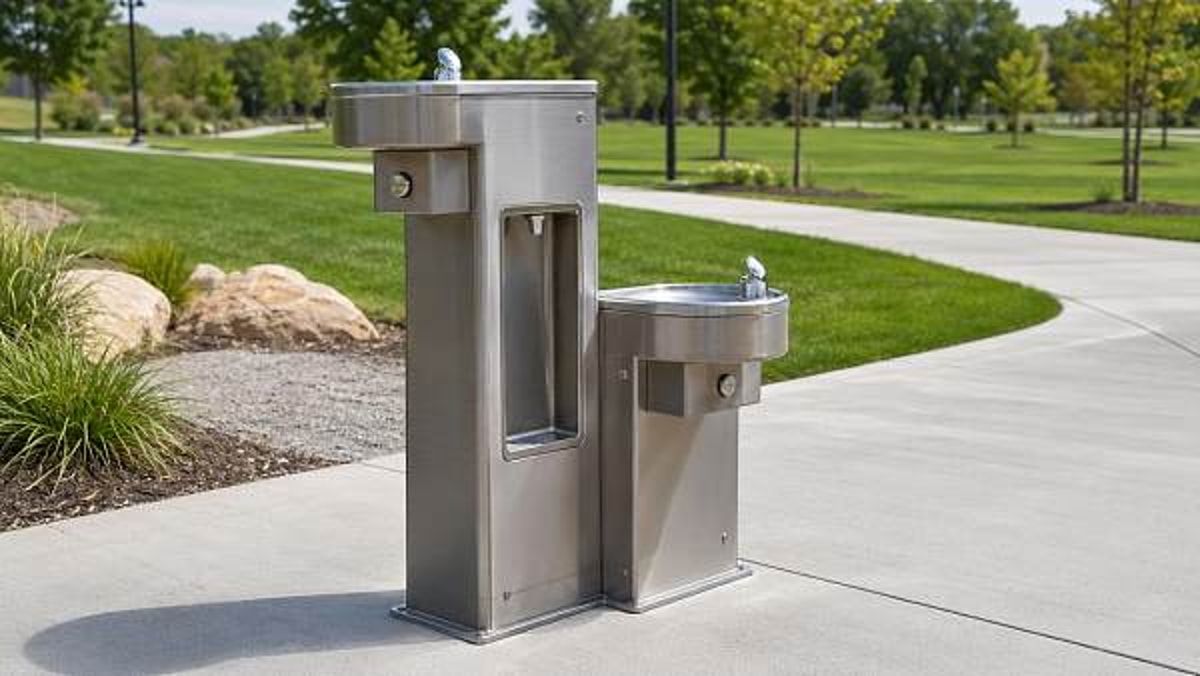
Bottle-filling capability is increasingly requested for campuses, recreation parks, and mixed-use public developments. For many buyers, a combination unit with both bubbler and bottle filler improves usability across different age groups. However, the bottle filler opening should be shielded and easy to wipe down, and the sensor or push activation area should remain functional in rain, dust, and direct sunlight.
Accessibility and User Range
A durable fountain still underperforms if it excludes users. Public installations often need to consider adult, child, and wheelchair access within one layout plan. Dual-height configurations, clear side access, and reachable controls can improve inclusivity without adding excessive complexity. In larger parks, specifying at least 1 accessible fountain point per major activity zone is often a practical planning baseline.
Useful evaluation questions
- Can users activate water with limited hand strength?
- Is the water stream high enough for drinking but low enough to avoid overspray?
- Does the unit support child and adult use without unsafe climbing or awkward reach?
- Can cleaning teams access contact points in under 5 minutes during routine rounds?
Before selecting a product family, buyers often benefit from mapping intended use conditions against technical priorities. The table below can support early-stage specification reviews.
This kind of matrix helps teams avoid overbuying for low-intensity sites or under-specifying for heavy public use. For GCT-oriented sourcing environments, matching the fountain type to the operating profile is often more valuable than chasing the lowest unit price.
Installation, Climate, and Maintenance Factors That Protect ROI
Even the best park drinking fountains will underperform if installation and maintenance planning are weak. In many projects, lifecycle issues begin at the civil and plumbing stage rather than at the product stage. Slope, drainage, water pressure variation, slab quality, and service access all influence durability once the unit is live.
Plan for Local Climate From Day One
Outdoor fountains in freeze-prone climates need a clear strategy: seasonal shutdown, self-draining design, or freeze-resistant valve systems. Ignoring this can lead to cracked fittings, split supply lines, and commissioning delays the following season. In locations with winter lows below 0°C, the fountain specification should be reviewed together with local plumbing practice before purchase approval.
Hot climates create different issues. In prolonged summer exposure above 30°C, surface temperatures can rise quickly, and some finishes degrade faster under UV stress. Buyers may want to consider shaded placement, more heat-stable materials, or periodic inspection intervals every 30 to 60 days during peak season.
Maintenance Access Should Be Fast and Predictable
A maintenance-friendly unit can save significant labor over time. Access panels should open with controlled security hardware, internal components should be reachable without full disassembly, and replacement parts should be standardized where possible. If a simple diaphragm, cartridge, or bubbler replacement takes 2 technicians instead of 1, annual service cost rises quickly across a multi-site portfolio.
Recommended maintenance framework
- Visual inspection: every 1 to 2 weeks in peak season
- Cleaning and drain check: weekly in high-use parks
- Functional flow test: monthly
- Fastener and panel review: every 3 months
- Seasonal shutdown or restart checklist: 2 times per year where climate requires it
These intervals vary by location, but buyers should request a maintenance guide before finalizing an order. Reliable suppliers can usually clarify spare part availability, expected wear items, and typical lead times for replacements, often in the range of 7 to 21 days depending on customization and region.
Common Buying Mistakes and How to Avoid Them
Many sourcing problems come from a mismatch between product selection and site reality. A fountain chosen from a catalog may look adequate but fail once exposed to skate traffic, sports groups, school dismissal peaks, or limited cleaning support. Park drinking fountains should be specified by risk profile, not by appearance alone.
Mistake 1: Buying on Upfront Price Only
A lower unit cost can be attractive in tenders, but maintenance-heavy products often erase that saving within 12 to 24 months. If a cheaper fountain needs three extra service visits per year, labor, shutdown time, and parts logistics can outweigh the original savings. Buyers should model 3-year cost, not just delivered price.
Mistake 2: Overlooking Site Abuse Patterns
Some locations need stronger anti-vandal measures than others. A park next to a transit stop, public plaza, or unsupervised recreation zone may need thicker housings, concealed supply lines, and more robust control protection. Without those features, even well-made park drinking fountains can suffer early damage.
Mistake 3: Ignoring Serviceability in Multi-Site Operations
For municipalities, campus estates, and leisure operators managing 10, 20, or more outdoor points, standardization matters. If each site uses a different part set or access method, technician training, spare inventory, and repair response all become harder to control. Consolidating around fewer fountain platforms can improve uptime and procurement efficiency.
A practical pre-purchase checklist
- Define expected daily usage volume and peak periods.
- Confirm climate exposure, including freeze risk and UV intensity.
- Review accessibility and age-range requirements.
- Check material, fastener, and drainage design details.
- Ask for maintenance guidance and spare part lead times.
- Compare 3-year operating cost, not unit cost alone.
For information-stage buyers, these six steps create a more reliable framework than broad product claims. They also improve communication between procurement teams, designers, maintenance managers, and sourcing partners during specification review.
How Commercial Buyers Can Source More Confidently
In today’s commercial sourcing environment, selecting park drinking fountains is part of a wider public experience strategy. The right product should align with user comfort, facility image, operating budget, and maintenance capacity. For hospitality-adjacent developments, educational campuses, amusement and leisure parks, and civic outdoor projects, a strong fountain specification supports both utility and brand perception.
The best-performing solutions usually combine durable construction, low-maintenance drainage, protected controls, and fit-for-site installation planning. Buyers who evaluate materials, climate suitability, service access, and user range from the start are more likely to secure reliable long-term value instead of recurring repair issues.
If you are comparing park drinking fountains for a new development, upgrade program, or multi-site sourcing plan, Global Commercial Trade can help you assess commercial-fit options, procurement considerations, and supplier alignment. Contact us to get a tailored sourcing perspective, request product detail support, or explore more solutions for durable public-space amenities.
Search News
Hot Articles
- Musical InstrumentsChina Table Tennis Team Departs for London; BS EN 14904:2021 Takes EffectMay 01, 2026
- Outdoor RidesSanya Asian Beach Games Closure Triggers Halal Certification Demand for Sand Sports EquipmentMay 01, 2026
- Outdoor RidesAI Football Training Robots Export Surge After Man Utd MatchMay 01, 2026
Popular Tags
Need ExpertConsultation?
Connect with our specialized leisureengineering team for procurementstrategies.
Recommended News
 May 01, 2026Park Trash Cans That Cut Maintenance Instead of Adding ItPark trash cans that reduce labor, resist weather, and stay cleaner longer. Learn which designs, materials, and features help lower maintenance costs across parks and outdoor spaces.● Institutional Buyer
 May 01, 2026Park Drinking Fountains That Hold Up Better in Public SpacesPark drinking fountains built for public spaces need durability, hygiene, and low maintenance. Discover how to choose vandal-resistant models that cut long-term costs.● Institutional Buyer
 May 01, 2026Restaurant POS Systems That Reduce Training Time at the CounterRestaurant POS systems that cut counter training time: compare intuitive workflows, role-based controls, and error-reducing features to speed onboarding and improve service consistency.● Institutional Buyer
 Apr 30, 20262026 Shanghai Smart Campus Expo: VR EdTech Gains ITU & ISO/IEC 23053 Dual CertificationVR EdTech gains ITU & ISO/IEC 23053 dual certification at 2026 Shanghai Smart Campus Expo—key for global smart PE tenders in UAE, Thailand & ASEAN.● Institutional Buyer
 Apr 29, 20262026 Shanghai Smart Campus Expo: VR EdTech Gains ITU & ISO/IEC Dual CertVR EdTech gains ITU & ISO/IEC dual cert at 2026 Shanghai Smart Campus Expo—key for exporters, integrators & compliance providers.● Institutional Buyer
 Apr 28, 20262026 Shanghai Smart Campus Expo: VR Teaching Devices Gain ITU & ISO/IEC 23053 CertificationVR teaching devices certified to ITU & ISO/IEC 23053 at 2026 Shanghai Smart Campus Expo—unlock EU tenders, interoperability, and global edtech growth.● Institutional Buyer
 Apr 27, 20262026 Shanghai Smart Campus Expo: VR EdTech Gains ITU & ISO/IEC Dual CertificationVR EdTech gains ITU & ISO/IEC dual certification at 2026 Shanghai Smart Campus Expo—key for global edtech exporters, integrators, and compliance teams.● Institutional Buyer
 Apr 26, 20262026 Shanghai Smart Campus Expo: VR EdTech Devices Gain ITU & ISO/IEC 23053 CertificationVR EdTech devices certified to ITU & ISO/IEC 23053 at 2026 Shanghai Smart Campus Expo — key for GCC & SEA education exporters, integrators, and compliance teams.● Institutional Buyer
 Apr 25, 20262026 Shanghai Smart Campus Expo: VR EdTech Gains ITU & ISO/IEC 23053 Dual CertificationVR EdTech gains ITU & ISO/IEC 23053 dual certification at 2026 Shanghai Smart Campus Expo—key for EU/UAE edtech tenders. Act now.● Institutional Buyer
 Apr 24, 20262026 Shanghai Smart Campus Expo: VR EdTech Gains ITU & ISO/IEC 23053 Dual CertificationVR EdTech gains ITU & ISO/IEC 23053 dual certification at 2026 Shanghai Smart Campus Expo—key for global edtech tenders. Discover impact & compliance insights.● Institutional Buyer
 Apr 23, 20262026 Shanghai Smart Campus Expo: VR EdTech Gains ITU & ISO/IEC Dual CertificationVR EdTech gains ITU & ISO/IEC dual certification at 2026 Shanghai Smart Campus Expo — a must-see milestone for global edtech exporters, LMS integrators, and STEM hardware providers.● Institutional Buyer
 Apr 22, 20262026 Shanghai Smart Campus Expo: VR EdTech Gains ITU & ISO/IEC Dual CertificationVR EdTech gains ITU & ISO/IEC dual certification at 2026 Shanghai Smart Campus Expo—unlock B2G opportunities in UAE, Chile & Indonesia now.● Institutional Buyer
 Apr 21, 2026FSAE China 2026: Domestic Timing System Gains ITU CertificationFSAE China 2026: Domestic timing system wins ITU certification — first education-level motorsport solution compliant with ITU-T G.9972. Discover implications for timing tech, AI integration & standards adoption.● Institutional Buyer
 Apr 21, 20262026 Shanghai Smart Campus Expo: VR EdTech Gains ITU & ISO/IEC 23053 Dual CertificationVR EdTech gains ITU & ISO/IEC 23053 dual certification at 2026 Shanghai Smart Campus Expo—key for exporters, integrators & procurement pros.● Institutional Buyer
 Apr 20, 20262026 Shanghai Smart Campus Expo: VR EdTech Gains ITU & ISO/IEC Dual CertificationVR EdTech gains ITU & ISO/IEC dual certification at 2026 Shanghai Smart Campus Expo—key for global edtech exporters, procurement agencies & VR integrators.● Institutional Buyer
 Apr 19, 20262026 Shanghai Smart Campus Expo: VR EdTech Gains ITU & ISO/IEC Dual CertificationVR EdTech hits a milestone: 2026 Shanghai Smart Campus Expo unveils ITU & ISO/IEC dual-certified haptic teaching devices—game-changing for global edtech exporters, OEMs, and procurement agencies.● Institutional Buyer
 Apr 18, 20262026 Shanghai Smart Campus Expo: VR Teaching Devices Gain ITU & ISO/IEC Dual CertificationVR teaching devices gain ITU & ISO/IEC dual certification at 2026 Shanghai Smart Campus Expo — a must-have for edtech exporters targeting Saudi, Mexico & Poland.● Institutional Buyer
 Apr 17, 20262026 Shanghai Smart Campus Expo: VR Teaching Devices Gain ITU & ISO/IEC Dual CertificationVR teaching devices with ITU & ISO/IEC dual certification headline the 2026 Shanghai Smart Campus Expo—unlock global edtech tenders now.● Institutional Buyer
 Apr 16, 20262026 Shanghai Smart Campus Expo Highlights VR EdTech ExportVR EdTech Export takes center stage at 2026 Shanghai Smart Campus Expo — discover VR learning rides, AR sand tables & global procurement opportunities.● Institutional Buyer
 Apr 17, 2026Smart campus tech integrations that break when you add new educational suppliesDiscover why commercial furniture, sensory playgrounds & educational supplies break smart campus tech—and how to ensure playground safety, interoperability & future-proof amusement equipment.● Institutional Buyer
 Apr 15, 2026Smart campus tech integrations that break when firmware updates dropDiscover firmware-resilient commercial furniture, sensory playgrounds, amusement equipment & hotel tables—engineered to stay safe, synced, and operational post-update.● Institutional Buyer
 Apr 15, 2026Educational supplies that teachers quietly replace after one semesterDiscover high-wear educational supplies, sensory playgrounds, playground climbers & commercial furniture—strategically replaced by teachers. Optimize procurement with GCT’s wear analytics and compliance insights.● Institutional Buyer
 Apr 13, 20262026 China International Education Tour: AI and Green Training Equipment in SpotlightExplore AI education platforms & green training equipment at 2026 China International Education Tour. 242 global exhibitors showcase ISO-certified VR tools & low-carbon solutions for international buyers.● Institutional Buyer
 Apr 11, 20262026 China Intl Education Expo: AI & Green Tech in SpotlightExplore AI & green tech trends at 2026 China Intl Education Expo: 242 global institutions showcase smart classrooms & sustainable training solutions. Discover export opportunities for EdTech and eco-friendly equipment.● Institutional Buyer