Park Trash Cans That Cut Maintenance Instead of Adding It
Choosing the right park trash cans should reduce maintenance, not create more work. For planners, facility managers, and sourcing teams comparing outdoor waste solutions, the best options combine durability, easy servicing, weather resistance, and user-friendly design. This guide explores what makes park trash cans more efficient to manage while supporting cleaner public spaces and lower long-term operating costs.
Why do some park trash cans lower maintenance while others create constant work?
Not all park trash cans are built around the same operational reality. Some are designed mainly for basic waste collection, while others are engineered to reduce labor hours, limit mess, resist damage, and simplify servicing. For information researchers and commercial sourcing teams, this difference matters because a lower unit price can easily lead to higher lifetime cost.
Maintenance-heavy models usually fail in predictable ways: liners are awkward to remove, openings encourage overflow, finishes degrade in sun or rain, and lightweight bodies shift, tip, or vandalize easily. Once that happens, staff must spend more time emptying, cleaning surrounding areas, replacing parts, and responding to complaints from visitors.
By contrast, maintenance-efficient park trash cans support daily operations. They are easier to empty, better at containing waste, and more durable in changing weather. They also fit the actual traffic pattern of public spaces such as parks, trails, leisure venues, campuses, hotel gardens, and mixed-use outdoor commercial areas. In practice, the question is not only “Will this hold trash?” but “Will this reduce labor, extend service life, and keep the site looking clean with less intervention?”
What design features make park trash cans easier to service every day?
The most efficient park trash cans are designed around maintenance workflow. Facility teams should look at what happens during every emptying cycle, because small design details have a major effect on labor time across months or years.
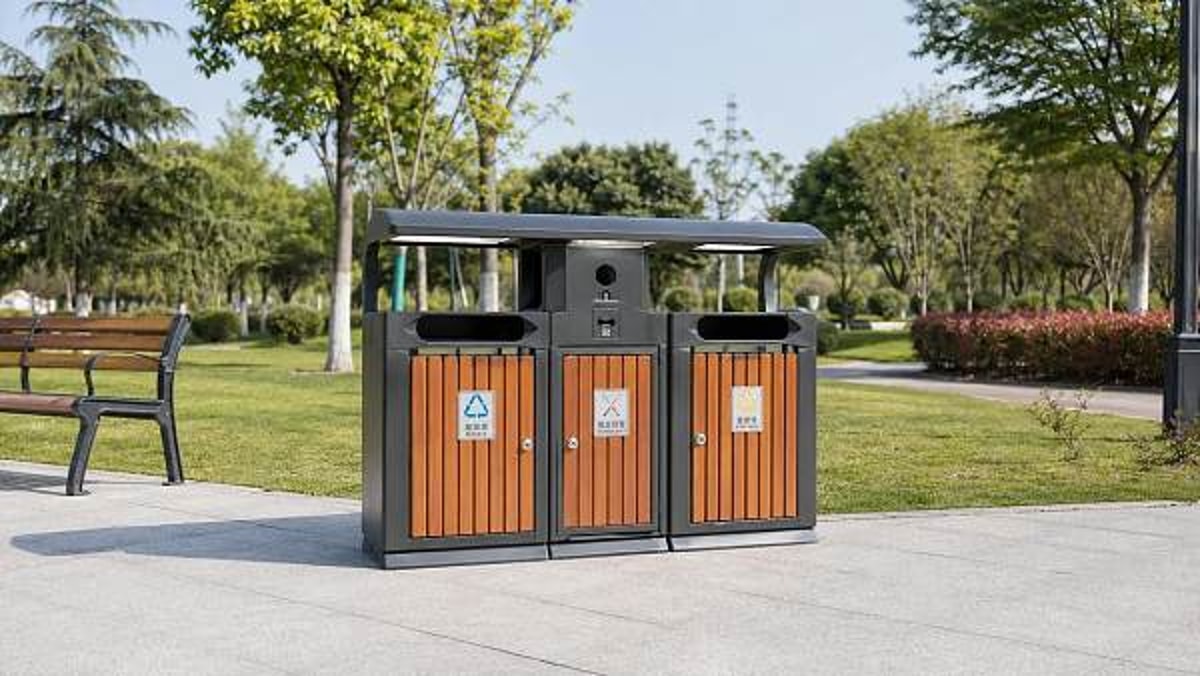
First, liner access is critical. Side-door or front-door access often reduces strain compared with top-lift systems that require awkward lifting. A rigid liner with handles is usually easier to manage than thin insert systems that collapse or stick. If a maintenance worker has to fight the bin every time it is serviced, operating cost rises immediately.
Second, the opening shape matters. Wide, well-positioned openings help users dispose of waste correctly, while restrictive or poorly angled openings increase litter around the container. Some park trash cans include covered tops, rain hoods, or partially enclosed apertures that reduce water entry and discourage oversized dumping. That keeps bags lighter, reduces odor, and prevents soaked trash from becoming difficult to remove.
Third, bag retention and liner stability should not be overlooked. A secure bag ring or clamp prevents slippage. Without it, bags fall inward, trash spills between liner and shell, and staff lose time cleaning residue. Smooth interior surfaces also help because sharp edges or exposed hardware can tear liners.
Finally, smart placement support can improve service efficiency. Units that are easy to anchor, move when necessary, and align with path networks simplify collection routes. When park trash cans are selected with service logic in mind, they become part of an efficient waste management system rather than isolated pieces of site furniture.
Which materials hold up best outdoors without increasing cleaning and replacement costs?
Material choice has a direct impact on maintenance. Outdoor waste containers face moisture, UV exposure, temperature swings, impact, and public misuse. The best park trash cans use materials that match the local environment and the expected level of traffic.
Powder-coated steel is a common choice for high-traffic public areas because it offers strength and a clean commercial appearance. However, coating quality matters. Poor finishes chip, rust, and fade quickly, especially in wet or coastal climates. Stainless steel performs well in corrosion-sensitive environments, but it may show fingerprints and surface marks more easily in some settings.
Recycled plastic and heavy-duty polyethylene can also be effective for park trash cans, especially where moisture resistance and low surface maintenance are priorities. These materials do not rust and can be easier to wash down, though structural quality varies by manufacturer. In premium public spaces, combinations of metal frames and composite slats can balance durability with visual design.
Wood-look finishes may suit landscape design, but buyers should verify whether they are true low-maintenance composites or natural materials that require refinishing. Attractive appearance is important, especially in hospitality, leisure, and placemaking projects, yet maintenance teams benefit most when aesthetics do not depend on constant upkeep.
The key question is not simply which material looks best on installation day. It is which material keeps its structure, finish, and ease of cleaning after years of public use.
How should buyers compare park trash cans for different outdoor settings?
The right specification depends on the environment. Park trash cans for a quiet botanical garden should not be judged the same way as units for an amusement park pathway, an urban recreation zone, or a school campus. Sourcing teams should compare containers according to traffic volume, contamination risk, climate exposure, and visual expectations.
In high-footfall areas, capacity and emptying speed often matter most. Larger containers can reduce collection frequency, but only if liners remain manageable and waste does not compact excessively. In scenic or design-led spaces, appearance may be more important, but that should not come at the cost of difficult maintenance. In areas exposed to rain, wind, or wildlife, covered and anchored models become more valuable.
For global commercial buyers, this type of comparison is especially useful because procurement decisions often affect multiple sites. Standardizing park trash cans across a portfolio can streamline spare parts, staff training, and replacement planning, but only if the chosen model fits the most demanding operating conditions.
What are the most common mistakes when choosing park trash cans?
One of the biggest mistakes is buying by appearance alone. Attractive park trash cans may support placemaking, but if they are difficult to empty or clean, maintenance teams pay the price. Another common error is underestimating climate impact. A bin that performs well in a mild environment may deteriorate quickly in coastal, humid, or freeze-thaw conditions.
Buyers also often misjudge capacity. Too small, and overflow becomes routine. Too large, and liners become too heavy for safe handling. The right balance depends on foot traffic, collection frequency, and waste type. In family leisure areas, food packaging and drink containers can fill units faster than expected, while landscaped park zones may generate more light litter and organics.
Another mistake is ignoring vandal resistance and anchoring. In unsecured public areas, lightweight or poorly fixed containers may shift, tip, or be damaged. Maintenance then expands beyond waste collection into repair and repositioning. Similarly, replacement parts availability is often overlooked. If lids, liners, locks, or panels cannot be sourced easily, a minor failure can make a whole unit unusable.
Finally, some organizations choose park trash cans without consulting the people who will service them. Facilities staff can quickly identify design flaws that are invisible on a product sheet. Their feedback is often the most practical source of lifecycle value.
How can teams judge total cost instead of just purchase price?
A low upfront price does not mean low cost. To evaluate park trash cans properly, buyers should estimate total cost of ownership. That includes installation, liner replacement, collection labor, cleaning time, finish durability, repairs, and expected service life. In many cases, labor and maintenance outweigh initial purchase cost over time.
Start with servicing frequency. If one model reduces collection rounds because it has better capacity or placement efficiency, that creates recurring savings. Then look at cleaning burden. Containers that allow rainwater in, trap residue, or stain easily consume more staff time. Next, assess replacement cycles. A unit that lasts eight to ten years may be more economical than a cheaper alternative that needs early replacement or frequent part changes.
For organizations managing multiple parks, campuses, leisure properties, or public-commercial environments, standardization can also improve cost control. Consistent park trash cans simplify ordering, maintenance procedures, and long-term budgeting. This is particularly relevant in international sourcing, where product consistency, compliance, and supply reliability are part of commercial value, not just product value.
What questions should you ask suppliers before shortlisting park trash cans?
Before moving toward specification or procurement, buyers should ask focused questions that reveal whether the product truly supports low-maintenance operation. Useful questions include: What material and coating system is used? How does the liner remove during service? Is the unit tested for corrosion, UV resistance, or impact? Are spare liners and replacement parts stocked? Can the design be anchored securely? What bag sizes fit correctly? Is the opening designed for general waste, recycling, or both?
It is also worth asking for real project references in similar environments. Park trash cans installed in public gardens, resorts, attractions, municipal spaces, or school grounds can offer practical evidence of performance. Photos after several years of use are often more revealing than launch images.
For sourcing teams working through global trade channels, supplier reliability matters as much as product design. Lead times, customization capability, packaging standards, and consistency across production batches all affect implementation success. A well-designed bin loses value if delivery, parts support, or quality stability is weak.
Quick FAQ: what should decision-makers remember most?
The best park trash cans are not simply containers that look appropriate outdoors. They are operational tools that help keep public and commercial spaces clean with less labor, fewer repairs, and stronger long-term value. For information researchers, planners, and procurement teams, the smartest evaluation approach is to focus on daily servicing, weather performance, material quality, site fit, and supplier reliability together.
If you need to confirm a practical direction before sourcing, start by discussing service frequency, local climate, waste volume, anchoring needs, spare parts support, finish requirements, and whether the park trash cans must align with broader design standards across multiple sites. Those questions will usually clarify the right product path faster than comparing price alone.
Search News
Hot Articles
- Musical InstrumentsChina Table Tennis Team Departs for London; BS EN 14904:2021 Takes EffectMay 01, 2026
- Outdoor RidesSanya Asian Beach Games Closure Triggers Halal Certification Demand for Sand Sports EquipmentMay 01, 2026
- Outdoor RidesAI Football Training Robots Export Surge After Man Utd MatchMay 01, 2026
Popular Tags
Need ExpertConsultation?
Connect with our specialized leisureengineering team for procurementstrategies.
Recommended News
 May 01, 2026Park Trash Cans That Cut Maintenance Instead of Adding ItPark trash cans that reduce labor, resist weather, and stay cleaner longer. Learn which designs, materials, and features help lower maintenance costs across parks and outdoor spaces.● Institutional Buyer
 May 01, 2026Park Drinking Fountains That Hold Up Better in Public SpacesPark drinking fountains built for public spaces need durability, hygiene, and low maintenance. Discover how to choose vandal-resistant models that cut long-term costs.● Institutional Buyer
 May 01, 2026Restaurant POS Systems That Reduce Training Time at the CounterRestaurant POS systems that cut counter training time: compare intuitive workflows, role-based controls, and error-reducing features to speed onboarding and improve service consistency.● Institutional Buyer
 Apr 30, 20262026 Shanghai Smart Campus Expo: VR EdTech Gains ITU & ISO/IEC 23053 Dual CertificationVR EdTech gains ITU & ISO/IEC 23053 dual certification at 2026 Shanghai Smart Campus Expo—key for global smart PE tenders in UAE, Thailand & ASEAN.● Institutional Buyer
 Apr 29, 20262026 Shanghai Smart Campus Expo: VR EdTech Gains ITU & ISO/IEC Dual CertVR EdTech gains ITU & ISO/IEC dual cert at 2026 Shanghai Smart Campus Expo—key for exporters, integrators & compliance providers.● Institutional Buyer
 Apr 28, 20262026 Shanghai Smart Campus Expo: VR Teaching Devices Gain ITU & ISO/IEC 23053 CertificationVR teaching devices certified to ITU & ISO/IEC 23053 at 2026 Shanghai Smart Campus Expo—unlock EU tenders, interoperability, and global edtech growth.● Institutional Buyer
 Apr 27, 20262026 Shanghai Smart Campus Expo: VR EdTech Gains ITU & ISO/IEC Dual CertificationVR EdTech gains ITU & ISO/IEC dual certification at 2026 Shanghai Smart Campus Expo—key for global edtech exporters, integrators, and compliance teams.● Institutional Buyer
 Apr 26, 20262026 Shanghai Smart Campus Expo: VR EdTech Devices Gain ITU & ISO/IEC 23053 CertificationVR EdTech devices certified to ITU & ISO/IEC 23053 at 2026 Shanghai Smart Campus Expo — key for GCC & SEA education exporters, integrators, and compliance teams.● Institutional Buyer
 Apr 25, 20262026 Shanghai Smart Campus Expo: VR EdTech Gains ITU & ISO/IEC 23053 Dual CertificationVR EdTech gains ITU & ISO/IEC 23053 dual certification at 2026 Shanghai Smart Campus Expo—key for EU/UAE edtech tenders. Act now.● Institutional Buyer
 Apr 24, 20262026 Shanghai Smart Campus Expo: VR EdTech Gains ITU & ISO/IEC 23053 Dual CertificationVR EdTech gains ITU & ISO/IEC 23053 dual certification at 2026 Shanghai Smart Campus Expo—key for global edtech tenders. Discover impact & compliance insights.● Institutional Buyer
 Apr 23, 20262026 Shanghai Smart Campus Expo: VR EdTech Gains ITU & ISO/IEC Dual CertificationVR EdTech gains ITU & ISO/IEC dual certification at 2026 Shanghai Smart Campus Expo — a must-see milestone for global edtech exporters, LMS integrators, and STEM hardware providers.● Institutional Buyer
 Apr 22, 20262026 Shanghai Smart Campus Expo: VR EdTech Gains ITU & ISO/IEC Dual CertificationVR EdTech gains ITU & ISO/IEC dual certification at 2026 Shanghai Smart Campus Expo—unlock B2G opportunities in UAE, Chile & Indonesia now.● Institutional Buyer
 Apr 21, 2026FSAE China 2026: Domestic Timing System Gains ITU CertificationFSAE China 2026: Domestic timing system wins ITU certification — first education-level motorsport solution compliant with ITU-T G.9972. Discover implications for timing tech, AI integration & standards adoption.● Institutional Buyer
 Apr 21, 20262026 Shanghai Smart Campus Expo: VR EdTech Gains ITU & ISO/IEC 23053 Dual CertificationVR EdTech gains ITU & ISO/IEC 23053 dual certification at 2026 Shanghai Smart Campus Expo—key for exporters, integrators & procurement pros.● Institutional Buyer
 Apr 20, 20262026 Shanghai Smart Campus Expo: VR EdTech Gains ITU & ISO/IEC Dual CertificationVR EdTech gains ITU & ISO/IEC dual certification at 2026 Shanghai Smart Campus Expo—key for global edtech exporters, procurement agencies & VR integrators.● Institutional Buyer
 Apr 19, 20262026 Shanghai Smart Campus Expo: VR EdTech Gains ITU & ISO/IEC Dual CertificationVR EdTech hits a milestone: 2026 Shanghai Smart Campus Expo unveils ITU & ISO/IEC dual-certified haptic teaching devices—game-changing for global edtech exporters, OEMs, and procurement agencies.● Institutional Buyer
 Apr 18, 20262026 Shanghai Smart Campus Expo: VR Teaching Devices Gain ITU & ISO/IEC Dual CertificationVR teaching devices gain ITU & ISO/IEC dual certification at 2026 Shanghai Smart Campus Expo — a must-have for edtech exporters targeting Saudi, Mexico & Poland.● Institutional Buyer
 Apr 17, 20262026 Shanghai Smart Campus Expo: VR Teaching Devices Gain ITU & ISO/IEC Dual CertificationVR teaching devices with ITU & ISO/IEC dual certification headline the 2026 Shanghai Smart Campus Expo—unlock global edtech tenders now.● Institutional Buyer
 Apr 16, 20262026 Shanghai Smart Campus Expo Highlights VR EdTech ExportVR EdTech Export takes center stage at 2026 Shanghai Smart Campus Expo — discover VR learning rides, AR sand tables & global procurement opportunities.● Institutional Buyer
 Apr 17, 2026Smart campus tech integrations that break when you add new educational suppliesDiscover why commercial furniture, sensory playgrounds & educational supplies break smart campus tech—and how to ensure playground safety, interoperability & future-proof amusement equipment.● Institutional Buyer
 Apr 15, 2026Smart campus tech integrations that break when firmware updates dropDiscover firmware-resilient commercial furniture, sensory playgrounds, amusement equipment & hotel tables—engineered to stay safe, synced, and operational post-update.● Institutional Buyer
 Apr 15, 2026Educational supplies that teachers quietly replace after one semesterDiscover high-wear educational supplies, sensory playgrounds, playground climbers & commercial furniture—strategically replaced by teachers. Optimize procurement with GCT’s wear analytics and compliance insights.● Institutional Buyer
 Apr 13, 20262026 China International Education Tour: AI and Green Training Equipment in SpotlightExplore AI education platforms & green training equipment at 2026 China International Education Tour. 242 global exhibitors showcase ISO-certified VR tools & low-carbon solutions for international buyers.● Institutional Buyer
 Apr 11, 20262026 China Intl Education Expo: AI & Green Tech in SpotlightExplore AI & green tech trends at 2026 China Intl Education Expo: 242 global institutions showcase smart classrooms & sustainable training solutions. Discover export opportunities for EdTech and eco-friendly equipment.● Institutional Buyer