What to check before ordering wholesale projector screens
Before ordering wholesale projector screens, procurement teams need to look beyond size and price. Screen material, gain, aspect ratio, installation method, durability, and supplier consistency all directly affect project performance and long-term value. This guide outlines the key checks buyers should make to reduce sourcing risk, meet commercial requirements, and secure reliable wholesale projector screens for professional applications.
Understanding what wholesale projector screens really involve
For many buyers, wholesale projector screens appear to be a straightforward category: a surface, a frame, and a quoted price. In commercial sourcing, however, the product is more complex. Projector screens are performance components that influence image brightness, color accuracy, contrast perception, viewing angle, and the final user experience in meeting rooms, classrooms, hotels, houses of worship, entertainment venues, and training facilities.
A wholesale order also carries a different risk profile from a single retail purchase. Procurement teams often need volume consistency, stable lead times, installation compatibility, and compliance documentation across multiple sites or repeated projects. That is why wholesale projector screens should be evaluated as part of a broader commercial solution rather than as an isolated commodity item.
In the current B2B market, especially for buyers serving hospitality, education, and commercial interiors, the demand is shifting toward solutions that combine reliable visual performance with installation efficiency and lifecycle value. This makes pre-order checks essential, particularly when sourcing across borders or through OEM and ODM suppliers.
Why the market pays close attention to projector screen specifications
The projector itself often receives the most attention in AV projects, yet the screen can determine whether that projector performs as intended. A high-lumen projector paired with the wrong screen fabric may still produce glare, hotspotting, weak black levels, or poor off-axis visibility. For procurement professionals, this means the screen is not a minor accessory. It is a specification-sensitive component that affects project success, user satisfaction, and maintenance costs.
Commercial buyers are also under pressure to source products that fit modern space design. A boardroom may require a recessed motorized screen; a school may need durable manual pull-down units; a premium hotel may prefer fixed frame screens for event rooms; and a simulator or themed venue may require custom formats. As a result, wholesale projector screens must be checked against technical, architectural, and operational requirements at the same time.
Core checks before placing an order
1. Screen material and surface performance
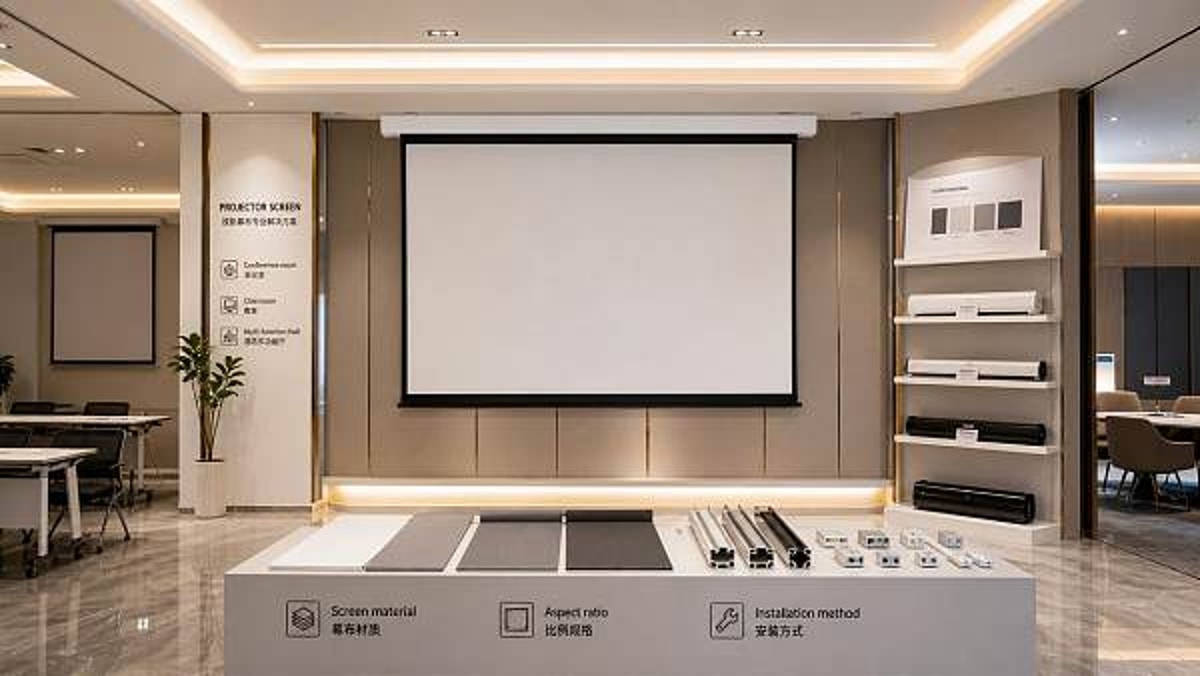
Start with the screen surface. Matte white remains the most common option because it offers balanced color reproduction and wide viewing angles in controlled environments. Gray screens can help improve perceived contrast in rooms with more ambient light. ALR, or ambient light rejecting materials, may suit premium commercial environments but usually require stricter projector placement and a higher budget.
Ask suppliers for material data, gain rating, viewing angle, surface texture details, flame-retardant status, and cleaning guidance. If possible, request physical swatches or sample units. For wholesale projector screens, consistency across production batches is critical. Even small differences in texture or coating can become obvious when multiple screens are installed in one project.
2. Gain, viewing angle, and room conditions
Gain should never be selected in isolation. A higher-gain screen can increase on-axis brightness, but it may reduce viewing angle and create hotspotting. In training centers, classrooms, and conference spaces where people sit across a wide area, broad viewing angles usually matter more than peak brightness. In darker presentation rooms with fixed seating, other gain profiles may be acceptable.
Procurement teams should review room lighting, projector throw distance, projector brightness, seating distribution, and wall color before approving wholesale projector screens. A screen that works well in one environment may perform poorly in another, even within the same building.
3. Aspect ratio and image format compatibility
Many purchasing issues arise because buyers focus on diagonal size instead of active viewing area and aspect ratio. Standard options include 1:1, 4:3, 16:9, and 16:10. Education and corporate projects often use 16:10 or 16:9 to match current projectors and presentation content, while legacy systems may still require 4:3. Event, cinema, and simulation environments may require custom ratios.
Before ordering, confirm the native resolution and intended content format of the projector system. This prevents unused screen area, distorted images, and client dissatisfaction after installation.
4. Installation method and space constraints
Wholesale projector screens are available in fixed frame, manual pull-down, tripod, floor rising, electric motorized, tab-tensioned, and recessed ceiling types. The right choice depends on architectural conditions, usage frequency, and the visual expectations of the end user.
Check mounting points, ceiling depth, wall load capacity, housing dimensions, cable routing, control interfaces, and access for service. In hospitality and institutional projects, installation complications can cost more than the product difference between two screen models. Buyers should request shop drawings, installation manuals, and dimensional tolerances before confirming the order.
5. Durability, flatness, and long-term maintenance
For commercial applications, durability is not optional. The screen should maintain flatness, resist edge curl, and withstand repeated operation. Motorized units should be checked for motor cycle life, noise level, retraction stability, and control reliability. Frame screens should be reviewed for tensioning design and structural rigidity.
Ask how the surface reacts to humidity, dust, and frequent cleaning. In hotels, education facilities, and public venues, these conditions affect replacement cycles. Wholesale projector screens with a lower initial price may become more expensive if maintenance issues appear within one or two years.
Commercial application overview
Different sectors prioritize different performance criteria. A practical classification table helps procurement teams align technical choices with business use cases.
Supplier evaluation beyond the product sheet
Even accurate screen specifications do not guarantee a smooth wholesale project. Buyers should evaluate the supplier’s manufacturing discipline and commercial reliability. This is especially important when ordering wholesale projector screens for multiple installations or tender-based projects.
Check whether the supplier can provide consistent batch production, quality inspection records, packaging standards, spare part support, and after-sales response. For motorized models, ask about motor brand, testing procedures, and warranty terms. For custom projects, verify drawing approval workflow, sample lead time, and tolerance management. If a supplier cannot answer these points clearly, pricing alone should not justify selection.
It is also wise to confirm export experience, documentation readiness, and compliance familiarity. Depending on the destination market, buyers may need information related to fire safety, electrical safety, environmental materials, or public-space installation standards. Well-prepared suppliers reduce compliance delays and project risk.
Questions procurement teams should ask before approval
A disciplined pre-order review helps turn technical data into a purchase decision. The following questions are useful when evaluating wholesale projector screens:
- Is the screen material suitable for the room’s ambient light and seating layout?
- Does the aspect ratio match the projector and primary content format?
- Will the screen size fit the room and maintain comfortable viewing distances?
- Does the installation method align with architectural and maintenance constraints?
- Can the supplier prove batch consistency and provide samples or test reports?
- What warranty, spare parts, and after-sales support are available for commercial use?
- Are packaging and shipping methods strong enough to protect large-format screens?
Common sourcing mistakes to avoid
One common mistake is choosing wholesale projector screens based only on the lowest quote. This often overlooks differences in material grade, motor quality, casing finish, and flatness performance. Another mistake is copying one specification across all projects without checking room conditions. Standardization is useful, but only when the actual environments are similar.
Procurement teams also sometimes underestimate logistics. Large screens are vulnerable to shipping damage, particularly in international trade. Confirm carton design, corner protection, moisture resistance, and loading method. Finally, avoid vague approvals such as “same as sample” without linking the sample to final production specifications. Clear documentation protects both buyer and supplier.
Practical guidance for better commercial outcomes
The most effective approach is to treat wholesale projector screens as part of a system decision. Coordinate the screen specification with the projector, room design, control method, and end-user expectations. Where possible, involve AV consultants, installers, or facility teams before final approval. Their input can identify issues that are not visible in a quotation sheet.
For repeat procurement, build an internal specification checklist covering material type, gain range, aspect ratio, mounting details, warranty terms, and packaging requirements. This improves consistency across tenders and reduces approval time. It also creates a stronger basis for supplier comparison, especially in cross-border sourcing programs.
Final takeaway
Ordering wholesale projector screens successfully requires more than selecting a size and negotiating price. Buyers need to understand screen material behavior, gain and viewing angle trade-offs, aspect ratio fit, installation realities, durability expectations, and supplier reliability. When these checks are completed early, procurement teams can reduce sourcing risk, protect project quality, and improve long-term value across commercial applications.
For organizations managing hospitality, education, office, or specialty venue projects, a structured evaluation process is the most dependable path to better wholesale projector screens. Well-documented specifications, verified samples, and capable suppliers will consistently outperform fast but incomplete purchasing decisions.
Search News
Hot Articles
Popular Tags
Need ExpertConsultation?
Connect with our specialized leisureengineering team for procurementstrategies.
Recommended News
 May 05, 2026Physics lab apparatus: where low-cost kits usually fall shortPhysics lab apparatus buying on price alone often leads to poor accuracy, weak durability, and higher lifecycle costs. Learn what low-cost kits miss and how to source safer, better-value solutions.● Institutional Buyer
 May 05, 2026School laboratory equipment: what should be replaced firstSchool laboratory equipment replacement starts with safety-critical assets. Learn what to replace first to improve compliance, reduce downtime, and maximize tight budgets.● Institutional Buyer
 May 05, 2026Thermal receipt printers: hidden upkeep costs before large rolloutThermal receipt printers may look affordable, but hidden upkeep costs can erode rollout budgets. Learn how to reduce downtime, control maintenance, and choose smarter for scale.● Institutional Buyer
 May 05, 2026Human anatomy models that improve hands-on teaching, not storageHuman anatomy models built for hands-on teaching, not storage. Discover durable, classroom-ready options that improve engagement, simplify setup, and support smarter education sourcing.● Institutional Buyer
 May 05, 2026Ceiling mount projector brackets: where installation mistakes happenCeiling mount projector brackets: discover where installation mistakes happen, how to avoid safety and alignment issues, and the checklist that helps teams deliver smoother AV projects.● Institutional Buyer
 May 05, 2026Barcode scanners for library: common issues with older systemsBarcode scanners for library upgrades can solve slow checkouts, read errors, and compatibility issues in older systems. Learn what fails first and how to choose a reliable replacement.● Institutional Buyer
 May 05, 2026What to check before ordering wholesale projector screensWholesale projector screens buyers should check material, gain, aspect ratio, installation, and supplier consistency before ordering. Reduce sourcing risk and choose reliable commercial solutions.● Institutional Buyer
 May 05, 2026Geography globes wholesale: what makes one model classroom-readyGeography globes wholesale buyers: discover what makes a model truly classroom-ready, from durability and readability to safety, compliance, and reliable bulk supply.● Institutional Buyer
 May 05, 2026Microscope slides wholesale: where quality gaps usually show upMicroscope slides wholesale buyers should watch for hidden quality gaps in flatness, edge finishing, cleanliness, and batch consistency—learn how to reduce waste and choose reliable suppliers.● Institutional Buyer
 May 05, 2026POS touch screens: what affects response speed and lifespanPOS touch screens directly impact checkout speed, uptime, and total cost. Learn what affects response speed and lifespan to choose the right solution for every business scenario.● Institutional Buyer
 May 04, 2026Kindergarten Furniture Bulk Orders and the Safety Details MissedKindergarten furniture bulk buyers: discover the hidden safety checks suppliers often miss, from emissions and stability to ergonomics and compliance, before placing large orders.● Institutional Buyer
 May 04, 2026School Desks and Chairs Wholesale: Matching Age to Size CorrectlySchool desks and chairs wholesale guide: learn how to match age to size correctly for better comfort, safety, compliance, and smarter school furniture purchasing.● Institutional Buyer
 May 04, 2026Library Bookshelves Wholesale: How Much Load Is Really Enough?Library bookshelves wholesale guide: learn how much load is truly enough for safety, durability, and compliance. Compare ratings, avoid costly mistakes, and choose the right shelving with confidence.● Institutional Buyer
 May 04, 2026Smart Interactive Whiteboards: Which Features Get Used Daily?Smart interactive whiteboards: discover which features teams and teachers actually use daily, from touch accuracy and wireless casting to easy collaboration, ROI, and smarter buying decisions.● Institutional Buyer
 May 04, 2026Student Chairs With Writing Pad: Which Sizes Fit Best?Student chairs with writing pad: discover which sizes best support comfort, posture, room capacity, and tablet use. Compare fit options for schools, universities, and training spaces.● Institutional Buyer
 May 03, 2026Beijing Women's FC Win Spurs AI Training System Export to UKBeijing Women's FC win sparks UK demand for AI sports training systems — real-time analytics, GDPR/ISO 27001 compliance & Heathrow logistics insights revealed.● Institutional Buyer
 May 01, 2026Park Trash Cans That Cut Maintenance Instead of Adding ItPark trash cans that reduce labor, resist weather, and stay cleaner longer. Learn which designs, materials, and features help lower maintenance costs across parks and outdoor spaces.● Institutional Buyer
 May 01, 2026Park Drinking Fountains That Hold Up Better in Public SpacesPark drinking fountains built for public spaces need durability, hygiene, and low maintenance. Discover how to choose vandal-resistant models that cut long-term costs.● Institutional Buyer
 May 01, 2026Restaurant POS Systems That Reduce Training Time at the CounterRestaurant POS systems that cut counter training time: compare intuitive workflows, role-based controls, and error-reducing features to speed onboarding and improve service consistency.● Institutional Buyer
 Apr 30, 20262026 Shanghai Smart Campus Expo: VR EdTech Gains ITU & ISO/IEC 23053 Dual CertificationVR EdTech gains ITU & ISO/IEC 23053 dual certification at 2026 Shanghai Smart Campus Expo—key for global smart PE tenders in UAE, Thailand & ASEAN.● Institutional Buyer
 Apr 29, 20262026 Shanghai Smart Campus Expo: VR EdTech Gains ITU & ISO/IEC Dual CertVR EdTech gains ITU & ISO/IEC dual cert at 2026 Shanghai Smart Campus Expo—key for exporters, integrators & compliance providers.● Institutional Buyer
 Apr 28, 20262026 Shanghai Smart Campus Expo: VR Teaching Devices Gain ITU & ISO/IEC 23053 CertificationVR teaching devices certified to ITU & ISO/IEC 23053 at 2026 Shanghai Smart Campus Expo—unlock EU tenders, interoperability, and global edtech growth.● Institutional Buyer
 Apr 27, 20262026 Shanghai Smart Campus Expo: VR EdTech Gains ITU & ISO/IEC Dual CertificationVR EdTech gains ITU & ISO/IEC dual certification at 2026 Shanghai Smart Campus Expo—key for global edtech exporters, integrators, and compliance teams.● Institutional Buyer
 Apr 26, 20262026 Shanghai Smart Campus Expo: VR EdTech Devices Gain ITU & ISO/IEC 23053 CertificationVR EdTech devices certified to ITU & ISO/IEC 23053 at 2026 Shanghai Smart Campus Expo — key for GCC & SEA education exporters, integrators, and compliance teams.● Institutional Buyer