Highlighter markers wholesale: why ink consistency matters more
When evaluating highlighter markers wholesale, many buyers focus on price, color range, or packaging first. Yet ink consistency often has the greatest impact on writing smoothness, shelf appeal, classroom performance, and long-term user satisfaction. For research-driven sourcing teams, understanding why stable ink flow matters more can help identify reliable suppliers, reduce product complaints, and support better purchasing decisions.
Why the market is shifting from low unit cost to dependable writing performance
In office and educational supplies, product expectations are changing. Buyers in school systems, commercial distributors, private-label brands, and cross-border wholesalers are no longer comparing highlighter markers wholesale offers on color count alone. They are paying closer attention to consistency across batches, smooth laydown on different paper types, cap-off time, tip durability, and complaint rates after delivery.
This shift reflects a broader sourcing trend seen across commercial categories: stable user experience now matters more because procurement teams are under pressure to reduce returns, protect brand reputation, and improve repeat purchase outcomes. In this environment, ink consistency has become a practical quality signal. If the ink is too watery, too dry, uneven in saturation, or unstable across climates, the product may look acceptable on first inspection but fail in classrooms, offices, and retail channels.
For information researchers studying highlighter markers wholesale options, this means the conversation has moved beyond “How cheap is the marker?” toward “How reliably does it perform after shipping, storage, and repeated use?” That is an important market change, especially for buyers sourcing at scale for institutional or branded distribution.
The strongest trend signal: quality complaints increasingly trace back to ink behavior
Many common product issues in highlighter markers wholesale programs are not caused by packaging design or even color selection. They often come from unstable ink formulation and weak production control. End users may describe the problem in simple terms: the marker skips, bleeds too much, dries out early, starts overly dark and then fades, or performs differently from one pen to another in the same set. Behind those complaints, ink consistency is usually a central factor.
This matters because the procurement impact is wider than one defective item. In wholesale supply, inconsistency can affect merchandising, educational usability, online ratings, retailer confidence, and reorder decisions. A batch that performs unevenly can also create hidden costs in after-sales service, replacement handling, and inventory write-downs.
As a result, more buyers are treating ink flow stability as a frontline evaluation point rather than a secondary technical detail. In practical sourcing terms, that is one of the clearest signs that the market is maturing.
What is driving this change in highlighter markers wholesale demand
Several forces are pushing the market toward stronger interest in ink consistency.
1. Institutional buyers want fewer surprises
Schools, offices, training centers, and distributors often buy in volume and distribute products across many users. They need predictable performance. A marker that works well in a showroom sample but varies in actual shipments creates operational friction. This has made consistency a higher priority in highlighter markers wholesale assessment.
2. Private-label competition is raising the quality floor
Many importers and regional brands are expanding own-brand stationery lines. They compete not only on price, but also on user reviews and repeat orders. Ink consistency directly affects both. A private-label program with uneven writing quality can damage brand trust quickly, especially in e-commerce and modern retail environments.
3. Application scenarios are becoming more demanding
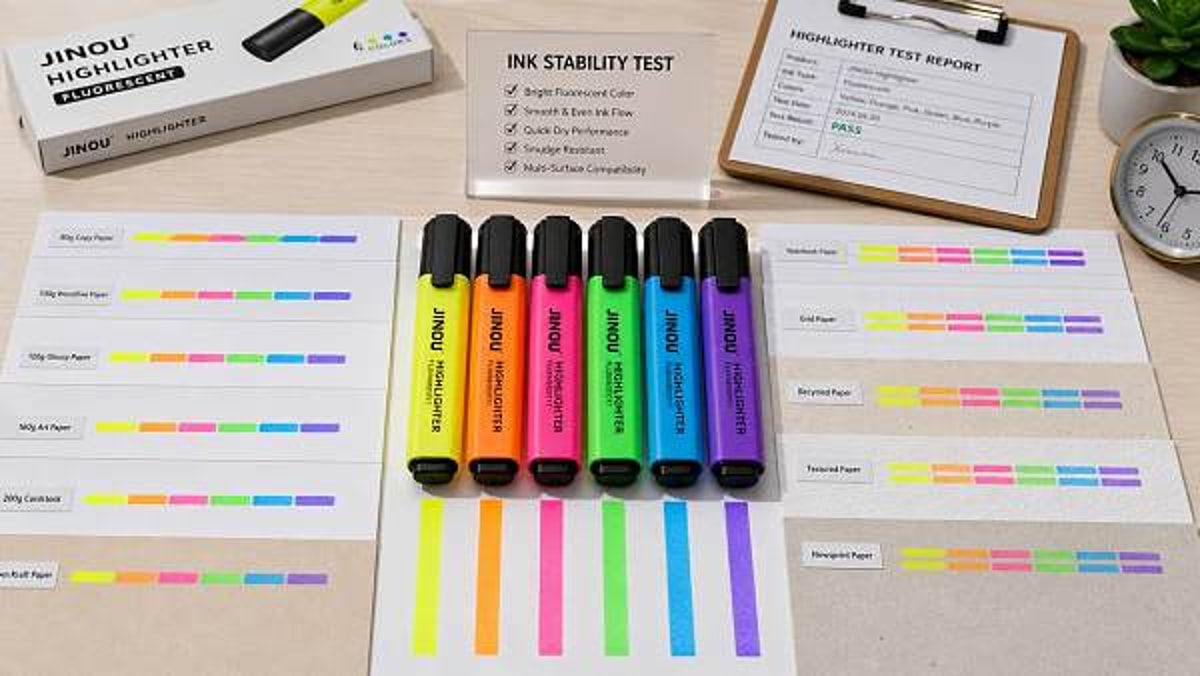
Today’s markers are used on a wider range of paper stocks, from thin notebook paper to printed workbooks and office copy paper. Buyers increasingly expect low feathering, visible highlighting without covering text, and stable color from first stroke to last. These expectations are not met by color variety alone; they depend on ink balance and manufacturing control.
4. Supply chains face more environmental variation
Products in highlighter markers wholesale channels may pass through long shipping cycles, temperature fluctuations, and extended warehousing. Ink that is poorly formulated or weakly stabilized may separate, evaporate, or change performance under these conditions. This is why sourcing teams now connect product reliability with logistics reality, not just factory samples.
A practical view of the trend: what buyers used to compare versus what they compare now
Why ink consistency matters more than it first appears
Ink consistency is not just about whether the marker leaves color on paper. It affects almost every commercial result a wholesale buyer cares about. Smooth highlighting improves the user experience. Consistent saturation improves visual presentation on shelves and in product photos. Controlled flow helps reduce bleed-through and paper damage. Reliable formulation supports longer shelf stability, especially when products move through international distribution channels.
In highlighter markers wholesale sourcing, consistent ink also acts as a proxy for manufacturing discipline. Suppliers that manage viscosity, dye balance, filtration, filling precision, and sealing quality tend to deliver more reliable outcomes overall. In contrast, suppliers that compete only on low price may struggle with the technical controls needed for consistent writing performance.
This is why experienced buyers often treat the marker’s writing behavior as a condensed quality indicator. It reveals whether the factory can maintain standards at production scale, not just during pre-order sampling.
Who is most affected by this trend in highlighter markers wholesale
Signals buyers should watch when comparing suppliers
For research-oriented sourcing teams, the challenge is turning the idea of consistency into usable evaluation criteria. The best suppliers in highlighter markers wholesale usually show signs of process maturity before the order is placed.
Useful signals include stable sample-to-sample performance, clear batch identification, willingness to discuss ink formulation control, evidence of leakage and shelf-life testing, and realistic communication about paper compatibility. A reliable supplier is also less likely to overpromise on every feature at once. Instead, they explain trade-offs honestly, such as balancing brightness, drying speed, and bleed control.
Another important signal is repeatability. If a supplier can reproduce the same writing feel across different production runs, that suggests stronger control over raw materials, filling operations, and sealing. In highlighter markers wholesale, repeatability often matters more than one impressive sample set.
How sourcing priorities are evolving across the buying process
The buying process itself is changing. Previously, some teams treated marker evaluation as a straightforward catalog comparison. Now the process is becoming more layered. Buyers increasingly combine product testing with supplier capability review, storage considerations, and end-use scenario checks.
What this means for suppliers trying to win better wholesale opportunities
For manufacturers and exporters, the trend is equally important. Buyers searching for highlighter markers wholesale are increasingly responsive to proof of stable performance. Suppliers that present themselves only through low quotes may still win short-term orders, but they are less likely to build durable business with institutional buyers or private-label programs.
Stronger market positioning now comes from showing control, not just capacity. That includes demonstrating better ink management, more consistent production outcomes, practical testing standards, and a realistic understanding of user environments. In a B2B context, trust grows when a supplier can connect technical quality with business outcomes such as fewer defects, better customer retention, and smoother channel performance.
This is especially relevant in a sourcing ecosystem shaped by professional buyers and intelligence-led platforms such as GCT, where product credibility is tied to deeper evaluation of manufacturing reliability, compliance awareness, and long-term procurement suitability.
Recommended judgment points for research-driven buyers
If you are assessing highlighter markers wholesale options for future sourcing, several judgment points deserve close attention. First, compare not only visual appearance but stroke stability from first use through repeated writing. Second, test across the actual paper categories your customers use. Third, ask whether the supplier can explain how it controls consistency between lots, not only within one sample batch.
It is also wise to evaluate storage and transit resilience. A marker that performs well immediately after production may behave differently after warehousing or international shipment. Finally, consider whether the supplier’s communication style supports transparent problem prevention. In wholesale trade, responsiveness before the order often predicts service reliability after the order.
Looking ahead: why this trend is likely to continue
The direction is unlikely to reverse. As buyers become more data-driven and more accountable for downstream performance, highlighter markers wholesale decisions will continue to move toward quality predictability. Product categories once treated as simple commodities are now evaluated through the lens of user experience, channel feedback, and lifecycle value.
That does not mean price becomes irrelevant. It means low price without reliable ink consistency is becoming less attractive in serious B2B sourcing. The most competitive offers are likely to be those that combine reasonable cost, stable formulation, repeatable quality, and clear supplier accountability.
Final takeaway for better sourcing decisions
The most important change in highlighter markers wholesale is not simply broader product choice. It is the market’s growing recognition that ink consistency influences nearly every commercial result that matters: user satisfaction, complaint rates, reorder confidence, retail presentation, and brand trust. For information researchers and sourcing teams, that makes consistency a strategic buying lens rather than a technical afterthought.
If your business wants to judge how this trend affects its own purchasing decisions, focus on a few core questions: Can the supplier maintain stable writing performance across batches? Will the product remain reliable after storage and shipping? Does the factory show clear quality control discipline? And does the offer support long-term channel performance, not just an attractive first quote? Those answers will usually tell you more than price alone.
Search News
Hot Articles
Popular Tags
Need ExpertConsultation?
Connect with our specialized leisureengineering team for procurementstrategies.
Recommended News
 May 05, 2026Custom promotional pens that get used instead of thrown awayCustom promotional pens that people actually keep: learn how to choose quality, comfortable, brand-right pens that boost visibility, reduce waste, and deliver better long-term value.● Institutional Buyer
 May 05, 2026Custom graduation gowns: why fabric choice changes event photosCustom graduation gowns look dramatically different on camera depending on fabric. Learn how sheen, drape, and wrinkle resistance shape photo quality and smarter sourcing.● Institutional Buyer
 May 05, 2026Ballpoint pens bulk: why writing distance changes buyer satisfactionBallpoint pens bulk buyers often overlook writing distance, yet it strongly shapes user satisfaction, brand perception, and reorder value across offices, schools, promotions, and service counters.● Institutional Buyer
 May 05, 2026Watercolor paints bulk: student use reveals quality fastWatercolor paints bulk for schools: see how student use quickly exposes pigment, packaging, and durability issues. Learn what buyers should check before sourcing at scale.● Institutional Buyer
 May 05, 2026Wholesale sticky notes: which paper grades actually stay putWholesale sticky notes buyers: learn which paper grades truly stay put. Compare economy, office, premium, and recycled options to improve adhesion, writing quality, and repeat orders.● Institutional Buyer
 May 05, 2026Highlighter markers wholesale: why ink consistency matters moreHighlighter markers wholesale buyers should look beyond price: consistent ink flow improves writing performance, reduces complaints, and supports stronger repeat orders. Learn what reliable sourcing really requires.● Institutional Buyer
 May 05, 2026Wholesale school backpacks: when low price leads to high returnsWholesale school backpacks may look cost-saving, but low prices often mean higher returns, complaints, and hidden procurement costs. Learn how to compare suppliers smarter.● Institutional Buyer
 May 05, 2026Art supplies wholesale trends schools are paying attention toArt supplies wholesale trends schools are watching now: safer materials, smarter bulk buying, sustainable options, and reliable suppliers that protect budgets and improve classroom outcomes.● Institutional Buyer
 May 05, 2026Colored pencils wholesale: which specs matter beyond color countColored pencils wholesale buyers should look beyond color count. Compare core strength, pigment quality, safety, wood, and packaging to source better products with confidence.● Institutional Buyer
 May 05, 2026School uniforms wholesale: what causes fit issues at scaleSchool uniforms wholesale fit issues often start with sizing gaps, fabric behavior, and weak supplier coordination. Learn the key causes and how buyers can reduce returns and protect uniform program quality.● Institutional Buyer
 May 05, 2026Graduation caps and tassels: matching colors is harder than it looksGraduation caps and tassels are harder to match than they seem. Learn how to control color standards, supplier quality, and bulk order accuracy for flawless ceremony delivery.● Institutional Buyer
 May 05, 2026Why some dry erase boards bulk orders fail in daily useDry erase boards bulk orders can fail fast in real use. Learn what causes ghosting, warping, weak mounting, and short lifespan—and how to source boards that truly fit schools, offices, hotels, and healthcare.● Institutional Buyer
 May 04, 2026PU Leather Journals: Why Some Covers Peel Too SoonPU leather journals can look elegant and affordable, but why do some peel so quickly? Discover the real causes, warning signs, and smarter buying tips before you choose.● Institutional Buyer
 May 04, 2026Retractable Badge Reels: The Small Item That Fails FirstRetractable badge reels fail faster than many workplace accessories. Learn what causes breakage, how to source durable options, and how to cut replacement costs.● Institutional Buyer
 May 04, 2026Id Card Holders Wholesale: Hard Shell or Soft Vinyl?Id card holders wholesale guide: compare hard shell vs soft vinyl for durability, cost, branding, and daily use to choose the best bulk option for offices, schools, events, and more.● Institutional Buyer
 May 04, 2026Office Laminating Machines: The Heat Settings People OverlookOffice laminating machines perform best when heat settings match pouch thickness, paper type, and speed. Learn how proper temperature control reduces bubbles, curl, waste, and rework.● Institutional Buyer
 May 04, 2026Custom Printed Lanyards: Which Material Holds Up Best?Custom printed lanyards: discover which materials last longest, keep logos sharp, and deliver better value for events, offices, schools, and premium commercial use.● Institutional Buyer
 May 04, 2026Why Wholesale Spiral Notebooks Vary So Much in Paper FeelWholesale spiral notebooks can look alike yet feel completely different. Learn what paper weight, fiber, coating, and sourcing standards mean for writing quality and smarter bulk buying.● Institutional Buyer
 May 04, 2026Binding Machines Wholesale: Small Price Gaps, Big Quality RisksBinding machines wholesale buyers face hidden quality risks behind small price gaps. Learn how to compare durability, compliance, and total cost before you order.● Institutional Buyer
 May 04, 2026Custom Printed Planners That People Actually Keep UsingCustom printed planners that people actually keep using—learn how to choose the right format, materials, and branding to boost retention, usability, and long-term brand value.● Institutional Buyer
 May 02, 2026Wholesale chef coats that hold shape after repeated industrial washingWholesale chef coats that stay sharp after repeated industrial washing. Compare fabrics, stitching, and supplier standards to choose durable uniforms that protect brand image and reduce replacement costs.● Institutional Buyer
 May 02, 2026What makes non slip chef shoes comfortable for 12-hour shiftsNon slip chef shoes for 12-hour shifts should deliver lasting support, cushioning, breathability, and grip. Learn what buyers and chefs should compare before choosing.● Institutional Buyer
 May 02, 2026Kenya Marathon Record Break Sparks Carbon-Plate Shoe Export Surge to AfricaKenya Marathon Record Break sparks surge in carbon-plate shoe exports to Africa—urgent bilingual labeling compliance needed for EAC markets.● Institutional Buyer
 May 01, 2026Custom Hotel Uniforms: Where Fit Problems Usually StartCustom hotel uniforms often fail at the fit-planning stage. Learn where sizing issues start, how to compare suppliers, and how to avoid costly reorders with smarter sourcing.● Institutional Buyer