School uniforms wholesale: what causes fit issues at scale
In school uniforms wholesale, fit issues rarely stem from a single mistake. At scale, they often result from inconsistent sizing standards, limited student body data, fabric behavior, and rushed production coordination across suppliers. For procurement teams, understanding these root causes is essential to reducing returns, controlling costs, and securing uniform programs that meet comfort, compliance, and long-term supply expectations.
Why procurement teams should use a checklist first
In school uniforms wholesale, fit problems are expensive because they multiply across grades, campuses, and replenishment cycles. A single sizing mistake can trigger exchanges, parent complaints, emergency freight, dead inventory, and supplier disputes. For buyers managing educational supply programs, a checklist-based review is more effective than relying on catalogs or sample approval alone. It helps teams verify where fit risk begins, what can be measured in advance, and which variables must be contractually controlled before production starts.
This approach also aligns with how institutional procurement works in practice. School uniform programs are not purchased only for appearance. They must satisfy wearability, child safety, movement, laundering durability, school identity, and predictable restocking. That means the right question is not simply, “Does the sample fit?” but “Will the fit remain consistent across sizes, batches, fabrics, factories, and reorder periods?”
First-pass checklist: what to confirm before placing any bulk order
Before approving any school uniforms wholesale program, procurement teams should confirm the following points in sequence. This early-stage checklist prevents most large-scale fit failures.
- Size standard origin: Ask whether the supplier uses UK, US, EU, age-based, height-based, or proprietary size grading. Many fit issues begin when buyers assume one standard while the factory follows another.
- Student body data quality: Confirm whether size planning is based on actual school measurements, historical sales, or generic age assumptions. Generic assumptions usually fail in mixed-age or multi-region programs.
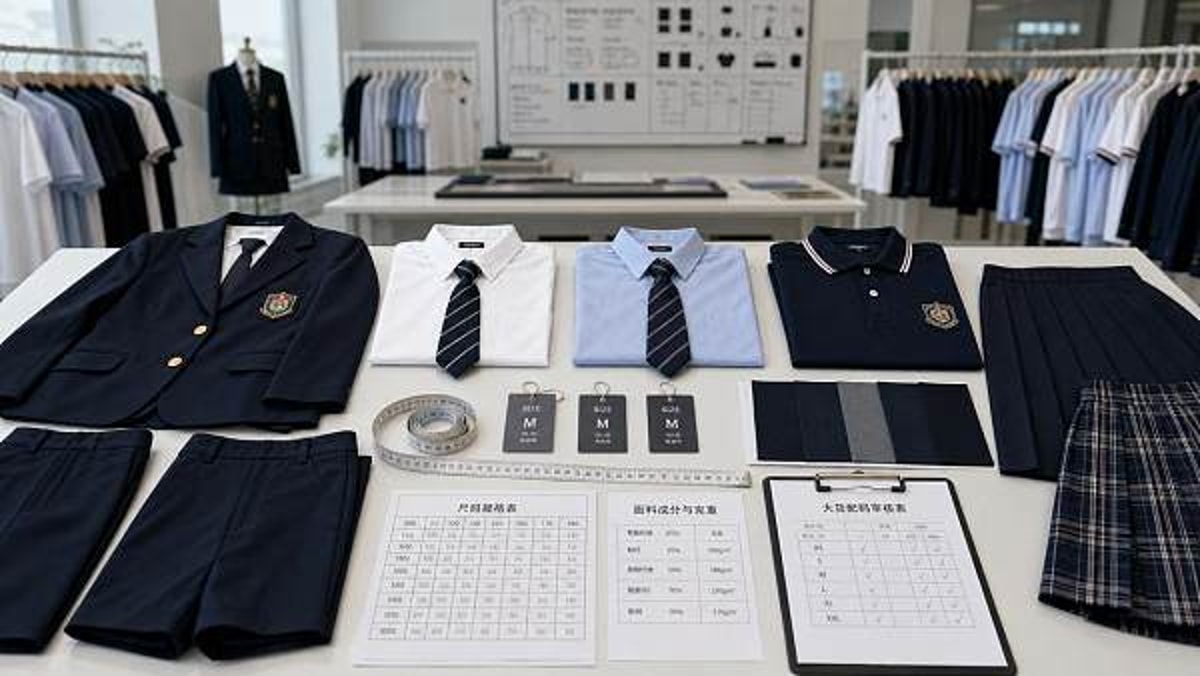
- Garment measurement method: Require a clear spec sheet with chest, waist, hip, shoulder, body length, sleeve, inseam, and tolerance. Different factories may measure the same garment in different ways.
- Fabric behavior after wash: Verify shrinkage, stretch recovery, and drape. A blazer, polo, skirt, and PE short will not behave the same even if all are labeled with the same size code.
- Fit intent: Check whether the pattern is designed as slim, regular, relaxed, or growth-friendly. Parents and school administrators often expect different things from the same uniform item.
- Grade rule consistency: Confirm whether grading increments are proportional across the full size run. Poor grading creates acceptable middle sizes but distorted smallest or largest sizes.
- Reorder continuity: Ask whether future replenishment will use the same pattern block, fabric mill, and factory line. A good first order can still become a poor long-term program if continuity is weak.
Core causes of fit issues at scale in school uniforms wholesale
1. Inconsistent sizing systems across suppliers
One of the most common causes in school uniforms wholesale is size translation failure. A buyer may request sizes 6 to 18, expecting age-based wearability, while the supplier grades from body height or chest circumference. The size labels look familiar, but the finished garments do not correspond to actual student proportions. This is especially common when sourcing from multiple factories or changing vendors between tender cycles.
2. Overreliance on age-based assumptions
Age is a weak predictor of fit, particularly in diverse school populations. Procurement teams that skip measurement studies often discover that garments fit one grade cluster well but fail at transition ages. Growth patterns vary by geography, nutrition, ethnicity, and school type. In wholesale school uniform sourcing, age-only planning usually increases exchange ratios and weakens inventory forecasting.
3. Fabric and construction changing the final silhouette
Fit is not controlled by pattern alone. Piqué knits, woven cotton blends, stretch twill, and polyester suiting all sit differently on the body. Interlining, elastic waist insertion, pleating depth, seam allowance, and wash finishing can all change perceived fit. In school uniforms wholesale, this becomes a scale problem when one size chart is applied across multiple garment categories without item-specific adjustment.
4. Poor grading logic between sizes
A fit sample may look acceptable in one reference size, yet production still fails because the size grade is poorly engineered. If shoulder width, torso length, sleeve length, and waist increase at unrealistic rates, the end result is uneven fit across the size run. This issue often appears in tailored garments such as shirts, blazers, and trousers, where proportional balance matters more than label size.
5. Incomplete communication between buyer, agent, and factory
Many large-volume fit problems are communication failures rather than technical failures. If the school, distributor, procurement office, and manufacturer do not define tolerance, target body shape, wearing ease, and expected wash outcome in one approved document set, each party fills the gaps differently. This is a frequent hidden cause in global sourcing programs managed across time zones and multiple approval layers.
Practical evaluation table for procurement review
The table below helps buyers translate fit risk into operational review points before confirming a school uniforms wholesale contract.
Scenario-based checks: what changes by program type
Not every school procurement project faces the same fit risks. Buyers should add scenario-specific checks depending on the structure of the uniform program.
For multi-campus or international school groups
Regional body differences matter more. Standardized global size charts may simplify sourcing, but they can also reduce fit accuracy. It is often better to keep a shared design language while localizing grading or stocking ratios by region.
For tender-based public procurement
Lowest-price pressure can encourage suppliers to reuse unsuitable patterns or downgrade fabric stability. Buyers should require measurable fit compliance documents, not just declarations of equivalence.
For private schools with premium branding requirements
Aesthetic fit becomes more visible. Slimmer silhouettes, blazers, and customized items require more detailed fitting rounds and stronger replenishment controls. Premium presentation raises parent expectations, so fit tolerance must be defined more tightly.
Commonly overlooked issues that create avoidable returns
- Gender and unisex confusion: A unisex size chart may simplify inventory but often compromises fit for shirts, trousers, and sportswear.
- Seasonal layering impact: Winter uniforms need allowance for base layers, while summer items require breathability without excessive looseness.
- Waist adjustability assumptions: Elastic or internal adjusters help, but they do not solve poor rise, hip, or thigh proportions.
- Sample bias: One showroom sample sewn by a senior technician may not reflect bulk output from a high-speed line.
- Reorder drift: Even when the first shipment performs well, later orders may shift if the factory changes fabric source, marker planning, or finishing settings.
Execution advice: how to reduce fit issues before production starts
For procurement teams handling school uniforms wholesale, the best results come from converting fit expectations into controlled documentation and staged approvals. A practical execution sequence includes:
- Collect real measurement data from representative student groups instead of relying only on age bands.
- Request item-by-item size specifications rather than one generic chart for all garments.
- Approve both pre-wash and post-wash measurements for core items such as polos, shirts, trousers, skirts, and knitwear.
- Test fit across the smallest, middle, and largest sizes, not just a single sample size.
- Lock tolerance, grading rules, and fabric composition into the purchase agreement and technical pack.
- Define a replenishment protocol so repeat orders follow the same approved standard.
Final procurement priorities and next-step questions
The main lesson in school uniforms wholesale is that fit issues at scale are usually predictable. They come from unclear size frameworks, weak measurement inputs, fabric-performance gaps, and loose production control. Buyers who evaluate these factors early can reduce returns, protect budget accuracy, and build more stable long-term supply relationships.
If your organization is preparing to source or upgrade a uniform program, the most useful next discussion points are clear: What body measurement data is available? Which garments carry the highest exchange risk? What fit tolerances can the supplier guarantee? How will repeat orders stay consistent? And what testing, lead times, and budget adjustments are needed to support a reliable rollout? Starting with these questions will make every later negotiation on price, timeline, compliance, and supplier selection far more effective.
Search News
Hot Articles
Popular Tags
Need ExpertConsultation?
Connect with our specialized leisureengineering team for procurementstrategies.
Recommended News
 May 05, 2026Custom promotional pens that get used instead of thrown awayCustom promotional pens that people actually keep: learn how to choose quality, comfortable, brand-right pens that boost visibility, reduce waste, and deliver better long-term value.● Institutional Buyer
 May 05, 2026Custom graduation gowns: why fabric choice changes event photosCustom graduation gowns look dramatically different on camera depending on fabric. Learn how sheen, drape, and wrinkle resistance shape photo quality and smarter sourcing.● Institutional Buyer
 May 05, 2026Ballpoint pens bulk: why writing distance changes buyer satisfactionBallpoint pens bulk buyers often overlook writing distance, yet it strongly shapes user satisfaction, brand perception, and reorder value across offices, schools, promotions, and service counters.● Institutional Buyer
 May 05, 2026Watercolor paints bulk: student use reveals quality fastWatercolor paints bulk for schools: see how student use quickly exposes pigment, packaging, and durability issues. Learn what buyers should check before sourcing at scale.● Institutional Buyer
 May 05, 2026Wholesale sticky notes: which paper grades actually stay putWholesale sticky notes buyers: learn which paper grades truly stay put. Compare economy, office, premium, and recycled options to improve adhesion, writing quality, and repeat orders.● Institutional Buyer
 May 05, 2026Highlighter markers wholesale: why ink consistency matters moreHighlighter markers wholesale buyers should look beyond price: consistent ink flow improves writing performance, reduces complaints, and supports stronger repeat orders. Learn what reliable sourcing really requires.● Institutional Buyer
 May 05, 2026Wholesale school backpacks: when low price leads to high returnsWholesale school backpacks may look cost-saving, but low prices often mean higher returns, complaints, and hidden procurement costs. Learn how to compare suppliers smarter.● Institutional Buyer
 May 05, 2026Art supplies wholesale trends schools are paying attention toArt supplies wholesale trends schools are watching now: safer materials, smarter bulk buying, sustainable options, and reliable suppliers that protect budgets and improve classroom outcomes.● Institutional Buyer
 May 05, 2026Colored pencils wholesale: which specs matter beyond color countColored pencils wholesale buyers should look beyond color count. Compare core strength, pigment quality, safety, wood, and packaging to source better products with confidence.● Institutional Buyer
 May 05, 2026School uniforms wholesale: what causes fit issues at scaleSchool uniforms wholesale fit issues often start with sizing gaps, fabric behavior, and weak supplier coordination. Learn the key causes and how buyers can reduce returns and protect uniform program quality.● Institutional Buyer
 May 05, 2026Graduation caps and tassels: matching colors is harder than it looksGraduation caps and tassels are harder to match than they seem. Learn how to control color standards, supplier quality, and bulk order accuracy for flawless ceremony delivery.● Institutional Buyer
 May 05, 2026Why some dry erase boards bulk orders fail in daily useDry erase boards bulk orders can fail fast in real use. Learn what causes ghosting, warping, weak mounting, and short lifespan—and how to source boards that truly fit schools, offices, hotels, and healthcare.● Institutional Buyer
 May 04, 2026PU Leather Journals: Why Some Covers Peel Too SoonPU leather journals can look elegant and affordable, but why do some peel so quickly? Discover the real causes, warning signs, and smarter buying tips before you choose.● Institutional Buyer
 May 04, 2026Retractable Badge Reels: The Small Item That Fails FirstRetractable badge reels fail faster than many workplace accessories. Learn what causes breakage, how to source durable options, and how to cut replacement costs.● Institutional Buyer
 May 04, 2026Id Card Holders Wholesale: Hard Shell or Soft Vinyl?Id card holders wholesale guide: compare hard shell vs soft vinyl for durability, cost, branding, and daily use to choose the best bulk option for offices, schools, events, and more.● Institutional Buyer
 May 04, 2026Office Laminating Machines: The Heat Settings People OverlookOffice laminating machines perform best when heat settings match pouch thickness, paper type, and speed. Learn how proper temperature control reduces bubbles, curl, waste, and rework.● Institutional Buyer
 May 04, 2026Custom Printed Lanyards: Which Material Holds Up Best?Custom printed lanyards: discover which materials last longest, keep logos sharp, and deliver better value for events, offices, schools, and premium commercial use.● Institutional Buyer
 May 04, 2026Why Wholesale Spiral Notebooks Vary So Much in Paper FeelWholesale spiral notebooks can look alike yet feel completely different. Learn what paper weight, fiber, coating, and sourcing standards mean for writing quality and smarter bulk buying.● Institutional Buyer
 May 04, 2026Binding Machines Wholesale: Small Price Gaps, Big Quality RisksBinding machines wholesale buyers face hidden quality risks behind small price gaps. Learn how to compare durability, compliance, and total cost before you order.● Institutional Buyer
 May 04, 2026Custom Printed Planners That People Actually Keep UsingCustom printed planners that people actually keep using—learn how to choose the right format, materials, and branding to boost retention, usability, and long-term brand value.● Institutional Buyer
 May 02, 2026Wholesale chef coats that hold shape after repeated industrial washingWholesale chef coats that stay sharp after repeated industrial washing. Compare fabrics, stitching, and supplier standards to choose durable uniforms that protect brand image and reduce replacement costs.● Institutional Buyer
 May 02, 2026What makes non slip chef shoes comfortable for 12-hour shiftsNon slip chef shoes for 12-hour shifts should deliver lasting support, cushioning, breathability, and grip. Learn what buyers and chefs should compare before choosing.● Institutional Buyer
 May 02, 2026Kenya Marathon Record Break Sparks Carbon-Plate Shoe Export Surge to AfricaKenya Marathon Record Break sparks surge in carbon-plate shoe exports to Africa—urgent bilingual labeling compliance needed for EAC markets.● Institutional Buyer
 May 01, 2026Custom Hotel Uniforms: Where Fit Problems Usually StartCustom hotel uniforms often fail at the fit-planning stage. Learn where sizing issues start, how to compare suppliers, and how to avoid costly reorders with smarter sourcing.● Institutional Buyer