Graduation caps and tassels: matching colors is harder than it looks
Choosing graduation caps and tassels sounds simple—until color standards, school branding, order accuracy, and supplier consistency come into play. For project managers responsible for bulk purchasing or event delivery, even small mismatches can create visible issues and costly delays. This guide explains why matching colors is more complex than expected and how to manage sourcing, specifications, and quality control with greater confidence.
Why graduation caps and tassels have become a more complex sourcing issue
In recent years, the market for graduation caps and tassels has shifted from a simple seasonal purchase to a brand-sensitive, compliance-aware, and schedule-critical project category. Schools, universities, training institutions, and event organizers increasingly expect visual consistency across every graduation element, from gowns and caps to cords, stoles, and tassels. That change matters because caps and tassels are highly visible in photography, livestreaming, alumni marketing, and institutional branding. A minor shade deviation that might once have gone unnoticed can now stand out in high-resolution event content distributed worldwide.
For project managers and program leads, this means graduation caps and tassels are no longer just an accessory line item. They have become part of a broader delivery risk profile involving color fidelity, fabric dye lot variation, packaging accuracy, and supplier communication. The challenge is not merely choosing “blue” or “gold.” It is defining which blue, under what light source, on which material, and with what tolerance for variation across production batches.
The strongest market signals behind color-matching difficulties
Several industry signals explain why matching graduation caps and tassels is harder than it looks. First, institutional branding has become more exact. Schools increasingly maintain style guides, logo standards, and approved color references, often aligned with digital and print branding systems. However, those systems do not always translate cleanly into textile production. A HEX code used on a website or a CMYK color used in print may not produce the same result on polyester fabric or rayon tassel thread.
Second, buyers are sourcing globally more often, which expands options but also raises consistency risks. A supplier may interpret color references differently based on local dye practice, machinery, substrate, or finishing method. Third, institutions are ordering more customized combinations. Rather than accepting standard packages, they want school colors, year charms, department distinctions, and coordinated accessories. Customization increases the number of variables, which raises the probability of mismatch.
Finally, lead times remain under pressure. Graduation events have fixed dates, and delays in sample approval can compress production windows. When teams rush color decisions, they often approve near matches rather than exact matches, only to discover visible differences after mass production.
Trend change summary for project teams
Why “the same color” often looks different in production
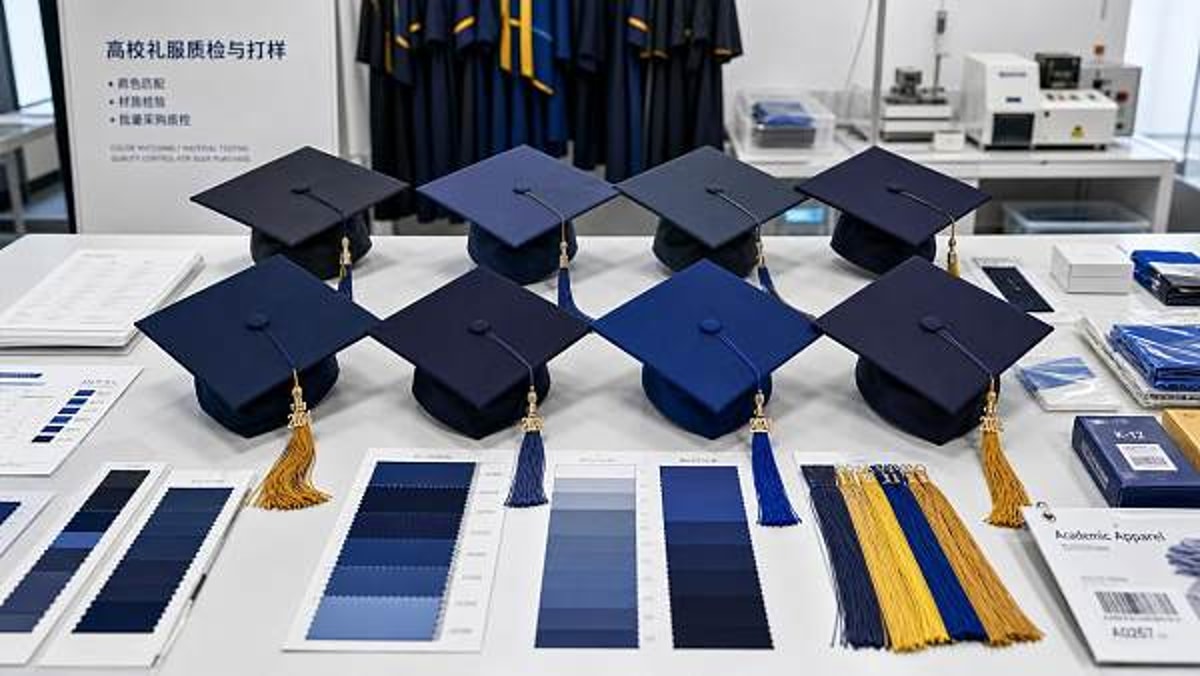
The central issue with graduation caps and tassels is that color is material-dependent. Caps are usually made from fabric with a woven or nonwoven surface, while tassels may use rayon or polyester threads with different luster, absorption, and reflective behavior. Even if both are dyed to a similar target, they may appear different because gloss, fiber structure, and texture affect how the eye perceives color.
Lighting conditions also matter. A color match approved in office lighting may look different outdoors, on stage, or under camera flash. This is especially relevant because graduation ceremonies now generate more digital content than before. If project managers evaluate samples only in one environment, they may miss a mismatch that becomes obvious during the event itself.
Another frequent source of error is reliance on screen-based approval. Buyers may compare supplier photos on laptops or phones without calibrated displays. That method is useful for progress checks but weak for final color decisions. In practical terms, physical swatches remain the safest reference for graduation caps and tassels when exact branding alignment is required.
The operational impact on project managers, buyers, and event delivery teams
These color-matching issues affect more than appearance. For project managers, they influence planning accuracy, stakeholder communication, and budget control. When graduation caps and tassels arrive with visible variation, the problem can trigger urgent resorting, partial replacement, internal approval disputes, and reputational pressure close to the event date.
The impact is especially sharp in multi-campus systems, large universities, and outsourced event operations where multiple departments approve specifications. Procurement may focus on unit cost, marketing may focus on brand fidelity, and operations may focus on on-time delivery. Without a shared standard, the final product can satisfy one team while disappointing another.
Who feels the impact most
What is driving better supplier expectations in this category
As expectations rise, buyers now look beyond price and basic sample approval. Suppliers of graduation caps and tassels are increasingly judged on whether they can manage technical communication, repeatable dyeing, lot traceability, and pre-shipment verification. In other words, the market is rewarding process maturity, not just manufacturing capacity.
This is part of a broader sourcing trend across commercial products: institutional buyers want fewer surprises. For categories tied to public events, they prefer vendors that can document color references, confirm material composition, explain tolerance ranges, and flag risks early. A factory that says “close enough” is becoming less attractive than one that asks the right questions before production starts.
- Use of physical color swatches instead of screen screenshots as final approval tools
- Clear separation of cap fabric color and tassel thread color targets
- Documented approval checkpoints before bulk production
- Batch labeling and carton-level identification for easier event distribution
- Stronger pre-shipment inspection for color, assembly, and quantity accuracy
How project teams should adjust specifications for graduation caps and tassels
One of the most useful changes project teams can make is to rewrite specifications in a way that reflects real production behavior. Instead of asking for “match school colors,” define the reference source, substrate, and approval method. If graduation caps and tassels must align closely, state whether the tassel should match the cap visually or match a separate institutional color standard, because these are not always the same outcome.
It is also wise to build tolerance decisions into the timeline rather than forcing them at the end. For example, determine in advance who has authority to approve minor variation, what level of difference is acceptable across lots, and whether the event can tolerate variation between undergraduate and postgraduate accessory sets. These governance details reduce conflict when time becomes tight.
Specification areas worth strengthening
The next phase: from low-cost ordering to risk-managed sourcing
The broader direction is clear: sourcing graduation caps and tassels is moving toward risk-managed procurement. Buyers still care about price, but the more decisive question is whether the supplier can protect event quality under deadline pressure. This is particularly relevant for institutions with annual repeat orders, because consistency from year to year now matters almost as much as consistency within one delivery.
Looking ahead, teams should expect more requests for sample archiving, digital approval records, and multi-stage QC reporting. Suppliers that support these practices will likely gain trust, especially among institutional buyers and outsourced event planners handling large-scale ceremonies. The category may appear simple, but the sourcing logic is becoming more professional and more data-driven.
What signals should buyers keep watching now
For organizations reviewing their next purchase cycle, a few signals deserve ongoing attention. Watch whether your supplier can maintain consistent graduation caps and tassels across repeat orders, not just first samples. Review how quickly approval issues are escalated and whether color questions are answered with evidence or assumptions. Check if packaging accuracy is improving, because operational errors often travel with color control weaknesses. Finally, monitor whether internal stakeholders are aligned on what “match” actually means before you place the order.
If your team wants to judge how these trends affect your own sourcing decisions, focus on a short list of questions: Do we have a physical color standard? Are cap and tassel materials clearly defined? Who owns final approval? What variation can we accept? Which supplier can document consistency, not just promise it? Those answers will do more to protect ceremony delivery than any last-minute correction after goods arrive.
Search News
Hot Articles
Popular Tags
Need ExpertConsultation?
Connect with our specialized leisureengineering team for procurementstrategies.
Recommended News
 May 05, 2026Custom promotional pens that get used instead of thrown awayCustom promotional pens that people actually keep: learn how to choose quality, comfortable, brand-right pens that boost visibility, reduce waste, and deliver better long-term value.● Institutional Buyer
 May 05, 2026Custom graduation gowns: why fabric choice changes event photosCustom graduation gowns look dramatically different on camera depending on fabric. Learn how sheen, drape, and wrinkle resistance shape photo quality and smarter sourcing.● Institutional Buyer
 May 05, 2026Ballpoint pens bulk: why writing distance changes buyer satisfactionBallpoint pens bulk buyers often overlook writing distance, yet it strongly shapes user satisfaction, brand perception, and reorder value across offices, schools, promotions, and service counters.● Institutional Buyer
 May 05, 2026Watercolor paints bulk: student use reveals quality fastWatercolor paints bulk for schools: see how student use quickly exposes pigment, packaging, and durability issues. Learn what buyers should check before sourcing at scale.● Institutional Buyer
 May 05, 2026Wholesale sticky notes: which paper grades actually stay putWholesale sticky notes buyers: learn which paper grades truly stay put. Compare economy, office, premium, and recycled options to improve adhesion, writing quality, and repeat orders.● Institutional Buyer
 May 05, 2026Highlighter markers wholesale: why ink consistency matters moreHighlighter markers wholesale buyers should look beyond price: consistent ink flow improves writing performance, reduces complaints, and supports stronger repeat orders. Learn what reliable sourcing really requires.● Institutional Buyer
 May 05, 2026Wholesale school backpacks: when low price leads to high returnsWholesale school backpacks may look cost-saving, but low prices often mean higher returns, complaints, and hidden procurement costs. Learn how to compare suppliers smarter.● Institutional Buyer
 May 05, 2026Art supplies wholesale trends schools are paying attention toArt supplies wholesale trends schools are watching now: safer materials, smarter bulk buying, sustainable options, and reliable suppliers that protect budgets and improve classroom outcomes.● Institutional Buyer
 May 05, 2026Colored pencils wholesale: which specs matter beyond color countColored pencils wholesale buyers should look beyond color count. Compare core strength, pigment quality, safety, wood, and packaging to source better products with confidence.● Institutional Buyer
 May 05, 2026School uniforms wholesale: what causes fit issues at scaleSchool uniforms wholesale fit issues often start with sizing gaps, fabric behavior, and weak supplier coordination. Learn the key causes and how buyers can reduce returns and protect uniform program quality.● Institutional Buyer
 May 05, 2026Graduation caps and tassels: matching colors is harder than it looksGraduation caps and tassels are harder to match than they seem. Learn how to control color standards, supplier quality, and bulk order accuracy for flawless ceremony delivery.● Institutional Buyer
 May 05, 2026Why some dry erase boards bulk orders fail in daily useDry erase boards bulk orders can fail fast in real use. Learn what causes ghosting, warping, weak mounting, and short lifespan—and how to source boards that truly fit schools, offices, hotels, and healthcare.● Institutional Buyer
 May 04, 2026PU Leather Journals: Why Some Covers Peel Too SoonPU leather journals can look elegant and affordable, but why do some peel so quickly? Discover the real causes, warning signs, and smarter buying tips before you choose.● Institutional Buyer
 May 04, 2026Retractable Badge Reels: The Small Item That Fails FirstRetractable badge reels fail faster than many workplace accessories. Learn what causes breakage, how to source durable options, and how to cut replacement costs.● Institutional Buyer
 May 04, 2026Id Card Holders Wholesale: Hard Shell or Soft Vinyl?Id card holders wholesale guide: compare hard shell vs soft vinyl for durability, cost, branding, and daily use to choose the best bulk option for offices, schools, events, and more.● Institutional Buyer
 May 04, 2026Office Laminating Machines: The Heat Settings People OverlookOffice laminating machines perform best when heat settings match pouch thickness, paper type, and speed. Learn how proper temperature control reduces bubbles, curl, waste, and rework.● Institutional Buyer
 May 04, 2026Custom Printed Lanyards: Which Material Holds Up Best?Custom printed lanyards: discover which materials last longest, keep logos sharp, and deliver better value for events, offices, schools, and premium commercial use.● Institutional Buyer
 May 04, 2026Why Wholesale Spiral Notebooks Vary So Much in Paper FeelWholesale spiral notebooks can look alike yet feel completely different. Learn what paper weight, fiber, coating, and sourcing standards mean for writing quality and smarter bulk buying.● Institutional Buyer
 May 04, 2026Binding Machines Wholesale: Small Price Gaps, Big Quality RisksBinding machines wholesale buyers face hidden quality risks behind small price gaps. Learn how to compare durability, compliance, and total cost before you order.● Institutional Buyer
 May 04, 2026Custom Printed Planners That People Actually Keep UsingCustom printed planners that people actually keep using—learn how to choose the right format, materials, and branding to boost retention, usability, and long-term brand value.● Institutional Buyer
 May 02, 2026Wholesale chef coats that hold shape after repeated industrial washingWholesale chef coats that stay sharp after repeated industrial washing. Compare fabrics, stitching, and supplier standards to choose durable uniforms that protect brand image and reduce replacement costs.● Institutional Buyer
 May 02, 2026What makes non slip chef shoes comfortable for 12-hour shiftsNon slip chef shoes for 12-hour shifts should deliver lasting support, cushioning, breathability, and grip. Learn what buyers and chefs should compare before choosing.● Institutional Buyer
 May 02, 2026Kenya Marathon Record Break Sparks Carbon-Plate Shoe Export Surge to AfricaKenya Marathon Record Break sparks surge in carbon-plate shoe exports to Africa—urgent bilingual labeling compliance needed for EAC markets.● Institutional Buyer
 May 01, 2026Custom Hotel Uniforms: Where Fit Problems Usually StartCustom hotel uniforms often fail at the fit-planning stage. Learn where sizing issues start, how to compare suppliers, and how to avoid costly reorders with smarter sourcing.● Institutional Buyer