Office acoustic pods or open booths: which solves noise better
In busy workplaces, controlling noise is no longer just a comfort issue—it directly affects focus, privacy, and project efficiency. For project managers comparing office acoustic pods with open booths, the real question is which solution delivers better sound control without compromising layout, cost, or user experience. This guide explores the key differences to help you make a smarter specification decision.
Why this comparison matters more now than it did a few years ago
The debate between office acoustic pods and open booths has become more urgent because workplace expectations have changed. Hybrid work has reduced the need for fixed desks, but it has increased demand for spaces that support video calls, focused work, quick team huddles, and confidential conversations. At the same time, many companies have redesigned offices to be more open, collaborative, and space-efficient. The result is a familiar problem: more visual openness often brings more sound leakage, distraction, and user frustration.
For project managers and fit-out leaders, this is not just a furniture decision. It is now a performance decision tied to occupancy planning, employee experience, and long-term adaptability. In that context, office acoustic pods are increasingly evaluated against open booths not as similar products, but as two very different responses to the same acoustic challenge.
The biggest market shift: buyers are moving from “more seats” to “better sound outcomes”
One of the clearest signals in commercial interiors is that procurement teams are no longer judging workplace products only by appearance, seat count, or installation speed. Acoustic performance, speech privacy, ventilation quality, and measurable user comfort are becoming stronger evaluation points. This shift favors solutions that can demonstrate predictable results rather than simply improving aesthetics.
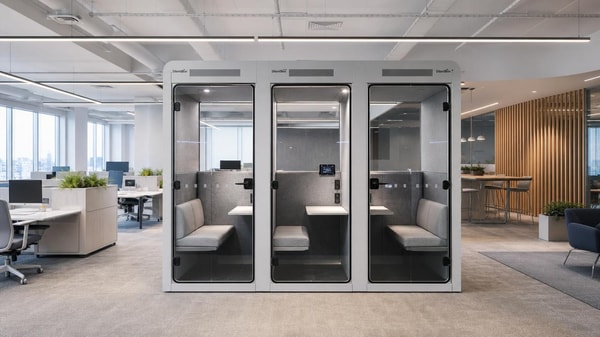
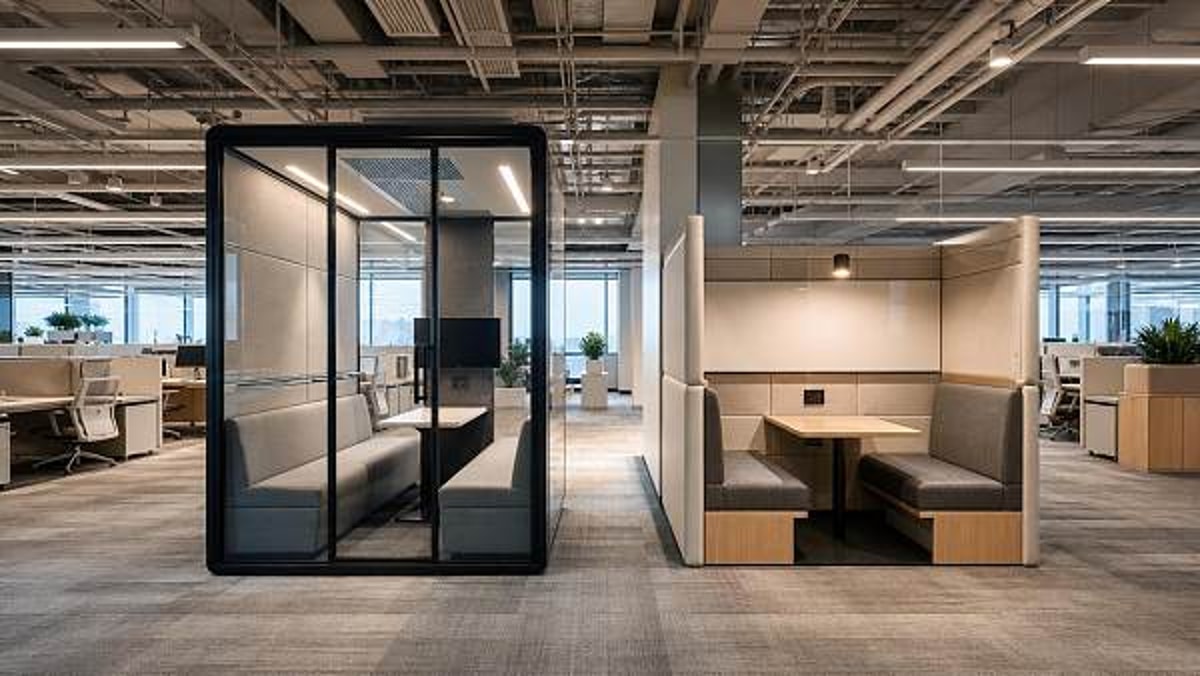
Open booths still play an important role in agile office layouts. They are useful for informal touchdown work, short discussions, and visual zoning. However, when the objective is serious noise control, they often underperform because they do not fully isolate users from surrounding sound. Office acoustic pods, by contrast, are designed specifically to reduce transmission, absorb internal reflections, and create a contained environment for speech and concentration.
A practical trend table: how specification priorities are changing
The following table summarizes how workplace decision criteria are evolving and why the comparison between office acoustic pods and open booths is becoming more outcome-focused.
What is driving the change in noise-control expectations
Several forces are pushing buyers toward more serious acoustic solutions. First, video conferencing has turned speech clarity into a daily operational requirement. An open booth may feel semi-private, but if surrounding conversations are picked up on calls, the space fails its purpose. Second, more organizations are measuring workplace effectiveness through employee feedback, utilization data, and retention signals. Noise complaints now surface quickly and influence future space planning.
Third, projects increasingly involve multi-functional zones rather than single-purpose floors. A quiet individual task may happen next to a social breakout area. In these mixed environments, passive acoustic treatment alone is often not enough. Office acoustic pods create a controlled micro-environment within the larger floorplate, which makes them particularly relevant in retrofit projects where rebuilding walls is not practical.
Finally, there is a stronger emphasis on compliance, sustainability, and lifecycle value. Buyers want movable, reusable solutions that support changing layouts without major demolition. High-quality office acoustic pods align well with that direction because they can often be relocated, reconfigured, and integrated into future workplace phases.
Which solves noise better in real-world conditions
If the question is strictly about noise control, office acoustic pods generally solve it better than open booths. The reason is simple: pods combine enclosure, sound-absorbing materials, controlled openings, and often engineered ventilation and sealing details. Open booths may reduce some reverberation and create a sense of retreat, but they usually leave one side exposed and allow considerable sound to enter and escape.
That said, “better” depends on what kind of noise problem you are solving. For speech privacy, confidential calls, focused solo work, and online meetings, office acoustic pods are usually the stronger choice. For quick informal collaboration in a moderately noisy office, open booths may be sufficient and more economical. The wrong decision often happens when teams use open booths to solve problems that actually require acoustic isolation.
Project managers should therefore separate three goals during evaluation: reducing distraction, improving speech privacy, and creating alternative work settings. Both product types can support the third goal. Only office acoustic pods consistently address the second, and they are usually more effective on the first when placed correctly.
The impact on different project stakeholders
The choice between office acoustic pods and open booths affects more than end users. It influences planning, MEP coordination, budget control, and post-occupancy satisfaction across the project lifecycle.
Where open booths still make strategic sense
The growing preference for office acoustic pods does not mean open booths are obsolete. In fact, open booths remain highly relevant where the acoustic goal is partial buffering rather than isolation. They work well in reception-adjacent areas, collaborative neighborhoods, touchdown zones, and education-inspired office layouts where visibility and accessibility matter.
They also fit projects where budget must be spread across many micro-settings rather than concentrated in fewer enclosed units. In these cases, open booths can improve space choice, break up noise paths visually, and absorb some ambient sound when built with quality materials. The key trend is not that booths disappear, but that buyers are becoming more precise about what booths can and cannot do.
Signals project managers should watch before specifying office acoustic pods
As the market matures, not all office acoustic pods deliver equal value. Stronger buyers are now screening beyond appearance and marketing claims. A few signals deserve close attention during prequalification and comparison:
- Whether acoustic performance is explained in practical terms such as speech privacy and typical use cases, not just generic “noise reduction” claims.
- How ventilation, lighting, power integration, and occupancy comfort are handled, since poor internal conditions can undermine acoustic benefits.
- How the unit will be delivered, assembled, and relocated within project constraints such as lifts, access routes, and phased handovers.
- Whether finishes, glazing, and material choices align with durability, cleaning standards, and fire or safety requirements relevant to the site.
These signals matter because the market is shifting from decorative acoustic products toward operationally credible workplace assets. For B2B buyers, especially those sourcing across regions, supplier transparency and specification discipline are becoming part of the acoustic decision itself.
A decision framework for the next 12 to 24 months
Looking ahead, the most resilient projects will avoid choosing one solution for the entire office. Instead, they will combine open booths and office acoustic pods according to activity type. This blended strategy reflects the direction of workplace planning: fewer one-size-fits-all layouts and more layered environments calibrated to real use patterns.
A practical way to decide is to map each area by sensitivity to noise, need for privacy, and duration of use. High-sensitivity, high-privacy tasks point toward office acoustic pods. Low-sensitivity, short-duration collaboration points toward open booths. Medium cases require closer review of surrounding noise, user behavior, and budget priorities. This type of matrix-based thinking is becoming more important as organizations seek flexible assets that can justify capital spending over time.
What this means for sourcing and long-term workplace value
For global commercial buyers, the comparison is no longer simply pod versus booth. It is performance certainty versus spatial openness, immediate cost versus lifecycle adaptability, and visual appeal versus measurable usability. In that broader sourcing context, office acoustic pods are gaining momentum because they answer several current needs at once: privacy, flexibility, retrofit friendliness, and stronger acoustic control.
That does not mean every project should specify more enclosed products. It means every project should define its acoustic intent more clearly. If your team expects a solution to support concentrated work or private conversation in a busy floorplate, open booths may create false confidence. If the goal is to enrich workplace variety while preserving openness, booths may be exactly right.
Final judgment and next-step questions
In most real-world comparisons, office acoustic pods solve noise better than open booths because they are built for containment, absorption, and privacy rather than partial screening. The stronger trend in the market is not just toward buying more pods, but toward making more accurate acoustic decisions based on work mode, risk, and future flexibility.
If your organization wants to judge the impact of this trend on an upcoming project, focus on a few questions: What kind of noise is causing the real problem? Which users need privacy, and for how long? Are you solving distraction, confidentiality, or both? Can the chosen solution be relocated as workplace needs evolve? And does the supplier provide enough technical clarity to support a confident specification?
For project managers, these are the questions that turn office acoustic pods from a design feature into a strategic workplace asset.
Search News
Hot Articles
Popular Tags
Need ExpertConsultation?
Connect with our specialized leisureengineering team for procurementstrategies.
Recommended News
 May 05, 2026Cork bulletin boards: why frame quality matters over board sizeCork bulletin boards deliver better long-term value when frame quality comes first. Learn how stronger materials, secure corners, and stable mounting improve durability, safety, and appearance.● Institutional Buyer
 May 05, 2026Soundproof phone booths: when sound ratings mislead office plansSoundproof phone booths can mislead office plans when ratings are taken at face value. Learn how to compare privacy, ventilation, placement, and compliance before you buy.● Institutional Buyer
 May 05, 2026Laser printer toner bulk: what affects page yield mostLaser printer toner bulk page yield depends on more than toner volume. Discover the top factors affecting real output and make smarter, lower-cost sourcing decisions.● Institutional Buyer
 May 05, 2026Science lab furniture: small design choices with big safety impactScience lab furniture shapes lab safety in ways many teams overlook. Discover smart design choices that reduce risk, improve compliance, and support efficient long-term performance.● Institutional Buyer
 May 05, 2026Wholesale ink cartridges: remanufactured vs compatible in real useWholesale ink cartridges compared in real use: remanufactured vs compatible on print quality, yield, firmware risk, and sourcing value—helping procurement teams buy smarter.● Institutional Buyer
 May 05, 2026Cash drawers wholesale: what causes jams at checkoutCash drawers wholesale guide: uncover the real causes of checkout jams, from latch design to POS compatibility, and learn how to source reliable drawers that reduce downtime.● Institutional Buyer
 May 05, 2026Office acoustic pods or open booths: which solves noise betterOffice acoustic pods vs. open booths: discover which solution controls noise better for privacy, focus, and hybrid calls, and make a smarter office planning decision.● Institutional Buyer
 May 05, 2026Office LED panel lights that cut glare without dim workspacesOffice LED panel lights that reduce glare without sacrificing brightness. Discover how to choose low-glare, high-comfort lighting for productive, compliant, and modern office spaces.● Institutional Buyer
 May 05, 2026Chemical resistant lab tops: which materials hold up bestChemical resistant lab tops compared: discover whether epoxy resin, phenolic resin, or stainless steel holds up best for harsh chemicals, heat, and daily lab demands.● Institutional Buyer
 May 05, 2026How to compare drafting tables wholesale without overbuyingDrafting tables wholesale comparison starts with MOQ, specs, and supplier reliability. Learn how to avoid overbuying, reduce inventory risk, and choose better-value sourcing options.● Institutional Buyer
 May 04, 2026Ergonomic Office Chairs Wholesale: Comfort Claims vs Real SupportErgonomic office chairs wholesale: learn how to verify real support beyond comfort claims with fit, adjustability, durability, and compliance insights for smarter commercial buying.● Institutional Buyer
 May 04, 2026Modular Office Workstations: Flexibility Can Add Setup CostsModular office workstations can improve flexibility, but setup costs often rise through installation, power, data, and rework. Learn when the added investment truly pays off.● Institutional Buyer
 May 04, 2026Steel Filing Cabinets: Why Some Drawers Jam Too EarlySteel filing cabinets often jam early due to weak slides, poor leveling, overload, or lock issues. Discover what to check before buying and how to avoid costly drawer failures.● Institutional Buyer
 May 04, 2026Office Network Racks: Airflow Problems Start With Bad PlanningOffice network racks can fail early when airflow is ignored. Learn the key planning checklist to prevent overheating, reduce maintenance risks, and build a more reliable office network.● Institutional Buyer
 May 04, 2026Office Partitions Wholesale: Open Plan Savings, Closed Office NeedsOffice partitions wholesale helps project managers cut fit-out costs, speed delivery, and balance open-plan efficiency with private office performance. Explore smarter commercial workspace solutions.● Institutional Buyer
 May 04, 2026Conference Room Tables: Common Layout Mistakes to AvoidConference room tables can make or break meeting flow. Discover common layout mistakes to avoid and plan smarter spaces for collaboration, AV integration, and professional results.● Institutional Buyer
 May 04, 2026Mobile Pedestals Wholesale: Why Drawer Slides Matter MoreMobile pedestals wholesale buyers should look beyond price—drawer slides shape durability, load capacity, and maintenance costs. Learn what to compare before ordering.● Institutional Buyer
 May 04, 2026Height Adjustable Standing Desks: Stability Matters More Than SpeedHeight adjustable standing desks should be judged by stability, not just speed. Learn how stronger frames improve safety, user confidence, and long-term value in commercial spaces.● Institutional Buyer
 May 04, 2026Executive Office Desks: When Looks Start to Hurt FunctionExecutive office desks should do more than look impressive. Discover how to balance prestige, ergonomics, storage, and tech support for smarter office buying decisions.● Institutional Buyer
 May 04, 2026Server Cabinets Wholesale: How to Avoid Ordering the Wrong DepthServer cabinets wholesale guide: avoid costly depth mistakes by checking usable internal space, rail fit, cable clearance, and expansion needs before placing bulk orders.● Institutional Buyer
 May 04, 2026Commercial Paper Shredders and the Hidden Cost of DowntimeCommercial paper shredders do more than destroy documents—they protect uptime, compliance, and budgets. Discover how to avoid hidden downtime costs and choose smarter for busy workplaces.● Institutional Buyer
 May 04, 2026Mesh Office Chairs OEM Orders: Specs That Cause ReworkMesh office chairs OEM projects often face rework from vague specs, certification gaps, and component mismatches. Learn what to verify before production to avoid delays and protect budgets.● Institutional Buyer
 May 04, 2026Stackable Visitor Chairs That Save Space Without Looking CheapStackable visitor chairs that save space without looking cheap—discover how to choose stylish, durable seating for offices, schools, and hospitality spaces.● Institutional Buyer
 May 04, 2026What Makes Commercial Acoustic Panels Worth the Cost?Commercial acoustic panels help buyers balance cost with performance, compliance, durability, and design. Learn what makes them worth the investment across offices, schools, hotels, and more.● Institutional Buyer