How to compare drafting tables wholesale without overbuying
Comparing drafting tables wholesale options is not just about unit price—it is about avoiding excess inventory, mismatched specifications, and unreliable supply. For procurement teams, the right evaluation framework balances quality, MOQ, customization, compliance, and long-term value. This guide shows how to compare suppliers and product tiers strategically, so you can source with confidence without overbuying.
Why wholesale drafting table buying has changed for procurement teams
The market for drafting tables wholesale has shifted noticeably in recent years. Procurement no longer happens in a stable environment where buyers can simply reorder the same specification and expect predictable lead times, pricing, and user demand. Educational institutions are redesigning classrooms, design studios are mixing digital and manual workflows, and commercial buyers are under pressure to reduce idle inventory. As a result, wholesale comparison now requires a more dynamic view of demand, product fit, and supplier resilience.
One important signal is the widening gap between basic utility models and higher-spec ergonomic drafting tables. In the past, buyers often selected one standard model for all users. Today, demand is more segmented. Schools may need durable entry-level units for high-volume use, while architecture firms, engineering departments, and creative labs may require adjustable heights, improved tilt mechanisms, storage add-ons, or compatibility with hybrid learning and collaborative workspaces. This shift makes overbuying more likely if procurement teams rely on old assumptions rather than current usage patterns.
Another change is the rising importance of supplier transparency. Buyers of drafting tables wholesale increasingly need clarity on material grade, frame stability, finish durability, replacement parts, packaging quality, and after-sales support. Low upfront pricing may hide high downstream costs if units arrive damaged, wobble after assembly, or fail to meet project timelines. In this environment, smart comparison is less about finding the cheapest offer and more about reducing decision risk across the full procurement cycle.
The main forces driving change in drafting tables wholesale
Several forces are reshaping how buyers should evaluate drafting tables wholesale suppliers and product ranges. First is demand volatility. Procurement teams serving schools, offices, studios, and public-sector projects are seeing uneven order timing. Budgets may be released later, enrollment or project headcount may shift, and renovation plans may change mid-cycle. This makes large-volume commitments riskier than before.
Second is the push for better space efficiency. Commercial interiors now prioritize multi-use rooms and flexible furniture. A drafting table is no longer judged only by drawing performance; it is also assessed by foldability, storage efficiency, mobility, and visual fit within modern spaces. Buyers comparing drafting tables wholesale offers should therefore examine whether a supplier’s catalog matches contemporary space planning needs instead of assuming every table serves the same function.
Third is compliance and durability scrutiny. Institutional buyers increasingly ask for product safety details, surface emissions information where relevant, load-bearing data, packaging test standards, and consistency across production batches. Even when regulations differ by market, procurement teams benefit from suppliers who can document what they manufacture and how they control quality. That documentation can make internal approval faster and reduce disputes after delivery.
Fourth is the growing value of customization without excess complexity. Many buyers do not want fully bespoke manufacturing, but they do want controlled options: color, size range, frame finish, branding, accessory kits, or packaging labels. The best drafting tables wholesale comparison should identify which suppliers offer modular customization that supports project needs without forcing oversized MOQs or long delays.
What today’s market signals mean for different buyer types
Not every buyer faces the same level of risk when comparing drafting tables wholesale. The impact varies by use case, planning horizon, and user expectations. Procurement teams should map market changes to the operational reality of their own organization before negotiating volume.
This is why a one-size-fits-all approach rarely works. A buyer supporting a new campus fit-out may need stable quality over several batches, while a distributor may need a balanced assortment that prevents slow-moving stock. The better the buyer understands these distinctions, the more accurately they can compare drafting tables wholesale offers on relevant terms instead of generic sales claims.
How to compare drafting tables wholesale without building costly inventory risk
The biggest overbuying mistake is comparing suppliers only at the quote level. Unit cost matters, but it should be reviewed alongside sell-through assumptions, end-user requirements, and reorder flexibility. A lower price per table does not improve procurement performance if the order includes unnecessary features, the MOQ exceeds realistic demand, or the supplier cannot replenish matching units later.
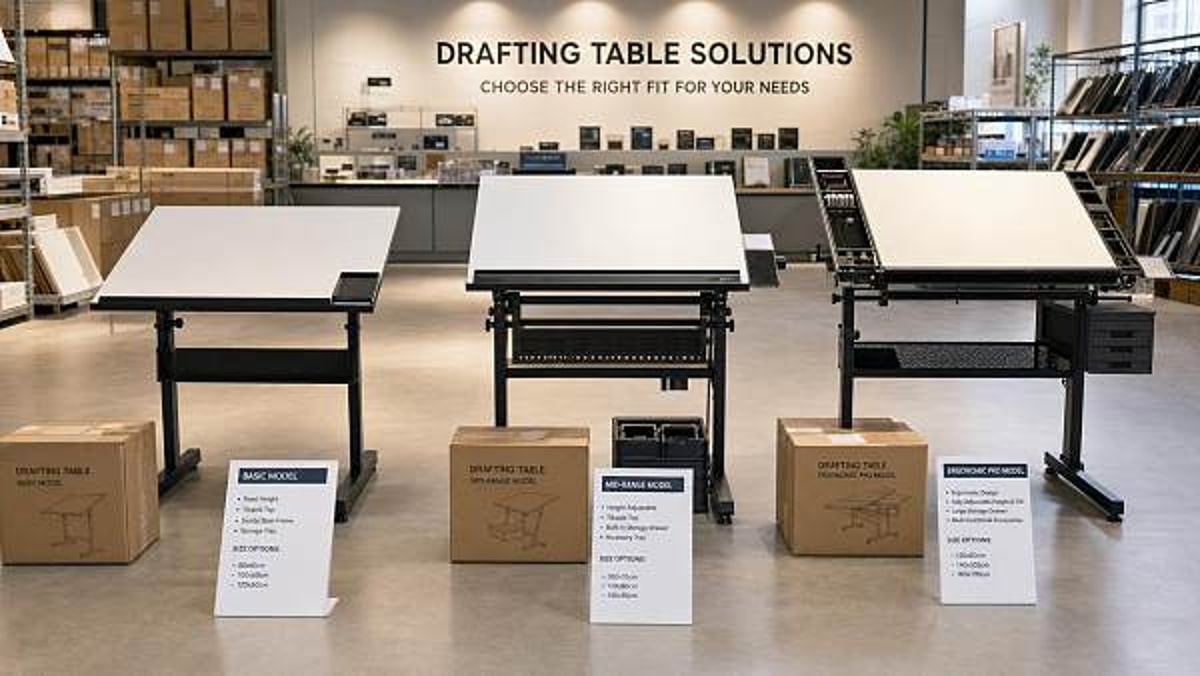
Start by dividing the market into three tiers: basic, mid-range, and specialized. Basic models fit price-driven, high-volume environments. Mid-range models often serve the broadest set of institutional and commercial needs. Specialized models support demanding users or premium spaces. When comparing drafting tables wholesale, ask whether your demand truly requires all three tiers or whether a focused two-tier assortment would reduce complexity while preserving user satisfaction.
Next, evaluate MOQ against actual deployment schedules. If a supplier offers excellent pricing at a high volume threshold, calculate the hidden cost of storing, financing, and potentially discounting excess units. In many cases, a slightly higher per-unit cost paired with lower MOQ, mixed-model ordering, or scheduled release shipments will produce better total value. This is particularly important when buyer demand is seasonal or tied to project milestones.
Then review specification consistency. Procurement teams should confirm dimensions, tabletop materials, frame gauge, hardware quality, edge finishing, adjustability mechanism, locking performance, and assembly requirements. If the supplier provides incomplete or vague details, comparison becomes unreliable. A clear specification sheet makes it easier to benchmark drafting tables wholesale options fairly and to avoid receiving products that appear similar online but perform differently in use.
A practical comparison framework for current market conditions
In a changing market, procurement teams benefit from using a weighted comparison framework rather than an informal review. This helps separate attractive offers from dependable supply solutions.
This framework is especially useful when two drafting tables wholesale suppliers appear similar at first glance. The better supplier is often the one with stronger process control, clearer documentation, and more practical commercial flexibility, not simply the lowest quoted number.
Signals that a low-cost wholesale offer may create future problems
Procurement teams should treat certain signals as warning signs. If a supplier cannot explain the difference between product tiers, cannot provide stable carton specifications, or avoids detailed discussion of hardware and materials, price may be masking inconsistency. The same caution applies when sample quality is strong but batch controls are unclear. In drafting tables wholesale, inconsistency can lead to difficult assembly, higher return rates, and visible mismatch across installations.
Another warning sign is inflexible volume pressure. Some suppliers push large commitments by offering sharp price breaks that exceed realistic consumption. Buyers should ask a simple question: if demand softens, what happens to unsold stock? Unless there is proven turnover, aggressive volume purchasing can create storage cost, tie up budget, and reduce agility for future specification changes.
Packaging is also more strategic than many buyers assume. Drafting tables often include metal frames, boards, and adjustment components that are vulnerable during transit. Weak packaging can erase any savings through damages and replacement handling. For this reason, drafting tables wholesale comparison should include carton strength, corner protection, internal fixing method, labeling accuracy, and spare hardware policy.
Where the next procurement advantage is likely to come from
The next advantage in drafting tables wholesale will likely come from better demand matching rather than bigger purchasing. Buyers that align product assortment closely to usage scenarios will be better positioned than those that simply negotiate hard on headline price. This means using current project data, room layouts, user profiles, and replenishment patterns to decide which models deserve stock depth and which should remain special-order items.
Supplier collaboration will also matter more. Buyers increasingly benefit from vendors who can support pilot runs, sample refinements, staged deliveries, and repeatability across orders. In practical terms, this gives procurement teams a way to test a model’s acceptance before rolling it out at scale. That approach lowers risk and helps avoid overbuying when end-user preferences are still evolving.
Digital procurement discipline is another emerging edge. Teams that standardize their comparison criteria, maintain approved specification libraries, and track performance by supplier are more likely to recognize which drafting tables wholesale relationships deserve expansion. This is especially useful in multi-site organizations where different departments may otherwise buy similar products with conflicting standards.
How procurement teams should respond now
The immediate recommendation is to move from quote comparison to scenario comparison. Instead of asking only, “Which supplier is cheapest?” ask, “Which supplier fits our demand pattern, quality threshold, lead-time needs, and replenishment strategy?” This shift improves decision quality in a market where requirements are more segmented and planning is less predictable.
A practical response plan for drafting tables wholesale sourcing includes five actions. First, classify expected demand by user segment rather than ordering one model for everyone. Second, negotiate MOQ and shipment schedules together, not separately. Third, request complete specifications and test sample consistency. Fourth, compare landed cost and damage exposure, not just ex-factory pricing. Fifth, build a shortlist of suppliers with enough flexibility to support future adjustments.
For organizations buying on behalf of schools, studios, project developers, or resellers, these actions create a more resilient sourcing model. They help buyers preserve budget, limit dead stock, and maintain confidence that the product selected today will still make sense as user needs continue to evolve.
Final decision check before placing a wholesale order
Before committing to drafting tables wholesale, procurement teams should confirm a final set of judgment points: Is the order volume tied to verified demand? Does the specification match actual user tasks? Can the supplier repeat the same quality level across batches? Is there room for phased purchasing if conditions change? And does the commercial structure reward smart replenishment instead of forced overstock?
If your business wants to judge how these market changes affect its own sourcing strategy, focus first on three questions: which product tier your users genuinely need, how much inventory risk your budget can absorb, and which supplier can support flexibility without sacrificing consistency. Those answers will do more to improve drafting tables wholesale outcomes than chasing the lowest price alone.
Search News
Hot Articles
Popular Tags
Need ExpertConsultation?
Connect with our specialized leisureengineering team for procurementstrategies.
Recommended News
 May 05, 2026Cork bulletin boards: why frame quality matters over board sizeCork bulletin boards deliver better long-term value when frame quality comes first. Learn how stronger materials, secure corners, and stable mounting improve durability, safety, and appearance.● Institutional Buyer
 May 05, 2026Soundproof phone booths: when sound ratings mislead office plansSoundproof phone booths can mislead office plans when ratings are taken at face value. Learn how to compare privacy, ventilation, placement, and compliance before you buy.● Institutional Buyer
 May 05, 2026Laser printer toner bulk: what affects page yield mostLaser printer toner bulk page yield depends on more than toner volume. Discover the top factors affecting real output and make smarter, lower-cost sourcing decisions.● Institutional Buyer
 May 05, 2026Science lab furniture: small design choices with big safety impactScience lab furniture shapes lab safety in ways many teams overlook. Discover smart design choices that reduce risk, improve compliance, and support efficient long-term performance.● Institutional Buyer
 May 05, 2026Wholesale ink cartridges: remanufactured vs compatible in real useWholesale ink cartridges compared in real use: remanufactured vs compatible on print quality, yield, firmware risk, and sourcing value—helping procurement teams buy smarter.● Institutional Buyer
 May 05, 2026Cash drawers wholesale: what causes jams at checkoutCash drawers wholesale guide: uncover the real causes of checkout jams, from latch design to POS compatibility, and learn how to source reliable drawers that reduce downtime.● Institutional Buyer
 May 05, 2026Office acoustic pods or open booths: which solves noise betterOffice acoustic pods vs. open booths: discover which solution controls noise better for privacy, focus, and hybrid calls, and make a smarter office planning decision.● Institutional Buyer
 May 05, 2026Office LED panel lights that cut glare without dim workspacesOffice LED panel lights that reduce glare without sacrificing brightness. Discover how to choose low-glare, high-comfort lighting for productive, compliant, and modern office spaces.● Institutional Buyer
 May 05, 2026Chemical resistant lab tops: which materials hold up bestChemical resistant lab tops compared: discover whether epoxy resin, phenolic resin, or stainless steel holds up best for harsh chemicals, heat, and daily lab demands.● Institutional Buyer
 May 05, 2026How to compare drafting tables wholesale without overbuyingDrafting tables wholesale comparison starts with MOQ, specs, and supplier reliability. Learn how to avoid overbuying, reduce inventory risk, and choose better-value sourcing options.● Institutional Buyer
 May 04, 2026Ergonomic Office Chairs Wholesale: Comfort Claims vs Real SupportErgonomic office chairs wholesale: learn how to verify real support beyond comfort claims with fit, adjustability, durability, and compliance insights for smarter commercial buying.● Institutional Buyer
 May 04, 2026Modular Office Workstations: Flexibility Can Add Setup CostsModular office workstations can improve flexibility, but setup costs often rise through installation, power, data, and rework. Learn when the added investment truly pays off.● Institutional Buyer
 May 04, 2026Steel Filing Cabinets: Why Some Drawers Jam Too EarlySteel filing cabinets often jam early due to weak slides, poor leveling, overload, or lock issues. Discover what to check before buying and how to avoid costly drawer failures.● Institutional Buyer
 May 04, 2026Office Network Racks: Airflow Problems Start With Bad PlanningOffice network racks can fail early when airflow is ignored. Learn the key planning checklist to prevent overheating, reduce maintenance risks, and build a more reliable office network.● Institutional Buyer
 May 04, 2026Office Partitions Wholesale: Open Plan Savings, Closed Office NeedsOffice partitions wholesale helps project managers cut fit-out costs, speed delivery, and balance open-plan efficiency with private office performance. Explore smarter commercial workspace solutions.● Institutional Buyer
 May 04, 2026Conference Room Tables: Common Layout Mistakes to AvoidConference room tables can make or break meeting flow. Discover common layout mistakes to avoid and plan smarter spaces for collaboration, AV integration, and professional results.● Institutional Buyer
 May 04, 2026Mobile Pedestals Wholesale: Why Drawer Slides Matter MoreMobile pedestals wholesale buyers should look beyond price—drawer slides shape durability, load capacity, and maintenance costs. Learn what to compare before ordering.● Institutional Buyer
 May 04, 2026Height Adjustable Standing Desks: Stability Matters More Than SpeedHeight adjustable standing desks should be judged by stability, not just speed. Learn how stronger frames improve safety, user confidence, and long-term value in commercial spaces.● Institutional Buyer
 May 04, 2026Executive Office Desks: When Looks Start to Hurt FunctionExecutive office desks should do more than look impressive. Discover how to balance prestige, ergonomics, storage, and tech support for smarter office buying decisions.● Institutional Buyer
 May 04, 2026Server Cabinets Wholesale: How to Avoid Ordering the Wrong DepthServer cabinets wholesale guide: avoid costly depth mistakes by checking usable internal space, rail fit, cable clearance, and expansion needs before placing bulk orders.● Institutional Buyer
 May 04, 2026Commercial Paper Shredders and the Hidden Cost of DowntimeCommercial paper shredders do more than destroy documents—they protect uptime, compliance, and budgets. Discover how to avoid hidden downtime costs and choose smarter for busy workplaces.● Institutional Buyer
 May 04, 2026Mesh Office Chairs OEM Orders: Specs That Cause ReworkMesh office chairs OEM projects often face rework from vague specs, certification gaps, and component mismatches. Learn what to verify before production to avoid delays and protect budgets.● Institutional Buyer
 May 04, 2026Stackable Visitor Chairs That Save Space Without Looking CheapStackable visitor chairs that save space without looking cheap—discover how to choose stylish, durable seating for offices, schools, and hospitality spaces.● Institutional Buyer
 May 04, 2026What Makes Commercial Acoustic Panels Worth the Cost?Commercial acoustic panels help buyers balance cost with performance, compliance, durability, and design. Learn what makes them worth the investment across offices, schools, hotels, and more.● Institutional Buyer