Scientific calculators wholesale: when cheaper models cost more
In scientific calculators wholesale, the lowest unit price rarely produces the lowest real procurement cost. For buyers serving schools, distributors, training centers, exam channels, or institutional supply programs, a cheap calculator can become expensive when it fails early, lacks certification, creates return volume, or arrives inconsistently across batches. The smarter approach is to evaluate total landed value rather than unit price alone.
For procurement teams, the key question is not simply, “Which supplier offers the cheapest scientific calculators wholesale?” It is, “Which product and supplier combination minimizes risk, protects margin, meets user expectations, and remains reliable over the full contract cycle?” In many cases, the answer points away from the lowest quote and toward a more disciplined sourcing decision.
This article examines why cheaper scientific calculator models often cost more over time, what procurement professionals should assess before placing volume orders, and how to compare suppliers using a practical total-cost framework. The goal is to help buyers make sourcing decisions that stand up financially, operationally, and reputationally.
Why the cheapest scientific calculators wholesale offer can become the most expensive
Low-price calculator offers are attractive because they improve apparent purchase efficiency at the quotation stage. Yet wholesale procurement does not end when the PO is issued. Real costs emerge after delivery, during inspection, user deployment, customer service handling, warranty claims, replenishment, and future tender reviews.
In the scientific calculators wholesale market, very low pricing often reflects compromises in component quality, battery performance, key durability, display clarity, packaging consistency, compliance testing, or factory quality control. These compromises may not be visible in product photos or early samples, but they appear quickly at scale.
A buyer who saves 8% on unit cost may later absorb 15% in hidden operational loss. Common cost drivers include return handling, dead-on-arrival replacement, complaints from schools or resellers, emergency reordering from alternate suppliers, delayed program rollouts, and staff time spent managing defects. Once those costs are included, the “cheaper” model can become the more expensive choice.
This is especially true for procurement teams supplying education channels, institutional exams, office distributors, and government-linked contracts. In these environments, reliability and standardization matter more than a marginal unit saving. A failed calculator is not just a product issue; it can disrupt classroom use, damage trust with the end client, and undermine contract renewal potential.
What procurement buyers actually care about when sourcing calculators
The target reader for this topic is usually not a casual consumer. It is a procurement manager, category buyer, importer, distributor, or institutional sourcing professional. That audience cares less about marketing language and more about supply confidence, usable product quality, and commercial predictability.
In practical terms, buyers tend to focus on six questions. First, will the calculators perform reliably over the expected usage period? Second, do they comply with the standards required in the destination market? Third, can the supplier maintain consistent quality across large batches? Fourth, will after-sales issues remain manageable? Fifth, is the landed cost still competitive after risk is considered? Sixth, can the supplier support long-term replenishment without disruptive variation?
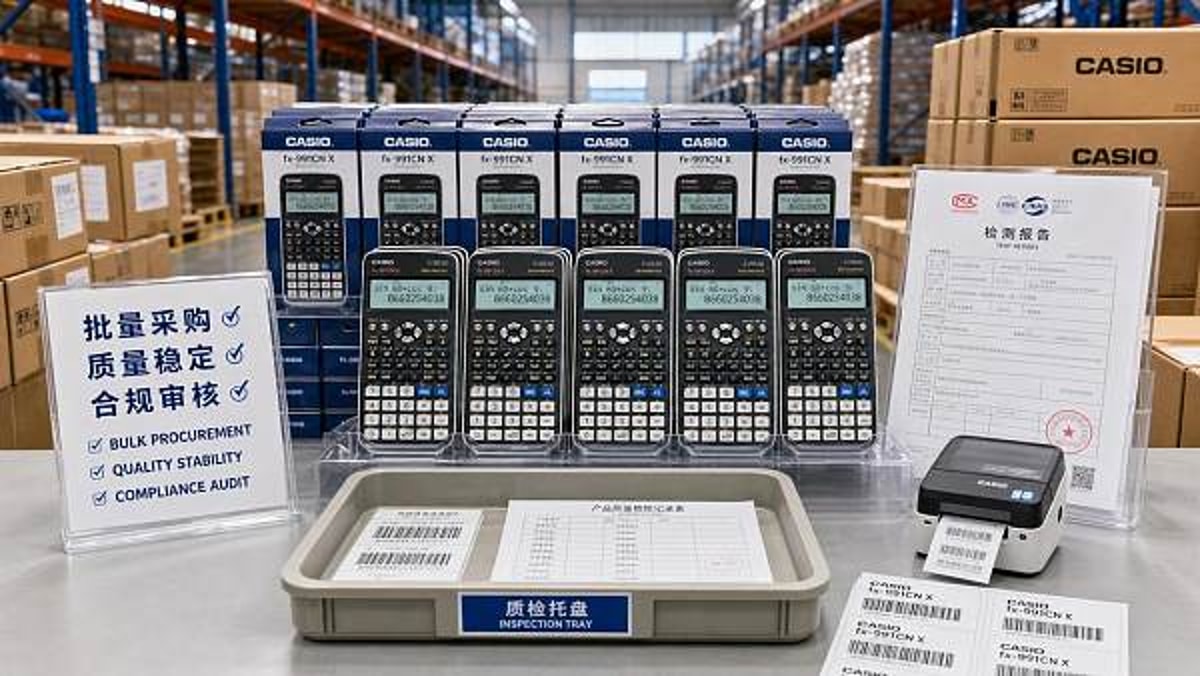
These concerns are why scientific calculators wholesale sourcing should be treated as a category management decision, not a one-time price hunt. The best suppliers help buyers reduce uncertainty. They provide stable specifications, documented testing, clear quality procedures, realistic lead times, and responsive problem resolution. Those capabilities often matter more than a slightly lower FOB price.
The hidden costs that inflate “cheap” calculator purchases
To understand why cheaper models can cost more, procurement teams should break the total cost into visible and hidden categories. The purchase price is only one line item. Hidden costs are where low-grade sourcing decisions become expensive.
1. Quality failure costs. If keys stick, solar panels underperform, displays fade, or internal boards fail, replacement rates increase. Even a 3% to 5% defect rate creates meaningful overhead in high-volume orders. The buyer pays not just for replacement units, but also for claims processing, reverse logistics, customer support time, and damaged channel relationships.
2. Compliance and market access risk. In many markets, calculators require specific safety, chemical, packaging, labeling, or battery-related compliance documentation. If a low-cost supplier lacks valid CE, RoHS, REACH, or other applicable declarations, the shipment may face customs delays, testing disputes, fines, relabeling expense, or rejection. A low quote can collapse instantly when compliance gaps surface.
3. Inconsistent batch quality. One approved sample does not guarantee stable mass production. Some factories outsource subcomponents or alter materials to maintain price targets. Procurement teams then receive calculators that look similar but perform differently. This creates SKU instability, customer confusion, and difficult quality claims because the defect is not always obvious during basic incoming inspection.
4. Short service life. Scientific calculators are often used repeatedly in classrooms, offices, tutoring centers, or exam prep settings. A model that fails after months instead of years increases replacement frequency and weakens total value. The unit cost may be lower, but the annualized cost of ownership becomes higher.
5. Packaging and presentation losses. For distributors and institutional buyers, poor packaging matters. Crushed boxes, unclear manuals, low-grade printing, and mixed accessories reduce perceived quality and generate complaints even when the device itself works. In retail-adjacent or educational supply channels, presentation affects acceptance and return rates.
6. Supplier reliability risk. The cheapest supplier may be unable to hold production slots, maintain lead time, or support repeat orders. If replenishment fails during peak academic seasons, buyers may need urgent spot purchasing at higher prices. That turns a low-cost contract into a margin-eroding emergency.
How to evaluate scientific calculators wholesale using total cost of ownership
A more effective way to compare offers is to use total cost of ownership, or TCO. This framework helps procurement teams evaluate what they will actually spend over the life of the sourcing cycle, rather than what appears on the first quotation.
A simple TCO model for scientific calculators wholesale can include: unit purchase price, tooling or customization cost, compliance testing cost, shipping and duties, inbound inspection cost, expected defect rate, return handling, warranty replacement expense, customer service labor, and forecasted replenishment risk. When these factors are modeled together, supplier rankings often change.
For example, Supplier A may offer a calculator at $3.20 and Supplier B at $3.45. On paper, Supplier A looks cheaper. But if Supplier A has a 6% return rate, limited documentation, inconsistent key quality, and frequent delays, while Supplier B has a 1% return rate, full compliance files, stable production, and better packaging, Supplier B may deliver lower actual cost and far less channel friction.
Procurement teams do not need a highly complex model to benefit. Even a basic comparison sheet can reveal the difference between nominal savings and real savings. The important shift is strategic: stop measuring calculators only by order price and start measuring them by delivered performance.
Product quality checks that matter more than appearance
In many sourcing categories, visual inspection catches obvious issues. With calculators, appearance is only the beginning. A product can look acceptable in photos and still perform poorly in real use. Procurement teams should define test points that reflect actual operating conditions.
Start with the keypad. Key responsiveness, travel consistency, print durability, and resistance to sticking are critical, especially in education environments with frequent repetitive use. A calculator that loses key function early will generate immediate dissatisfaction, even if all other features remain intact.
Next, assess display quality. Screen contrast, readability under classroom lighting, viewing angle, and response consistency all affect user experience. Weak displays are common in very low-cost models and can produce complaints that are hard to classify as “defects” but still hurt customer satisfaction.
Battery and power performance are equally important. If the calculator uses dual power, test both solar and battery behavior under realistic indoor conditions. Some low-price units advertise solar support but function poorly in normal office or classroom light. That leads to unpredictable shutdowns and user frustration.
Housing durability also deserves attention. Check casing fit, hinge strength where applicable, drop resistance, and scratch sensitivity. Institutional procurement often involves transport, storage, and repetitive handling. A fragile shell raises replacement rates long before internal electronics fail.
Finally, review instruction quality and labeling. A badly translated manual, inconsistent function naming, or unclear package labeling increases support burden. For wholesale buyers serving schools or resellers, these details influence product acceptance more than many suppliers realize.
Compliance, certification, and documentation are not optional extras
One of the biggest mistakes in scientific calculators wholesale sourcing is treating compliance as a formality after price negotiation. For procurement teams, documentation should be part of supplier qualification from the start.
Depending on the target market, buyers may need declarations or test reports related to CE, RoHS, REACH, WEEE, battery rules, packaging standards, or other local requirements. The exact set varies by destination and product configuration, but the principle is constant: if the supplier cannot provide clear, current, verifiable documents, the risk profile rises sharply.
Buyers should also verify whether documentation applies to the exact model being purchased, not just a similar product from the same factory. A common issue in low-cost sourcing is the recycling of outdated reports or the presentation of documents that cover different materials or electrical configurations.
Strong suppliers support procurement with organized technical files, labeling consistency, carton marks, HS code familiarity, and rapid response during customs or customer audits. This administrative competence reduces non-product risk, which is often where wholesale programs become unexpectedly costly.
Why supplier consistency matters as much as calculator performance
Many procurement problems do not come from the calculator design itself. They come from the supplier’s inability to manufacture consistently over time. A good first order does not automatically mean a good annual supply relationship.
Consistency includes stable raw material sourcing, controlled assembly procedures, repeatable quality checkpoints, and disciplined packaging standards. It also includes the supplier’s ability to maintain the same model specification without silent substitutions. When low-cost factories face margin pressure, they may change batteries, keypads, displays, or internal boards without clearly informing the buyer.
This creates serious downstream issues. Schools and distributors may receive the “same” model with different tactile feel, different display behavior, or different longevity. Support teams then struggle to standardize troubleshooting, and procurement loses confidence in future tenders.
To reduce this risk, buyers should request production batch records, quality control procedures, approved sample retention, and clear change-notification commitments. A reliable scientific calculators wholesale partner understands that specification stability is part of the value proposition.
Questions procurement teams should ask before placing a volume order
Good sourcing outcomes often come from asking better questions early. Before placing a large order, procurement teams should go beyond price, MOQ, and lead time.
Useful questions include: What is the historical defect rate for this model? What incoming and final inspections are performed? Which components are sourced in-house versus externally? Can the supplier provide current compliance documents for the exact SKU? What is the standard warranty claim process? How are production changes communicated? What percentage of orders ship on time? Can spare or replacement units be built into the contract?
Buyers should also ask for a pilot quantity or pre-shipment sample from actual mass production, not only a showroom sample. This helps reveal whether the factory can reproduce approved quality at scale. For strategic accounts, it is often worth performing a third-party inspection before shipment, especially when the supplier is new.
These steps may seem slower than simply selecting the lowest quote, but they are faster than solving preventable quality or compliance failures after arrival.
When a lower-cost model still makes sense
Not every procurement project requires a premium calculator. There are cases where a lower-cost model is commercially sensible. The key is to match product quality to the use case rather than defaulting to the cheapest option across all channels.
For short-cycle promotional programs, basic educational kits, non-critical training environments, or highly price-sensitive bids, a lower-cost calculator may be acceptable if minimum quality and compliance thresholds are still met. The mistake is not buying a budget model. The mistake is buying an unreliable model for a use case that demands durability and consistency.
Procurement teams should segment demand. High-frequency classroom use, institutional contracts, and branded resale channels usually justify stronger specifications and tighter supplier control. One-off value programs may tolerate a simpler product. Category strategy, not unit price alone, should determine the sourcing decision.
How to make smarter scientific calculators wholesale decisions
The most effective procurement teams build a sourcing scorecard. Price remains important, but it sits alongside defect rate, documentation completeness, on-time delivery, response speed, packaging quality, consistency, and total support burden. This creates a more accurate picture of supplier value.
It is also wise to compare suppliers over a multi-order horizon. A partner that is slightly more expensive but dependable over 12 months is often better than a low-cost source that fails on the second shipment. Procurement performance should be measured by continuity and cost control across the contract cycle, not by isolated unit-price wins.
For buyers working in education supply, office products distribution, or institutional sourcing, the lesson is simple: scientific calculators wholesale should be treated as a risk-managed purchasing category. The calculator is a relatively small-ticket item, but the consequences of poor sourcing can scale quickly when volumes are high and users are sensitive to reliability.
Conclusion: cheaper calculators are not always lower-cost procurement
In scientific calculators wholesale, low unit price can be misleading. What appears cheap at quotation stage may become expensive after defects, compliance issues, short lifecycles, inconsistent batches, and supplier instability are factored in. Procurement teams that focus only on upfront price often inherit avoidable cost later.
The better sourcing approach is to evaluate total landed value: reliable performance, valid documentation, stable quality, predictable supply, and manageable after-sales exposure. Buyers who apply that lens are more likely to protect margins, reduce operational friction, and deliver better outcomes for end users.
In other words, the real objective is not to buy the cheapest calculator. It is to buy the calculator that creates the lowest total cost and the highest supply confidence for the business. That is the standard procurement professionals should use when comparing scientific calculators wholesale options.
Search News
Hot Articles
Popular Tags
Need ExpertConsultation?
Connect with our specialized leisureengineering team for procurementstrategies.
Recommended News
 May 06, 2026Tablet charging carts with locking doors still need these checksTablet charging carts with locking doors still need key checks. Learn how to evaluate ventilation, power safety, mobility, and compatibility before you buy.● Institutional Buyer
 May 06, 2026Document cameras for teachers: image quality or software first?Document cameras for teachers: should you prioritize image quality or software? Explore a practical checklist to compare clarity, workflow, compatibility, and long-term value.● Institutional Buyer
 May 06, 2026Smart podiums for classrooms that fit hybrid teaching betterSmart podiums for classrooms designed for hybrid teaching: compare integration, durability, ergonomics, and serviceability to choose scalable solutions that cut support issues and improve teaching efficiency.● Institutional Buyer
 May 06, 2026Chromebook charging stations and the airflow issue many missChromebook charging stations often look efficient, but airflow is the hidden factor that impacts battery life, safety, and charging performance. Learn what smart buyers should inspect before choosing.● Institutional Buyer
 May 06, 2026Language lab equipment features that improve speaking practiceLanguage lab equipment features can dramatically improve speaking practice. Discover which tools best fit schools, universities, exam centers, and training programs.● Institutional Buyer
 May 06, 2026Wireless presentation systems that solve lag in larger roomsWireless presentation systems for larger rooms: discover how to reduce lag, improve stability, strengthen security, and ensure smooth sharing across enterprise AV and IT environments.● Institutional Buyer
 May 06, 2026Tablet charging carts and the hidden issue of cable wearTablet charging carts face a hidden reliability risk: cable wear. Learn how smarter evaluation can reduce downtime, lower maintenance costs, and improve long-term device performance.● Institutional Buyer
 May 06, 2026Scientific calculators wholesale: when cheaper models cost moreScientific calculators wholesale is not just about the lowest quote. Learn how defects, compliance, batch consistency, and supplier reliability affect true cost—and how smarter sourcing protects margin.● Institutional Buyer
 May 06, 2026IOC Selects Chinese University’s Athlete Support Model as Global Procurement BenchmarkIOC adopts Chinese university's AI psychological coaching + wearable load monitoring model as global procurement benchmark — a strategic opportunity for edtech, sports health tech, and data security providers.● Institutional Buyer
 May 05, 2026Liaoning Tieren Appoints Korean Coach Xu Zhengyuan, Signals Shift in K-League Equipment ProcurementLiaoning Tieren appoints Korean coach Xu Zhengyuan — sparking interest in K-League equipment procurement and KFA 2026-certified smart training tech.● Institutional Buyer
 May 05, 2026Physics lab apparatus: where low-cost kits usually fall shortPhysics lab apparatus buying on price alone often leads to poor accuracy, weak durability, and higher lifecycle costs. Learn what low-cost kits miss and how to source safer, better-value solutions.● Institutional Buyer
 May 05, 2026School laboratory equipment: what should be replaced firstSchool laboratory equipment replacement starts with safety-critical assets. Learn what to replace first to improve compliance, reduce downtime, and maximize tight budgets.● Institutional Buyer
 May 05, 2026Thermal receipt printers: hidden upkeep costs before large rolloutThermal receipt printers may look affordable, but hidden upkeep costs can erode rollout budgets. Learn how to reduce downtime, control maintenance, and choose smarter for scale.● Institutional Buyer
 May 05, 2026Human anatomy models that improve hands-on teaching, not storageHuman anatomy models built for hands-on teaching, not storage. Discover durable, classroom-ready options that improve engagement, simplify setup, and support smarter education sourcing.● Institutional Buyer
 May 05, 2026Ceiling mount projector brackets: where installation mistakes happenCeiling mount projector brackets: discover where installation mistakes happen, how to avoid safety and alignment issues, and the checklist that helps teams deliver smoother AV projects.● Institutional Buyer
 May 05, 2026Barcode scanners for library: common issues with older systemsBarcode scanners for library upgrades can solve slow checkouts, read errors, and compatibility issues in older systems. Learn what fails first and how to choose a reliable replacement.● Institutional Buyer
 May 05, 2026What to check before ordering wholesale projector screensWholesale projector screens buyers should check material, gain, aspect ratio, installation, and supplier consistency before ordering. Reduce sourcing risk and choose reliable commercial solutions.● Institutional Buyer
 May 05, 2026Geography globes wholesale: what makes one model classroom-readyGeography globes wholesale buyers: discover what makes a model truly classroom-ready, from durability and readability to safety, compliance, and reliable bulk supply.● Institutional Buyer
 May 05, 2026Microscope slides wholesale: where quality gaps usually show upMicroscope slides wholesale buyers should watch for hidden quality gaps in flatness, edge finishing, cleanliness, and batch consistency—learn how to reduce waste and choose reliable suppliers.● Institutional Buyer
 May 05, 2026POS touch screens: what affects response speed and lifespanPOS touch screens directly impact checkout speed, uptime, and total cost. Learn what affects response speed and lifespan to choose the right solution for every business scenario.● Institutional Buyer
 May 04, 2026Kindergarten Furniture Bulk Orders and the Safety Details MissedKindergarten furniture bulk buyers: discover the hidden safety checks suppliers often miss, from emissions and stability to ergonomics and compliance, before placing large orders.● Institutional Buyer
 May 04, 2026School Desks and Chairs Wholesale: Matching Age to Size CorrectlySchool desks and chairs wholesale guide: learn how to match age to size correctly for better comfort, safety, compliance, and smarter school furniture purchasing.● Institutional Buyer
 May 04, 2026Library Bookshelves Wholesale: How Much Load Is Really Enough?Library bookshelves wholesale guide: learn how much load is truly enough for safety, durability, and compliance. Compare ratings, avoid costly mistakes, and choose the right shelving with confidence.● Institutional Buyer
 May 04, 2026Smart Interactive Whiteboards: Which Features Get Used Daily?Smart interactive whiteboards: discover which features teams and teachers actually use daily, from touch accuracy and wireless casting to easy collaboration, ROI, and smarter buying decisions.● Institutional Buyer