Clear pencil cases that last longer in busy school settings
For procurement teams managing high-traffic school environments, choosing clear pencil cases is about more than visibility alone. Long-lasting performance, student safety, easy inspection, and cost efficiency all matter when supplies face daily wear. This article explores what makes clear pencil cases durable in busy educational settings and how buyers can evaluate materials, construction, and supplier reliability for smarter sourcing decisions.
School supply buying is shifting from low upfront cost to longer service life
A noticeable change in educational procurement is the move away from buying purely on unit price. In many school systems, clear pencil cases were once treated as simple accessories with limited strategic value. That view is changing. Higher student mobility, stricter campus security routines, tighter budget scrutiny, and greater attention to waste reduction are pushing buyers to evaluate durability more carefully. In busy school settings, replacement cycles matter. A pencil case that splits after one semester may appear inexpensive at first, but frequent reordering increases administrative workload, raises logistics costs, and creates avoidable material waste.
For procurement officers, the question is no longer just whether clear pencil cases are transparent enough for inspection. The more important question is which models can handle repeated opening, stuffing, dropping, and storage in crowded backpacks without cracking, clouding, or tearing. This shift reflects a broader trend across office and educational supplies: buyers are demanding products that perform reliably under real institutional use conditions rather than ideal showroom conditions.
Why demand for more durable clear pencil cases is increasing now
Several market signals are shaping sourcing decisions. First, school environments have become more operationally complex. Shared classrooms, rotating schedules, after-school programs, and transport between home and campus create more handling stress on basic student supplies. Second, schools are under pressure to demonstrate value in every category, even low-cost items. Third, clear storage products are increasingly favored where visual inspection supports safety and compliance procedures. As a result, clear pencil cases must now combine transparency with structural resilience.
Another important driver is sustainability. Many institutions are trying to reduce disposable purchases. A durable case that survives a full academic year, or even multiple years, aligns better with responsible procurement goals than cheap options that quickly fail. This does not mean schools will automatically pay premium prices. Instead, buyers are looking for stronger life-cycle value: acceptable pricing, fewer replacements, less disruption, and better student usability.
Key demand drivers behind the change
Material choices are becoming a major decision point
One of the biggest changes in the category is that material specification is no longer a background detail. In durable clear pencil cases, the material determines far more than appearance. It affects flexibility in cold classrooms, resistance to cracking, tolerance for overfilling, ease of cleaning, odor profile, and long-term transparency. Buyers who once accepted generic “PVC clear case” descriptions are now more likely to request precise information about thickness, softness, reinforcement, and compliance.
PVC is still common because it is cost-effective and easy to produce in transparent formats. However, TPU, EVA-based constructions, and improved composite plastics are gaining attention where flexibility, lower odor, or better resistance to splitting is required. Material upgrades are especially relevant for younger students, who often handle supplies more roughly, and for institutions with stricter standards around chemicals and user safety.
From a procurement perspective, durability cannot be judged by thickness alone. A thicker sheet may still fail if the formulation becomes brittle, if the edges are weak, or if the zipper attachment is poor. High-performing clear pencil cases often combine balanced thickness with good flexibility, stable welding or stitching, and hardware that can survive repeated use cycles.
Construction quality is now as important as transparency
A second industry shift is the rising importance of construction details. In school use, failure often begins at stress points rather than across the entire body of the case. Corners split, zipper tapes detach, stitched sections fray, and closure systems jam. That means sourcing teams should assess build quality in a more structured way.
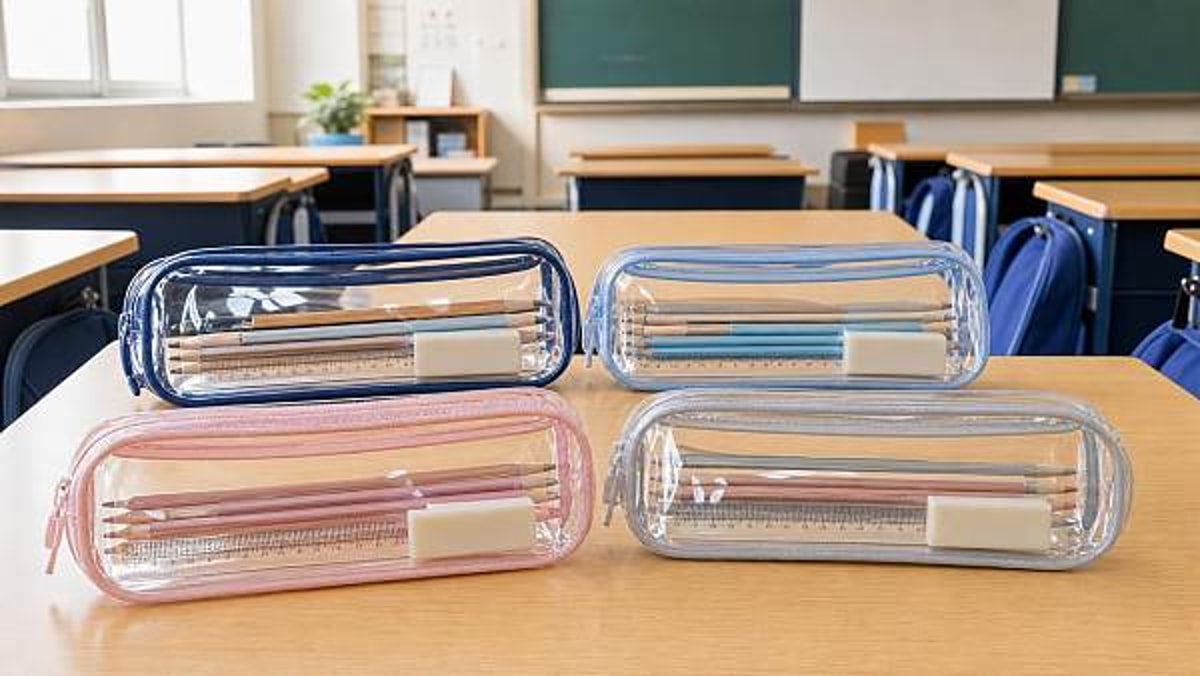
The best clear pencil cases for busy school settings typically show consistency in the following areas: reinforced edges, smooth zipper travel, secure zipper stops, uniform welding lines or stitching, and enough flexibility to bend without whitening or cracking. Rounded corners can also improve longevity by reducing concentrated stress. If the case includes mesh, fabric trim, or colored binding, those components should be tested for peeling and abrasion as well.
This construction-focused view reflects a wider procurement trend: schools increasingly want evidence of performance under use, not just product photos and catalog descriptions. Samples, wear testing, and defect-rate history are becoming more relevant in supplier evaluation, even for standard educational accessories.
What buyers should inspect before approving a model
- Material flexibility after repeated bending
- Resistance to scratching and clouding
- Strength of seams, welds, and stitched joins
- Zipper quality, puller durability, and opening smoothness
- Edge finishing and corner reinforcement
- Cleaning performance after pen marks or dust exposure
- Safety and compliance documentation for school use
Safety, compliance, and inspection needs are influencing specifications
Another clear trend is the tightening link between product durability and compliance. For procurement teams, transparent school storage products must support safe campus operations while also meeting institutional expectations around materials. Depending on market destination, buyers may request documentation related to restricted substances, phthalate limitations, CPSIA-related requirements, REACH considerations, or general product safety testing. The exact standard varies by region, but the direction is clear: schools want fewer sourcing risks and stronger documentation.
This affects how clear pencil cases should be shortlisted. A model that looks durable but lacks credible compliance support may create unnecessary risk, especially for district-level procurement or cross-border supply. Buyers should also consider user comfort. Strong odor, sticky surfaces, or sharp edges can quickly lead to complaints even if the product passes basic visual checks. In practice, long-lasting performance today means a combination of mechanical durability, user acceptability, and regulatory confidence.
The impact is different across procurement roles and school segments
Not every buyer experiences these changes in the same way. A private school purchasing manager may emphasize aesthetics and parent satisfaction, while a public district buyer may prioritize compliance, bid consistency, and replacement cost. Wholesalers and educational distributors may focus more on SKU stability and supplier fill rates. Understanding these different pressures helps explain why the market for clear pencil cases is becoming more segmented.
Supplier reliability is becoming part of the product decision
In a more demanding market, a durable product specification means little without dependable execution. One important trend is that procurement teams increasingly evaluate clear pencil cases together with supplier capability. Can the factory maintain material consistency over large runs? Are zipper and trim components stable from batch to batch? Is there a clear inspection process before shipment? Can the supplier support custom labeling, school branding, or pack assortment without introducing quality drift?
This is particularly relevant when schools order before peak academic seasons. Late delivery can be as disruptive as poor durability. Buyers should therefore assess lead-time realism, production capacity, packaging standards, sample accuracy, and communication responsiveness. For B2B procurement, the stronger sourcing decision is often the one that balances product longevity with supply chain predictability.
What future-ready procurement teams should watch next
Looking ahead, several signals deserve attention. First, material innovation will continue, especially where buyers want transparency with improved softness, lower odor, and better environmental positioning. Second, quality documentation will become more visible in competitive tenders. Third, schools may increasingly request proof of durability through sample testing rather than accepting generic claims. Fourth, more buyers will compare total cost of ownership across the academic year, including replacement frequency and handling effort.
There is also likely to be growing demand for adaptable designs. Clear pencil cases that work for pencils, calculators, art tools, and exam accessories may outperform narrowly designed products because they support standardization across grade levels. For procurement teams, this means that versatility can be a cost-control advantage when paired with strong durability.
Practical judgment framework for upcoming sourcing rounds
How to respond to the trend without overbuying or overspecifying
The smartest response is not simply to buy the most expensive clear pencil cases on the market. Instead, procurement teams should define actual use conditions. Are the cases for daily classroom use, testing environments, school stores, starter kits, or institutional distribution programs? Will they be handled mostly by younger children, middle school students, or mixed-age groups? Will inspection visibility be a mandatory requirement? These answers help determine where stronger materials and construction add meaningful value and where a standard product remains sufficient.
A practical approach is to test two or three specification levels under real school conditions for several weeks. Review damage points, student feedback, cleaning results, and replacement rates. This kind of field-based comparison often reveals that the best-value clear pencil cases are not necessarily the cheapest or the most premium, but the ones that balance transparency, comfort, durability, and supplier consistency.
Final sourcing perspective for institutional buyers
The market direction is clear: clear pencil cases are being evaluated with more discipline because school operations demand more from every product category. The trend is being shaped by heavy daily use, safety and inspection expectations, compliance awareness, sustainability goals, and a stronger focus on total cost over time. For buyers, the opportunity is to move beyond basic transparency and identify products that hold up in real educational settings.
If your organization wants to judge how these changes affect its own purchasing strategy, focus on a few key questions: Which failure points appear most often in your current supply program? How many replacements are occurring per term? Which compliance documents are now expected in your target market? And which suppliers can consistently deliver durable clear pencil cases at the quality level your schools actually need? Those answers will provide a stronger basis for the next sourcing decision than price alone.
Search News
Hot Articles
Popular Tags
Need ExpertConsultation?
Connect with our specialized leisureengineering team for procurementstrategies.
Recommended News
 May 06, 2026Wholesale children books: how to judge value beyond unit priceWholesale children books should be judged by more than unit price. Discover how to compare quality, safety, content value, and supplier reliability for smarter buying.● Institutional Buyer
 May 06, 2026Math manipulatives bulk orders that support mixed-age classroomsMath manipulatives bulk solutions for mixed-age classrooms: compare durable, age-flexible, safety-focused options that improve teaching continuity, reduce waste, and simplify school purchasing.● Institutional Buyer
 May 06, 2026Wholesale compasses and dividers that stay accurate over timeWholesale compasses and dividers built for lasting accuracy. Discover how to evaluate hinge stability, material quality, and batch consistency to reduce replacement costs.● Institutional Buyer
 May 06, 2026Marching band uniforms that look sharp without raising repair billsMarching band uniforms that stay sharp and lower repair costs. Compare fabrics, construction, and supplier reliability to choose durable, budget-smart uniforms.● Institutional Buyer
 May 06, 2026Geometry sets wholesale: which pieces matter most in real useGeometry sets wholesale buying is easier when you know which pieces truly matter. Discover the essential tools, quality checks, and sourcing tips that improve value and reduce replacement costs.● Institutional Buyer
 May 06, 2026Clear pencil cases that last longer in busy school settingsClear pencil cases built for busy schools: discover how durable materials, safer construction, and reliable suppliers help cut replacements, support inspections, and improve long-term value.● Institutional Buyer
 May 06, 2026Flash cards manufacturer questions that affect print consistencyFlash cards manufacturer selection affects color accuracy, material stability, and batch consistency. Learn the key sourcing questions that help reduce risk and ensure reliable print quality.● Institutional Buyer
 May 06, 2026What makes educational posters bulk orders worth the priceEducational posters bulk orders cost more upfront, but they cut unit prices, improve classroom consistency, and last longer. See why schools and institutions view them as a smart investment.● Institutional Buyer
 May 06, 2026Why wholesale erasers and sharpeners vary so much in qualityWholesale erasers and sharpeners vary in quality due to materials, blade engineering, safety compliance, and production control. Learn how to source smarter and reduce risk.● Institutional Buyer
 May 05, 2026Shandong Lions Reject Tao Hanlin’s Retirement — Implications for Sportswear OEMsSportswear OEMs: Shandong Lions’ rejection of Tao Hanlin’s retirement signals growing buyer focus on supplier longevity, stability & cultural trust in global sourcing.● Institutional Buyer
 May 05, 2026Custom promotional pens that get used instead of thrown awayCustom promotional pens that people actually keep: learn how to choose quality, comfortable, brand-right pens that boost visibility, reduce waste, and deliver better long-term value.● Institutional Buyer
 May 05, 2026Custom graduation gowns: why fabric choice changes event photosCustom graduation gowns look dramatically different on camera depending on fabric. Learn how sheen, drape, and wrinkle resistance shape photo quality and smarter sourcing.● Institutional Buyer
 May 05, 2026Ballpoint pens bulk: why writing distance changes buyer satisfactionBallpoint pens bulk buyers often overlook writing distance, yet it strongly shapes user satisfaction, brand perception, and reorder value across offices, schools, promotions, and service counters.● Institutional Buyer
 May 05, 2026Watercolor paints bulk: student use reveals quality fastWatercolor paints bulk for schools: see how student use quickly exposes pigment, packaging, and durability issues. Learn what buyers should check before sourcing at scale.● Institutional Buyer
 May 05, 2026Wholesale sticky notes: which paper grades actually stay putWholesale sticky notes buyers: learn which paper grades truly stay put. Compare economy, office, premium, and recycled options to improve adhesion, writing quality, and repeat orders.● Institutional Buyer
 May 05, 2026Highlighter markers wholesale: why ink consistency matters moreHighlighter markers wholesale buyers should look beyond price: consistent ink flow improves writing performance, reduces complaints, and supports stronger repeat orders. Learn what reliable sourcing really requires.● Institutional Buyer
 May 05, 2026Wholesale school backpacks: when low price leads to high returnsWholesale school backpacks may look cost-saving, but low prices often mean higher returns, complaints, and hidden procurement costs. Learn how to compare suppliers smarter.● Institutional Buyer
 May 05, 2026Art supplies wholesale trends schools are paying attention toArt supplies wholesale trends schools are watching now: safer materials, smarter bulk buying, sustainable options, and reliable suppliers that protect budgets and improve classroom outcomes.● Institutional Buyer
 May 05, 2026Colored pencils wholesale: which specs matter beyond color countColored pencils wholesale buyers should look beyond color count. Compare core strength, pigment quality, safety, wood, and packaging to source better products with confidence.● Institutional Buyer
 May 05, 2026School uniforms wholesale: what causes fit issues at scaleSchool uniforms wholesale fit issues often start with sizing gaps, fabric behavior, and weak supplier coordination. Learn the key causes and how buyers can reduce returns and protect uniform program quality.● Institutional Buyer
 May 05, 2026Graduation caps and tassels: matching colors is harder than it looksGraduation caps and tassels are harder to match than they seem. Learn how to control color standards, supplier quality, and bulk order accuracy for flawless ceremony delivery.● Institutional Buyer
 May 05, 2026Why some dry erase boards bulk orders fail in daily useDry erase boards bulk orders can fail fast in real use. Learn what causes ghosting, warping, weak mounting, and short lifespan—and how to source boards that truly fit schools, offices, hotels, and healthcare.● Institutional Buyer
 May 04, 2026PU Leather Journals: Why Some Covers Peel Too SoonPU leather journals can look elegant and affordable, but why do some peel so quickly? Discover the real causes, warning signs, and smarter buying tips before you choose.● Institutional Buyer
 May 04, 2026Retractable Badge Reels: The Small Item That Fails FirstRetractable badge reels fail faster than many workplace accessories. Learn what causes breakage, how to source durable options, and how to cut replacement costs.● Institutional Buyer