Marching band uniforms that look sharp without raising repair bills
For procurement teams, choosing marching band uniforms means balancing visual impact with long-term maintenance costs. The right designs can keep bands looking polished on the field while reducing repair frequency, replacement spend, and sourcing headaches. This guide explores how buyers can evaluate materials, construction, and supplier reliability to secure uniforms that perform well and protect budgets.
Why scenario differences matter before you source marching band uniforms
Not every band uses uniforms in the same way, and that is where many avoidable repair bills begin. A school program with weekly practices, regional travel, and rotating student members will stress garments very differently than a parade unit that wears uniforms only a few times each season. A university marching ensemble may demand premium visual consistency under stadium lighting, while a municipal or community band may prioritize easy alterations, storage durability, and straightforward reorder processes.
For buyers, the smartest approach is to evaluate marching band uniforms by application scenario rather than by catalog appearance alone. The same decorative trim, shoulder structure, or fitted silhouette that looks impressive in a showroom can raise annual maintenance costs if the band performs in heat, rain, buses, crowded changing areas, or frequent outdoor competitions. Procurement decisions should therefore connect design choices with wear frequency, user turnover, climate, laundering access, and repair resources.
This scenario-based view fits the broader commercial sourcing mindset: total value matters more than unit price. Buyers need uniforms that sustain brand image, support performance needs, and reduce operational friction across the full lifecycle. In practical terms, that means looking beyond color and style toward fabric resilience, seam construction, trim attachment methods, stain management, and supplier responsiveness.
Common use cases and what each one demands
The most effective marching band uniforms are those matched to how the band actually performs. Procurement teams can reduce repair spend by identifying the dominant use case early and aligning specifications accordingly.
Scenario 1: High school bands need marching band uniforms built for heavy use
In high school settings, uniforms face some of the toughest operational conditions. Students dress quickly, travel often, and perform in unpredictable weather. Sizing changes from year to year, and garments are handled by many users with different levels of care. In this scenario, buyers should treat durability and serviceability as first-tier requirements rather than secondary considerations.
Look for marching band uniforms with reinforced stress points at underarms, seat seams, crotch seams, sleeve joins, and closure areas. Hidden stretch panels can help reduce seam strain without changing the visual profile. Fabrics should resist snags from instrument hardware, velcro accessories, and trailer loading. Easy hem adjustments, replaceable cuffs, and modular bibber systems are especially valuable where student membership changes annually.
In this use case, procurement teams often save more through fewer repairs than through a lower initial quote. Uniforms that can survive repeated practice-to-performance cycles with simple upkeep usually deliver the best long-term cost profile.
What to specify
- Double-stitched or reinforced high-motion seams
- Colorfast, machine-manageable shell fabrics where appropriate
- Standardized replacement parts for buttons, plumes, trim, and zippers
- Clear alteration allowances for future resizing
Scenario 2: University and stadium bands need sharper presentation without fragile detailing
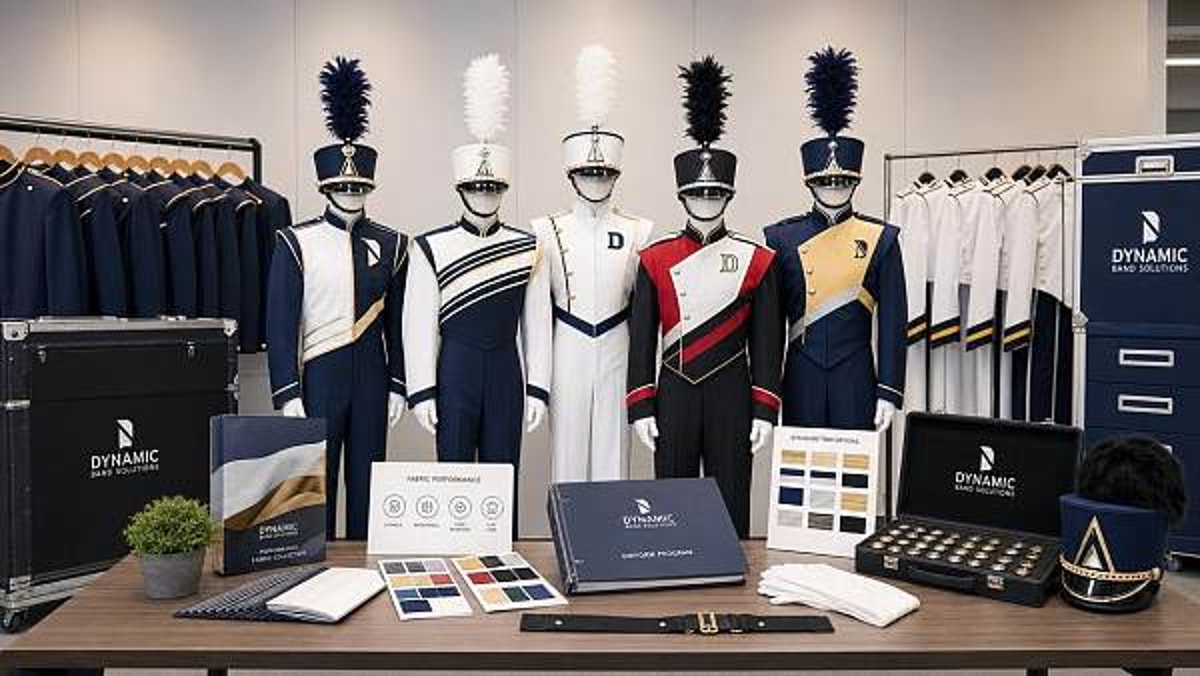
University bands typically place greater emphasis on broadcast visibility, school identity, and consistent presentation across large formations. Buyers in this segment may be tempted to choose ornate marching band uniforms with bold trim, sculpted shoulders, and high-contrast accents. These features can work well, but only if attached and engineered for repeated wear.
The risk in this scenario is decorative fragility. Metallic braids, epaulets, appliqués, and layered panels often create the very repair issues that consume budget later. Ask suppliers how trim is fixed, whether embellishments are top-stitched or glued, and what the expected failure points are after repeated cleaning and transport. Premium appearance should come from smart patterning, structured lines, and stable color blocking rather than overly delicate ornamentation.
For large institutions, continuity also matters. A strong supplier should support phased replenishment so that additional marching band uniforms ordered next season still match fabric tone, trim width, and silhouette. Inconsistent reorders may not be a repair cost on paper, but they create image problems and force early replacement cycles.
Scenario 3: Parade and ceremonial use calls for comfort, weather resistance, and storage durability
Parade-focused bands often wear uniforms for long durations while walking, waiting, and performing outdoors. Here, the issue is not only movement stress but also sweat, sun, sudden rain, and long intervals between uses. Marching band uniforms for this scenario should hold shape after storage and recover well from moisture exposure.
Breathable linings, lighter structured fabrics, and secure but simple closures tend to outperform overly heavy constructions. Buyers should ask whether garments wrinkle badly after hanging in transport vehicles or storage rooms, and whether moisture can damage trim, interfacing, or decorative coatings. If the band stores uniforms for months, resistance to mildew odor and distortion becomes a real lifecycle concern.
In ceremonial environments, visual discipline still matters, but comfort directly affects garment longevity. When users overheat or feel restricted, uniforms are more likely to be pulled, stretched, or mishandled during wear and removal. Better comfort often translates into fewer repairs.
Scenario 4: Community bands need easier fit management and lower servicing complexity
Community, municipal, and mixed-age bands usually operate with smaller administrative teams and less formal repair infrastructure. In these settings, the best marching band uniforms are not necessarily the most customized; they are the easiest to issue, maintain, and reassign. A classic design with broad fit tolerance can outperform a tailored style that requires frequent specialist alterations.
Procurement teams should evaluate whether the supplier offers inclusive size grading, practical cut options for different body types, and straightforward reorder terms. Components such as detachable capes, removable overlays, or highly specific accessories may look attractive but can become inventory headaches. The more pieces in the system, the more opportunities for loss, mismatch, and replacement cost.
For this scenario, maintenance simplicity is a strategic requirement. Labels, storage guidance, repair kits, and documented care procedures can be as important as the garment itself.
Material and construction choices that reduce repair bills across scenarios
Regardless of application, certain build decisions consistently improve the cost performance of marching band uniforms. Buyers should ask detailed sourcing questions rather than accept general claims such as “premium quality” or “durable finish.”
Fabrics
Balanced synthetic blends often work well because they combine shape retention, abrasion resistance, and manageable care. Very heavy fabrics may look luxurious but can increase heat stress and seam strain. Lightweight options need enough body to preserve visual sharpness in formation. Request fabric weight, abrasion behavior, colorfastness data, and pilling performance where available.
Closures and fastenings
Zippers, hooks, snaps, and buttons are common failure points. For high-volume student use, durable closures with easy replacement pathways are preferable to decorative but fragile hardware. Hidden zippers can preserve a clean look without increasing snag risk.
Trim and decoration
If trim defines the visual identity, specify how it can be repaired. Sewn-on trim is usually easier to service than glued embellishment. Embroidery can be more durable than surface add-ons, but buyers should check backing stability and stiffness.
Pattern engineering
Well-designed marching band uniforms distribute stress better. Gussets, flexible panels, and smart shaping in mobility zones can prevent tearing without compromising the silhouette. Ask suppliers whether their patterns were developed for actual marching movement, not just formal standing posture.
Common procurement mistakes by scenario
Many repair-heavy programs do not fail because they bought poor-looking uniforms. They fail because the sourcing decision ignored operational context. Common mistakes include choosing highly ornate designs for youth programs, underestimating climate exposure, buying limited size ranges, and failing to secure spare parts at contract stage.
Another frequent misstep is evaluating samples only in static conditions. Marching band uniforms should be assessed in motion, under realistic dressing speed, and with actual accessories. A garment that appears polished on a hanger may pull at the shoulders, split near the seat, or trap excessive heat during performance. Procurement teams should ask for wear testing, stress-point photos, and documented case references from similar organizations.
How to assess supplier reliability for long-term uniform programs
A reliable supplier does more than manufacture marching band uniforms. They support lifecycle management. For buyers, this means evaluating production consistency, reorder capability, communication speed, QC discipline, and after-sales service. Ask whether the supplier can maintain fabric and trim continuity across future batches, provide repair parts, and document measurement standards clearly.
In B2B sourcing, the cheapest vendor can become the most expensive if replacement timelines are unclear or quality varies by batch. Buyers should request references from bands with similar usage intensity, review sample workmanship closely, and confirm realistic lead times for both full runs and emergency replenishment. It is also wise to verify whether the supplier can support OEM or customization needs without sacrificing maintainability.
A practical checklist for choosing marching band uniforms that stay sharp
- Define the dominant use scenario: competition, stadium, parade, community, or ceremonial
- Map wear frequency, climate exposure, travel conditions, and user turnover
- Prioritize repairable construction over decorative complexity
- Confirm sizing flexibility and alteration allowances
- Secure spare parts, reorder continuity, and written care guidance
- Evaluate samples in motion, not only by appearance
- Compare total lifecycle value, not just initial unit price
Final sourcing guidance for procurement teams
The best marching band uniforms are not simply the most eye-catching designs. They are the ones that fit the real performance scenario, preserve a sharp visual identity, and limit ongoing repair pressure. For procurement teams, that means making scenario-based decisions: high school programs need resilience and adjustability, stadium bands need visual consistency with durable detailing, parade groups need comfort and weather readiness, and community ensembles need easy fit management and simple servicing.
Before issuing a final purchase order, align stakeholders on the band’s actual usage pattern, define acceptable maintenance workload, and compare suppliers on both workmanship and support. When marching band uniforms are sourced with lifecycle logic instead of short-term price logic, buyers can protect budgets while still delivering the polished field presence performers and audiences expect.
Search News
Hot Articles
Popular Tags
Need ExpertConsultation?
Connect with our specialized leisureengineering team for procurementstrategies.
Recommended News
 May 06, 2026Wholesale children books: how to judge value beyond unit priceWholesale children books should be judged by more than unit price. Discover how to compare quality, safety, content value, and supplier reliability for smarter buying.● Institutional Buyer
 May 06, 2026Math manipulatives bulk orders that support mixed-age classroomsMath manipulatives bulk solutions for mixed-age classrooms: compare durable, age-flexible, safety-focused options that improve teaching continuity, reduce waste, and simplify school purchasing.● Institutional Buyer
 May 06, 2026Wholesale compasses and dividers that stay accurate over timeWholesale compasses and dividers built for lasting accuracy. Discover how to evaluate hinge stability, material quality, and batch consistency to reduce replacement costs.● Institutional Buyer
 May 06, 2026Marching band uniforms that look sharp without raising repair billsMarching band uniforms that stay sharp and lower repair costs. Compare fabrics, construction, and supplier reliability to choose durable, budget-smart uniforms.● Institutional Buyer
 May 06, 2026Geometry sets wholesale: which pieces matter most in real useGeometry sets wholesale buying is easier when you know which pieces truly matter. Discover the essential tools, quality checks, and sourcing tips that improve value and reduce replacement costs.● Institutional Buyer
 May 06, 2026Clear pencil cases that last longer in busy school settingsClear pencil cases built for busy schools: discover how durable materials, safer construction, and reliable suppliers help cut replacements, support inspections, and improve long-term value.● Institutional Buyer
 May 06, 2026Flash cards manufacturer questions that affect print consistencyFlash cards manufacturer selection affects color accuracy, material stability, and batch consistency. Learn the key sourcing questions that help reduce risk and ensure reliable print quality.● Institutional Buyer
 May 06, 2026What makes educational posters bulk orders worth the priceEducational posters bulk orders cost more upfront, but they cut unit prices, improve classroom consistency, and last longer. See why schools and institutions view them as a smart investment.● Institutional Buyer
 May 06, 2026Why wholesale erasers and sharpeners vary so much in qualityWholesale erasers and sharpeners vary in quality due to materials, blade engineering, safety compliance, and production control. Learn how to source smarter and reduce risk.● Institutional Buyer
 May 05, 2026Shandong Lions Reject Tao Hanlin’s Retirement — Implications for Sportswear OEMsSportswear OEMs: Shandong Lions’ rejection of Tao Hanlin’s retirement signals growing buyer focus on supplier longevity, stability & cultural trust in global sourcing.● Institutional Buyer
 May 05, 2026Custom promotional pens that get used instead of thrown awayCustom promotional pens that people actually keep: learn how to choose quality, comfortable, brand-right pens that boost visibility, reduce waste, and deliver better long-term value.● Institutional Buyer
 May 05, 2026Custom graduation gowns: why fabric choice changes event photosCustom graduation gowns look dramatically different on camera depending on fabric. Learn how sheen, drape, and wrinkle resistance shape photo quality and smarter sourcing.● Institutional Buyer
 May 05, 2026Ballpoint pens bulk: why writing distance changes buyer satisfactionBallpoint pens bulk buyers often overlook writing distance, yet it strongly shapes user satisfaction, brand perception, and reorder value across offices, schools, promotions, and service counters.● Institutional Buyer
 May 05, 2026Watercolor paints bulk: student use reveals quality fastWatercolor paints bulk for schools: see how student use quickly exposes pigment, packaging, and durability issues. Learn what buyers should check before sourcing at scale.● Institutional Buyer
 May 05, 2026Wholesale sticky notes: which paper grades actually stay putWholesale sticky notes buyers: learn which paper grades truly stay put. Compare economy, office, premium, and recycled options to improve adhesion, writing quality, and repeat orders.● Institutional Buyer
 May 05, 2026Highlighter markers wholesale: why ink consistency matters moreHighlighter markers wholesale buyers should look beyond price: consistent ink flow improves writing performance, reduces complaints, and supports stronger repeat orders. Learn what reliable sourcing really requires.● Institutional Buyer
 May 05, 2026Wholesale school backpacks: when low price leads to high returnsWholesale school backpacks may look cost-saving, but low prices often mean higher returns, complaints, and hidden procurement costs. Learn how to compare suppliers smarter.● Institutional Buyer
 May 05, 2026Art supplies wholesale trends schools are paying attention toArt supplies wholesale trends schools are watching now: safer materials, smarter bulk buying, sustainable options, and reliable suppliers that protect budgets and improve classroom outcomes.● Institutional Buyer
 May 05, 2026Colored pencils wholesale: which specs matter beyond color countColored pencils wholesale buyers should look beyond color count. Compare core strength, pigment quality, safety, wood, and packaging to source better products with confidence.● Institutional Buyer
 May 05, 2026School uniforms wholesale: what causes fit issues at scaleSchool uniforms wholesale fit issues often start with sizing gaps, fabric behavior, and weak supplier coordination. Learn the key causes and how buyers can reduce returns and protect uniform program quality.● Institutional Buyer
 May 05, 2026Graduation caps and tassels: matching colors is harder than it looksGraduation caps and tassels are harder to match than they seem. Learn how to control color standards, supplier quality, and bulk order accuracy for flawless ceremony delivery.● Institutional Buyer
 May 05, 2026Why some dry erase boards bulk orders fail in daily useDry erase boards bulk orders can fail fast in real use. Learn what causes ghosting, warping, weak mounting, and short lifespan—and how to source boards that truly fit schools, offices, hotels, and healthcare.● Institutional Buyer
 May 04, 2026PU Leather Journals: Why Some Covers Peel Too SoonPU leather journals can look elegant and affordable, but why do some peel so quickly? Discover the real causes, warning signs, and smarter buying tips before you choose.● Institutional Buyer
 May 04, 2026Retractable Badge Reels: The Small Item That Fails FirstRetractable badge reels fail faster than many workplace accessories. Learn what causes breakage, how to source durable options, and how to cut replacement costs.● Institutional Buyer