Flash cards manufacturer questions that affect print consistency
Choosing a flash cards manufacturer is not just about price or turnaround time—it directly affects print consistency, color accuracy, material stability, and long-term product quality. For technical evaluators, the right questions at the sourcing stage can reveal hidden risks in production control, finishing standards, and batch-to-batch reliability, helping ensure every deck meets demanding commercial and educational expectations.
Why print consistency has become a bigger sourcing issue
The sourcing environment for printed learning tools has changed. Buyers no longer evaluate a flash cards manufacturer only by unit cost, lead time, or sample appearance. Across education, institutional procurement, specialty retail, and branded promotional products, the market now expects stable repeatability over multiple runs. A deck that looks excellent in a first sample but shifts in color, surface feel, die-cut accuracy, or lamination performance in later batches creates operational risk far beyond the print room.
This shift is being driven by several visible signals. Shorter product cycles mean brands reorder in smaller but more frequent batches. Global distribution increases exposure to humidity, temperature changes, and transit pressure, making paper and coating stability more important. At the same time, institutional buyers are under greater scrutiny to document quality control, material compliance, and supplier reliability. As a result, technical evaluators are asking deeper questions before approving a flash cards manufacturer, especially when consistency matters as much as creative appearance.
In practical terms, the core question has evolved from “Can this supplier print the deck?” to “Can this supplier reproduce the same deck reliably over time, at scale, and under changing production conditions?” That is a trend worth watching because it changes both qualification standards and supplier selection criteria.
The main market changes shaping evaluation criteria
Several industry changes are redefining what technical teams should verify when assessing a flash cards manufacturer. These changes do not affect design quality alone; they affect how production systems perform under pressure.
For technical evaluators, these signals mean one thing: a visually acceptable pilot run is no longer enough. The more relevant test is whether the flash cards manufacturer operates a controlled system that can absorb variability in materials, staffing, machines, and schedules without changing the final product standard.
Questions that reveal whether consistency is process-based or accidental
A common sourcing mistake is to focus on what the sample looks like instead of how the sample was achieved. A capable flash cards manufacturer should be able to explain the production logic behind consistency, not just deliver an attractive prototype. The following questions help distinguish controlled manufacturing from one-time execution.
1. How are color standards established and maintained?
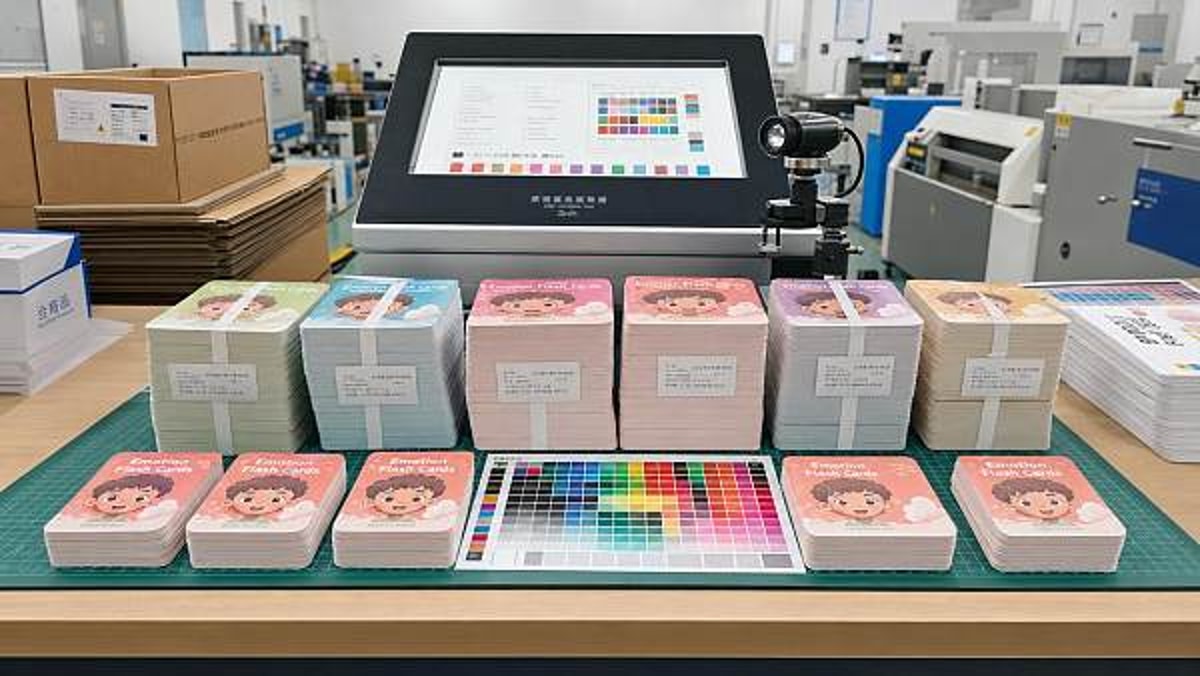
Ask whether the supplier uses defined color targets, approved drawdowns, spectrophotometer readings, or press-side calibration routines. A strong answer should cover prepress file handling, proof approval, press calibration frequency, and how reorders are matched to archived standards. If the supplier relies mainly on operator visual judgment, consistency risk is higher, especially for educational products with brand-critical or category-coded colors.
2. What controls are in place for paperboard and surface materials?
The same artwork can print differently on boards with different brightness, bulk, moisture content, or coating behavior. Technical teams should ask whether the flash cards manufacturer approves substrate suppliers by grade, keeps incoming material inspection records, and restricts substitutions without customer approval. Material control is one of the clearest indicators of batch reliability.
3. How are finishing operations monitored?
Flash cards often depend on lamination, aqueous coating, UV, rounded corners, edge painting, or custom boxing. Each finishing step can introduce curl, scratching, adhesion failure, or dimensional drift. Ask what tolerances apply, how curl and bonding are checked, and whether die-cut and corner radius measurements are documented during production.
4. What happens when production shifts to another machine or line?
In growing facilities, jobs may move across presses, cutters, or finishing lines due to capacity pressure. This is a key trend issue because flexible capacity is useful only if standards transfer correctly. A dependable flash cards manufacturer should explain how machine profiles, setup sheets, and QC checkpoints keep output aligned even when the job changes equipment.
5. How are reorders linked to original approved specifications?
Many consistency failures appear months later because the supplier cannot retrieve exact production settings, approved board codes, finishing notes, or packing instructions. Ask how the manufacturer archives production records and whether reorder execution is tied to a controlled specification file rather than memory or email history.
Why these questions matter more across different buyer groups
The impact of print inconsistency is not the same for every buyer. However, in most commercial use cases, quality variation now creates downstream costs that exceed the apparent savings of selecting a weaker supplier.
This broader impact explains why the qualification of a flash cards manufacturer is increasingly cross-functional. Technical assessment is no longer isolated from brand, logistics, compliance, and commercial planning. A supplier that performs well only in isolated sample development may still fail the broader consistency test.
What is driving stricter scrutiny of manufacturing control
The tightening of supplier evaluation standards reflects real changes in demand and operating conditions. First, educational and training products are becoming more design-sensitive. Cards are now expected to support premium tactile experience, long service life, and stronger visual identity. Second, omnichannel distribution makes defects more visible because online reviews quickly amplify issues such as peeling lamination, color mismatch, or inaccurate counts.
Third, procurement teams increasingly seek resilient sourcing. They want a flash cards manufacturer that can handle artwork updates, multilingual versions, and recurring orders without quality drift. Fourth, sustainability and compliance pressures are influencing substrate and coating choices. Whenever material systems change, consistency risk rises unless the manufacturer manages qualification and equivalency carefully.
The key trend is that print consistency is no longer treated as a craftsmanship issue alone. It is now viewed as an operational discipline combining materials engineering, digital workflow control, equipment calibration, documented inspection, and change management.
Signals that a flash cards manufacturer may struggle in future orders
Technical evaluators should pay attention not only to present performance but also to warning signs that suggest future instability. One signal is vague language around tolerances. If the supplier cannot define acceptable color variation, cut accuracy, or carton packing standards, consistency may depend too heavily on individual operators. Another signal is frequent material substitution framed as normal flexibility. In reality, uncontrolled substitutions often produce the most visible differences between batches.
A third signal is weak documentation. If artwork approval, sample sign-off, and production specifications are scattered across emails, reorders become vulnerable to interpretation errors. A fourth signal is overreliance on final inspection. A mature flash cards manufacturer should build quality into prepress, setup, in-process verification, and packing stages rather than trying to catch all defects at the end. Finally, if the supplier cannot explain how it manages peak-season capacity without changing quality outcomes, technical buyers should investigate further.
How technical teams should update their evaluation approach
Because the market is shifting toward repeatability and controlled execution, technical evaluators should evolve their sourcing methods as well. Instead of approving based on one preproduction sample, consider a staged review. First, validate print and finishing quality. Second, verify the manufacturing control system behind that quality. Third, test reorder readiness by confirming archived standards, approved material lists, and change-control rules. This approach makes supplier approval more predictive.
This structured method helps teams select a flash cards manufacturer based on future reliability, not just present sample quality. It also creates stronger internal alignment between procurement, engineering, product, and brand stakeholders.
Where the market is likely heading next
Looking ahead, supplier selection will likely become more evidence-based. Buyers will increasingly favor manufacturers that can demonstrate stable process data, documented material governance, and controlled finishing performance. Digital workflow tools, standardized color management, and traceable quality records will become more important differentiators than generic claims of experience.
Another likely direction is tighter alignment between product design and manufacturability. As flash cards incorporate specialty finishes, multilingual variants, sustainability requirements, or custom packaging, technical evaluators will need earlier engagement with the flash cards manufacturer. Early dialogue reduces the chance that attractive specifications create hidden consistency risks in production.
For global sourcing platforms and commercial buyers, this trend supports a broader lesson: manufacturing quality should be assessed as a system capability. The most resilient suppliers are not simply those with modern equipment, but those able to maintain stable output under changing demand, changing materials, and repeated commercial cycles.
What to confirm before moving forward
If your team is assessing a flash cards manufacturer, the most useful next step is to confirm whether the supplier can answer the right consistency questions with evidence rather than reassurance. Ask for process descriptions, sample-to-production controls, approved material protocols, finishing tolerances, and reorder traceability. Review whether quality is operator-dependent or system-managed. In a market where product presentation, durability, and repeatability matter more than ever, these questions are not administrative details—they are leading indicators of future performance.
For technical evaluators, that is the central sourcing judgment: not whether a supplier can produce one acceptable deck, but whether the flash cards manufacturer can keep delivering the same standard as demand, specifications, and commercial expectations continue to change.
Search News
Hot Articles
Popular Tags
Need ExpertConsultation?
Connect with our specialized leisureengineering team for procurementstrategies.
Recommended News
 May 06, 2026Wholesale children books: how to judge value beyond unit priceWholesale children books should be judged by more than unit price. Discover how to compare quality, safety, content value, and supplier reliability for smarter buying.● Institutional Buyer
 May 06, 2026Math manipulatives bulk orders that support mixed-age classroomsMath manipulatives bulk solutions for mixed-age classrooms: compare durable, age-flexible, safety-focused options that improve teaching continuity, reduce waste, and simplify school purchasing.● Institutional Buyer
 May 06, 2026Wholesale compasses and dividers that stay accurate over timeWholesale compasses and dividers built for lasting accuracy. Discover how to evaluate hinge stability, material quality, and batch consistency to reduce replacement costs.● Institutional Buyer
 May 06, 2026Marching band uniforms that look sharp without raising repair billsMarching band uniforms that stay sharp and lower repair costs. Compare fabrics, construction, and supplier reliability to choose durable, budget-smart uniforms.● Institutional Buyer
 May 06, 2026Geometry sets wholesale: which pieces matter most in real useGeometry sets wholesale buying is easier when you know which pieces truly matter. Discover the essential tools, quality checks, and sourcing tips that improve value and reduce replacement costs.● Institutional Buyer
 May 06, 2026Clear pencil cases that last longer in busy school settingsClear pencil cases built for busy schools: discover how durable materials, safer construction, and reliable suppliers help cut replacements, support inspections, and improve long-term value.● Institutional Buyer
 May 06, 2026Flash cards manufacturer questions that affect print consistencyFlash cards manufacturer selection affects color accuracy, material stability, and batch consistency. Learn the key sourcing questions that help reduce risk and ensure reliable print quality.● Institutional Buyer
 May 06, 2026What makes educational posters bulk orders worth the priceEducational posters bulk orders cost more upfront, but they cut unit prices, improve classroom consistency, and last longer. See why schools and institutions view them as a smart investment.● Institutional Buyer
 May 06, 2026Why wholesale erasers and sharpeners vary so much in qualityWholesale erasers and sharpeners vary in quality due to materials, blade engineering, safety compliance, and production control. Learn how to source smarter and reduce risk.● Institutional Buyer
 May 05, 2026Shandong Lions Reject Tao Hanlin’s Retirement — Implications for Sportswear OEMsSportswear OEMs: Shandong Lions’ rejection of Tao Hanlin’s retirement signals growing buyer focus on supplier longevity, stability & cultural trust in global sourcing.● Institutional Buyer
 May 05, 2026Custom promotional pens that get used instead of thrown awayCustom promotional pens that people actually keep: learn how to choose quality, comfortable, brand-right pens that boost visibility, reduce waste, and deliver better long-term value.● Institutional Buyer
 May 05, 2026Custom graduation gowns: why fabric choice changes event photosCustom graduation gowns look dramatically different on camera depending on fabric. Learn how sheen, drape, and wrinkle resistance shape photo quality and smarter sourcing.● Institutional Buyer
 May 05, 2026Ballpoint pens bulk: why writing distance changes buyer satisfactionBallpoint pens bulk buyers often overlook writing distance, yet it strongly shapes user satisfaction, brand perception, and reorder value across offices, schools, promotions, and service counters.● Institutional Buyer
 May 05, 2026Watercolor paints bulk: student use reveals quality fastWatercolor paints bulk for schools: see how student use quickly exposes pigment, packaging, and durability issues. Learn what buyers should check before sourcing at scale.● Institutional Buyer
 May 05, 2026Wholesale sticky notes: which paper grades actually stay putWholesale sticky notes buyers: learn which paper grades truly stay put. Compare economy, office, premium, and recycled options to improve adhesion, writing quality, and repeat orders.● Institutional Buyer
 May 05, 2026Highlighter markers wholesale: why ink consistency matters moreHighlighter markers wholesale buyers should look beyond price: consistent ink flow improves writing performance, reduces complaints, and supports stronger repeat orders. Learn what reliable sourcing really requires.● Institutional Buyer
 May 05, 2026Wholesale school backpacks: when low price leads to high returnsWholesale school backpacks may look cost-saving, but low prices often mean higher returns, complaints, and hidden procurement costs. Learn how to compare suppliers smarter.● Institutional Buyer
 May 05, 2026Art supplies wholesale trends schools are paying attention toArt supplies wholesale trends schools are watching now: safer materials, smarter bulk buying, sustainable options, and reliable suppliers that protect budgets and improve classroom outcomes.● Institutional Buyer
 May 05, 2026Colored pencils wholesale: which specs matter beyond color countColored pencils wholesale buyers should look beyond color count. Compare core strength, pigment quality, safety, wood, and packaging to source better products with confidence.● Institutional Buyer
 May 05, 2026School uniforms wholesale: what causes fit issues at scaleSchool uniforms wholesale fit issues often start with sizing gaps, fabric behavior, and weak supplier coordination. Learn the key causes and how buyers can reduce returns and protect uniform program quality.● Institutional Buyer
 May 05, 2026Graduation caps and tassels: matching colors is harder than it looksGraduation caps and tassels are harder to match than they seem. Learn how to control color standards, supplier quality, and bulk order accuracy for flawless ceremony delivery.● Institutional Buyer
 May 05, 2026Why some dry erase boards bulk orders fail in daily useDry erase boards bulk orders can fail fast in real use. Learn what causes ghosting, warping, weak mounting, and short lifespan—and how to source boards that truly fit schools, offices, hotels, and healthcare.● Institutional Buyer
 May 04, 2026PU Leather Journals: Why Some Covers Peel Too SoonPU leather journals can look elegant and affordable, but why do some peel so quickly? Discover the real causes, warning signs, and smarter buying tips before you choose.● Institutional Buyer
 May 04, 2026Retractable Badge Reels: The Small Item That Fails FirstRetractable badge reels fail faster than many workplace accessories. Learn what causes breakage, how to source durable options, and how to cut replacement costs.● Institutional Buyer