Why wholesale erasers and sharpeners vary so much in quality
For procurement professionals, sourcing wholesale erasers and sharpeners can be surprisingly complex. Prices may look similar, but differences in raw materials, blade quality, safety compliance, production consistency, and OEM standards can significantly affect performance and buyer satisfaction. Understanding why wholesale erasers and sharpeners vary so much in quality is essential for making cost-effective, reliable purchasing decisions in global supply chains.
Why scenario differences matter more than unit price
In practice, wholesale erasers and sharpeners are not bought for a single generic use. They are sourced for schools, office chains, exam programs, brand promotions, art retailers, e-commerce bundles, and institutional contracts. Each scenario creates a different definition of “good quality.” An eraser that performs well in a primary classroom may be too dusty for premium office use. A sharpener that looks attractive in a retail blister pack may fail under heavy daily use in a campus supply room.
This is why quality variation in wholesale erasers and sharpeners appears so wide: buyers are often comparing products built for different operating realities. Procurement teams that focus only on quoted price often miss hidden variables such as blade hardness, barrel concentricity, PVC formulation, pigment transfer risk, child-safety design, and packaging durability. The result can be customer complaints, excess returns, or poor contract renewal rates.
For B2B buyers, the right question is not simply whether one supplier is better than another. It is whether the supplier’s product grade matches the actual application scenario, compliance needs, and expected user behavior.
Where wholesale erasers and sharpeners are commonly used
Before evaluating factories or samples, procurement professionals should map the intended business environment. Wholesale erasers and sharpeners typically enter the market through several high-volume channels, and each channel values different attributes.
School and educational procurement
This segment prioritizes safety, affordability, batch consistency, and ease of use for children. Erasers must remove graphite cleanly without tearing paper, while sharpeners must avoid blade exposure and pencil breakage. Durability matters, but so does compliance with safety and chemical standards in the destination market.
Office and institutional supply programs
Corporate offices, universities, training centers, and public agencies often need dependable products that perform consistently across large user groups. Here, low dust, neat finish, and strong packaging control are often more important than novelty design. Supply continuity also becomes critical because procurement cycles may be tied to annual contracts.
Retail stationery and gift channels
Retail buyers frequently emphasize shelf appeal, color options, branding, and margin flexibility. In this scenario, the visual quality of wholesale erasers and sharpeners may influence purchase decisions as much as functional quality. However, if decoration coatings crack, blades rust, or erasers smear on first use, retail reputation suffers quickly.
Art, sketching, and specialty users
Artists and technical users are more sensitive to precision. They may require sharpeners that create a long, controlled pencil point and erasers that lift graphite or colored pencil without damaging textured paper. In this niche, product engineering matters more than lowest cost, and user tolerance for inconsistency is low.
Promotional, OEM, and private label projects
For custom-branded projects, the risk often lies in appearance consistency, logo print adhesion, packaging execution, and lead time reliability. A product can look acceptable in a prototype but become unstable when mass production begins. This is one of the main reasons wholesale erasers and sharpeners vary so much in quality in cross-border sourcing.
A practical comparison of quality priorities by scenario
The table below helps procurement teams align product evaluation with business use rather than with generic catalog descriptions.
Why eraser quality can differ sharply across suppliers
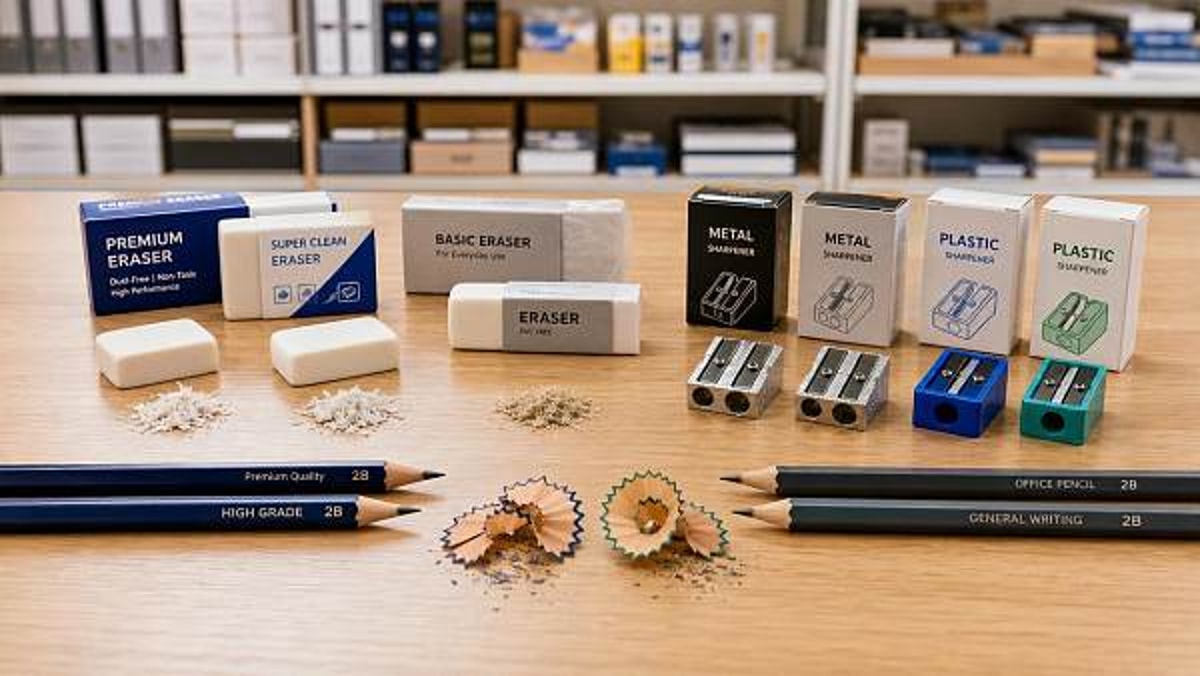
Many buyers assume an eraser is a simple molded item, but material formulation changes everything. Low-grade erasers may contain fillers that reduce cost but also reduce cleaning efficiency. They can harden over time, leave residue, smear graphite, or tear thin paper. Higher-grade formulas are engineered for softness, controlled friction, and clean debris formation.
A second factor is intended user type. For school contracts, manufacturers may emphasize safe edges, bright colors, and lower cost. For office and premium retail channels, buyers may prefer dust-free or low-dust formulas, cleaner white compounds, and more stable aging properties. Specialty art erasers may require a completely different composition to lift marks gently from delicate surfaces.
Production control is another hidden divider. Even if the formula is acceptable, poor curing, uneven mixing, or loose quality inspection can create batch variation. For wholesale erasers and sharpeners supplied under annual contracts, this inconsistency becomes expensive because the first shipment may pass while later batches trigger complaints.
Why sharpener quality varies even more in heavy-use scenarios
Sharpeners are especially sensitive to engineering quality because they combine plastic or metal bodies, blades, screws, alignment tolerances, and user-force interaction. In low-cost models, the blade steel may dull quickly, the screw may loosen, or the channel geometry may be slightly off-center. That leads to broken pencil tips, uneven sharpening, and user frustration.
The impact becomes more obvious in schools, art rooms, and training centers where a single sharpener may be used dozens of times each day. In these settings, a very small material downgrade creates a large operational problem. A retail customer might forgive one low-performing unit; an institutional user managing thousands of students will not.
For procurement teams buying wholesale erasers and sharpeners together, it is important to test sharpeners under real pencil types. Standard graphite pencils, colored pencils, triangular pencils, and soft-core drawing pencils all interact differently with blade angle and housing design.
How application needs change the quality checklist
A reliable sourcing process should adapt the checklist to the business scenario rather than using one universal inspection sheet.
For education buyers
Confirm child-safe design, chemical compliance, durable packaging for distribution, and stable color coding if products are sorted by grade or classroom set. Sample testing should include repeated sharpening cycles and paper-based erasing tests under student-use conditions.
For office procurement teams
Focus on reliability, clean desk use, and long replacement intervals. A slightly higher unit price can lower total cost if the blade lasts longer and the eraser produces less mess. Packaging should support easy storage and internal distribution.
For retailers and distributors
Evaluate visual uniformity, barcode and pack quality, anti-scuff printing, and how the product performs on first use. Retail risk is often linked to mismatch between attractive presentation and weak real performance.
For OEM and private label projects
Request pilot production samples, not just hand-finished prototypes. Review logo adhesion, Pantone consistency, carton marking accuracy, and acceptable quality limits for mass inspection. In wholesale erasers and sharpeners, branding defects can be just as damaging as functional defects.
Common sourcing mistakes by scenario
- Using retail-style samples to judge institutional performance without endurance testing.
- Comparing quotes without matching blade material, eraser formula, packaging spec, or compliance scope.
- Assuming all student-use products meet destination safety requirements.
- Treating OEM color customization as low risk when batch color drift is common.
- Ignoring humidity, storage, and transport conditions that can affect eraser aging or blade corrosion.
A procurement framework for choosing the right wholesale erasers and sharpeners
A stronger buying process usually includes five steps. First, define the exact usage scenario and user profile. Second, translate that scenario into measurable requirements such as sharpening cycle life, erasing cleanliness, safety standards, and packaging format. Third, compare suppliers only after normalizing specifications. Fourth, validate with realistic batch samples. Fifth, monitor consistency after the first shipment rather than assuming approval is permanent.
For global buyers, supplier transparency matters as much as product quality. A dependable manufacturer should be able to explain material choices, blade sourcing, testing methods, compliance documents, and corrective action procedures. This is especially valuable when sourcing wholesale erasers and sharpeners across multiple markets with different regulations and consumer expectations.
FAQ for procurement teams
Why do similar-looking products have very different pricing?
Because the visible appearance hides major differences in raw materials, blade steel, tooling accuracy, inspection standards, and compliance scope. Two sharpeners may look almost identical while having completely different service lives.
Are low-cost wholesale erasers and sharpeners always a bad choice?
Not necessarily. They can be suitable for short-term promotions or low-intensity use. The risk appears when they are placed in demanding scenarios such as schools, institutions, or premium retail programs where failure rates are more visible and more costly.
What should be tested before placing a large order?
Test real-use performance, not just appearance. For erasers, assess clean removal, residue, smearing, and paper damage. For sharpeners, test blade retention, break resistance, point quality, and fit with the target pencil types. Also verify packaging durability and compliance paperwork.
Final takeaway: buy by scenario, not by assumption
The reason wholesale erasers and sharpeners vary so much in quality is not random. It comes from different materials, manufacturing controls, compliance levels, and product designs aimed at different business uses. For procurement professionals, the most effective approach is to start with the application scenario, identify the true performance risks, and then match suppliers to that reality.
Whether you are supplying schools, offices, retailers, or private label programs, better sourcing decisions come from clearer scenario-based specifications, stronger sample validation, and closer control over production consistency. When wholesale erasers and sharpeners are evaluated in the right context, quality differences become easier to predict, compare, and manage across the supply chain.
Search News
Hot Articles
Popular Tags
Need ExpertConsultation?
Connect with our specialized leisureengineering team for procurementstrategies.
Recommended News
 May 06, 2026Wholesale children books: how to judge value beyond unit priceWholesale children books should be judged by more than unit price. Discover how to compare quality, safety, content value, and supplier reliability for smarter buying.● Institutional Buyer
 May 06, 2026Math manipulatives bulk orders that support mixed-age classroomsMath manipulatives bulk solutions for mixed-age classrooms: compare durable, age-flexible, safety-focused options that improve teaching continuity, reduce waste, and simplify school purchasing.● Institutional Buyer
 May 06, 2026Wholesale compasses and dividers that stay accurate over timeWholesale compasses and dividers built for lasting accuracy. Discover how to evaluate hinge stability, material quality, and batch consistency to reduce replacement costs.● Institutional Buyer
 May 06, 2026Marching band uniforms that look sharp without raising repair billsMarching band uniforms that stay sharp and lower repair costs. Compare fabrics, construction, and supplier reliability to choose durable, budget-smart uniforms.● Institutional Buyer
 May 06, 2026Geometry sets wholesale: which pieces matter most in real useGeometry sets wholesale buying is easier when you know which pieces truly matter. Discover the essential tools, quality checks, and sourcing tips that improve value and reduce replacement costs.● Institutional Buyer
 May 06, 2026Clear pencil cases that last longer in busy school settingsClear pencil cases built for busy schools: discover how durable materials, safer construction, and reliable suppliers help cut replacements, support inspections, and improve long-term value.● Institutional Buyer
 May 06, 2026Flash cards manufacturer questions that affect print consistencyFlash cards manufacturer selection affects color accuracy, material stability, and batch consistency. Learn the key sourcing questions that help reduce risk and ensure reliable print quality.● Institutional Buyer
 May 06, 2026What makes educational posters bulk orders worth the priceEducational posters bulk orders cost more upfront, but they cut unit prices, improve classroom consistency, and last longer. See why schools and institutions view them as a smart investment.● Institutional Buyer
 May 06, 2026Why wholesale erasers and sharpeners vary so much in qualityWholesale erasers and sharpeners vary in quality due to materials, blade engineering, safety compliance, and production control. Learn how to source smarter and reduce risk.● Institutional Buyer
 May 05, 2026Shandong Lions Reject Tao Hanlin’s Retirement — Implications for Sportswear OEMsSportswear OEMs: Shandong Lions’ rejection of Tao Hanlin’s retirement signals growing buyer focus on supplier longevity, stability & cultural trust in global sourcing.● Institutional Buyer
 May 05, 2026Custom promotional pens that get used instead of thrown awayCustom promotional pens that people actually keep: learn how to choose quality, comfortable, brand-right pens that boost visibility, reduce waste, and deliver better long-term value.● Institutional Buyer
 May 05, 2026Custom graduation gowns: why fabric choice changes event photosCustom graduation gowns look dramatically different on camera depending on fabric. Learn how sheen, drape, and wrinkle resistance shape photo quality and smarter sourcing.● Institutional Buyer
 May 05, 2026Ballpoint pens bulk: why writing distance changes buyer satisfactionBallpoint pens bulk buyers often overlook writing distance, yet it strongly shapes user satisfaction, brand perception, and reorder value across offices, schools, promotions, and service counters.● Institutional Buyer
 May 05, 2026Watercolor paints bulk: student use reveals quality fastWatercolor paints bulk for schools: see how student use quickly exposes pigment, packaging, and durability issues. Learn what buyers should check before sourcing at scale.● Institutional Buyer
 May 05, 2026Wholesale sticky notes: which paper grades actually stay putWholesale sticky notes buyers: learn which paper grades truly stay put. Compare economy, office, premium, and recycled options to improve adhesion, writing quality, and repeat orders.● Institutional Buyer
 May 05, 2026Highlighter markers wholesale: why ink consistency matters moreHighlighter markers wholesale buyers should look beyond price: consistent ink flow improves writing performance, reduces complaints, and supports stronger repeat orders. Learn what reliable sourcing really requires.● Institutional Buyer
 May 05, 2026Wholesale school backpacks: when low price leads to high returnsWholesale school backpacks may look cost-saving, but low prices often mean higher returns, complaints, and hidden procurement costs. Learn how to compare suppliers smarter.● Institutional Buyer
 May 05, 2026Art supplies wholesale trends schools are paying attention toArt supplies wholesale trends schools are watching now: safer materials, smarter bulk buying, sustainable options, and reliable suppliers that protect budgets and improve classroom outcomes.● Institutional Buyer
 May 05, 2026Colored pencils wholesale: which specs matter beyond color countColored pencils wholesale buyers should look beyond color count. Compare core strength, pigment quality, safety, wood, and packaging to source better products with confidence.● Institutional Buyer
 May 05, 2026School uniforms wholesale: what causes fit issues at scaleSchool uniforms wholesale fit issues often start with sizing gaps, fabric behavior, and weak supplier coordination. Learn the key causes and how buyers can reduce returns and protect uniform program quality.● Institutional Buyer
 May 05, 2026Graduation caps and tassels: matching colors is harder than it looksGraduation caps and tassels are harder to match than they seem. Learn how to control color standards, supplier quality, and bulk order accuracy for flawless ceremony delivery.● Institutional Buyer
 May 05, 2026Why some dry erase boards bulk orders fail in daily useDry erase boards bulk orders can fail fast in real use. Learn what causes ghosting, warping, weak mounting, and short lifespan—and how to source boards that truly fit schools, offices, hotels, and healthcare.● Institutional Buyer
 May 04, 2026PU Leather Journals: Why Some Covers Peel Too SoonPU leather journals can look elegant and affordable, but why do some peel so quickly? Discover the real causes, warning signs, and smarter buying tips before you choose.● Institutional Buyer
 May 04, 2026Retractable Badge Reels: The Small Item That Fails FirstRetractable badge reels fail faster than many workplace accessories. Learn what causes breakage, how to source durable options, and how to cut replacement costs.● Institutional Buyer