What to Check When Comparing a Sterling Silver Clasp Manufacturer
Why does the choice of a sterling silver clasp manufacturer matter so much?
A clasp is small, but it carries a large share of product risk.
When comparing a sterling silver clasp manufacturer, the real question is not only unit cost.
It is whether the supplier can protect finish quality, mechanical reliability, and delivery consistency across repeated orders.
In jewelry and luxury accessories, clasp failure often becomes a brand problem before it becomes a component problem.
That is why a sourcing review should cover alloy control, tolerance stability, plating behavior, and batch traceability.
For commercial buyers working across premium retail, hospitality gifting, or branded accessory programs, the supplier decision also affects lead times and after-sales claims.
At GCT, sourcing comparisons are usually framed around commercial performance, not just sample appearance.
A polished sample can be easy to produce.
Consistent production, compliant material declarations, and dependable shipping windows are harder to maintain.
What should you verify first before discussing price?
Start with the material claim.
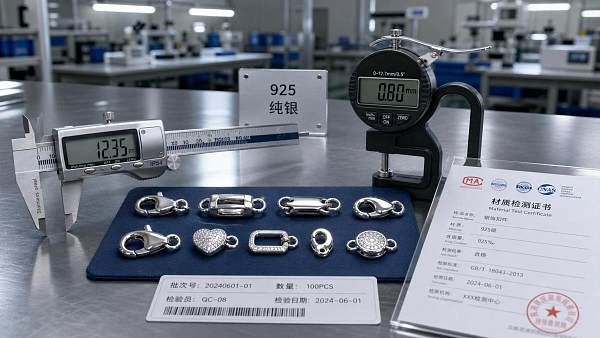
A credible sterling silver clasp manufacturer should clearly state whether the clasp body is 925 sterling silver, silver-plated base metal, or a mixed construction.
This point sounds basic, yet it is where many comparison errors begin.
Ask for assay method details, mill certificates, and declared silver content by component.
If springs, pins, or internal parts use different metals, that should be documented early.
The next check is manufacturing method.
Die casting, stamping, hand assembly, and CNC finishing create different results in weight, precision, and durability.
A supplier that cannot explain process flow usually cannot control process variation.
It also helps to verify the finishing route.
For example, anti-tarnish coating, rhodium plating, polishing stages, and cleaning standards directly affect wear life and customer satisfaction.
This first screening often removes weak options before commercial terms are even worth discussing.
How can you tell if production capability is real, not just well presented?
Samples and catalogs rarely show production discipline.
A stronger test is whether the sterling silver clasp manufacturer can show repeatable controls from tooling to final inspection.
Ask for dimensional tolerance standards, pull-force testing records, plating thickness controls, and defect acceptance criteria.
If the answer stays general, that is useful information by itself.
In actual sourcing, production capability also shows up in capacity planning.
Can the supplier handle pilot runs, seasonal scale-up, and replenishment orders without changing finish quality?
This matters when clasps are used across multiple SKUs or collection updates.
Another useful signal is tooling ownership and revision control.
A dependable manufacturer should identify which molds or dies are dedicated, shared, or newly developed.
They should also show how design changes are approved and recorded.
- Request defect photos from previous production, not only ideal samples.
- Check whether inspection is 100% or sampling-based for closure function.
- Confirm how mixed lots are prevented during polishing and plating.
- Review lead times for tooling, sample approval, mass production, and reorders separately.
These details usually separate a decorative supplier from a manufacturing partner.
When does customization become a sourcing advantage rather than a delay risk?
Customization is valuable only when it improves fit, function, or brand alignment.
A sterling silver clasp manufacturer may offer logo engraving, custom shapes, special finishes, or proprietary locking structures.
The question is whether those options can move through development without creating avoidable delay.
More commonly, problems appear at the handoff between design approval and factory execution.
Dimensions that looked acceptable in drawings may interfere with chain thickness, stone settings, or packaging constraints.
That is why prototype validation should include actual assembly trials, not isolated component review.
It is also wise to compare standard clasp programs against custom development.
In some cases, a modified standard item gives faster launch timing and lower rejection risk.
In others, full customization is necessary to protect a luxury identity or patented product concept.
The practical check is simple: ask for development milestones, revision limits, and approval samples from similar projects.
Which compliance and quality documents actually matter?
Not every document has the same decision value.
For a sterling silver clasp manufacturer, useful documentation should connect directly to market entry, material safety, and claim prevention.
Depending on destination market, that may include REACH, nickel release testing, lead and cadmium limits, and country-of-origin support files.
If clasps are entering premium retail channels, tarnish performance and coating disclosures may also be relevant.
A common sourcing mistake is treating certificates as a box-ticking exercise.
What matters more is whether the documents match the exact product construction and current production batch.
A test report for another alloy, another finish, or an old style should not close the compliance question.
GCT sourcing reviews often place extra weight on traceability because it supports both trust and operational response.
When a defect appears, the ability to isolate affected lots quickly matters more than having a thick document folder.
A short document checklist
- Material declaration by component and finish
- Relevant chemical compliance reports for target markets
- Inspection records for function, dimensions, and appearance
- Batch coding or lot traceability method
- Packaging standard to prevent scratching and tarnish during transit
How should lead time, MOQ, and pricing be compared without missing hidden costs?
The cheapest quote can become the most expensive program.
When reviewing a sterling silver clasp manufacturer, pricing should be read together with yield rate, tooling charges, sampling policy, and reorder flexibility.
A low unit price paired with high minimum order quantity may lock cash into slow-moving inventory.
A fast sample lead time may still hide a long production queue.
It helps to compare cost in stages.
Look at development cost, first-order cost, replenishment cost, and failure cost after delivery.
Failure cost includes returns, rework, shipment replacement, and brand disruption.
That last category is often omitted, even though it changes supplier ranking.
This kind of comparison keeps the sourcing decision grounded in total operating reality.
What are the most common mistakes when shortlisting a sterling silver clasp manufacturer?
One mistake is approving by appearance alone.
A bright finish can hide weak spring response, rough inner edges, or unstable plating adhesion.
Another mistake is comparing quotations without normalizing specifications.
If one supplier quotes full sterling silver and another quotes partial silver construction, the numbers are not comparable.
Some buyers also overlook packaging and transit protection.
For small polished parts, surface damage during shipping can erase the savings from a lower purchase price.
There is also a strategic error: selecting a supplier with no room to support future design changes.
A capable sterling silver clasp manufacturer should be able to support growth, not only the first order.
That includes engineering communication, documentation discipline, and a realistic problem-solving process.
What should the next sourcing step look like?
Build the comparison around evidence, not promises.
A practical shortlist for any sterling silver clasp manufacturer should include sample validation, document review, process checks, and commercial terms in one matrix.
That makes trade-offs visible before commitment.
In most cases, the best supplier is not the one with the lowest quote.
It is the one that can maintain 925 material integrity, stable closure performance, consistent finishing, and predictable fulfillment over time.
For businesses navigating premium accessories and global sourcing, this is exactly where better intelligence improves buying outcomes.
Review the product specification, define pass-fail criteria, and test each supplier against the same checkpoints.
That approach creates a cleaner decision and a more reliable supply relationship.
Search News
Hot Articles
- Outdoor RidesHow to Select Leisure Park Equipment for Safe, High-Throughput Visitor AreasOct 03, 2026
- Fashion & Gem JewelryDiamond Tester Wholesale: How to Vet Accuracy, Calibration, and MOQ Before OrderingOct 02, 2026
- Hotel Room AmenitiesHow Hotels Can Choose Amenity Bottles That Balance Brand Image and Refill CostsOct 01, 2026
Popular Tags
Need ExpertConsultation?
Connect with our specialized leisureengineering team for procurementstrategies.
Recommended News
 Oct 02, 2026Diamond Tester Wholesale: How to Vet Accuracy, Calibration, and MOQ Before OrderingDiamond tester wholesale guide: verify accuracy, calibration records, supplier quality controls, and MOQ terms before ordering. Source reliable testers with confidence.● Luxury Retail Analyst
 Sep 09, 2026Wholesale Coral Earrings: How Buyers Can Assess Quality, Treatments, and Supply RiskCoral jewelry earrings wholesale guide for buyers: assess quality, treatments, secure settings, documentation, and supply risks before ordering.● Luxury Retail Analyst
 Sep 01, 2026How to Choose a Jewelry Laser Engraving Machine Manufacturer for Custom ProductionChoose a jewelry laser engraving machine manufacturer with proven sample testing, precision fixtures, workflow-ready software, and reliable support for custom production.● Luxury Retail Analyst
 Aug 27, 2026Evaluating Luxury Retail Accessories Suppliers: Quality, Lead Times, and Brand FitLuxury retail accessories supplier selection made clearer: assess quality, lead times, compliance, costs, and brand fit to protect premium launches and margins.● Luxury Retail Analyst
 Jul 29, 2026Fine Jewelry Price Guide: What Affects Cost and How to Judge Real ValueFine jewelry price guide for buyers: learn what drives cost in metals, gemstones, craftsmanship, certification, and branding so you can judge real value, reduce sourcing risk, and buy with confidence.● Luxury Retail Analyst
 Jul 14, 2026What to Ask an Enamel Jewelry Manufacturer Before Sampling and Mass ProductionEnamel jewelry manufacturer selection starts with the right questions. Learn what to ask about materials, color matching, MOQ, QC, compliance, and lead times before sampling and mass production.● Luxury Retail Analyst
 Jul 12, 2026Surgical Steel Belly Rings vs Titanium: Material Differences, Safety, and CostSurgical steel belly rings vs titanium: compare safety, nickel exposure, comfort, durability, and cost to choose the best option for sensitive skin or budget-friendly style.● Luxury Retail Analyst
 Jul 12, 2026Natural Coral Jewelry Guide: How to Identify Real Coral, Treatments, and QualityNatural coral jewelry guide covering how to identify real coral, spot treatments, assess quality, and buy with confidence. Learn the key signs before you choose.● Luxury Retail Analyst
 Jul 11, 2026Braided Leather Bracelets OEM: Material, Clasp, and MOQ Factors Before SamplingBraided leather bracelets OEM guide covering material grades, clasp options, and MOQ factors before sampling. Learn how to reduce sourcing risk, control cost, and choose the right supplier.● Luxury Retail Analyst
 Jul 09, 2026Jewelry Craftsmanship Gemstone Setting Methods Explained: Prong, Bezel, Pave, and MoreJewelry craftsmanship gemstone setting explained clearly: compare prong, bezel, pavé, channel, and more to choose secure, beautiful, and commercially smart jewelry designs.● Luxury Retail Analyst
 Jul 06, 2026Photo Locket Necklace Manufacturer Selection Guide: Materials, MOQ, and Custom OptionsPhoto locket necklace manufacturer selection guide covering materials, MOQ, custom options, compliance, and quality checks to help buyers source smarter and build stronger jewelry lines.● Luxury Retail Analyst
 Jul 05, 2026What to Check When Comparing a Sterling Silver Clasp ManufacturerChoosing a sterling silver clasp manufacturer? Learn what to check first: 925 silver claims, finish quality, testing, compliance, lead times, and hidden sourcing costs.● Luxury Retail Analyst
 Jul 02, 2026Jewelry Craftsmanship Techniques Explained: Casting, Stone Setting, Engraving, and PolishingJewelry craftsmanship techniques explained: discover how casting, stone setting, engraving, and polishing shape quality, durability, and sourcing confidence.● Luxury Retail Analyst
 Jul 01, 2026Lost Wax Casting Machines Explained: Types, Capacity, and Metal CompatibilityLost wax casting machines explained: compare types, real capacity, and metal compatibility to choose the right system for precision casting, higher quality, and smarter sourcing.● Luxury Retail Analyst
 Jun 29, 2026How to Evaluate a Luxury Accessories Online Store Before You BuyLuxury accessories online store buying guide: learn how to verify authenticity, compare policies, check reviews, and avoid costly mistakes before you place an order.● Luxury Retail Analyst
 Jun 22, 2026Matching Couple Rings: Popular Materials, Fit Differences, and How to ChooseMatching couple rings guide: compare popular materials, fit differences, comfort, durability, and resizing options to choose a stylish pair that truly lasts.● Luxury Retail Analyst
 Jun 19, 2026How to Build a Fashion Accessories Catalog That Improves Product Discovery and SalesFashion accessories catalog strategies that improve product discovery, filtering, and conversions. Learn how to structure pages, categories, and data to drive more qualified sales.● Luxury Retail Analyst
 Jun 19, 2026How to Choose Luxury Accessories for Women by Material, Style, and Price PointLuxury accessories for women: learn how to choose the right pieces by material, style, and price point for better value, timeless appeal, and smarter buying decisions.● Luxury Retail Analyst
 Jun 18, 2026Stainless Steel Rings Bulk: 304 vs 316L, Finishes, and Custom Order FactorsStainless steel rings bulk guide: compare 304 vs 316L, explore finish options, and learn key custom order factors to reduce sourcing risk and improve product value.● Luxury Retail Analyst
 Jun 18, 2026Body Piercing Jewelry Bulk Buying Guide: Materials, Sizes, and MOQ QuestionsBody piercing jewelry bulk buying guide covering safe materials, size checks, MOQ strategy, supplier screening, and compliance tips to reduce risk and source with confidence.● Luxury Retail Analyst
 Jun 18, 2026How to Evaluate a Luxury Jewelry Exporter for Quality, Compliance, and DeliveryLuxury jewelry exporter evaluation starts with more than design. Learn how to verify quality, compliance, and delivery control to source premium jewelry with less risk.● Luxury Retail Analyst
 Jun 17, 2026Iced Out Watches Wholesale: How to Compare MOQ, Stone Quality, and MarginsIced out watches wholesale guide: compare MOQ, stone quality, and real margins to choose reliable suppliers, reduce risk, and grow resale profits with smarter sourcing.● Luxury Retail Analyst
 Jun 15, 2026How to Evaluate an Amber Jewelry Manufacturer: Quality Grades, OEM Options, and Lead TimesAmber jewelry manufacturer selection starts with quality grades, OEM capability, and realistic lead times. Learn how to compare suppliers, reduce sourcing risk, and choose with confidence.● Luxury Retail Analyst
 Jun 14, 2026Stainless Steel Rings Bulk Buying Guide: Grades, Finishes, Sizes, and Supplier ChecksStainless steel rings bulk buying guide covering grades, finishes, sizing, and supplier checks to help you reduce returns, protect quality, and source with confidence.● Luxury Retail Analyst