What to Ask an Enamel Jewelry Manufacturer Before Sampling and Mass Production
What to Ask an Enamel Jewelry Manufacturer Before Sampling and Mass Production
Choosing the right enamel jewelry manufacturer can decide whether sampling turns into smooth, profitable production.
Before approving artwork or placing a bulk order, buyers need clear answers on materials, workmanship, compliance, timing, and quality control.
A polished quotation alone is not enough.
The real test is whether the enamel jewelry manufacturer can repeat sample quality at scale without delays, defects, or communication gaps.
Why the right questions matter before sampling
Sampling is where cost, design intent, and factory capability first meet.
If the discussion stays too general, hidden risks usually appear later in production.
That often means color mismatch, plating failure, poor adhesion, missed shipping windows, or rising rework costs.
A capable enamel jewelry manufacturer should answer detailed technical questions directly, with proof, not vague assurances.
1. What enamel process do you recommend for this design?
Start with the process, because process drives appearance, durability, and cost.
Ask whether the enamel jewelry manufacturer suggests hard enamel, soft enamel, epoxy-coated enamel, or hand-painted finishing.
Each option suits different price points and product uses.
- Hard enamel usually gives a smoother, premium surface.
- Soft enamel can highlight texture and recessed metal lines.
- Epoxy may improve surface protection for fashion-focused items.
- Hand painting may suit artistic, lower-volume collections.
A reliable enamel jewelry manufacturer should explain why one method fits your artwork, wear conditions, and target margin better than another.
2. Which base materials and plating options do you use?
Material choice affects both visual quality and long-term performance.
Ask which base metals are available, such as brass, sterling silver, stainless steel, zinc alloy, or copper.
Then ask how those materials influence enamel fill, polishing, and plating stability.
Plating details matter just as much.
Ask about gold, rhodium, silver, rose gold, antique finishes, and black metal options.
A strong enamel jewelry manufacturer should provide plating thickness ranges, anti-tarnish treatments, and expected wear performance under normal use.
3. Can you match exact colors consistently?
Color control is one of the biggest pain points in enamel jewelry sourcing.
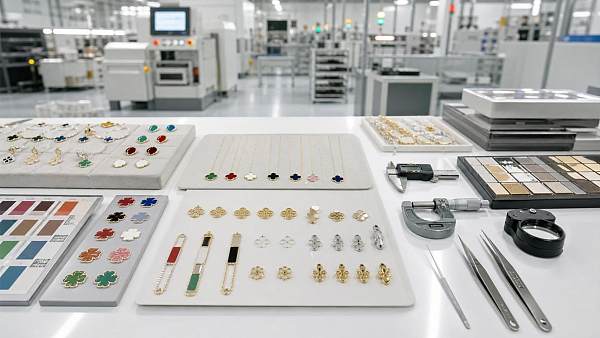
Ask whether the enamel jewelry manufacturer works from Pantone references, physical chips, previous samples, or digital artwork only.
Also ask how color variation is controlled across repeat orders.
This is especially important for branded collections and multi-SKU programs.
The best enamel jewelry manufacturer will flag shades that are hard to reproduce, especially pastels, translucent fills, or very small color areas.
4. What are your sampling standards and revision limits?
Not all samples are built for the same purpose.
Ask whether the sample is a visual prototype, sales sample, pre-production sample, or full approval sample.
That distinction affects finish accuracy and development timing.
Then ask how many sample revisions are included.
A professional enamel jewelry manufacturer should define revision fees, tooling update charges, and approval checkpoints before production begins.
This keeps design changes from quietly turning into budget overruns.
5. What is your MOQ, and how does pricing change by volume?
MOQ is not just a number.
It reveals how the enamel jewelry manufacturer balances setup cost, labor intensity, and line efficiency.
Ask for pricing at several breakpoints, not only one quantity.
- Sample quantity
- Pilot order quantity
- Standard production quantity
- Repeat order quantity
That makes real cost comparisons easier when evaluating more than one enamel jewelry manufacturer.
6. How do you control quality during mass production?
A sample proves capability once.
Quality systems prove repeatability.
Ask the enamel jewelry manufacturer how inspections are handled from raw material to final packing.
Useful questions include:
- Do you inspect incoming metal and plating chemicals?
- How do you check enamel fill depth and color consistency?
- What is your acceptable defect rate?
- Do you support AQL inspection standards?
- Can third-party inspections be arranged?
A disciplined enamel jewelry manufacturer should already have clear checkpoints and documentation, not create them only when asked.
7. What compliance and testing can you support?
Compliance should be discussed early, especially for export markets and retail chains.
Ask whether the enamel jewelry manufacturer can meet REACH, RoHS, CPSIA, nickel release limits, lead and cadmium restrictions, or other destination-specific rules.
Do not assume compliance because the factory has served another market.
A qualified enamel jewelry manufacturer should explain which tests are routine, which are outsourced, and how material traceability is maintained.
8. What is the real lead time, including tooling and rework?
Quoted lead times often look clean on paper.
Actual lead times depend on tooling, sample approval, plating queue, holiday schedules, and packaging readiness.
Ask the enamel jewelry manufacturer to break timing into stages.
- Artwork review and technical feedback
- Tooling development
- Sample production
- Revision cycle
- Bulk production
- Inspection and packing
This gives a more useful schedule than a single headline date.
9. Who owns tooling, artwork, and production records?
This question is easy to overlook until a supplier change becomes necessary.
Ask whether tooling is exclusive, how artwork files are stored, and whether approved standards are archived for repeat orders.
A serious enamel jewelry manufacturer should document these points in writing.
That reduces dependency risk and protects design continuity over time.
10. How do you handle defects, delays, and after-sales claims?
Problems are not unusual in manufacturing.
What matters is whether the enamel jewelry manufacturer has a credible response process.
Ask about replacement policy, credit terms, root-cause analysis, and turnaround time for corrective action.
Also ask who makes final decisions when quality disputes happen.
A dependable enamel jewelry manufacturer will answer with a process, not a promise.
A practical shortlist before approving any factory
Before moving from quotation to sampling, compare every enamel jewelry manufacturer against the same checklist.
- Process fit for your design and price point
- Stable material and plating options
- Proven color matching capability
- Transparent sample and tooling terms
- Clear MOQ and scalable pricing
- Documented quality control system
- Relevant compliance support
- Realistic production timeline
- Written protection for records and tooling
- Defined claim and correction procedure
Final takeaway
Choosing an enamel jewelry manufacturer is not only about unit price or a nice-looking sample.
It is a decision about repeatability, compliance, communication, and commercial risk.
The right questions help uncover whether a supplier can support both your first launch and your next reorder.
In practice, the strongest enamel jewelry manufacturer is usually the one that gives precise answers early, flags production limits honestly, and documents expectations clearly.
Use these questions during RFQ review and sample evaluation, then carry the answers into your production agreement before mass manufacturing starts.
Search News
Hot Articles
- Fashion & Gem JewelryHow to Choose Designer Eyewear That Fits Your Store’s Customer ProfileOct 12, 2026
- Musical InstrumentsA Practical Guide to Identifying Wooden Orchestral Instruments by Family and ToneOct 10, 2026
- Indoor PlaygroundHow to Choose Animatronic Haunted House Props for High-Throughput AttractionsOct 08, 2026
Popular Tags
Need ExpertConsultation?
Connect with our specialized leisureengineering team for procurementstrategies.
Recommended News
 Oct 12, 2026How to Choose Designer Eyewear That Fits Your Store’s Customer ProfileDesigner eyewear buying guide for retailers: match frames, price points, brand appeal, fit, and supplier support to your store’s customer profile for stronger sales.● Luxury Retail Analyst
 Oct 07, 2026Thermal Diamond Testers: How They Work and When They Can Misidentify StonesThermal diamond tester guide: learn how it works, spot false positives from moissanite, and choose reliable verification methods for jewelry trade and retail.● Luxury Retail Analyst
 Oct 02, 2026Diamond Tester Wholesale: How to Vet Accuracy, Calibration, and MOQ Before OrderingDiamond tester wholesale guide: verify accuracy, calibration records, supplier quality controls, and MOQ terms before ordering. Source reliable testers with confidence.● Luxury Retail Analyst
 Sep 09, 2026Wholesale Coral Earrings: How Buyers Can Assess Quality, Treatments, and Supply RiskCoral jewelry earrings wholesale guide for buyers: assess quality, treatments, secure settings, documentation, and supply risks before ordering.● Luxury Retail Analyst
 Sep 01, 2026How to Choose a Jewelry Laser Engraving Machine Manufacturer for Custom ProductionChoose a jewelry laser engraving machine manufacturer with proven sample testing, precision fixtures, workflow-ready software, and reliable support for custom production.● Luxury Retail Analyst
 Aug 27, 2026Evaluating Luxury Retail Accessories Suppliers: Quality, Lead Times, and Brand FitLuxury retail accessories supplier selection made clearer: assess quality, lead times, compliance, costs, and brand fit to protect premium launches and margins.● Luxury Retail Analyst
 Jul 29, 2026Fine Jewelry Price Guide: What Affects Cost and How to Judge Real ValueFine jewelry price guide for buyers: learn what drives cost in metals, gemstones, craftsmanship, certification, and branding so you can judge real value, reduce sourcing risk, and buy with confidence.● Luxury Retail Analyst
 Jul 14, 2026What to Ask an Enamel Jewelry Manufacturer Before Sampling and Mass ProductionEnamel jewelry manufacturer selection starts with the right questions. Learn what to ask about materials, color matching, MOQ, QC, compliance, and lead times before sampling and mass production.● Luxury Retail Analyst
 Jul 12, 2026Surgical Steel Belly Rings vs Titanium: Material Differences, Safety, and CostSurgical steel belly rings vs titanium: compare safety, nickel exposure, comfort, durability, and cost to choose the best option for sensitive skin or budget-friendly style.● Luxury Retail Analyst
 Jul 12, 2026Natural Coral Jewelry Guide: How to Identify Real Coral, Treatments, and QualityNatural coral jewelry guide covering how to identify real coral, spot treatments, assess quality, and buy with confidence. Learn the key signs before you choose.● Luxury Retail Analyst
 Jul 11, 2026Braided Leather Bracelets OEM: Material, Clasp, and MOQ Factors Before SamplingBraided leather bracelets OEM guide covering material grades, clasp options, and MOQ factors before sampling. Learn how to reduce sourcing risk, control cost, and choose the right supplier.● Luxury Retail Analyst
 Jul 09, 2026Jewelry Craftsmanship Gemstone Setting Methods Explained: Prong, Bezel, Pave, and MoreJewelry craftsmanship gemstone setting explained clearly: compare prong, bezel, pavé, channel, and more to choose secure, beautiful, and commercially smart jewelry designs.● Luxury Retail Analyst
 Jul 06, 2026Photo Locket Necklace Manufacturer Selection Guide: Materials, MOQ, and Custom OptionsPhoto locket necklace manufacturer selection guide covering materials, MOQ, custom options, compliance, and quality checks to help buyers source smarter and build stronger jewelry lines.● Luxury Retail Analyst
 Jul 05, 2026What to Check When Comparing a Sterling Silver Clasp ManufacturerChoosing a sterling silver clasp manufacturer? Learn what to check first: 925 silver claims, finish quality, testing, compliance, lead times, and hidden sourcing costs.● Luxury Retail Analyst
 Jul 02, 2026Jewelry Craftsmanship Techniques Explained: Casting, Stone Setting, Engraving, and PolishingJewelry craftsmanship techniques explained: discover how casting, stone setting, engraving, and polishing shape quality, durability, and sourcing confidence.● Luxury Retail Analyst
 Jul 01, 2026Lost Wax Casting Machines Explained: Types, Capacity, and Metal CompatibilityLost wax casting machines explained: compare types, real capacity, and metal compatibility to choose the right system for precision casting, higher quality, and smarter sourcing.● Luxury Retail Analyst
 Jun 29, 2026How to Evaluate a Luxury Accessories Online Store Before You BuyLuxury accessories online store buying guide: learn how to verify authenticity, compare policies, check reviews, and avoid costly mistakes before you place an order.● Luxury Retail Analyst
 Jun 22, 2026Matching Couple Rings: Popular Materials, Fit Differences, and How to ChooseMatching couple rings guide: compare popular materials, fit differences, comfort, durability, and resizing options to choose a stylish pair that truly lasts.● Luxury Retail Analyst
 Jun 19, 2026How to Build a Fashion Accessories Catalog That Improves Product Discovery and SalesFashion accessories catalog strategies that improve product discovery, filtering, and conversions. Learn how to structure pages, categories, and data to drive more qualified sales.● Luxury Retail Analyst
 Jun 19, 2026How to Choose Luxury Accessories for Women by Material, Style, and Price PointLuxury accessories for women: learn how to choose the right pieces by material, style, and price point for better value, timeless appeal, and smarter buying decisions.● Luxury Retail Analyst
 Jun 18, 2026Stainless Steel Rings Bulk: 304 vs 316L, Finishes, and Custom Order FactorsStainless steel rings bulk guide: compare 304 vs 316L, explore finish options, and learn key custom order factors to reduce sourcing risk and improve product value.● Luxury Retail Analyst
 Jun 18, 2026Body Piercing Jewelry Bulk Buying Guide: Materials, Sizes, and MOQ QuestionsBody piercing jewelry bulk buying guide covering safe materials, size checks, MOQ strategy, supplier screening, and compliance tips to reduce risk and source with confidence.● Luxury Retail Analyst
 Jun 18, 2026How to Evaluate a Luxury Jewelry Exporter for Quality, Compliance, and DeliveryLuxury jewelry exporter evaluation starts with more than design. Learn how to verify quality, compliance, and delivery control to source premium jewelry with less risk.● Luxury Retail Analyst
 Jun 17, 2026Iced Out Watches Wholesale: How to Compare MOQ, Stone Quality, and MarginsIced out watches wholesale guide: compare MOQ, stone quality, and real margins to choose reliable suppliers, reduce risk, and grow resale profits with smarter sourcing.● Luxury Retail Analyst