Thermal Diamond Testers: How They Work and When They Can Misidentify Stones
Thermal Diamond Testers: How They Work and When They Can Misidentify Stones
A thermal diamond tester is a fast, practical tool for screening gemstones, but its readings are not always definitive. By measuring heat conductivity, it can help distinguish diamonds from many common simulants; however, certain stones and testing conditions may produce misleading results. This guide explains how thermal diamond testers work, where their limitations lie, and when professional verification is essential.
For a jewelry retailer, pawnbroker, repair workshop, or buyer handling mixed inventory, speed matters. A tester can provide a useful answer in seconds, especially when a stone is loose, clean, and large enough to test reliably. The risk begins when that quick answer is treated as a complete identification. A positive reading does not establish whether a diamond is natural or laboratory-grown, and it may not distinguish diamond from every high-conductivity alternative. In commercial jewelry transactions, that distinction can affect valuation, product disclosure, documentation, and customer trust.
The Principle Behind a Thermal Diamond Tester
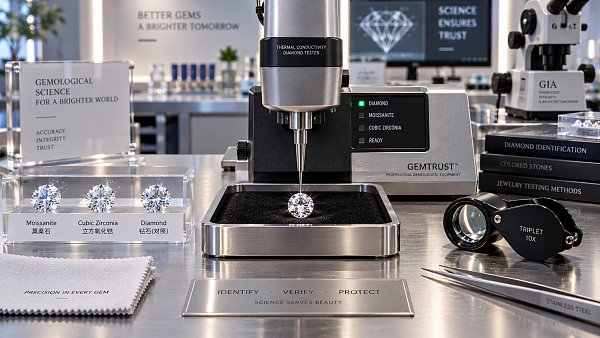
Diamond is an unusually efficient conductor of heat. A conventional thermal diamond tester uses a small heated probe, commonly controlled by an electronic sensor. When the probe touches a stone, the instrument observes how quickly heat moves away from the tip. If heat is drawn from the probe rapidly, the device may indicate “diamond” or move into a diamond range on its display. If the heat remains near the probe, the stone is more likely to be glass, cubic zirconia, quartz, or another lower-conductivity material.
This method is valuable because many visual characteristics can be deceptive. Glass imitations may have convincing brilliance under display lighting. Cubic zirconia can resemble diamond to an untrained eye. Even experienced sales staff should not rely only on sparkle, facet pattern, or an informal “fog test.” Thermal conductivity offers a repeatable physical property, provided the instrument is used correctly.
The tester is not “seeing” the stone’s internal structure. It is measuring a heat-transfer response at the point where probe and gemstone meet. That detail explains many false readings. A poor contact point, residue on the facet, a cold setting, or a tiny stone can alter the heat path enough to confuse a basic instrument.
What a Positive Result Actually Means
The most useful interpretation of a positive result is narrow: the stone has thermal behavior consistent with diamond under the tester’s conditions. It is a screening result, not a full gemological conclusion.
A natural diamond and a laboratory-grown diamond can both conduct heat in the way a thermal tester expects. Both may therefore produce the same positive response. This is not an instrument failure; it reflects the fact that lab-grown diamonds are diamonds in material terms, even though their origin differs. Origin determination requires more specialized screening and, in some cases, advanced laboratory examination.
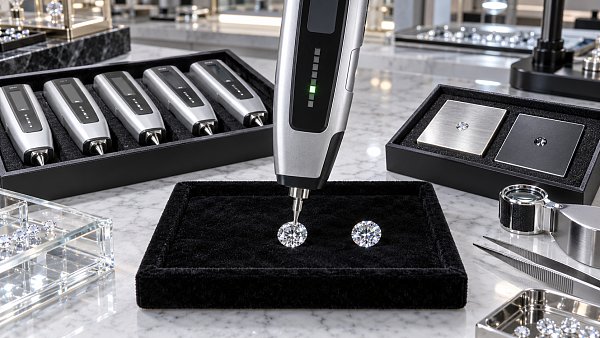
Likewise, some testers may identify moissanite as diamond. Moissanite is silicon carbide, a material with high thermal conductivity. Older or simpler thermal-only devices are particularly vulnerable to this issue. Many modern handheld units add electrical conductivity testing because moissanite and diamond behave differently electrically. These combined thermal-and-electrical testers can reduce confusion, but they still should not be regarded as a substitute for professional analysis when a stone’s identity or origin has material commercial significance.
A practical reading guide
When Testers Misidentify Stones
Moissanite is the best-known source of misleading positive readings, but it is not the only issue. Some errors arise from the gemstone, while others are caused by the piece of jewelry, the environment, or operator technique.
Mounted jewelry is a frequent problem. If the probe touches metal rather than the crown facet, or if it is placed too close to a prong, heat may travel through the mounting and distort the response. A metal setting can also act as a heat sink for very small stones. This is especially relevant for pavé rings, halo settings, tennis bracelets, and jewelry containing closely spaced melee diamonds. Testing each stone individually may be impractical, and a reading from one accessible stone should not be generalized to the whole item.
Stone size matters. A very small diamond may not provide enough contact area or thermal mass for a handheld tester to respond consistently. Irregular cuts, shallow crowns, chipped facets, heavily included stones, and recessed settings create similar challenges. The correct response is not to press harder. Excess force can damage a delicate setting, slip onto metal, or create inconsistent contact. It is better to follow the tester manufacturer’s stated minimum stone size and testing guidance.
Surface contamination is another overlooked variable. Lotion, polishing compound, fingerprints, oil, moisture, adhesive residues, or dirt can form a thin barrier between the probe and the gem. A stone should be clean and dry before testing. In repair environments, a recently steamed, ultrasonically cleaned, or polished item may also need time to stabilize at room temperature. Testing a stone immediately after heating or cooling can lead to unreliable behavior.
Battery condition and calibration deserve the same attention. A weak battery, damaged probe tip, or instrument used outside its intended operating range can compromise results. Better units include a test plate or self-check function, but this should be treated as a functional verification rather than proof that every future reading is correct. A basic check at the start of a shift is sensible where staff use the device routinely.
Thermal Testing Is Not a Diamond-Origin Test
The market now requires more precise language than “diamond or not.” A buyer may need to know whether a stone is natural, laboratory-grown, treated, assembled, or a simulant. Thermal response cannot answer all of those questions.
For product listings, invoices, wholesale assortments, and retail labels, businesses should separate material identification from origin disclosure. If a stone is represented as natural diamond, the supporting documentation should be appropriate to the transaction and claim being made. A thermal diamond tester can support intake triage, flag suspicious pieces, and help prevent obvious misclassification. It should not be the only basis for claims about natural origin, growth method, treatment history, or quality grade.
This matters beyond fine-jewelry specialists. Hotel boutiques, luxury gift programs, airport retail operators, and department-store concession partners may source jewelry through several layers of distributors. The farther a product moves from its original manufacturer, the more important it becomes to preserve clear product descriptions, supplier declarations, stone documentation where relevant, and an escalation path for disputed goods.
A Reliable Workflow for Trade and Retail Teams
The strongest use of a tester is within a controlled workflow. Start by reviewing available documentation and examining the piece under magnification. Look for obvious signs of damage, coatings, doubled facet junctions, unusual setting construction, or mixed stone types. Then clean and dry the accessible stone, confirm the device is functioning as intended, and test a crown facet away from metal.
For important items, repeat the test at more than one suitable point. An inconsistent result is information: it may indicate poor contact, a mounted-stone limitation, a composite construction, or a need for further examination. Do not force a conclusion simply because a stock-receiving process expects a pass-or-fail decision.
A useful internal policy can divide inventory into three categories:
- Items that pass routine screening and match their accompanying documentation.
- Items that need a combined thermal/electrical check, closer visual inspection, or supplier clarification.
- Items whose identity, origin, or declared characteristics affect value enough to justify examination by a qualified gemologist or recognized laboratory.
The third group can include high-value single stones, goods with missing or conflicting paperwork, pieces involving resale or collateral decisions, and any item likely to generate a material customer claim. The goal is proportional verification. Not every small fashion-jewelry component needs laboratory review, but a simple handheld result should not carry more evidential weight than it can support.
Choosing a Tester Without Overbuying or Underchecking
A thermal-only device may be sufficient for basic separation of diamond-like stones from low-conductivity simulants in controlled, lower-risk work. It is compact, fast, and generally easy for trained staff to use. Where moissanite is a realistic concern, a thermal-and-electrical model is usually more appropriate. Its advantage is not that it resolves every gemstone question, but that it addresses one of the most common limitations of thermal-only screening.
Before selecting equipment, buyers should check practical specifications rather than focusing only on the display label. Relevant questions include the stated minimum testable stone size, whether mounted stones are supported, battery type, warm-up behavior, probe durability, operating instructions, and availability of replacement parts. If a supplier claims a device distinguishes natural from laboratory-grown diamond, that claim should be reviewed carefully against the actual method and stated limitations.
For international sourcing teams, procurement also involves consistency. Staff need the same operating procedure across sites, particularly when jewelry is received at regional warehouses and sold through different channels. Global Commercial Trade (GCT) follows this broader sourcing perspective across jewelry and luxury accessories: technical tools are most useful when their limits, documentation needs, and operational context are understood together rather than treated as isolated purchase decisions.
The Right Conclusion From a Fast Test
A thermal diamond tester remains one of the most practical first-line tools in gemstone screening. Used on a clean, accessible stone and interpreted carefully, it can quickly separate many ordinary simulants from diamond-like materials. Its weakness is not speed or usefulness; its weakness is being asked to answer questions outside its design.
Treat a positive result as a reason to continue the appropriate verification process, not as final proof of natural origin or full identity. When the transaction value, disclosure obligation, or customer expectation is high, combine instrument screening with documentation review, trained observation, and professional laboratory assessment where necessary. That approach is slower only where it needs to be—and far more defensible when a stone’s description is challenged.
Search News
Hot Articles
- Fashion & Gem JewelryThermal Diamond Testers: How They Work and When They Can Misidentify StonesOct 07, 2026
- Commercial KitchenWhat Is Driving Demand for Commercial Hospitality Projects Across the GCC?Oct 06, 2026
- Hotel Room AmenitiesHow to Select Hotel Hair Dryers That Balance Guest Safety, Durability, and CostOct 05, 2026
Popular Tags
Need ExpertConsultation?
Connect with our specialized leisureengineering team for procurementstrategies.
Recommended News
 Oct 07, 2026Thermal Diamond Testers: How They Work and When They Can Misidentify StonesThermal diamond tester guide: learn how it works, spot false positives from moissanite, and choose reliable verification methods for jewelry trade and retail.● Luxury Retail Analyst
 Oct 02, 2026Diamond Tester Wholesale: How to Vet Accuracy, Calibration, and MOQ Before OrderingDiamond tester wholesale guide: verify accuracy, calibration records, supplier quality controls, and MOQ terms before ordering. Source reliable testers with confidence.● Luxury Retail Analyst
 Sep 09, 2026Wholesale Coral Earrings: How Buyers Can Assess Quality, Treatments, and Supply RiskCoral jewelry earrings wholesale guide for buyers: assess quality, treatments, secure settings, documentation, and supply risks before ordering.● Luxury Retail Analyst
 Sep 01, 2026How to Choose a Jewelry Laser Engraving Machine Manufacturer for Custom ProductionChoose a jewelry laser engraving machine manufacturer with proven sample testing, precision fixtures, workflow-ready software, and reliable support for custom production.● Luxury Retail Analyst
 Aug 27, 2026Evaluating Luxury Retail Accessories Suppliers: Quality, Lead Times, and Brand FitLuxury retail accessories supplier selection made clearer: assess quality, lead times, compliance, costs, and brand fit to protect premium launches and margins.● Luxury Retail Analyst
 Jul 29, 2026Fine Jewelry Price Guide: What Affects Cost and How to Judge Real ValueFine jewelry price guide for buyers: learn what drives cost in metals, gemstones, craftsmanship, certification, and branding so you can judge real value, reduce sourcing risk, and buy with confidence.● Luxury Retail Analyst
 Jul 14, 2026What to Ask an Enamel Jewelry Manufacturer Before Sampling and Mass ProductionEnamel jewelry manufacturer selection starts with the right questions. Learn what to ask about materials, color matching, MOQ, QC, compliance, and lead times before sampling and mass production.● Luxury Retail Analyst
 Jul 12, 2026Surgical Steel Belly Rings vs Titanium: Material Differences, Safety, and CostSurgical steel belly rings vs titanium: compare safety, nickel exposure, comfort, durability, and cost to choose the best option for sensitive skin or budget-friendly style.● Luxury Retail Analyst
 Jul 12, 2026Natural Coral Jewelry Guide: How to Identify Real Coral, Treatments, and QualityNatural coral jewelry guide covering how to identify real coral, spot treatments, assess quality, and buy with confidence. Learn the key signs before you choose.● Luxury Retail Analyst
 Jul 11, 2026Braided Leather Bracelets OEM: Material, Clasp, and MOQ Factors Before SamplingBraided leather bracelets OEM guide covering material grades, clasp options, and MOQ factors before sampling. Learn how to reduce sourcing risk, control cost, and choose the right supplier.● Luxury Retail Analyst
 Jul 09, 2026Jewelry Craftsmanship Gemstone Setting Methods Explained: Prong, Bezel, Pave, and MoreJewelry craftsmanship gemstone setting explained clearly: compare prong, bezel, pavé, channel, and more to choose secure, beautiful, and commercially smart jewelry designs.● Luxury Retail Analyst
 Jul 06, 2026Photo Locket Necklace Manufacturer Selection Guide: Materials, MOQ, and Custom OptionsPhoto locket necklace manufacturer selection guide covering materials, MOQ, custom options, compliance, and quality checks to help buyers source smarter and build stronger jewelry lines.● Luxury Retail Analyst
 Jul 05, 2026What to Check When Comparing a Sterling Silver Clasp ManufacturerChoosing a sterling silver clasp manufacturer? Learn what to check first: 925 silver claims, finish quality, testing, compliance, lead times, and hidden sourcing costs.● Luxury Retail Analyst
 Jul 02, 2026Jewelry Craftsmanship Techniques Explained: Casting, Stone Setting, Engraving, and PolishingJewelry craftsmanship techniques explained: discover how casting, stone setting, engraving, and polishing shape quality, durability, and sourcing confidence.● Luxury Retail Analyst
 Jul 01, 2026Lost Wax Casting Machines Explained: Types, Capacity, and Metal CompatibilityLost wax casting machines explained: compare types, real capacity, and metal compatibility to choose the right system for precision casting, higher quality, and smarter sourcing.● Luxury Retail Analyst
 Jun 29, 2026How to Evaluate a Luxury Accessories Online Store Before You BuyLuxury accessories online store buying guide: learn how to verify authenticity, compare policies, check reviews, and avoid costly mistakes before you place an order.● Luxury Retail Analyst
 Jun 22, 2026Matching Couple Rings: Popular Materials, Fit Differences, and How to ChooseMatching couple rings guide: compare popular materials, fit differences, comfort, durability, and resizing options to choose a stylish pair that truly lasts.● Luxury Retail Analyst
 Jun 19, 2026How to Build a Fashion Accessories Catalog That Improves Product Discovery and SalesFashion accessories catalog strategies that improve product discovery, filtering, and conversions. Learn how to structure pages, categories, and data to drive more qualified sales.● Luxury Retail Analyst
 Jun 19, 2026How to Choose Luxury Accessories for Women by Material, Style, and Price PointLuxury accessories for women: learn how to choose the right pieces by material, style, and price point for better value, timeless appeal, and smarter buying decisions.● Luxury Retail Analyst
 Jun 18, 2026Stainless Steel Rings Bulk: 304 vs 316L, Finishes, and Custom Order FactorsStainless steel rings bulk guide: compare 304 vs 316L, explore finish options, and learn key custom order factors to reduce sourcing risk and improve product value.● Luxury Retail Analyst
 Jun 18, 2026Body Piercing Jewelry Bulk Buying Guide: Materials, Sizes, and MOQ QuestionsBody piercing jewelry bulk buying guide covering safe materials, size checks, MOQ strategy, supplier screening, and compliance tips to reduce risk and source with confidence.● Luxury Retail Analyst
 Jun 18, 2026How to Evaluate a Luxury Jewelry Exporter for Quality, Compliance, and DeliveryLuxury jewelry exporter evaluation starts with more than design. Learn how to verify quality, compliance, and delivery control to source premium jewelry with less risk.● Luxury Retail Analyst
 Jun 17, 2026Iced Out Watches Wholesale: How to Compare MOQ, Stone Quality, and MarginsIced out watches wholesale guide: compare MOQ, stone quality, and real margins to choose reliable suppliers, reduce risk, and grow resale profits with smarter sourcing.● Luxury Retail Analyst
 Jun 15, 2026How to Evaluate an Amber Jewelry Manufacturer: Quality Grades, OEM Options, and Lead TimesAmber jewelry manufacturer selection starts with quality grades, OEM capability, and realistic lead times. Learn how to compare suppliers, reduce sourcing risk, and choose with confidence.● Luxury Retail Analyst