Diamond Tester Wholesale: How to Vet Accuracy, Calibration, and MOQ Before Ordering
Diamond Tester Wholesale: How to Vet Accuracy, Calibration, and MOQ Before Ordering
Buying diamond testers in volume requires more than comparing unit prices. Procurement teams need verified accuracy, repeatable calibration, credible supplier controls, and an MOQ compatible with inventory strategy.
The central purchasing decision is straightforward: do not approve a diamond tester wholesale order until its performance claims can be traced to a defined testing method, calibration process, and production batch.
For jewelry retailers, pawn operations, appraisal services, and luxury accessory distributors, a poor tester creates more than returns. It can damage customer trust, slow counter service, and complicate staff training.
This guide explains how commercial buyers can evaluate tester accuracy, request useful validation records, assess minimum order quantities, and select suppliers capable of reliable long-term fulfillment.
What Procurement Teams Are Really Trying to Verify
Buyers searching for diamond tester wholesale options are rarely looking for a generic product list. They need confidence that each delivered unit will perform consistently in real retail environments.
The first concern is identification accuracy. A tester should reliably distinguish natural diamond from common simulants within its stated operating range, without producing confusing or inconsistent customer-facing results.
The second concern is repeatability. If the same stone is tested several times by different staff members, the device should provide the same result when operating conditions remain unchanged.
Third, buyers need calibration stability. A tester that appears accurate during factory inspection but drifts after shipping, battery replacement, or regular use creates hidden operational costs.
Finally, the commercial question is whether the supplier can deliver the approved standard across every unit, every reorder, and every destination market rather than only on a sample shipment.
These priorities matter because diamond testers are often used at decisive moments. A retail associate may use one during a sale, a buyer during intake, or an appraiser during preliminary screening.
No handheld tester should be represented as a complete gemological determination system. Its value is rapid screening, supported by trained judgment and escalation procedures for uncertain or high-value stones.
A credible wholesale partner understands this boundary. They state what their device measures, identify known limitations, and avoid marketing claims that imply laboratory-grade certainty where none exists.
Start With the Detection Principle, Not the Housing Design
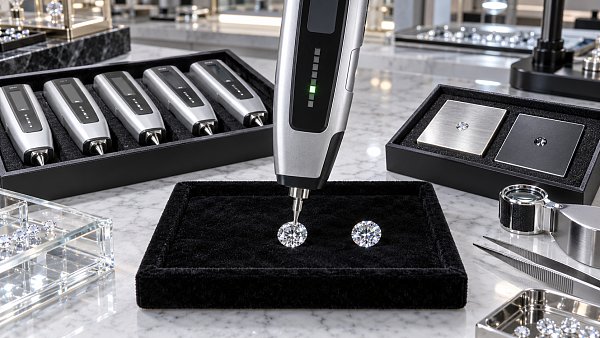
Before comparing catalogs, ask which detection principle the tester uses. Most entry-level devices rely on thermal conductivity, while advanced models may combine thermal and electrical conductivity measurements.
Thermal-only testers can identify many diamonds effectively, but they may also react similarly to moissanite. This makes them unsuitable when a buyer needs dependable diamond-versus-moissanite screening.
Combined thermal and electrical conductivity testers generally provide stronger differentiation. However, procurement teams should still confirm the model’s stated capability for moissanite, synthetic diamonds, and mounted stones.
Do not assume that a “multi-tester” label confirms technical performance. Ask suppliers to identify the sensor technology, supported stone types, minimum stone size, and measurement limitations in writing.
Small stones, loose versus mounted stones, metal settings, dirty surfaces, extreme temperatures, and weak probe contact can all affect readings. These variables should appear in product documentation.
For commercial sourcing, the right question is not whether a tester can identify diamond under ideal conditions. Ask how it behaves when used by normal staff during routine transactions.
Request a demonstration using stones relevant to your business. Include natural diamond, moissanite, cubic zirconia, glass, sapphire, and any synthetic or treated materials likely to enter your workflow.
If the supplier cannot explain expected results for these samples, the technical specification is incomplete. A low quotation cannot compensate for an unclear operating boundary or unreliable screening result.
How to Evaluate Accuracy Claims Before Placing a Wholesale Order
Accuracy claims should be translated into a testable acceptance standard. Statements such as “high precision” or “professional grade” are marketing language unless supported by documented comparison results.
Ask the supplier for a validation protocol that identifies reference materials, sample quantities, environmental conditions, operator instructions, and the pass or fail criteria used during testing.
A useful report shows more than a single successful demonstration. It should reveal whether the device consistently classifies target stones across repeated tests and relevant operating conditions.
For a first order, create your own receiving acceptance plan. Define the stone set, number of units sampled, number of repeated measurements, and permitted rate of incorrect readings.
Sampling should reflect business risk. A small boutique order may inspect several units, while a distributor or chain retailer should test a statistically meaningful sample from each delivered batch.
Consider both false positives and false negatives. A false positive can lead to an incorrect preliminary claim, while a false negative can create unnecessary disputes and missed sales opportunities.
Also evaluate response time. Slow stabilization, inconsistent indicator lights, or unclear audible signals may reduce usable accuracy because retail staff often operate under time pressure and distractions.
Ask whether the tester requires warm-up time, surface preparation, probe pressure, or specific battery levels. These requirements should be practical for the intended location, staff skill level, and transaction volume.
Require the supplier to disclose known exceptions. For example, some devices may struggle with very small stones, certain mounted pieces, coated materials, or samples with poor thermal contact.
A supplier that openly documents limitations is usually easier to manage than one that promises universal detection. Procurement decisions improve when operational constraints are visible before purchase approval.
Calibration Is a Supply Chain Control, Not a Product Feature
Calibration is often treated as a checkbox, yet it is one of the strongest indicators of whether a diamond tester wholesale supplier understands commercial quality management.
Ask how each unit is calibrated at the factory. The answer should specify the reference material, calibration frequency, operator procedure, equipment used, and production record retained for each batch.
Many handheld testers use an integrated reference plate or calibration surface. Confirm whether this reference is protected from wear, contamination, damage, or accidental substitution during production and shipping.
Request a copy of the user calibration instructions. They should be clear enough for store managers or receiving personnel to perform routine verification without specialist tools or vague interpretation.
Calibration stability also depends on transport conditions. Clarify packaging protection, recommended storage temperature, battery handling, and whether the supplier conducts post-shipment or pre-dispatch functional checks.
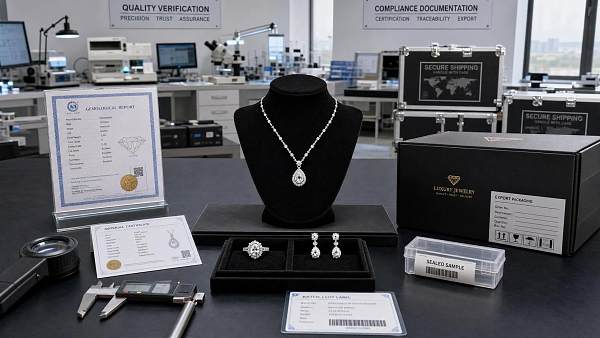
For higher-volume programs, request a batch-specific quality certificate. It should include model number, batch number, inspection date, inspected quantity, test method, and responsible quality control signature.
A generic certificate downloaded from a website has limited value. Procurement teams need documentation tied to the actual shipment, particularly when products will be redistributed under a private label.
Where possible, specify an incoming inspection requirement in the purchase order. This links the commercial agreement to measurable performance rather than relying only on pre-contract sales promises.
Include remedies for failed inspection, such as replacement units, credit, rework, or return authorization. The appropriate remedy depends on logistics cost, defect severity, and shipment destination.
Calibration records do not eliminate the need for receiving inspection. They provide traceability, making it easier to isolate a batch issue and prevent an avoidable retailer-wide quality incident.
Documents Worth Requesting From a Wholesale Supplier
Commercial buyers should request documents that support product verification, market access, and after-sales accountability. The goal is evidence that can be reviewed internally and retained in supplier files.
Begin with a current specification sheet. It should identify the model, sensing method, power supply, operating temperature, stone-size range, dimensions, materials, package contents, and usage limitations.
Request the quality control checklist used for finished units. Useful checklists show functional testing, probe inspection, indicator verification, battery compartment inspection, appearance checks, and packaging confirmation.
Ask for compliance declarations relevant to the intended market. Depending on the product configuration and destination, these may include electrical safety, electromagnetic compatibility, battery, labeling, or material declarations.
Do not treat a logo on packaging as proof of compliance. Ask which standard applies, which product version was assessed, who issued the document, and whether it remains valid.
For private-label programs, confirm that test reports and declarations cover the final configuration. Changes to chargers, batteries, labeling, enclosure materials, or electronics can affect compliance responsibilities.
Also request warranty terms, spare-part availability, and repair procedures. A tester is a relatively low-cost item, but unresolved failures can create disproportionate operational friction across multiple locations.
Good suppliers provide serial numbers or batch codes where feasible. Traceability supports defect analysis, warranty handling, and warehouse control, especially when several models look almost identical externally.
Set an MOQ That Supports Inventory Rather Than Supplier Convenience
MOQ is not simply the smallest quantity a factory will accept. It should be assessed against demand uncertainty, product lifecycle risk, cash commitment, freight efficiency, and customization requirements.
For standard unbranded testers, a lower MOQ may be commercially sensible for initial validation. Use the first order to confirm actual field performance before committing to a larger replenishment program.
Private labeling usually increases MOQ because suppliers must prepare custom packaging, print artwork, label components, or reserve specific materials. Ask which requirement drives the quantity threshold.
Separate the product MOQ from the packaging MOQ. In some cases, a supplier can deliver standard units at a modest quantity while applying custom inserts or cartons only above a higher volume.
Ask whether mixed-model orders are possible. Combining entry-level and advanced testers may help distributors test demand while meeting a supplier’s total order value or production planning requirements.
Inventory risk is especially relevant when technology claims evolve quickly. Ordering too deeply before field validation can leave buyers holding products that no longer meet retailer expectations or competitive benchmarks.
Calculate the landed cost rather than the ex-factory price. Include product cost, packaging, customization, inspection, freight, duties, domestic handling, warranty reserve, and the likely cost of defects.
A slightly higher unit price with stronger quality records and lower failure rates can deliver better total cost performance than the lowest quotation with weak documentation and uncertain calibration.
For recurring demand, negotiate a framework arrangement. It can establish approved specifications, target pricing, quality requirements, lead times, and reorder terms without forcing excessive inventory on the first shipment.
Use Samples and Pilot Orders to Test the Supplier, Not Just the Device
A sample is useful only when it represents future production. Ask whether the sample comes from normal production, a prototype run, or a specially selected unit prepared for demonstration.
Evaluate sample communication as carefully as product performance. Delayed replies, vague specifications, inconsistent quotations, or missing documents often predict future execution problems at larger order volumes.
During a pilot order, inspect packaging quality, manuals, accessories, labeling, carton durability, delivery accuracy, and document completeness. These details affect distribution costs and customer perception after resale.
Run the testers with intended users, not only technical staff. Retail associates and receiving teams can reveal problems involving ergonomics, signal visibility, probe positioning, and instruction clarity.
Document pilot findings in a supplier scorecard. Score technical performance, calibration usability, documentation, communication, lead time, packaging, defect response, and commercial flexibility using the same criteria for all suppliers.
Do not expand an order because a supplier offers a short-term discount. Expand only after the pilot demonstrates stable performance and the supplier proves capable of responding to questions with evidence.
Questions to Ask Before Issuing the Purchase Order
Your purchase order should convert the evaluation process into enforceable requirements. Avoid relying on informal chat messages, catalog screenshots, or verbal assurances once volume, branding, and delivery commitments increase.
Specify the exact model revision, color, package contents, accessories, battery configuration, manual language, labels, barcode requirements, and approved artwork version where private labeling applies.
State the functional acceptance criteria. Include calibration expectations, sample inspection method, permitted defect level, packaging requirements, documentation required, and the process for reporting nonconforming goods after delivery.
Confirm lead time from artwork approval or deposit receipt, not merely from inquiry date. Clarify whether production time includes testing, packaging, export preparation, and any required third-party inspection.
Ask who owns responsibility for configuration changes. A supplier should notify the buyer before changing a sensor, battery, charger, packaging material, software behavior, or critical production component.
For international procurement, identify the correct Incoterm and named place. This clarifies freight responsibility, export handling, insurance exposure, and the point at which risk transfers between parties.
Set communication expectations for production milestones. Buyers should receive updates at key stages, particularly when the order includes custom branding, regulated destination markets, or time-sensitive retail launches.
Build a Defensible Shortlist for Diamond Tester Wholesale Sourcing
The best wholesale choice is rarely the supplier with the cheapest displayed price. It is the supplier whose technical claims, calibration controls, documents, commercial terms, and delivery behavior align.
Shortlist suppliers using weighted criteria. Accuracy and repeatability should carry the greatest weight, followed by calibration controls, production traceability, compliance readiness, MOQ flexibility, and responsive after-sales support.
For procurement teams, the practical standard is not perfection. It is a reliably specified screening tool, backed by evidence and a supplier relationship that can withstand routine commercial scrutiny.
Before approving a diamond tester wholesale order, test the product against relevant stones, review batch-level controls, calculate landed cost, and make the MOQ serve your inventory plan.
That process reduces the risk of buying attractive-looking devices that fail under normal use. It also creates a repeatable sourcing framework for future jewelry technology purchases and supplier comparisons.
Search News
Hot Articles
- Outdoor RidesHow to Select Leisure Park Equipment for Safe, High-Throughput Visitor AreasOct 03, 2026
- Fashion & Gem JewelryDiamond Tester Wholesale: How to Vet Accuracy, Calibration, and MOQ Before OrderingOct 02, 2026
- Hotel Room AmenitiesHow Hotels Can Choose Amenity Bottles That Balance Brand Image and Refill CostsOct 01, 2026
Popular Tags
Need ExpertConsultation?
Connect with our specialized leisureengineering team for procurementstrategies.
Recommended News
 Oct 02, 2026Diamond Tester Wholesale: How to Vet Accuracy, Calibration, and MOQ Before OrderingDiamond tester wholesale guide: verify accuracy, calibration records, supplier quality controls, and MOQ terms before ordering. Source reliable testers with confidence.● Luxury Retail Analyst
 Sep 09, 2026Wholesale Coral Earrings: How Buyers Can Assess Quality, Treatments, and Supply RiskCoral jewelry earrings wholesale guide for buyers: assess quality, treatments, secure settings, documentation, and supply risks before ordering.● Luxury Retail Analyst
 Sep 01, 2026How to Choose a Jewelry Laser Engraving Machine Manufacturer for Custom ProductionChoose a jewelry laser engraving machine manufacturer with proven sample testing, precision fixtures, workflow-ready software, and reliable support for custom production.● Luxury Retail Analyst
 Aug 27, 2026Evaluating Luxury Retail Accessories Suppliers: Quality, Lead Times, and Brand FitLuxury retail accessories supplier selection made clearer: assess quality, lead times, compliance, costs, and brand fit to protect premium launches and margins.● Luxury Retail Analyst
 Jul 29, 2026Fine Jewelry Price Guide: What Affects Cost and How to Judge Real ValueFine jewelry price guide for buyers: learn what drives cost in metals, gemstones, craftsmanship, certification, and branding so you can judge real value, reduce sourcing risk, and buy with confidence.● Luxury Retail Analyst
 Jul 14, 2026What to Ask an Enamel Jewelry Manufacturer Before Sampling and Mass ProductionEnamel jewelry manufacturer selection starts with the right questions. Learn what to ask about materials, color matching, MOQ, QC, compliance, and lead times before sampling and mass production.● Luxury Retail Analyst
 Jul 12, 2026Surgical Steel Belly Rings vs Titanium: Material Differences, Safety, and CostSurgical steel belly rings vs titanium: compare safety, nickel exposure, comfort, durability, and cost to choose the best option for sensitive skin or budget-friendly style.● Luxury Retail Analyst
 Jul 12, 2026Natural Coral Jewelry Guide: How to Identify Real Coral, Treatments, and QualityNatural coral jewelry guide covering how to identify real coral, spot treatments, assess quality, and buy with confidence. Learn the key signs before you choose.● Luxury Retail Analyst
 Jul 11, 2026Braided Leather Bracelets OEM: Material, Clasp, and MOQ Factors Before SamplingBraided leather bracelets OEM guide covering material grades, clasp options, and MOQ factors before sampling. Learn how to reduce sourcing risk, control cost, and choose the right supplier.● Luxury Retail Analyst
 Jul 09, 2026Jewelry Craftsmanship Gemstone Setting Methods Explained: Prong, Bezel, Pave, and MoreJewelry craftsmanship gemstone setting explained clearly: compare prong, bezel, pavé, channel, and more to choose secure, beautiful, and commercially smart jewelry designs.● Luxury Retail Analyst
 Jul 06, 2026Photo Locket Necklace Manufacturer Selection Guide: Materials, MOQ, and Custom OptionsPhoto locket necklace manufacturer selection guide covering materials, MOQ, custom options, compliance, and quality checks to help buyers source smarter and build stronger jewelry lines.● Luxury Retail Analyst
 Jul 05, 2026What to Check When Comparing a Sterling Silver Clasp ManufacturerChoosing a sterling silver clasp manufacturer? Learn what to check first: 925 silver claims, finish quality, testing, compliance, lead times, and hidden sourcing costs.● Luxury Retail Analyst
 Jul 02, 2026Jewelry Craftsmanship Techniques Explained: Casting, Stone Setting, Engraving, and PolishingJewelry craftsmanship techniques explained: discover how casting, stone setting, engraving, and polishing shape quality, durability, and sourcing confidence.● Luxury Retail Analyst
 Jul 01, 2026Lost Wax Casting Machines Explained: Types, Capacity, and Metal CompatibilityLost wax casting machines explained: compare types, real capacity, and metal compatibility to choose the right system for precision casting, higher quality, and smarter sourcing.● Luxury Retail Analyst
 Jun 29, 2026How to Evaluate a Luxury Accessories Online Store Before You BuyLuxury accessories online store buying guide: learn how to verify authenticity, compare policies, check reviews, and avoid costly mistakes before you place an order.● Luxury Retail Analyst
 Jun 22, 2026Matching Couple Rings: Popular Materials, Fit Differences, and How to ChooseMatching couple rings guide: compare popular materials, fit differences, comfort, durability, and resizing options to choose a stylish pair that truly lasts.● Luxury Retail Analyst
 Jun 19, 2026How to Build a Fashion Accessories Catalog That Improves Product Discovery and SalesFashion accessories catalog strategies that improve product discovery, filtering, and conversions. Learn how to structure pages, categories, and data to drive more qualified sales.● Luxury Retail Analyst
 Jun 19, 2026How to Choose Luxury Accessories for Women by Material, Style, and Price PointLuxury accessories for women: learn how to choose the right pieces by material, style, and price point for better value, timeless appeal, and smarter buying decisions.● Luxury Retail Analyst
 Jun 18, 2026Stainless Steel Rings Bulk: 304 vs 316L, Finishes, and Custom Order FactorsStainless steel rings bulk guide: compare 304 vs 316L, explore finish options, and learn key custom order factors to reduce sourcing risk and improve product value.● Luxury Retail Analyst
 Jun 18, 2026Body Piercing Jewelry Bulk Buying Guide: Materials, Sizes, and MOQ QuestionsBody piercing jewelry bulk buying guide covering safe materials, size checks, MOQ strategy, supplier screening, and compliance tips to reduce risk and source with confidence.● Luxury Retail Analyst
 Jun 18, 2026How to Evaluate a Luxury Jewelry Exporter for Quality, Compliance, and DeliveryLuxury jewelry exporter evaluation starts with more than design. Learn how to verify quality, compliance, and delivery control to source premium jewelry with less risk.● Luxury Retail Analyst
 Jun 17, 2026Iced Out Watches Wholesale: How to Compare MOQ, Stone Quality, and MarginsIced out watches wholesale guide: compare MOQ, stone quality, and real margins to choose reliable suppliers, reduce risk, and grow resale profits with smarter sourcing.● Luxury Retail Analyst
 Jun 15, 2026How to Evaluate an Amber Jewelry Manufacturer: Quality Grades, OEM Options, and Lead TimesAmber jewelry manufacturer selection starts with quality grades, OEM capability, and realistic lead times. Learn how to compare suppliers, reduce sourcing risk, and choose with confidence.● Luxury Retail Analyst
 Jun 14, 2026Stainless Steel Rings Bulk Buying Guide: Grades, Finishes, Sizes, and Supplier ChecksStainless steel rings bulk buying guide covering grades, finishes, sizing, and supplier checks to help you reduce returns, protect quality, and source with confidence.● Luxury Retail Analyst